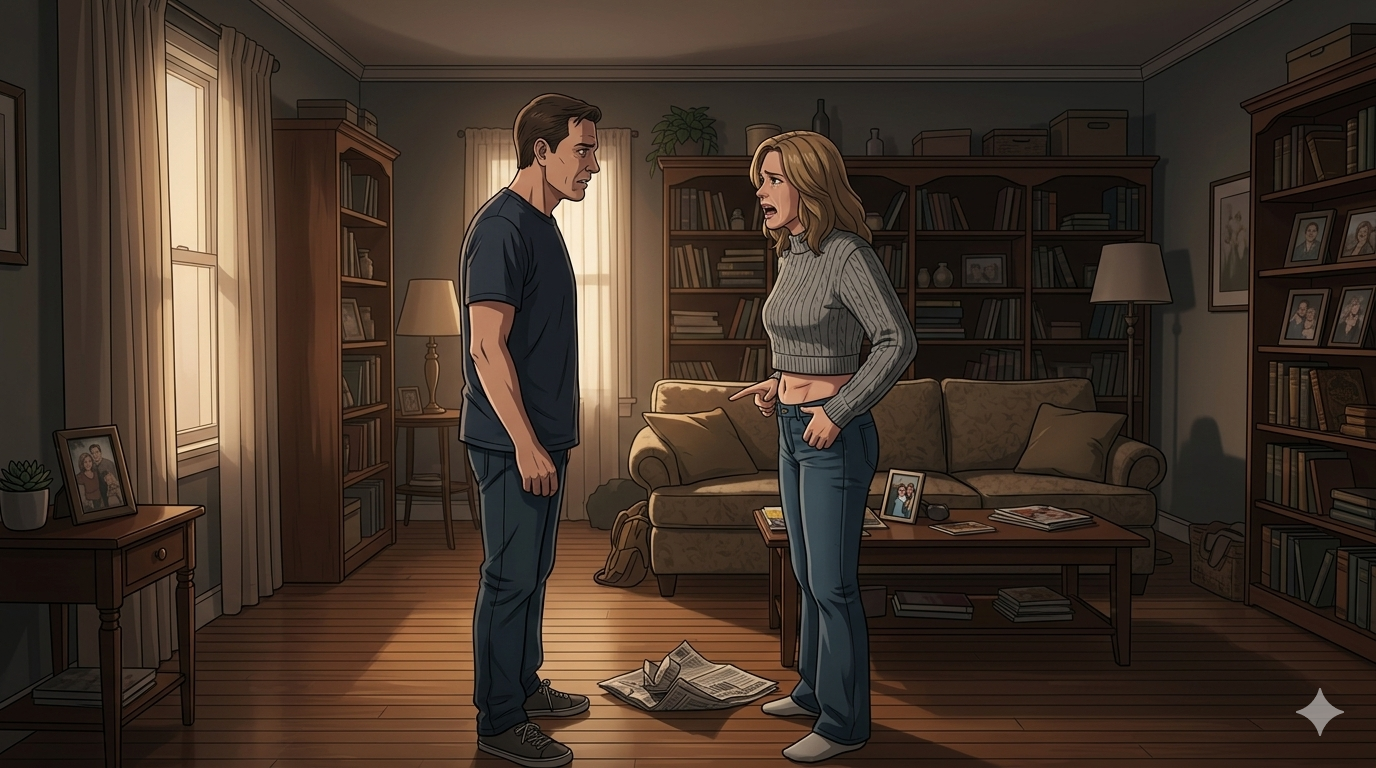
For years, Javier and I had mastered the art of being together without talking too much to each other.
By the time we ended up in that waiting room, silence had become our native language. Not the easy silence of old couples who no longer need words to feel close, not the soft quiet that settles around people who have loved each other long enough to rest inside one another’s presence. Ours was a harder thing. A trained thing. A silence built with discipline and injury and time, brick by brick, until it stood between us so naturally that even breathing around it no longer felt strange.
We sat side by side in the plastic chairs like two travelers waiting for delayed trains. Javier held an old magazine he wasn’t reading. He kept flipping the pages without really seeing them, fingertips brushing glossy paper, turning one sheet and then another as if the motion itself was enough to justify having something in his hands. I stared at the floor because staring at the floor has always helped me when my mind wants to run ahead of me. The tiles were off-white with pale gray flecks, each one separated by a dark line of grout that had begun to crack near the wall. I counted them. Then I started again. I counted them the way I used to count cracks in the ceiling when I was a child and my mother and father argued behind a closed door, the way I counted rain streaks on bus windows during the years when Javier and I still pretended our marriage was sleeping rather than dying.
I could feel him beside me. Not his warmth exactly. We had become careful about warmth years earlier. But I could feel the outline of him, the pressure of another body taking up space half a meter away. He smelled faintly of aftershave and laundry soap and the autumn cold he had carried in on his coat. He had driven us there in silence, one hand on the steering wheel, the other resting on the gearshift, radio off, the road ahead glistening from the rain that had fallen all morning. When we parked, he had turned off the engine and simply said, “We have time,” though we were early and I hadn’t asked.
“Elena Navarro,” the nurse called.
I looked up, stood, and smoothed my skirt with nervous hands. Javier glanced at me. Just a glance. Enough to say he had heard my name and registered that I was moving. For most marriages that would be nothing. For ours, it was almost intimate.
“I’ll wait here,” he said.
His voice surprised me, as it often did. There were days I heard it so little that when it arrived, even on a simple sentence, it felt like finding an old object in a drawer and realizing I still recognized its weight.
I nodded and followed the nurse down the corridor.
The exam room was like every exam room I had ever sat in: too bright, too clean, too full of paper and steel and the smell of antiseptic that seems designed to remind you that your body is, at least in part, a problem to be managed. The nurse asked me the usual questions, and I gave the usual answers. Yes, I had been tired. No, the bleeding wasn’t regular. Yes, I had been having pain low in my abdomen, though pain had become such a broad and unhelpful word that I nearly laughed when she used it. No, I hadn’t told my husband exactly how often it woke me at night. No, I hadn’t wanted to come in. Yes, the dizziness had been getting worse. No, I wasn’t pregnant.
That last answer still snagged in me, even after all those years. It always did.
The doctor came in, examined me, asked a few more questions, ordered the scan, stepped out, came back, stepped out again. The tests themselves were routine in the humiliating, vulnerable way all women’s tests seem designed to be. There was the familiar rustle of paper on the exam table. The cold touch of gel. The need to hold still while someone studies the hidden geography of your body with more calm than you can summon. I had done versions of these examinations before. I knew the choreography. None of it frightened me at first.
What frightened me was the doctor’s face when she came back with the results.
She was a composed woman in her forties with dark hair pinned back from her face and the kind of voice that usually made bad news sound manageable. But when she pulled the stool toward me and sat down, something in the air changed before she spoke. There are pauses that mean nothing and pauses that gather meaning. This one gathered.
“Mrs. Navarro,” she said, and then stopped just long enough to empty my stomach.
“Is it serious?”
She hesitated, not out of cruelty, but out of mercy. I know that now. She was measuring the space between accuracy and impact, deciding how to place the next sentence so it would do the least unnecessary damage while still doing its work.
“We have found a lesion,” she said. “We need more tests before I can confirm exactly what we’re dealing with, but everything indicates that it could be an advanced-stage tumor.”
The world did not shatter. That would have been easier. It simply stopped.
I heard myself say, “What?” but it came from far away, as if someone in another room had asked it for me.
“I don’t want to alarm you without complete confirmation,” she continued, “but I do want to be clear. We need to act quickly.”
I didn’t hear anything after that.
The words advanced stage began to echo inside me with a terrible metallic clarity. They bounced off every year I had already lived and every year I had assumed, carelessly, would be there waiting. Advanced stage. Advanced stage. Advanced stage. Not because I understood medicine well enough to know exactly what it meant, but because I understood enough to know what it might mean. Urgency. Time suddenly made visible. A future that had once stretched quietly ahead of me now becoming a narrow corridor lit by fluorescent lights and terms I did not want to learn.
And then, absurdly, another number arrived.
Eighteen years.
Eighteen years of silence.
Eighteen years of waiting for one of us to break it properly instead of politely, for one of us to stop setting plates on the table and asking if we needed olive oil and pretending that was the same thing as living. Eighteen years of sleeping beside a man who knew the shape of my body and no longer touched it. Eighteen years of punishing, being punished, staying, shrinking, moving around each other with the precision of people who had built a life out of not colliding.
Time, which had felt endless in that marriage, now began to feel like a wall rushing toward me.
I left the office with my legs shaking.
Javier was still in the waiting room. The magazine lay open on his lap, untouched. He looked up when I emerged, and for a second I knew he saw it before I said anything. Whatever was on my face must have been louder than words.
“Done?” he asked.
I nodded.
“They say…” I swallowed. My mouth had gone dry. “They have to do more tests.”
It was a coward’s sentence. We had become experts at coward’s sentences. The sort that reveal nothing and ask nothing in return. But Javier kept looking at me, longer than usual, and something in his expression changed. Not visibly enough for anyone else in the waiting room to notice, but enough that I felt the shift like a pressure front.
“What’s the matter, Elena?”
That question.
I had not heard it in years. Not truly. Not as a real question. There had been practical questions, of course. Did I pay the electricity bill? Was there any coffee left? What time would I be home? Had the plumber called back? But what’s the matter belonged to a different species of marriage, one I had almost forgotten we’d ever inhabited.
I felt something inside me break with such sudden force that I nearly sat back down.
“I think…” The sentence stuck. I tried again. “I think it’s serious.”
Silence fell between us.
Not the old silence. Not the one that wrapped itself around us every day like ritual. This one had weight. This one noticed itself. This one stood there waiting to see if we would finally use it for something other than punishment.
Javier closed the magazine very slowly, his hand flattening it once before he set it aside.
“Let’s talk to the doctor,” he said.
He stood before I could answer, and we went back in together.
I remember almost nothing of that second conversation except Javier’s face. The doctor repeated the information with more detail now that both of us were there. More imaging. A biopsy. Blood work. The possibility that the mass had already spread. The need for speed. Treatment options contingent on staging. Statistics she tried not to state too bluntly. Her voice stayed calm, clinical, professional. I understood the shape of the words and none of the content. My own body felt distant, like a country whose language I no longer spoke.
But I watched Javier.
I saw the way his jaw tightened hard enough to pulse. I saw his hand grip the back of the chair until his knuckles changed color. I saw how he fixed his gaze on the doctor as if looking at me would make the room impossible to stand in. And then, when the silence after one of her sentences became too large, he looked at me directly.
For the first time in years, he really looked.
“What options are there?” he asked.
The doctor answered him. Surgery if operable. Chemotherapy likely, maybe first, maybe after. More tests before certainty. We must move quickly. She used words like aggressive and concern and response rates. My head filled with static. Everything I hadn’t said to him in eighteen years crowded behind my teeth. Not because I suddenly felt romantic. Fear is not romance. But because dying, or even the possibility of dying, has a way of humiliating every false arrangement in your life. All at once the old silence looked less noble, less righteous, less like consequence and more like waste.
We left the hospital into an ordinary afternoon.
That was the rude part. The sky was the same gray-white it had been before the appointment. Cars moved through the wet streets. A woman walked past carrying a bouquet wrapped in newspaper. Two boys in school uniforms pushed each other at the bus stop. Someone somewhere was laughing. The world had not paused to honor the moment my life bent. It never does. I used to think grief and terror should announce themselves somehow to the city around you, but cities are not sentimental. They keep going.
Javier and I walked side by side down the sidewalk toward the car. As always, we said nothing.
Then I stopped.
“I don’t want this to be the last thing,” I said.
My voice sounded unlike me—thin, scraped out, almost childlike in its fragility.
Javier stopped too. “What?”
I turned to him. Rain had started again, lightly, dampening the shoulders of his coat. His face was drawn tight with the effort of not feeling too much in public. He looked older than he had that morning. So did I, probably.
“This,” I said, and pointed at the space between us because even then I couldn’t immediately say silence. “This. This punishment. This thing we’ve been living inside. I don’t want to die like this.”
The words came faster once they started, blunt and unpracticed.
“I know what I did. I know I broke you. I know I accepted this because I thought maybe it was what I deserved. But it’s been eighteen years, Javier. Eighteen years of being strangers in the same house. Eighteen years of walking past each other and pretending the air didn’t hurt. And now…” I stopped because my throat closed. “Now I may not have time left.”
He did not speak.
“I’m not asking you to forgive me,” I said. “I’m not asking you to forget. I don’t even know if I believe either of those things are possible. I’m just saying I don’t want this to be the last thing between us. I don’t want my last memory of my own marriage to be… this.”
The rain thickened slightly. A bus hissed to a stop at the curb, then moved on. Somewhere behind us a pharmacy door chimed open and shut. Nobody on that street knew our lives had just turned inside out. Nobody cared. That anonymity made the moment feel both smaller and more honest.
Javier took a breath so deep I could see the effort of it.
Then he said, quietly, “I didn’t want this either.”
I stared at him.
“What?”
His eyes stayed on mine now. That alone felt astonishing.
“I never wanted to live like this.”
The sentence did not fit any version of our history I had allowed myself to imagine. For years I had told myself a story that was simple enough to survive inside: I betrayed him, he withdrew, I endured it because I deserved to, and that was the shape of our life. It was a punishing story, but it had order. His sentence knocked a hole through it.
“Then why?” I asked.
He closed his eyes for a second, and when he opened them again there was something so naked in them I almost looked away.
“Because I didn’t know how to do anything else.”
The words entered me like a blade.
“I thought if I kept going, if I acted as if nothing had happened, I was proving it mattered. That you didn’t get to destroy something and then have me help put the pieces back together just because you regretted it. But…” He swallowed. “I didn’t know how to leave either.”
I had imagined anger in him so often through the years. I had built entire internal speeches around how to survive it if he ever chose to release it. I had not prepared for helplessness.
“So I stayed,” he said. “But I went inside.”
Tears spilled before I could stop them.
“Me too,” I whispered.
We stood there on the sidewalk in the rain, two middle-aged people who had shared a bed, a table, a name, a mortgage, funerals, bills, holidays, and eighteen years of silence, and for the first time in a long time we were not performing anything. Not civility. Not endurance. Not the grotesque parody of dignity that had kept us frozen. Just two people admitting that what we had called survival was also disappearance.
Javier took one small step toward me.
It was a tiny movement, almost nothing. But because of the years behind it, it felt like a bridge lowering.
“I don’t know if I can go back to who I was before,” he said.
I shook my head. “I’m not the same either.”
A pause.
“But maybe,” I said, “we can stop being this.”
He looked at me. Fear was in his face. Hope too, though he seemed ashamed of it.
“Yes?” I said.
He hesitated, then nodded.
Slowly.
And then he did something he had not done in eighteen years.
He held out his hand.
That was all.
No embrace. No declaration. No sudden forgiveness worthy of violins. Just his hand, offered into the space we had spent nearly two decades defending.
I took it.
His skin felt at once exactly the same and completely unfamiliar. Warm. Real. Alive. The callus at the base of his fingers, the wedding ring he had never removed, the slight tremor I would not have noticed in younger years because I would not have believed he could ever tremble.
It did not fix anything.
It did not erase the past. It did not absolve me or heal him or return a single lost year.
But it broke something.
Silence, maybe. Or the authority silence had held over us.
That night we sat at the kitchen table until after midnight and spoke more honestly than we had in almost two decades.
The kitchen had not changed much. The same square pine table. The same yellow lamp above it. The same cracked ceramic bowl by the window that I had bought on our honeymoon because I thought beautiful objects were the architecture of a beautiful life. There was chamomile tea between us because it gave our hands something to do. Rain ticked against the glass. The refrigerator hummed. We looked like the most ordinary married couple in the world, and maybe that is why the conversation felt so radical. Extraordinary truths do not always require dramatic rooms. Sometimes they need only a table you once ate at in silence.
“You should tell me everything,” Javier said at last.
He didn’t say about the diagnosis because both of us knew that was not what he meant.
I stared into my tea.
“It wasn’t a great love story,” I said.
His mouth tightened. “I know that much.”
“No,” I said. “You know only the version that hurt you.”
He folded and unfolded the paper tag on his teabag twice before answering. “Then tell me the rest.”
I had confessed the affair eighteen years earlier in one terrible burst, but confession and explanation are not the same thing. Back then I had said enough to wound, not enough to illuminate. Maybe because I lacked the language. Maybe because shame is lazier than truth.
So I told him.
I told him about the years before it, the two miscarriages that hollowed us out in different directions. The way my body had become, in my own eyes, a site of failure. The way Javier’s tenderness during that time had begun to feel unbearable because I translated it into pity. I told him about how grief made every room in the house feel too full and too empty at once, how he grew quieter and more careful and I mistook his care for distance, then for judgment, then for proof that I was no longer someone he could desire without sadness attached to it.
He listened without interrupting, which almost made it harder.
I told him about Daniel from the publishing house where I worked then. Not because Daniel deserved name or shape in our marriage now, but because lies grow where details are erased. He had been ordinary, attentive, stupidly flattering in all the ways a lonely woman can mistake for rescue. He had listened when I talked. He made me laugh during a season when I thought my body had forgotten how. He looked at me as if I were still a woman and not only a vessel that had failed at its intended task. I told Javier that the affair had not been grand or romantic or worth defending. It had not been built on love, only hunger and weakness and the terrible relief of stepping, for a few weeks, outside the version of myself I had come to despise.
“Did you love him?” Javier asked.
“No,” I said immediately.
“Did you think you did?”
“No.”
“Did you want to leave me for him?”
Again, no hesitation. “No.”
He absorbed that in silence.
“Then why didn’t you stop?”
Because shame does not stop people. Because feeling alive can be addictive even when the form is cheap. Because I had mistaken being wanted for being restored. Because the affair let me pretend, briefly, that my life was not the life where I had lost children and lost myself and was sleeping beside a man whose grief I could no longer interpret. All of those were true. I chose one.
“Because for a little while,” I said, “I didn’t have to be me.”
His eyes closed.
I kept going, because the only mercy left to us was completeness.
“I told you because I hated myself. Not because I was noble. I confessed because I could not keep carrying the lie and because some part of me thought the truth, however awful, was still a cleaner kind of pain. I didn’t understand then that confession only opens the wound. It doesn’t heal anything.”
Javier sat very still.
“I remember what you were wearing,” he said after a long time.
I looked up.
“The day you told me. Blue blouse. White buttons. You stood by the refrigerator and kept gripping the counter like you were going to fall. I remember thinking that whatever you were about to say had already been happening for a long time, because your face looked like a room someone had emptied.”
Tears rose again before I could stop them.
“I thought you’d leave,” I said.
“I thought I would too.”
“Why didn’t you?”
His hands tightened around the mug.
“Because if I left that night,” he said slowly, “it would have meant I still believed in decisive things. In endings. In the idea that pain could be answered by one clean action. I didn’t believe in any of that. I believed in being hurt. I believed in wanting you still. I believed in hating that I wanted you.” He stopped, as if the rest cost something. “And because I did not know how to explain to anyone, least of all myself, that the person who had broken me was also the person who knew where I kept my winter socks and how much salt I hated in lentils and exactly what song I always wanted in the car when it rained.”
I had spent eighteen years thinking of his silence only as weapon. In that moment I saw, perhaps for the first time, that it had also been refuge. Cowardly refuge, cruel refuge, but refuge nonetheless.
“So you stayed to punish me,” I said.
“At first, yes.” He rubbed one hand over his face. “Then I stayed because routine is easier than catastrophe. Then because too much time had passed and leaving would have required admitting we had both spent years preserving a corpse. Then because I couldn’t imagine who I would be if I stopped being the man who had not forgiven you.”
“And I stayed,” I said, “because misery felt like the least I owed.”
He looked at me with something like grief and understanding braided together.
“That isn’t repentance,” he said.
“I know.”
“It’s surrender.”
“I know.”
We sat with that.
At some point after one in the morning, Javier got up, rinsed the cups, dried them with the dish towel that had little faded lemons on it, and said, “We should sleep.”
For one foolish second I felt the old panic rise. Was that it? Had the night already closed?
Then he turned back from the sink and added, “I’ll come to every appointment.”
I nodded because if I tried to say thank you, I would probably break.
The next weeks became a blur of tests, calls, waiting rooms, and new forms of fear. Blood draws. CT scans. An MRI. A biopsy. Every office had its own smell, its own chairs, its own way of telling you that your body now belonged partly to schedules outside yourself. My life filled with acronyms and markers and names of medications I could not pronounce the first time I heard them. The lesion was on my ovary. It was malignant. Stage III, likely. The oncologist, a tall woman with silver glasses and a voice so calm it felt almost kind, explained that ovarian cancer often hides until it has already advanced. She did not patronize me with false reassurance. I loved her for that.
Javier came to everything.
He bought a small black notebook and wrote down every instruction, every appointment time, every side effect the doctors mentioned. He asked the questions I could not hold steady enough to ask. What are the surgical risks? What are we looking for in the blood work? What does response mean in this context? How soon can treatment begin? If I had not known him as well as I did, I might have mistaken him for a naturally orderly man. He wasn’t. Not like that. He was trying to build structure around terror because structure was the only thing he trusted not to humiliate him.
At home, the house began to sound different.
We still had silences. We were not transformed into people who narrated every feeling as soon as it appeared. But the silences no longer felt sentient. They became pauses between honest things instead of walls designed to keep honest things out. We fought, sometimes, because honesty is clumsy when it has been starved. We argued over practical matters first because practical matters were safer. Whether I should tell my sister Clara immediately or wait until surgery was confirmed. Whether I should keep working until treatment started. Whether we needed to sell the apartment if the costs grew too large. Whether he was overcooking the fish. The fish mattered less than the fact that he argued back when I said it was dry.
One night, after the biopsy confirmed what the doctors already suspected, he sat on the edge of the bed in the dark and said, “You know I was afraid to touch you after the second miscarriage.”
I had been lying on my side facing away from him. I turned.
“What?”
He kept his gaze on his hands.
“I thought if I wanted you it would look like I had forgotten what your body had been through. Or that I didn’t understand it. Every time I reached for you and saw your face change, I told myself I was right to stop.”
“My face changed because I was afraid you were comforting me,” I said softly. “And I couldn’t bear being comforted like a failed person.”
He looked up then, startled by the symmetry of it.
“I thought you didn’t want me anymore.”
“I thought you pitied me.”
We stared at each other across all those lost years. The distance between us suddenly looked both enormous and made of paper.
The surgery was scheduled for a Monday in November.
The night before, I could not sleep. Fear makes time granular. Every minute broke into smaller parts, each one filled with too much awareness. Around three in the morning I got out of bed and went into the kitchen for water. Javier was already there.
He stood by the sink in an old gray T-shirt, hands braced on the counter, looking out the window into the dark courtyard. When he turned, he didn’t seem surprised to see me.
“Can’t sleep?” he asked.
“No.”
He filled a glass and handed it to me. We stood in the yellow light in our socks like two people about to confess to a crime.
“I’m scared,” I said.
He did not say don’t be. The fact that he did not lie felt like an act of love.
“I know.”
“What if it’s worse than they think?”
“Then it’s worse.”
“What if I don’t wake up?”
The question landed between us with its full weight. He flinched almost imperceptibly.
“Then,” he said, after a moment, “I will have to learn how to live in a world I already know I don’t like.”
I stared at him.
He looked away, embarrassed perhaps by how naked the sentence was.
“I’m sorry,” I whispered.
“For what?”
“For waiting this long to say anything true.”
He shook his head. “If we start apologizing for every lost year, we won’t sleep at all.”
I almost smiled.
Then he stepped closer and did something he had not done in so long my whole body forgot to defend against it. He lifted his hand and touched my hair, pushing it gently behind my ear.
“We won’t finish,” he said.
“What?”
“Talking. Fixing. Any of it. No one finishes. But we can stop pretending there is no time.”
When he kissed my forehead, I nearly came apart.
The surgery lasted six hours.
An old cruelty of life is that the person on the table disappears into anesthesia and may remember very little, while the people waiting are forced to inhabit every minute. I know now what Javier did during those hours because he told me later in fragments, and because the nurse filling out some paperwork one afternoon smiled faintly and said, “Your husband wore a trench in the waiting room carpet.”
He paced. Sat. Stood. Called Clara. Forgot to drink the coffee he bought. Read the same informational poster about post-operative drains three times. Took off his wedding ring at one point and held it in his palm for ten minutes, then put it back on. He almost went into the hospital chapel and then turned around because he said prayer felt dishonest coming from him after so many years of silence. A nurse offered him a sandwich he could not swallow. When the surgeon finally emerged, he stood so fast the chair tipped over.
I remember none of that.
What I remember is waking to pain like a continent. Pain in my abdomen, pain in my throat, pain that felt deep and new and old all at once. I remember the recovery room lights and the strange padded fog of morphine and hearing someone say my name in a voice I recognized as Javier’s because even after everything, my body still knew it.
“They got it,” he said when I finally surfaced enough to understand language. He was sitting beside the bed, looking wrecked. “They got as much as they could. The doctor says the surgery went the way she hoped.”
Hope. Another word that had gone feral.
It turned out the cancer had spread but not as far as feared. They removed the tumor, one ovary, tissue, more than one thing I did not fully understand under the haze of drugs. There would be chemotherapy afterward. There would be months of uncertainty. There would be no clean finish line. But there was also not immediate doom, and sometimes, in medicine, that counts as grace.
Recovery from surgery is indecent. Nobody tells you that with enough force. It is ugly and exhausting and full of humiliations no one imagines when they speak in abstractions about bravery. I could not sit up without help. I could not laugh. I could not cough without feeling as if the stitches might split. I smelled like hospital and sweat and weakness. The first time Javier helped me stand to walk three steps to the bathroom, I wanted the floor to open and swallow me from shame.
Instead he wrapped one arm carefully around my back, the other under my elbow, and said, “Lean when you need to.”
I wanted to say I have leaned too much in my life already. Instead I leaned.
He became practical in all the ways that save dignity rather than stripping it. He learned how to empty drains without making a face. He fetched water, adjusted pillows, kept track of medication schedules, asked for extra blankets when my feet wouldn’t warm. He did all of it with the grave concentration of a man mending something he should never have let break so badly. Once, when he thought I was asleep, I felt his hand hover above my hair, not quite touching, as if tenderness itself still required permission.
Chemo began in December.
If surgery was indecent, chemotherapy was relentless. The days became organized around treatments, side effects, recovery, and the temporary truces between them. The infusion room was quieter than I expected, full of other women wrapped in blankets, books unread on their laps, husbands and daughters and sisters sitting nearby with the fragile attentiveness of civilians in a war zone. The first time I sat in that chair with the IV in my arm and watched the drugs drip into me, I felt less heroic than invaded.
Javier came every time.
At first he sat too upright, every muscle alert. Then gradually, as the routines became brutal in their predictability, he softened into the strange domesticity of illness. He learned which nurse could place the IV fastest. He remembered to bring crackers I could tolerate. He wrapped the blanket around my shoulders when the drugs made me cold. He read aloud sometimes when I was too tired to talk and not tired enough to sleep. Once he brought the old book of poems I used to love in our first years together and asked, “Can you stand Lorca today or is he too much?” I told him all poets were too much in oncology, and he laughed so suddenly that the woman in the next chair smiled at us.
When my hair began to fall out, I lasted three days pretending it did not matter.
On the fourth morning, I stood in the bathroom with clumps of it in my hand and felt an anger so pure it bordered on hilarity. Cancer had already taken enough. Now it wanted witness too. I sat on the floor and cried in a way I had not since the diagnosis. Not because I thought hair was the essence of womanhood, but because the body keeps score in symbols.
Javier found me there.
He looked at the hair on the tile, then at me, and sat down without asking permission. He leaned his back against the bathtub.
“Do you want me to get the clippers?” he asked.
I covered my face with both hands and nodded.
He shaved my head in the kitchen that afternoon.
We spread an old sheet under the chair. He plugged in the clippers and held them in his hand a moment as if asking them to be less cruel than they were. Then he began. Hair slid down the cape, the towel, the sheet, onto the floor in dark soft pieces. I cried. Then I laughed because some part of the situation was so absurd it demanded laughter. He kept going with gentle concentration, one hand steadying my head, the other guiding the machine.
When he was finished, he knelt in front of me and said, “You still have those impossible eyebrows.”
I looked at him, then burst out laughing again, louder this time, until tears ran into my mouth.
That night he brought one of the old photo albums down from the high shelf.
“Why?” I asked.
“Because I don’t want all our memories to belong to before the silence,” he said.
We sat on the sofa turning pages. Our wedding. Our first apartment. The seaside trip where he got stung by a jellyfish and insisted for years it was merely contact with marine life. My mother in the kitchen before she died, teaching him how to roll croquetas properly. The cat asleep in a basket of laundry. A younger version of us leaning toward each other with careless certainty. It hurt to see, but it also did something else. It reminded us that we had once been real. Not a mistake. Not only a cautionary tale. Real.
“Do you regret marrying me?” I asked.
He kept looking at a photograph of us sitting on the floor among unpacked boxes, eating takeout from cartons with our fingers.
“No,” he said. “I regret what we did with it after.”
That answer held me together more than any I-love-you could have then.
The months of treatment stripped us both down to the essential parts of ourselves. There is no way to stay elegant under sustained fear. You become practical or you become unreachable. We became practical. We also, to my surprise, became honest in places I had assumed were buried forever.
One night, lying in the dark after an infusion day that had left me aching and sour-mouthed and too exhausted to sleep, Javier asked, “Did you ever see him again? After?”
He did not need to say Daniel’s name. It had stayed mostly unspoken in our house for eighteen years, like a word that might still stain the walls.
“No,” I said. “Not once. He tried to call twice after I told you. I never answered.”
Javier was quiet.
“Did you want to?”
“No.”
He turned slightly toward me in the dark. “Not even once?”
I considered lying for mercy, then refused.
“In the first months after,” I said, “I wanted not him exactly, but the version of myself I had been with him. The one who had not yet understood what she’d done.”
Javier exhaled, long and hard. “I almost had an affair too.”
I turned so sharply the sheet pulled.
“What?”
“There was a woman at work. Marta.” His voice was flat, not dramatic. “This was years later. She liked me. I knew it. She made it easy. Asked me to drinks once. I said yes, then canceled from the street outside.”
I stared into the dark where I could barely make out his profile.
“Why are you telling me now?”
“Because I want all of it on the table if we’re going to die or live honestly.”
“And why didn’t you?”
He was silent so long I thought he might not answer.
“Because I realized I didn’t want another woman,” he said. “I wanted my life back. And there was no woman who could give me that.”
The sentence was not romantic. It was something better. True.
We spoke, too, about the children we never had. Not with the rawness of the early years, but not without pain. Grief changes shape but not species. It never entirely leaves the room.
“I blamed you,” Javier admitted once while folding laundry. “Not logically. Not fairly. But I did. For a long time.”
“I blamed myself enough for both of us.”
“I know.”
He set down one of my scarves, the silk one I had almost stopped wearing after the hair loss, and looked at me.
“That’s part of why your silence was so unbearable,” he said. “You agreed with my worst thoughts.”
I had no defense against that because it was true.
There were setbacks. Bad scans that turned out to be inflammation. Fevers. Mouth sores. A hospital stay for dehydration. A fight in February so ugly it left both of us shaking, sparked by paperwork because paperwork is often the disguise fear wears when it’s tired. I had started sorting bills and legal documents in case the worst happened. Javier came into the dining room and saw neat stacks labeled with my handwriting and went white.
“No,” he said.
I looked up. “No what?”
“No to this.”
“It has to be organized.”
“You are not dying tonight.”
“You don’t know that.”
The words hit him like a slap. He stepped back as if I had physically pushed him.
Then he said, “Do not talk to me as if I am only the man waiting to be left behind.”
We stared at each other. I wanted to apologize and defend myself simultaneously. Instead I said the most honest thing.
“I don’t know how to prepare without disappearing into it.”
He put both hands flat on the table and leaned forward.
“Then don’t do it alone.”
We sorted the papers together.
Somewhere between insurance forms and bank passwords and instructions for the landlord if something happened, we made another list. Not of death things. Of life things. Places we had once meant to go. Foods I still wanted to eat once my mouth tasted normal again. Songs we should listen to before pretending we were too old for loud music. People who mattered enough to see honestly. At the top of that list, in Javier’s handwriting, he wrote, Stop behaving as if fear is the same thing as reverence.
I kept that page too.
In spring, the first good scan came.
Good in oncology never means what it means in ordinary life. It meant no clear new growth. It meant response. It meant the treatment was doing enough to justify continuing. It meant the horizon, while still dangerous, had stepped back half a pace. We left the appointment in a kind of stunned gratitude. The jacaranda trees along the avenue were in bloom, purple petals scattered on wet pavement. For the first time in months, I was hungry.
“I want churros,” I said.
Javier looked at me as if I had announced I wanted to steal a horse.
“You haven’t wanted sugar since December.”
“I know.”
He studied me, then hailed no taxi, no car. Instead he turned toward the little café at the corner and said, “Then let’s not waste the miracle.”
We ate churros standing under the awning while rain misted the street. The sugar stuck to my fingers. The paper cone warmed my palms. Across the road, two schoolchildren ran for the bus, one carrying his backpack over his head. Javier watched me take the first real bite of pleasure I had taken in months and smiled in that small half-shy way I had once loved so much and then almost forgotten existed.
“What?” I asked.
“Nothing,” he said. “You just look alive.”
That afternoon I went home and slept for four hours with sugar and relief in my blood.
When summer came and treatment eased into the strange suspended territory of monitoring, we went to the sea.
It was Javier’s idea. He suggested it one Sunday morning over coffee as if he were proposing we buy dish soap. A small hotel, two nights, no commitments, just enough time to look at water and remember our bodies belonged to more than hospitals. The matter-of-factness of the offer almost undid me.
We drove down the coast with the windows cracked. He let me choose the music. I picked songs we used to love before the silence, and every other one made one of us laugh or ache. When Serrat came on, Javier turned it up without asking because his father used to sing badly to it on long drives. I watched the sun flash over the guardrail and cried quietly, and he did not speak. He only rested his hand on my knee and left it there until the song ended.
The hotel was small and slightly shabby, the kind of place that smelled like salt and old linen and had a balcony just wide enough for two chairs. It was perfect.
That evening we walked on the beach. My body was thinner than it had ever been, my head covered in a scarf because the sun on my scalp still felt too direct, my scar pulling slightly when I moved over uneven sand. Javier matched his pace to mine without making it obvious. Around us the water kept doing what water does—arriving, withdrawing, returning, not caring at all that human lives organize themselves around singular catastrophes.
“Do you remember the first time we came here?” he asked.
“You got stung by a jellyfish.”
“I brushed a jellyfish.”
“You screamed.”
“I object to the word screamed.”
I laughed. “You screamed like a choirboy.”
He made a mock-injured face.
“And you,” he said, “spent half an hour convinced a seagull was following you maliciously.”
“It was.”
“It wanted your sandwich.”
“It wanted my soul.”
We kept walking.
A child nearby was digging a trench with a plastic shovel while his parents pretended not to supervise. Once, the sight of children by the sea would have hit me like a physical blow. That evening it only opened a quieter tenderness.
“I still think about them,” I said.
Javier knew who I meant. The babies we had lost. The children who had once lived in names and future tenses.
“So do I,” he said.
I looked at him.
“I spent years thinking if we talked about them, it would split us open again,” he admitted.
“It already did.”
“I know.”
We stopped near the rocks where the tide foamed white.
“I think part of why I accepted your silence,” I said, “is that punishment felt familiar. Loss always seemed to require it.”
Javier turned toward me. Wind lifted the edge of my scarf.
“That was never what I wanted,” he said.
“What did you want?”
His face changed with the effort of answering honestly.
“I think I wanted you to come after me,” he said. “And every year you didn’t, I told myself it proved something.”
The truth of that nearly knocked the breath out of me.
“I was afraid,” I said. “I thought if I tried to reach you, you would finally tell me to leave.”
“Maybe I would have.”
“Yes.”
A beat.
“But maybe,” he said, “we would have had these years instead of the others.”
I looked at the water because otherwise I would have drowned in the sorrow of that sentence.
“I know.”
He picked up a shell with a broken edge, turned it over in his fingers, and then placed it in my palm.
“We don’t get them back,” he said. “But we do get this.”
That night in the hotel room, with the balcony door open to the sound of waves and the curtains breathing in and out with the wind, we touched each other as husband and wife for the first time in eighteen years.
I had once imagined, foolishly, that if that ever happened again it would come like revelation or absolution. It didn’t. It came carefully. Awkwardly in places. Tenderly. Full of pauses and questions and laughter when one of us knocked an elbow against the lamp. My body was not the body of our youth, nor of our middle years before illness. His was not the body I remembered either. We were older. Scarred. Changed. Afraid. But because there was no performance in it, because neither of us tried to force it into symbolic healing, it became more intimate than the memory of all our earlier ease.
Afterward we lay in the dark listening to the sea.
Javier traced one finger lightly along the edge of my abdominal scar.
“Does it hurt?” he asked.
“Sometimes.”
“I hate it.”
“No,” I said softly. “You hate what put it there.”
He was quiet.
“I hate the years too,” he said after a while. “The ones I spent turning myself into a prison because I thought that was dignity.”
I turned my face toward him in the dark.
“And I hate the years I spent thinking suffering was the same as accountability.”
He leaned his forehead against mine. Neither of us spoke again for a long time, but the silence now was made of rest, not exile.
Recovery did not become easy after that. Illness never took our emotional growth as payment and agreed to leave us alone. There were still bad blood results that sent us spiraling until the doctor explained them. There were still scans every few months. There was still the knowledge, always, that cancer is a faithless enemy. Some days I felt almost normal. Others I felt eighty. Some mornings Javier woke before me and simply watched my chest rise until his own body believed the day could start.
And yet our life changed.
Not into the life we had once imagined. Nothing so neat. We did not become young again. We did not become unhurt. But we did become present.
We started having breakfast at the table instead of in separate rooms. He left notes sometimes when he went out for bread. I began telling him when I was frightened instead of when I could no longer hide it. We listened to music again on Sundays while he cooked and I sat on the counter pretending not to supervise. We argued and apologized. We touched in passing. A hand on the back of my neck. His fingers brushing mine when he handed me a mug. My head on his shoulder while we watched television without caring what was on.
The first time he fell asleep with one arm around my waist again, I lay awake for an hour simply feeling the weight of it and wondering how many years we had mistaken pain for seriousness and joy for irresponsibility.
In October, almost a year after the diagnosis, the oncologist said the word remission with enough caveats to keep it from being a fairy tale and enough hope to make me cry in the parking lot afterward.
Not cure, she said. Monitoring. Vigilance. The cancer could return. We must not romanticize what medicine cannot promise. But for now, for this scan, for this blood work, for this body, there was no visible disease.
Javier leaned against the car and let me cry. When I could breathe again, he said, “Well.”
“Well?” I repeated, laughing through tears.
He shrugged with one shoulder. “I don’t know. It feels like the sort of moment that should have better language.”
“It should.”
We went for coffee then. Not because we needed caffeine, but because sitting at a café with sunlight on the table and no immediate appointment afterward felt like a decadent act.
That winter, on the anniversary of the diagnosis, we did nothing dramatic. No commemorative dinner. No speeches about survival. We stayed home. Made soup. Watched a terrible movie. Around midnight, as rain tapped against the windows and the heater made the old apartment pipes click in complaint, Javier reached over while pretending to pay attention to the television and put his hand on mine.
Without thinking. Without fear. As before.
I turned to look at him.
He met my eyes and smiled slightly, the same small smile from the beach, from the café, from somewhere before all the damage and after it too.
“I don’t know how much time we have,” he said.
“Neither do I.”
“But I don’t want to lose it in silence.”
I shook my head.
“Neither do I.”
I rested my head on his shoulder. His hand tightened gently around mine.
And for the first time in eighteen years, I did not feel alone in my own marriage.
That was the true miracle. Not that illness had arrived and somehow taught us wisdom. I would never romanticize it that way. Cancer is not a teacher. Betrayal is not a teacher. Silence is not a teacher. They are devastations. But sometimes devastation strips away everything that can no longer survive being false. Sometimes it leaves you no room to keep performing the version of yourself that is polite, enduring, deadened, obedient to old punishments. Sometimes it forces you to ask, at the ugliest possible hour, whether what remains of your life will be spent hiding or speaking.
We chose speaking.
Not perfectly. Not every hour. Not without regressions. There were days when fear made us clumsy and old reflexes returned. There were topics that still hurt enough to send us into separate rooms for an hour. But we came back. That was the difference. We came back. To the table. To the bed. To the conversation. To the hand extended and taken.
Because life does not always offer second chances. Sometimes it doesn’t even offer fairness. Sometimes it only offers the terrible, ordinary miracle of more time than you thought you had, and asks what you will do with it now that pretense has become expensive.
We decided not to spend it dying in advance.
We decided not to let silence be the last thing that knew us.
THE END!