They Tried to Take the Lake Cabin I Built for My Sick Father
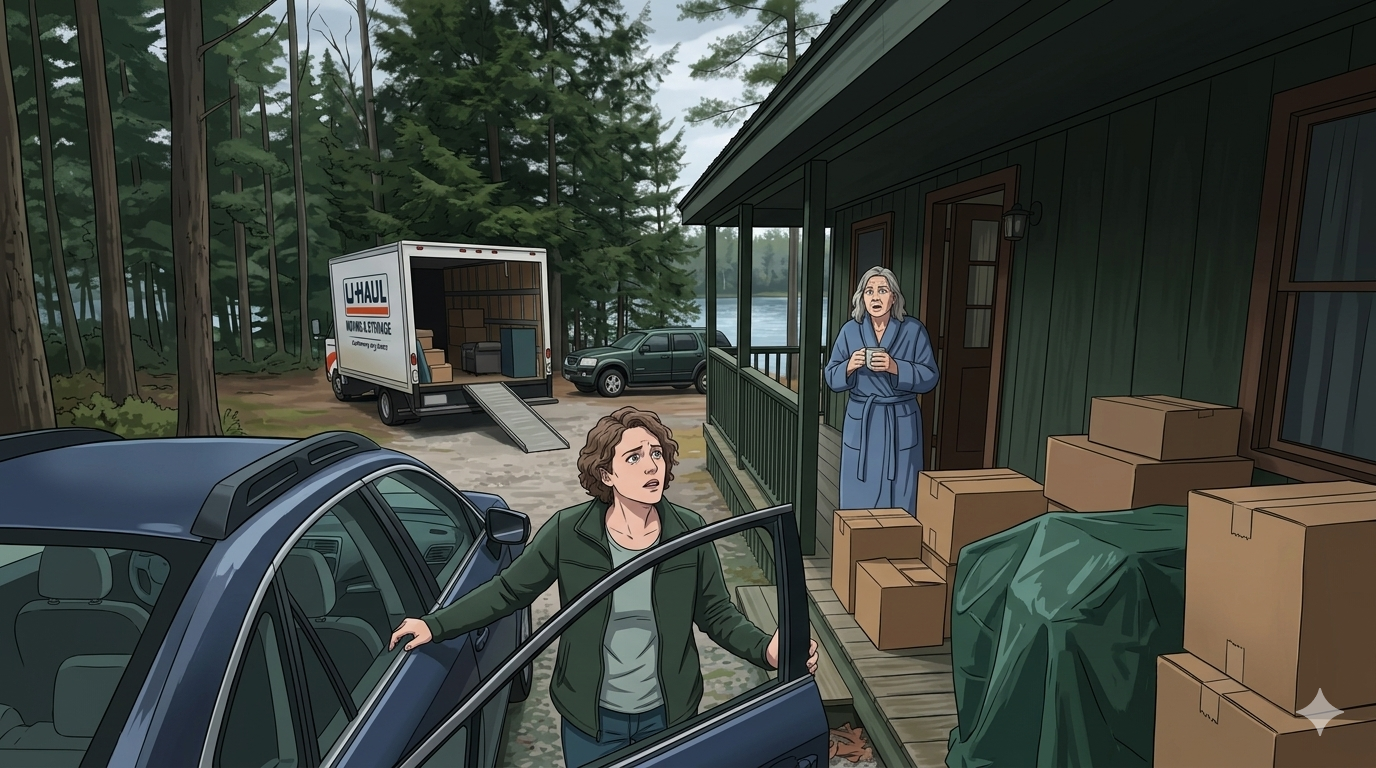
I knew something was wrong before I killed the engine.
The gravel in the driveway had fresh tire tracks carved through it, deep and wide, like something heavy had backed in more than once.
My mother stood on the porch in her robe with both hands clenched at her sides, not waving, not moving, just staring at my car with the expression people wear when they are trying very hard not to fall apart before help arrives.
My sister’s SUV sat crooked near the porch.
Next to the side entrance was a moving truck I had never seen before, its rear hatch lifted, a set of dollies leaning against the frame.
Someone had already stacked two plastic storage bins near the grass.
I got out of the car and looked at my mother.
“What happened?”
Her eyes went immediately to the front door.
“They said it would be easier if they did it quickly.”
They.
That one word hit me like ice water.
I took the porch steps two at a time and stepped inside the cabin I had built to feel calm.
The smell was wrong first.
Not coffee, cedar, lake air, and the faint vanilla candle my mother always lit in the kitchen.
I smelled cardboard, packing tape, and the sharp chemical scent of fresh marker on moving labels.
Then I heard Craig’s voice from the back hallway.
“No, put the bedroom set in the truck first.
We’ll sort the medical stuff later.”
I stopped dead.
The bedroom set.
The medical stuff.
For one half second, my brain refused to understand the sentence.
Then Vanessa appeared from the guest room carrying one of my mother’s framed photos and said, in the same distracted tone someone might use while loading after a vacation, “Oh good, you’re here.”
I looked past her shoulder.
The guest room closet was open.
Bedding had been stripped.
My father’s shower chair sat in the hallway.
One of the movers was unscrewing the handrail I had paid extra to anchor into the wall studs.
“What exactly do you think you’re doing?” I asked.
Vanessa exhaled like I was the one creating inconvenience.
“Mom and Dad can’t manage this place anymore.
We’re helping transition them.”
“Transition them where?”
“To the condo,” Craig said as he came into view, sleeves rolled up, clipboard in hand, wearing that same polished, managerial expression he always put on when he wanted to sound like the smartest person in the room.
“This property isn’t practical long-term.”
I turned to him.
“It’s fully accessible.”
He gave me a thin smile.
“Accessible doesn’t mean sustainable.”
My father was sitting at the kitchen table.
That terrified me more than anything else.
He loved that table.
Loved that room.
Loved the window that looked straight out at the water.
Usually when I came, he was on the porch or near the dock, bundled in some oversized sweater, pretending he was just sitting for a minute when I knew he’d been there an hour.
Now he was inside, rigid and pale, both hands wrapped around a mug that had gone untouched.
There was a folder in front of him.
He looked up at me and I saw shame all over his face.
“Dad?”
He swallowed.
“I told them to stop.”
The room got very quiet.
Not
because anyone respected that sentence.
Because all of us heard the tremor in it.
My mother came in behind me.
“They said they already put money down on the condo and that we had agreed.”
I looked at Vanessa.
“Agreed to what?”
She set the framed photo on the counter with exaggerated care.
“We’ve been trying to handle this like adults, Riley.”
That sentence told me almost everything I needed to know.
People only say that when they are doing something ugly and need moral camouflage.
Craig slid the folder toward me.
“Your parents signed authorization documents last week.
We’re relocating them closer to better care.
The cabin will be listed.
It’s the rational move.”
I didn’t sit.
I opened the folder standing up.
Inside were printed forms from some online legal template service, a purchase agreement for a condo thirty minutes from Vanessa’s subdivision, a listing intake packet for the cabin, and a so-called family management authorization that named Vanessa as acting representative for my parents’ property affairs.
Not power of attorney.
Not anything properly drafted.
A sloppy stack of amateur paper dressed up to look official.
But there, on the pages, were my parents’ signatures.
My stomach dropped.
I looked at my father.
“Did you know what you were signing?”
He hesitated.
That was answer enough.
My mother pressed a hand to her mouth.
“She said it was to get home-care services approved if your father got worse.”
Vanessa’s face tightened.
“That was part of it.”
“No,” I said quietly.
“It wasn’t.”
Craig crossed his arms.
“Let’s not be dramatic.”
That made me look up.
His tone was smooth, but his eyes were alert now.
He knew from the way I was turning pages that I had actually read this kind of garbage for a living.
I set the folder down and spoke carefully.
“You cannot sell this property.”
Craig gave a short laugh.
“Everything can be sold.”
“Not this.
The deed is held in an irrevocable trust.”
Vanessa blinked.
“What?”
I looked at her for the first time with absolutely no urge to soften anything.
“Mom and Dad have lifetime beneficial use.
They can live here, use it, enjoy it, and nobody gets to force a sale because nobody else owns it.”
Craig’s expression changed by less than an inch.
But I saw it.
That tiny flicker people make when the plan in their head crashes into a wall.
He recovered fast.
“Then they can choose to surrender that use.”
“My parents can choose anything they understand.
These papers are misleading, unsupported, and unenforceable.”
Vanessa folded her arms.
“You always do this.
You always make everything sound sinister because you need to be the hero.”
I almost laughed.
Because there it was.
Not concern.
Not panic.
Not even a decent fake of guilt.
Resentment.
Raw and old.
“You brought movers into their house,” I said.
“You had someone taking out accessibility equipment while Dad was still sitting in the kitchen.”
“We were making decisions they are too emotional to make,” she snapped.
My mother made a sound behind me, not quite a sob, not quite anger.
Vanessa turned toward her and immediately softened her voice in that performative way she had learned years ago.
“Mom, you know I’m trying to help.”
“No,” my mother said.
The room
froze.
My mother was not a dramatic person.
She avoided confrontation like it was contagious.
I had watched her swallow discomfort, insult, chaos, and disappointment for most of my life if it meant keeping a room calm.
So when she stepped forward in that robe, with her hair unbrushed and her face colorless from stress, and said, “No.
You are trying to move me out of my own home while your father is sitting here begging you to stop,” it landed with the force of something tectonic.
Vanessa stared at her.
Craig tried to step in.
“No one is moving anyone by force.”
I pointed at the movers.
“Then why is my father’s bedroom half packed?”
One of the movers actually lowered his eyes.
He looked uncomfortable.
Good.
I walked to the front door and said, loudly enough for the men outside to hear, “Gentlemen, this is a family ownership dispute.
You need to stop work and leave the property.”
Craig took a step toward me.
“You don’t get to direct people I hired.”
I met his eyes.
“Actually, on property subject to disputed authority? I absolutely do.
And if they remain after being informed the authorization is contested, they become participants in wrongful removal.”
That did it.
The older mover looked at Craig.
“Man, we’re not getting into a legal mess.”
Craig’s jaw tightened.
“This isn’t a legal mess.”
“It is now,” I said.
The men put down what they were carrying.
Vanessa’s face flushed hot red.
“Are you serious right now?”
I didn’t answer her.
I turned back to the folder and kept reading.
That was when I saw the page clipped near the back.
A market analysis.
Estimated list value of the cabin in spring.
Projected net after sale.
And, handwritten in Craig’s neat block letters at the top corner: bridge loan payoff + condo cash purchase.
For a second, everything in me went still.
Bridge loan.
I looked up slowly.
“What bridge loan?”
Neither of them answered.
That silence told its own story.
I picked up the market analysis and scanned the attached notes.
There was enough there to sketch the shape of the disaster.
Two months earlier, Craig had made some kind of short-term investment play through a friend in real estate redevelopment.
It had collapsed.
Badly.
He and Vanessa were exposed.
They needed cash fast, and not a little.
Not enough to be embarrassed.
Enough to be desperate.
“You were going to liquidate my parents’ home to cover your debt,” I said.
Vanessa’s voice went sharp.
“It is not that simple.”
“No?” I held up the paper.
“Then explain why your husband wrote his loan payoff target on a pricing sheet for a house he does not own.”
Craig took one step forward and tried to take the document from my hand.
I moved it away.
That was when my father spoke.
Not loudly.
But clearly.
“Did you lie to me?”
The question was for Vanessa.
You could feel it in the room.
She turned toward him and for the first time since I’d arrived, some of her confidence cracked.
“Dad, I was trying to fix a situation before it became worse.”
His mouth trembled.
“By telling me the papers were for my care?”
She opened her lips.
Closed them.
My mother made a
strangled sound and sat down hard in a kitchen chair like her knees had simply stopped working.
I went to her, crouched beside her, and put one hand over hers.
It was ice-cold.
Craig, sensing the emotional tide turning against him, switched strategies instantly.
“Everyone needs to calm down.
Vanessa and I have been under a lot of pressure, and yes, we made assumptions, but the objective was to get your parents into a simpler living arrangement.
You can criticize execution all you want, Riley, but the underlying concern was valid.”
There is a certain kind of person who thinks if they use business language, they can bleach the humanity out of betrayal.
Execution.
Underlying concern.
As if he had mishandled a rollout, not tried to strip an old man’s bedroom while he was sitting ten feet away.
I stood up.
“You need to leave.”
Vanessa wiped under one eye, furious tears gathering now that the scene was no longer hers to control.
“You don’t understand what it’s like to have everything collapsing.”
I looked at her.
“Then you should have asked for help.
You do not get to solve your collapse by manufacturing one for them.”
Craig’s face hardened.
“Be careful.”
I almost smiled at that.
That was his instinct when charm failed.
Not apology.
Not retreat.
Pressure.
“I’ve been careful,” I said.
“That’s why the trust exists.
That’s why the taxes are prepaid.
That’s why there is no mortgage on this cabin and no lien you can touch.
That’s why the documents you tricked them into signing won’t get you one inch of ownership.
And that’s why, if either of you refuses to leave, I call the sheriff and hand over the pages where you documented your attempt to convert this property for your personal debt.”
Vanessa stared at me like she had never actually seen me before.
Maybe she hadn’t.
Maybe in her mind I had always been the younger sister who organized everything, handled things quietly, and made everyone else’s chaos survivable.
Useful people are often mistaken for weak ones.
My father pushed his chair back.
The motion was slow, effortful, shaky.
But he stood.
He looked at Vanessa with tears in his eyes and said, “You need to go.”
She broke then.
Not into remorse.
Into anger.
The kind that erupts when entitlement finally meets a locked door.
“You always loved her more,” she said.
The sentence hung there, ugly and childish and somehow still sharp enough to wound.
My mother stood too.
“No.
We trusted her more because she showed up.”
That one landed.
Vanessa’s face changed like she had been slapped.
Because that was the truth beneath all the old grievances.
It wasn’t favoritism.
It was accumulation.
Who came.
Who stayed.
Who learned the medication list.
Who answered the late-night calls.
Who noticed when the silence on the other end of the phone meant something was wrong.
Craig put a hand at Vanessa’s elbow.
“Let’s go.”
But before they moved, he looked at me one last time and said, “You think this is over because you have paperwork.
Families don’t work that way.”
“No,” I said.
“Families work exactly this way.
They reveal themselves under pressure.”
The movers left first.
Then Craig.
Vanessa lingered for three seconds too long in the kitchen, scanning
the room like she might still find a version of this where she got to stay connected to the place, to the story, to the parents she had nearly uprooted.
But there was nothing left for her there except the truth.
She walked out without hugging either of them.
The sound of her car on the gravel felt unreal.
After they were gone, my mother started shaking.
Not delicately.
Violently.
The kind of delayed physical response that happens when fear finally realizes it is allowed to leave the body.
I got blankets.
I made tea.
I checked my father’s medication schedule because stress always made his symptoms worse.
He tried twice to apologize to me, and both times I stopped him.
He had nothing to apologize for.
Trusting your daughter should not be a punishable offense.
I spent that night at the cabin.
Then the next two.
By Monday morning, I had done what my job had trained me to do.
I documented everything.
Photos of the packed bedroom.
Photos of the removed rail hardware.
Copies of every page in Craig’s folder.
A written statement from each mover that they had been hired by Craig and Vanessa to begin a same-day relocation.
I called a real attorney this time, not an online template graveyard.
We updated the trust administration records, flagged the property title file, and prepared formal notices instructing both Vanessa and Craig to cease any representation of authority over my parents, their home, or their assets.
I also arranged for a camera system at the cabin and keypad entry on every exterior door.
My parents resisted that part at first.
Not because they didn’t understand the need.
Because accepting protection after betrayal feels, to people like them, too much like admitting the betrayal was real.
But eventually my father nodded.
A week later, Vanessa called my mother fourteen times in one afternoon.
My mother did not answer.
Craig sent me a single email claiming there had been a misunderstanding and suggesting we avoid escalating “a painful family communication breakdown.”
I forwarded it directly to the attorney.
Then came the final surprise.
About three weeks after the incident, the attorney called and told me one of the movers had reached out again.
Off the record, at first.
He had felt sick about the whole thing.
When he and the other guy arrived that day, Craig had told them the elderly couple had already agreed to downsize and that the daughter on site was “handling the emotional details.” The mover said he only realized something was off when my father, in a shaking voice, asked him not to take the blue chair by the window because that was where he watched the lake in the mornings.
The blue chair.
I had bought that chair with my first year-end bonus.
He said Craig had replied, “They’ll have a new one at the condo.”
That sentence stayed with me.
Because that was the whole philosophy right there.
Interchangeable people.
Interchangeable objects.
Interchangeable losses.
Just replace what mattered and call it solved.
Months passed.
Winter came hard around the lake, then gave way to a damp, bright spring.
My parents stayed in the cabin more often than before, almost defiantly.
My father sat on the porch wrapped in blankets and watched the water
break into silver under the afternoon sun.
My mother planted herbs in a raised planter by the kitchen window.
Their routines slowly became ordinary again.
Vanessa sent one handwritten letter in June.
Not an apology.
A justification stitched together out of stress, financial panic, childhood resentment, and the claim that she had been trying to create a more manageable future for everyone.
My mother read it once, folded it neatly, and placed it in a drawer.
She never responded.
I asked her later whether she thought she ever would.
She looked out at the lake for a long time before answering.
“I can forgive fear,” she said.
“I don’t know if I can forgive calculation.”
That was the aftershock of it all.
Not the attempted sale.
Not the fake paperwork.
Not even the moving truck.
It was the calm planning underneath the betrayal.
The meetings.
The forms.
The scheduling.
The way two people had looked at an old couple’s sanctuary and seen a solution to their own problem.
My parents still have the cabin.
The trust still holds.
The blue chair is still by the window.
And every time I drive up that gravel road now, I feel two things at once: gratitude that I protected them in time, and a bitterness I still can’t fully sand down.
Because once you learn who in your family sees your safety as negotiable, it becomes very hard to forget.
Maybe that is the real divide such stories leave behind.
Some people think desperation explains what Vanessa and Craig did.
Others think desperation just revealed what was already there.
THE END!