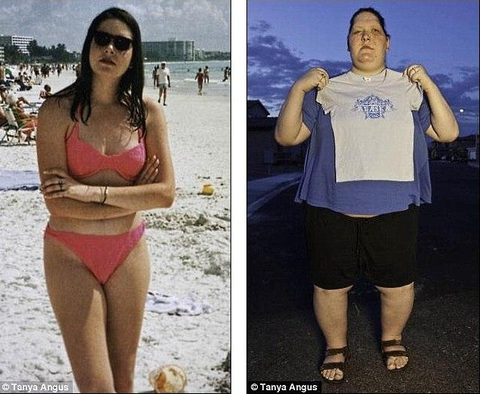
Her life changed dramatically in her early twenties. What began with slightly larger shoes and tighter clothes eventually became a rare medical condition that transformed almost every part of her body. This is the heartbreaking true story of Tanya Angus.
A Young Woman With a Bright Future

Before her life was changed by a rare medical condition, Tanya Angus was an ordinary young woman who enjoyed many of the things people her age loved.
She grew up in Las Vegas, Nevada, and was described as an energetic, outgoing young woman. During her teenage years, she enjoyed swimming, horseback riding, dancing, and spending time with friends.
She was approximately 5 feet 8 inches tall and weighed around 135–140 pounds. She had even participated in fashion modeling and appeared to have a promising future ahead of her.
Looking at photographs from her younger years, it is difficult to imagine how dramatically her life would change.
However, around the age of 19–21, Tanya began noticing unusual changes in her body.
At first, the changes seemed relatively small. Her shoes no longer fit comfortably, her clothes became tighter, and her hands appeared larger.
She initially had no idea that these changes were signs of a serious medical condition.
The Unusual Changes That Changed Her Life

As time passed, Tanya’s physical transformation became increasingly noticeable.
Her hands and feet continued growing. Her facial features changed, her body became larger, and even people around her began noticing that something was wrong.
What initially seemed like ordinary physical changes turned into a frightening medical mystery.
Her family became increasingly concerned because the changes were happening so quickly.
Tanya eventually returned to Las Vegas in 2002. Her family was shocked by how much her appearance had changed.
According to reports, her sister initially struggled to recognize her when she arrived at the airport.
This was the beginning of a long and difficult medical journey.
The Diagnosis: A Rare Condition Called Acromegaly

After seeking medical attention, Tanya was diagnosed with acromegaly, a rare hormonal disorder associated with excessive production of growth hormone.
In her case, the condition was linked to a tumor affecting her pituitary gland, a small gland located at the base of the brain.
The pituitary gland plays an important role in controlling hormones throughout the body.
When the body produces too much growth hormone over an extended period, it can cause abnormal growth of bones, cartilage, and other tissues.
This can affect the hands, feet, facial features, and internal organs.
Tanya’s condition was particularly severe.
Her body continued increasing in size, and the physical consequences became more difficult to manage.
Although acromegaly is treatable in many patients, Tanya’s case proved exceptionally complicated.
Her Body Continued Growing
As the condition progressed, Tanya experienced changes that affected almost every aspect of her everyday life.
Her height eventually reached approximately 7 feet 2 inches, and her weight was reported to be around 400 pounds near the end of her life.
Ordinary activities became increasingly difficult.
Finding suitable clothing and shoes was a constant challenge. Even getting into regular vehicles became difficult because of her height and body size.
She needed specially made shoes, and her family had to make adjustments to accommodate her physical needs.
The condition also caused significant pain.
Her heart, lungs, joints, and other body systems were affected by the excessive growth.
Tanya’s mobility gradually became more limited. She eventually relied on a wheelchair and needed assistance from her family.
Swimming pools provided some relief because the water helped support her body and reduced the pressure on her joints.
For someone who had once enjoyed swimming and an active lifestyle, losing that freedom was heartbreaking.
The Difficult Journey Through Multiple Surgeries
Doctors explored different ways to control Tanya’s condition.
Her pituitary tumor presented a major medical challenge because of its size and location.
Over the years, she underwent multiple operations and other treatments in an effort to control the excessive growth hormone.
However, the results were not what her family had hoped for.
One operation lasted approximately 13 hours and nearly cost her life.
Another surgery resulted in a stroke that caused her to lose much of her hearing.
Doctors also faced difficult decisions because further surgery carried serious risks.
In 2010, ABC News reported that specialists had concerns about the risks associated with operating on the tumor.
Her situation became so complicated that transporting her to a hospital in California required special arrangements.
After hearing about her situation, emergency medical personnel helped arrange a specially equipped transport vehicle that could accommodate her.
It was a remarkable example of how strangers came together to help someone facing an extraordinary medical challenge.
A Small Sign of Hope in 2011

Despite years of difficult treatments, Tanya and her family never stopped hoping for improvement.
In 2011, she began receiving treatment with a medication called Somatuline (lanreotide).
The treatment appeared to produce encouraging results.
Reports at the time indicated that her growth hormone levels had fallen significantly and that she had lost approximately 100 pounds.
For a woman whose body had continued growing for years, this was an important development.
By August 2012, reports indicated that her growth had finally stopped after years of uncontrolled changes.
For the first time in a long time, Tanya and her family had a reason to feel hopeful.
However, stopping the excessive growth did not mean that all the damage caused by the disease could be reversed.
She continued experiencing serious physical difficulties and required ongoing medical care.
The Emotional Struggle Behind Her Physical Transformation

Tanya’s story was not only about physical changes.
It was also about the emotional challenges of living with a condition that made her appearance dramatically different from the person she had once been.
People sometimes judged her without understanding what she was experiencing.
Her family spoke publicly about the cruel comments and misunderstandings Tanya encountered.
Some people assumed her physical condition was related to lifestyle choices, without realizing that a serious hormonal disorder was responsible.
But Tanya did not allow her medical condition to define her entire identity.
She appeared on television programs and shared her experiences to help other people understand acromegaly.
She also became involved with the acromegaly community, connecting with patients from many different countries.
Her willingness to speak openly about her condition helped raise awareness of a disease that many people had never heard of.
She wanted others experiencing similar symptoms to seek medical attention and receive an early diagnosis.
Her Final Days
Sadly, Tanya’s medical journey came to an end in January 2013.
She died on January 14, 2013, at the age of 34.
News of her death deeply affected her family, friends, and members of the acromegaly community.
Reports at the time discussed serious cardiovascular complications and a transient ischemic attack (TIA). Her exact cause of death was not conclusively established in the initial reports.
Her mother, Karen, remembered her daughter as someone who had endured tremendous physical difficulties but continued trying to help others.
Even during the most challenging periods of her illness, Tanya had made an effort to connect with people who were facing similar struggles.
Her story left a lasting impression on people around the world.
A Legacy That Continues to Raise Awareness

Tanya Angus’s life reminds us that medical conditions can change someone’s life in ways that are difficult to imagine.
Behind the dramatic photographs was a real person who had dreams, relationships, interests, and hopes for the future.
She was not simply a woman whose body grew unusually large.
She was a daughter, a friend, and an advocate who wanted to make a difference for people living with rare hormonal disorders.
Her experience also highlights the importance of recognizing unusual physical changes and seeking medical advice.
Tanya’s story remains an important reminder of the challenges faced by people living with rare diseases.
Her body changed dramatically, but her determination to help others became an important part of her legacy.

