I froze when I saw my eight-month-pregnant daughter-in-law working as a waitress.
For a second, I honestly thought I was hallucinating.
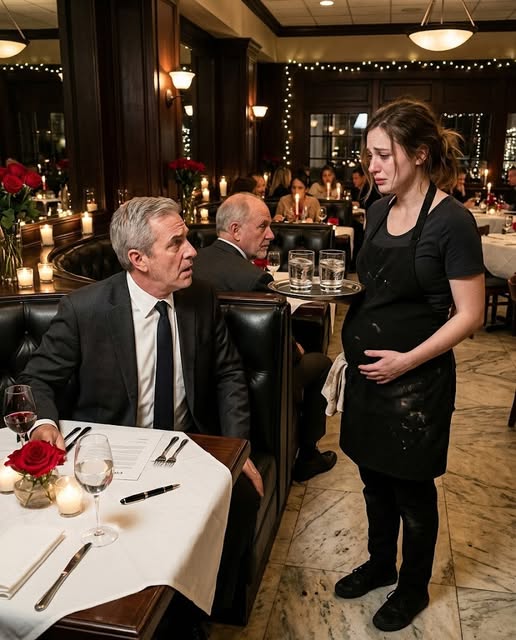
The dining room at Belmont’s was glowing with polished silver, low candlelight, and the soft red haze of Valentine’s decorations.
Gerald Thompson was talking numbers across from me in that clipped, impatient tone he used whenever he smelled a signature coming.
The contract between us was worth $2.3 million on paper and far more in leverage.
I should have been focused on the final clause, my pen, the deal, the future of Stone Enterprises.
Instead, I looked up and saw Hannah.
My daughter-in-law was standing beside the table in a stained black apron, one hand under a tray and the other bracing the underside of a belly so heavy it changed the way she moved.
She was eight months pregnant.
Her face was thinner than I remembered, her eyes ringed with exhaustion, and the old brightness that used to make her the fastest mind in any room had been replaced by pure, naked fear.
My son had told me she was gone.
Not just gone.
Gone with someone else.
He said she had abandoned him, stolen money, and run off in disgrace.
Gerald had backed him up with documents, timelines, and that cool, disgusted certainty men like him wear when they want a lie to feel like professionalism.
I had never seen proof that satisfied me entirely, but I had seen enough to stay quiet.
Enough to tell myself I was protecting the company from scandal while my son handled his private pain.
Then there she was, carrying my grandchild and serving water in a restaurant I partially owned.
She set a glass in front of me with trembling hands.
“Hannah,” I said.
Her eyes lifted to mine for less than a second.
That was all it took.
The terror in them was real.
“I’m just the server, sir,” she whispered.
Then she turned and fled toward the kitchen.
Gerald muttered something sharp about my health, the deal, the wasted time, but I was already on my feet.
I told him to stay put and pushed through the swinging doors.
The kitchen hit me like a wall of heat, steam, and sound.
Cooks shouted, skillets hissed, knives struck cutting boards.
Hannah stood near a stainless-steel prep station with one hand on the counter and the other pressed to the small of her back.
She looked like she might collapse.
“What is going on?” I demanded.
She shook her head.
“You shouldn’t be back here.”
“You’re my son’s wife,” I said.
“You’re eight months pregnant and waiting tables.
I think I’ve earned an explanation.”
She looked at me, really looked at me, and whatever she saw in my face must have convinced her I was finally listening.
“I didn’t disappear,” she said quietly.
“Preston made me disappear.”
I felt the words like a physical blow.
Before I could answer, she glanced toward the kitchen door and lowered her voice.
“Please.
Keep your voice down.
If Gerald realizes I’m talking to you, he’ll know I ran out of time.”
That sentence chilled me more than any accusation could have.
“What does Gerald have to do with this?” I asked.
“Everything.”
She took a slow breath, gathering herself.
Hannah had always been controlled under pressure.
Even then, exhausted and frightened, there was precision in the way she told me what happened.
She said that three months into her pregnancy, while reviewing back-end vendor files at Stone Enterprises, she found irregularities.
At first it looked like ordinary sloppiness: duplicated invoice numbers, vendor accounts opened too quickly, round-dollar change orders that did not match the actual scope of work.
But Hannah was an accountant, and a very good one.
Sloppiness has a pattern.
Theft has one too.
She kept digging.
The same subcontractors appeared again and again under different addresses.
Material purchases were billed twice through separate shell vendors.
Payroll funds moved through temporary staffing entities that had no employee tax records.
Several approvals were tied to Preston’s credentials.
Others were signed off by Gerald.
“When I first confronted Preston, he acted shocked,” she said.
“He said Gerald had asked him to approve a few emergency transfers to keep projects moving.
He told me not to overreact and promised he’d fix it.”
She laughed once, bitterly.
“Then he asked me for the files.”
She did not give them to him.
That was when his tone changed.
“He told me I was pregnant and emotional,” she said.
“Then he told me I was reckless for accusing his father’s closest partner.
Then he said if I kept pulling threads, I could destroy the company and your health at the same time.”
I felt my jaw clench.
“My health?”
“Yes.”
At the time, I had already begun having dizzy spells.
Some mornings I woke nauseated and weak.
Some afternoons the room seemed to tilt.
My doctor had blamed stress, blood pressure, age, overwork.
Gerald had been strangely attentive through all of it, urging me to cut back, insisting he could absorb more responsibility, reminding me how dangerous instability looked to investors.
I had resented the concern.
Now, standing in that kitchen, I heard it differently.
Hannah said she kept copies of the financial records and decided to come to me directly.
The night before she planned to do that, Preston came home late.
He was drunk enough to be honest and scared enough to be cruel.
“He told me the story was already built,” she said.
“He said Gerald had people in place.
Legal.
Compliance.
Tech.
He said if I accused them, all they had to do was point to my access history and the transfers from my workstation.
He said by the end of the week, everyone would believe I stole from the company and ran off with another man.”
I stared at her.
“He said that to you?”
She nodded.
“Why would he think I’d believe it?”
“Because he knew you trusted him,” she said.
“And because Gerald kept telling him you’d protect Stone Enterprises before you protected anything else.”
That hurt because it was plausible.
When a man spends forty years building a company, people start treating that company like his first language, his first loyalty, his first reflex.
Maybe I had done that.
Maybe my son had grown up learning that image mattered, control mattered, timing mattered.
Maybe he had learned how to use those things before he learned what they cost.
Hannah told me she left that night with copies of what she could carry, but she did not get far before
everything started locking her out.
Her company credentials stopped working.
Their joint accounts were frozen.
Her credit cards were shut off.
A formal notice from company counsel accused her of financial misconduct and instructed her not to contact executive leadership.
Someone had even filed an internal incident report suggesting she was emotionally unstable and had made erratic statements at work.
She was pregnant, isolated, and suddenly unemployable in the very industry where she had built her reputation.
“Why didn’t you call me directly?” I asked.
She reached into her apron pocket and showed me an old phone with a cracked screen.
My private number was there.
So was my office line, my assistant’s number, and three different email threads.
I recognized the addresses.
There were messages I had never seen.
One after another after another.
Please talk to me.
Something is wrong.
I did not steal anything.
Please don’t believe Preston.
I am trying to protect the baby.
Gerald is involved.
Some had bounced.
Others showed as delivered.
A few had responses from company legal threatening consequences if she continued to harass executive staff.
A cold rage opened in my chest.
“Gerald has been screening more than my meetings,” I said.
She gave me a sad look.
“Preston had access to the rest.”
Then she asked the question that changed the entire night.
“You haven’t signed anything yet, have you?”
I told her no.
Her face went white.
“Don’t,” she said.
“Whatever he puts in front of you, do not sign it.”
I asked why.
Instead of answering, she pointed to the round glass window in the kitchen door.
I looked through it and felt my stomach turn.
Preston had just walked into the dining room.
He moved straight to our table and bent toward Gerald as if they had been coordinating all evening.
Gerald did not look surprised to see him.
He looked relieved.
That, more than anything else, told me this was not a coincidence.
“They told me he was in Chicago,” I said.
“They tell everyone what they need them to hear,” Hannah replied.
Then she pulled one last document from her apron pocket.
It was a pharmacy printout with my name on it.
The medication listed there was not the one my doctor had prescribed.
The dosage had been changed months earlier.
The authorizing contact attached to the refill was not my physician’s office.
It was an administrative account associated with a benefits subsidiary under Stone Enterprises.
My vision narrowed.
“Are you telling me someone tampered with my medication?”
“I’m telling you I found that printout in Preston’s car,” she said, voice shaking.
“And when I confronted him, he said Gerald told him it would only make you tired and easier to manage until the new structure was in place.”
A wave of nausea hit me so violently I had to brace against the counter.
The contract.
My health.
The pressure.
The isolation.
It all aligned so fast it made me cold.
“What structure?” I asked.
She swallowed.
“The contract creates a new development subsidiary and shifts key authority under a contingency clause if the founder becomes medically impaired.
Gerald needed your signature to validate the transfer timing.
Preston needed you weak enough not to question it.
Once it was signed, they could use your medical
episodes to edge you out and call it succession planning.”
I closed my eyes for one second.
When I opened them, something old and hard had come back into me.
All my life, people mistook quiet for softness.
I learned long ago that the loudest man on a site was rarely the most dangerous one.
Real control sits still, watches, and strikes only when the structure reveals where the load is hidden.
I told Hannah to stay where she was.
She refused.
“I’m done hiding,” she said.
So we walked out together.
The kitchen doors swung open, and the dining room seemed to pause.
Gerald was halfway up from his chair.
Preston, my son, went rigid when he saw Hannah beside me.
He recovered quickly, too quickly.
“Dad,” he said, with a performance of concern that made me ill, “what are you doing back there? You shouldn’t be on your feet if you’re dizzy.”
I looked at him for a long moment.
Then I sat down, picked up the contract, and turned to the page with the signature line.
Gerald’s shoulders loosened.
Preston exhaled.
I let them believe it.
“Before I sign,” I said, “I want to know why my daughter-in-law was told to disappear.”
Neither man answered.
Preston went first with indignation.
“She lied to you, didn’t she? Dad, she’s unstable.
She’s been harassing us for months.
I told you—”
“Stop.”
He fell silent.
I slid the pharmacy printout onto the table.
Then I slid Hannah’s phone beside it.
Then I took the contract, turned it over, and read out loud the contingency clause Hannah had described.
I watched Gerald’s face while I did it.
Not Preston’s.
Gerald’s.
Preston was weak enough to panic.
Gerald was the engineer of this thing.
And there it was—that small, involuntary tightening at the corner of his mouth when the mechanism is exposed.
“Interesting clause,” I said.
“Especially paired with an unprescribed medication adjustment and filtered communications from my own daughter-in-law.”
Gerald leaned back and gave me a thin smile.
“Mitchell, you’re tired.
This is exactly the sort of confusion we’ve been worried about.”
There it was.
The play.
He turned toward Preston.
“Maybe we should call Dr.
Evans.
Your father isn’t himself.”
Preston immediately stepped in.
“Dad, please.
Let’s not do this in public.”
In public.
As if embarrassment were the real emergency.
I set down the pen.
“Manager,” I said, loud enough for half the room to hear.
“Call security.
No one at this table leaves.”
Gerald actually laughed.
“On what basis?”
“On the basis,” I said, “that I own part of this restaurant, control the legal department you’ve been impersonating authority over, and recorded every word from the moment I came back through that kitchen door.”
That last part was a bluff.
But it worked.
Preston’s face collapsed first.
Gerald’s followed a split second later.
That was all the confirmation I needed.
I took out my phone and called not company counsel, but an attorney I had not used in years—an old litigator who hated Gerald and loved a fight.
Then I called my doctor directly from speakerphone and asked him, in front of everyone, to confirm the medication he had prescribed me.
It did not match the printout.
Preston actually sat down at that point, as if his knees
had given out.
Gerald tried to stand.
Security arrived before he made it three steps.
What happened over the next seventy-two hours detonated my life.
Forensic accountants found what Hannah had found and more.
Shell subcontractors tied to Gerald’s cousin.
Payroll fraud routed through vendors Preston had approved.
Real estate options acquired quietly through entities positioned to profit from Stone Enterprises bids.
Legal drafts prepared in advance to isolate me if I resisted.
Internal communications showing that Hannah had been flagged as a threat weeks before she was accused of theft.
And the medication change was real.
Someone had used a benefits administration access point to submit a refill alteration to the pharmacy chain managing my prescription.
It did not rise to the level of a poison plot out of a thriller, but it was enough to worsen dizziness, cloud concentration, and make an overworked man look older and less stable than he was.
That was all Gerald needed.
Preston confessed before the lawyers even finished cornering him.
Not because he was noble.
Because he was terrified.
He admitted Gerald had convinced him he was overdue for control, that I would never step aside willingly, that the company would eventually go to outsiders unless family asserted itself.
Gerald fed every resentment my son had ever carried: that I respected competence more than blood, that I trusted Hannah’s judgment, that I still treated Preston like an heir in training instead of a man.
Somewhere in that poisoned mix of insecurity and greed, my son agreed to destroy his own wife and manipulate his own father.
I wish I could say I felt only fury when he admitted it.
The truth is uglier.
I felt grief.
A deep, humiliating grief.
Because once you hear your child explain exactly how he helped strip his pregnant wife of money, access, and reputation, some part of fatherhood dies right there in the room with you.
Gerald was arrested on fraud, conspiracy, and evidence-tampering related charges after a flood of records began surfacing.
Preston was not spared.
The district attorney did not care that his last name matched mine.
Civil suits followed.
Board meetings followed.
Headlines followed.
There is no dignified way for a family scandal to unravel when a company sits underneath it.
Everyone always pretends to be shocked by greed in public, but in private they mostly just ask what it will do to the stock, the financing, the pipeline.
I did not care.
For the first time in months, maybe years, I cared about one thing at a time.
The first thing was getting Hannah safe.
The second was telling the truth.
I moved Hannah into the guest house on my property that same week.
She resisted for exactly twelve minutes before her ankles swelled so badly her doctor ordered bed rest.
I hired a nurse, replaced every penny she had lost, and made it clear to everyone at Stone Enterprises that the accusations against her were false and that her work had likely saved the company from complete collapse.
She accepted the practical help long before she accepted my apology.
I do not blame her.
An apology from the man who failed to see her suffering is not a gift.
It is a debt payment.
Still, one evening, a month after Belmont’s,
I found her sitting on the back terrace wrapped in a blanket, one hand on her enormous stomach, watching a storm roll over the trees.
“I should have known,” I told her.
She was quiet for a while.
Then she said, “You should have asked one more question.”
That sentence has stayed with me ever since.
Not because it was cruel.
Because it was true.
A week later, my granddaughter was born.
She arrived red-faced, furious, and perfect, with Hannah’s eyes and, God help me, my son’s mouth.
I stood outside the hospital room for a full minute before I could bring myself to go in.
Hannah saw me in the doorway and nodded once.
That was permission enough.
When I held that little girl, I felt the wreckage of the past year rearrange itself into something that was not healing exactly, but direction.
A reason to build instead of just defend.
Hannah eventually filed for divorce.
Preston signed because he had no leverage left and no face left to save.
He asked to see the baby once through his attorney.
Hannah declined until the court could set proper terms.
I supported her decision.
At Stone Enterprises, I restructured everything.
I stepped back, but not because they had almost forced me to.
I stepped back because for the first time I understood that a company can become an altar if you are not careful, and families are terrible sacrifices to place on it.
Independent oversight came in.
Gerald’s people were purged.
Financial controls tightened.
Internal reporting was rebuilt from the ground up.
Hannah, after the baby was born and after enough time had passed for the ground to stop moving under her feet, agreed to return as an external consultant for the forensic recovery process.
Watching her walk back into those offices on her own terms was one of the proudest moments of my life.
Not because she forgave us.
Because she did not need to in order to stand there stronger than the people who tried to erase her.
As for my health, once the medication was corrected and the pressure lifted, the dizziness eased.
I was not immortal after all.
I was simply a tired man being pushed toward the edge by people who thought fatigue looked enough like surrender.
They were wrong.
Months later, I went back to Belmont’s alone and sat at the same table where I had nearly signed away my company and my judgment in one stroke.
The candles were different.
The décor was different.
But I could still see the shape of that night as clearly as if it were happening again: Hannah’s shaking hands, Gerald’s composure, Preston’s absence where trust should have been.
The manager recognized me and awkwardly offered the house special.
I ordered coffee instead.
Black.
Simple.
I sat there longer than I expected, thinking about how close I had come to mistaking manipulation for concern and polish for truth.
Thinking about how easy it is to believe the person who speaks with confidence over the person who speaks with fear.
That may have been the ugliest lesson in all of it.
Not that strangers can betray you.
Everyone knows they can.
It is that the biggest red flag is often the story that arrives too neatly wrapped, delivered by
the people who benefit most from your silence.
And once you see that, you start wondering which wound was worse—what my son did, what Gerald planned, or the fact that the person I should have trusted most had to stand in front of me eight months pregnant, in a waitress uniform, before I finally opened my eyes.
I still do not know the full answer.
I only know that when my granddaughter is old enough to ask what kind of man built Stone Enterprises, I care less now about whether she hears I was powerful.
I care that she hears I learned, even late, who deserved to be believed.