My husband’s mistress tried to use my passport for their trip.
That was the sentence I kept repeating in my head while I stood barefoot in the marble foyer of our Boston townhouse, wearing a black silk robe, one diamond earring, and a smile so calm it frightened even me.
The airline had called at 6:42 p.m.
“Mrs. Whitmore,” the woman on the phone said carefully, “we have a passenger attempting to board an international flight using your passport. The name matches. The face does not.”
For three seconds, I heard nothing but the rain tapping against the tall windows.
Then I asked, “Is she with my husband?”
A pause.
“Yes, ma’am.”
By 7:15, the trip was canceled.
By 8:30, a police report was filed.
By midnight, my husband, Charles Whitmore III, was standing in our dining room under a chandelier imported from Venice, telling me it had all been a misunderstanding.
His mistress, Madison Vale, claimed she had “grabbed the wrong document by accident.”
But my passport had been taken from the locked drawer in my private office.
And airport security footage showed the two of them laughing before check-in.
That was the moment I stopped being a wife.
And became evidence.
CHAPTER 1: THE WOMAN THEY THOUGHT WOULD CRY
Charles always loved an audience.
He proposed to me in front of three hundred people at the Boston Museum of Fine Arts, beneath a Monet, with a seven-carat emerald-cut diamond and a violin quartet playing something too beautiful to trust.
He toasted me at charity galas as “the woman who made me better.”
He kissed my hand at board dinners.
He called me his “north star” in interviews when Whitmore Holdings was expanding into Manhattan, Miami, and Los Angeles.
He knew how to perform devotion.
That was his gift.
Mine was remembering everything.
I remembered the first time he lied to me. He said he was in Chicago for a private equity meeting, but his cufflinks came back smelling faintly of jasmine and hotel soap.
I remembered the first time Madison smiled at me. She was twenty-eight, all golden hair and expensive innocence, hired as a “brand consultant” for the Whitmore Foundation. She wore ivory to our anniversary party and laughed too loudly whenever Charles spoke.
I remembered the way women like her always looked at wives like me.
Not with jealousy.
With impatience.
As if I were an old password she was waiting for someone to reset.
At first, I did what wealthy wives are trained to do. I did not make a scene. I did not throw wine. I did not accuse a woman in public. I did not give gossip pages a headline.
I watched.
I hired no private investigator at first. I didn’t need one. People underestimate quiet women, especially women in pearls. They assume silence is weakness. They never consider it may be inventory.
Madison left lip gloss in Charles’s Range Rover.
Charles began changing his phone face down.
The florist who sent roses to my hospital room after my mother died also began sending pale pink peonies to a penthouse in Back Bay.
And then there was the passport.
My office was at the back of the townhouse, behind a walnut-paneled door with a brass lock. It was the only room in the house Charles called “your little fortress,” usually with that patronizing smile men use when a woman owns something they cannot enter.
Inside were my contracts, my old journals, family records, and a navy-blue leather box where I kept my passport.
I had not touched it in six months.
Yet somehow, on a rainy Thursday in October, it ended up at Logan Airport in Madison Vale’s hand while she attempted to board a first-class flight to Paris with my husband.
Paris.
The city where Charles and I had honeymooned.
The city where he once told me my laugh sounded like champagne.
The city where, apparently, he intended to replace me with a younger woman carrying my name through customs.
When the airline called, I did not scream.
I thanked them for contacting me. I asked them to preserve all documents and camera footage. I requested the gate number, the flight number, the names of the staff involved, and the exact time of the attempted boarding.
Then I called Detective Lena Ortiz, whom I knew from a fundraiser for domestic violence survivors. Not a friend. Not yet. But a woman with eyes sharp enough to cut glass.
“My passport is being used by another woman at Logan,” I said. “She is traveling with my husband.”
Detective Ortiz was quiet for half a beat.
Then she said, “Do not touch anything in your office. I’ll send someone.”
When Charles came home at midnight, Madison was not with him.
He looked older without her beside him. Damp. Irritated. Less like a king and more like a man who had misplaced his crown.
“Vivienne,” he said, using the voice he reserved for managing disasters. “This has gotten completely out of hand.”
I sat at the end of our dining table, where twelve crystal glasses waited for guests who would never know what happened in that room. Behind me, rain slid down the windows like dark silk.
“Did it?” I asked.
He exhaled. “Madison accidentally grabbed your passport from my briefcase.”
“Interesting,” I said. “How did my passport get into your briefcase?”
His mouth tightened.
“She must have—”
“From my locked office drawer?”
He glanced toward the hallway.
I let the silence sit between us like a third person.
Charles removed his coat slowly. “You filed a police report.”
“Yes.”
“She made a mistake.”
“She attempted to board an international flight using a stolen government document.”
“Don’t be dramatic.”
There it was.
The sentence men like Charles use when a woman points at the knife in their hand.
Don’t be dramatic.
I stood, and the chair legs whispered against the floor.
“I am not being dramatic,” I said. “I am being precise.”
For the first time that night, something flickered in his face.
Fear.
Small, but unmistakable.
Good, I thought.
Let it breathe.
CHAPTER 2: THE LOCKED DRAWER AND THE LIE
The next morning, Madison posted a photo on Instagram.
Not her face, of course. She was not stupid in the ways that mattered least.
It was a blurry shot of a coffee cup near a rain-streaked window with the caption:
some people will do anything to ruin your happiness.
I almost admired the audacity.
Almost.
By noon, three women from my charity circle had texted me.
Heard there was a misunderstanding?
Are you okay?
Madison says she’s devastated.
Devastated.
That word sat in my mouth like a shard of ice.
I was not devastated.
I was awake.
The police dusted my office drawer for prints. The locksmith confirmed the lock had not been broken. Which meant whoever opened it had used a key.
Only two keys existed.
Mine.
And Charles’s.
He had insisted on having a duplicate years ago “for emergencies.” I remembered him saying it while kissing the back of my neck, turning control into tenderness.
The officers found no sign of forced entry.
But they found something else.
A faint scratch near the drawer’s inner brass plate, where someone had forced the passport box open with a letter opener.
The letter opener had been a gift from Charles.
Sterling silver. Engraved.
To Vivienne,
who opens every impossible door.
C.
That nearly made me laugh.
By evening, Charles had moved from denial to diplomacy.
He appeared in the doorway of my office wearing cashmere and contrition.
“Viv,” he said softly.
I did not look up from my laptop.
“I know how this looks.”
“How does it look?”
He stepped inside without permission.
“It looks like Madison did something careless because she was nervous. It looks like I should have checked the documents. It looks embarrassing.”
“Embarrassing,” I repeated.
He smiled weakly, encouraged by my calm.
“We can fix embarrassing.”
I closed the laptop.
“Charles, she did not steal a lipstick from Sephora. She took my passport from my locked drawer and attempted to leave the country using my identity.”
He rubbed his temples. “You always make things sound so severe.”
“They are severe.”
“She’s young.”
“She’s twenty-eight.”
“She panicked.”
“At check-in?”
“She thought—”
“She thought what?” I asked. “That my name, my birthdate, and my passport photo would magically rearrange themselves because she wanted a suite at the Ritz?”
His jaw tightened.
There he was. Not the remorseful husband. Not the charming philanthropist. The spoiled boy under the bespoke suit who hated being denied.
“You’re humiliating me,” he said.
“No, Charles. You humiliated yourself. I simply refused to clean it up.”
His eyes went cold.
“You know what happens if this gets out.”
“Yes.”
“Our shareholders—”
“Your shareholders.”
“Our family name—”
“Your family name.”
“Our marriage—”
I tilted my head. “Now that is interesting. You remembered we had one.”
He stared at me for a long time.
Then he said the thing that finally ended him.
“Be careful, Vivienne. You have a very comfortable life.”
There it was.
The threat wrapped in velvet.
The assumption.
That I was only rich because he allowed it. Only safe because he permitted it. Only powerful because I wore his name.
I smiled then.
Not warmly.
“Charles,” I said, “you have no idea whose life you’ve been living in.”
He left my office with a quiet curse under his breath.
I waited until his footsteps disappeared upstairs.
Then I opened the laptop again, entered a password he did not know existed, and pulled up a folder titled:
BLACK SWAN.
Inside were five years of documents.
Bank transfers.
Shell companies.
Property deeds.
Foundation invoices.
Encrypted emails.
And one video file labeled:
MVALE_LOGAN_CAM_1042PM.
Madison and Charles laughing under airport lights.
Madison holding my passport like a trophy.
Charles brushing hair from her cheek.
Both of them stepping toward the first-class counter as if the world had already agreed to forget me.
They had mistaken my silence for grief.
It had been preparation.
CHAPTER 3: BLACK SWAN IN PEARLS
My father taught me chess before he taught me how to ride a bike.
“Never punish the first mistake,” he used to say. “Punish the pattern.”
He was a civil rights attorney from Atlanta who wore linen suits and destroyed corrupt men with paper. My mother was a concert pianist who believed grace was not softness but discipline.
From them, I inherited two things.
A love of beautiful rooms.
And an appetite for justice.
Charles knew about the beautiful rooms.
He forgot about the justice.
When we married, the newspapers called me “an heiress with taste.” That was accurate but incomplete.
My grandmother had left me a small real estate portfolio in Savannah. I expanded it quietly. Brownstones in Brooklyn. A vineyard in Napa. Two boutique hotels in Charleston and Santa Fe. A private investment firm under my maiden name, Vivienne Hart Capital.
Charles thought my money was decorative.
He thought my seat on certain boards was ceremonial.
He thought the foundation gala I hosted every spring was a hobby.
Men like Charles see women as rooms they can enter and leave.
They rarely ask who owns the building.
The week after the airport incident, I moved like smoke.
I met Detective Ortiz at a small coffee shop near Beacon Hill. She arrived in a navy coat, no jewelry, no nonsense.
“Your husband’s lawyer called the department,” she said.
“I assumed he would.”
“They’re pushing the accident angle.”
“Of course.”
She stirred her coffee once. “But the airline staff confirmed the woman presented the passport herself. The ID mismatch was caught before boarding. Security has footage. Your locksmith statement helps. So does the office evidence.”
“Will they charge her?”
“I can’t promise anything yet. But this is not nothing.”
“I know.”
Detective Ortiz studied me. “Most people would be falling apart.”
“I did that privately years ago.”
Her expression softened, just slightly. “I’m sorry.”
“So am I,” I said. “But not enough to stop.”
That afternoon, I met my attorney, Marjorie Bell, on the thirty-fourth floor of a glass tower overlooking the Charles River.
Marjorie was seventy-one, wore red lipstick like armor, and had made three billionaires cry in conference rooms without raising her voice.
She read the documents silently while I watched sailboats cut through gray water below.
Finally, she removed her glasses.
“How long have you had these?”
“Some of them? Years.”
“Why not use them earlier?”
I looked at the folder.
Because I loved him once.
Because every wife waits for the man she married to return from the man he became.
Because leaving a life is not like leaving a room. There are echoes. There are ghosts. There are Sunday mornings and hospital chairs and the exact way his hand once found mine in the dark.
But I did not say that.
I said, “Because I wanted to be certain.”
Marjorie nodded. “And now?”
“Now I want a divorce, full separation of assets, a forensic audit of Whitmore Holdings, and a protective injunction preventing Charles from accessing my properties, accounts, or records.”
Her eyes gleamed.
“There’s more,” I said.
I slid over a second folder.
Marjorie opened it.
Then she smiled.
“Oh, darling,” she said. “This is not a divorce. This is a coronation.”
The second folder contained the original pre-nuptial agreement.
Not the copy Charles kept in his safe.
The original.
With the clause he had forgotten because he never believed it would matter.
If either party engaged in fraud, criminal conspiracy, or identity-related misconduct causing reputational or financial harm to the other, the injured spouse retained full rights to all individually held assets and could claim damages against marital assets used to facilitate the misconduct.
Charles had laughed at that clause when we signed it.
“Very dramatic,” he had said.
“Very precise,” I had replied.
Now it was both.
By Friday, Madison’s world began to tremble.
Her brand partnerships paused.
Her apartment lease, paid through a Whitmore shell company, came under review.
Her name appeared in a police filing.
Not in tabloids.
Not yet.
Paper first.
Noise later.
Charles tried flowers.
Then apologies.
Then anger.
Then his mother.
Eleanor Whitmore called at 9:03 a.m. on Sunday.
“Vivienne,” she said, her voice polished enough to reflect light, “this has become unnecessarily vulgar.”
I was in the garden room, drinking tea beneath a fig tree in a blue ceramic pot.
“Good morning, Eleanor.”
“Charles made a mistake.”
“Several.”
“Men do foolish things.”
“Women go to prison for them.”
A pause.
“She is a silly girl.”
“She is an adult woman who stole my passport.”
“You’re being vindictive.”
“No. Vindictive would be posting the airport footage with a violin soundtrack.”
Eleanor inhaled sharply.
I smiled into my tea.
“What do you want?” she asked.
“Freedom.”
“You already have freedom.”
“No, Eleanor. I have a marriage certificate and a man who thinks my locked drawer belongs to him.”
Her voice lowered. “Think carefully. The Whitmore family can make life difficult.”
“I know,” I said gently. “I learned by watching.”
Then I ended the call.
That night, Charles came home drunk.
Not sloppy. Charles was too vain for sloppy. But the edges were blurred. His tie hung loose. His perfect hair had surrendered.
He found me in the library, reading beneath the green banker’s lamp.
“You’re enjoying this,” he said.
I turned a page. “Not as much as you enjoyed Paris.”
He laughed bitterly. “God, you’re cold.”
“No, Charles. I was warm for twelve years. You just kept opening windows.”
He stepped closer.
“I loved you.”
I looked up.
That almost worked.
Almost.
Because the cruelest part was that he had. In his way. In the beginning. In the version of him before appetite became identity.
“I know,” I said.
His face twisted.
“Then why are you doing this?”
“Because love does not give you permission to erase me.”
He sank into the chair across from me. For a moment, he looked like the man I had married. Tired. Human. Lost.
“Madison meant nothing,” he whispered.
I closed the book.
“That is the saddest thing you’ve said all week.”
He frowned.
“You risked your marriage, your company, your reputation, and her future for a woman who meant nothing.”
His eyes reddened.
I stood and walked to the door.
“Sleep in the guest suite,” I said. “My attorney will contact yours tomorrow.”
He looked at me like I was killing him.
But I had learned something important.
Some men call it death when a woman stops feeding them her life.
CHAPTER 4: THE NIGHT OF THE GLASS HOUSE
The Whitmore Foundation Gala was held every November at The Glass House, a private event space overlooking the Boston Harbor.
It was our crown jewel.
Senators came. CEOs came. Actors came when their publicists needed philanthropy photos. Women arrived in diamonds heavy enough to bruise. Men arrived in tuxedos and sins.
Charles wanted to cancel it.
I refused.
“Vivienne,” Marjorie warned, “public events are unpredictable.”
“Not this one.”
“You’re sure?”
“I designed the seating chart.”
She laughed then. “Remind me never to betray you.”
The theme that year was “A Future Without Fear.”
Irony, when dressed properly, can look very expensive.
I wore black velvet.
No necklace.
No wedding ring.
Just my mother’s diamond earrings and a red lip sharp enough to draw blood.
When I entered, the room shifted.
People knew something had happened. Wealthy circles are not quiet; they are merely well-upholstered. Rumors had been moving through Boston like perfume in an elevator.
Charles arrived ten minutes after me with Eleanor on his arm.
Madison did not come.
At least, not through the front entrance.
I saw her near the bar at 8:17 p.m., wearing silver satin and panic. She had curled her hair, overlined her lips, and put on the face of a woman determined to be photographed into legitimacy.
Charles saw her too.
His expression went white.
That was when I understood.
He had told her not to come.
She had come anyway.
Beautiful.
Unplanned chaos often has excellent timing.
I moved through the room greeting donors, kissing cheeks, accepting compliments. I spoke with a senator’s wife about literacy grants. I laughed with the mayor about the harbor wind. I posed for photos beside Charles, close enough for gossip, far enough for truth.
At 9:00 p.m., Charles took the stage.
He was supposed to introduce me.
Every year, he did.
Every year, he told the room I was the heart of the foundation.
This year, his hands shook slightly as he adjusted the microphone.
“My wife,” he began, “has always believed in dignity.”
Across the room, Madison stepped forward.
No one else noticed at first.
I did.
Charles continued. “In compassion. In second chances.”
Madison’s eyes were glossy.
Oh no, I thought.
She was going to perform heartbreak.
And because women like Madison confuse attention with power, she believed the room would save her if she cried beautifully enough.
She walked toward the stage.
“Charles,” she called softly.
Heads turned.
A murmur rippled.
Charles froze.
Madison lifted her chin, tears trembling but not falling. Practiced. Camera-ready.
“I can’t let you do this,” she said.
The room went silent in the way rooms do when scandal enters wearing couture.
Eleanor looked like she had swallowed a knife.
Madison faced the crowd. “Everyone here thinks Vivienne is perfect. But nobody knows what she’s really like. She’s cruel. She’s controlling. She used the police to destroy me over an honest mistake.”
A woman gasped.
Someone’s champagne glass stopped halfway to their mouth.
Charles whispered, “Madison, stop.”
But she had tasted the stage now.
“She knew about us,” Madison continued. “She knew Charles loved me. And instead of letting him go, she set a trap.”
That was my favorite part.
The trap.
As if I had placed my passport in her hand and pushed her toward France.
I waited until she turned toward me.
“Say something,” she demanded. “Tell them the truth.”
So I did.
I walked to the stage slowly.
Not rushed.
Not shaken.
Just a woman in black velvet crossing a room full of wolves who had mistaken her for dinner.
Charles backed away from the microphone as I approached.
Madison wiped one tear.
I stood beside her and looked out at the crowd.
Then I smiled.
“The truth,” I said, “is a beautiful thing. It requires no rehearsal.”
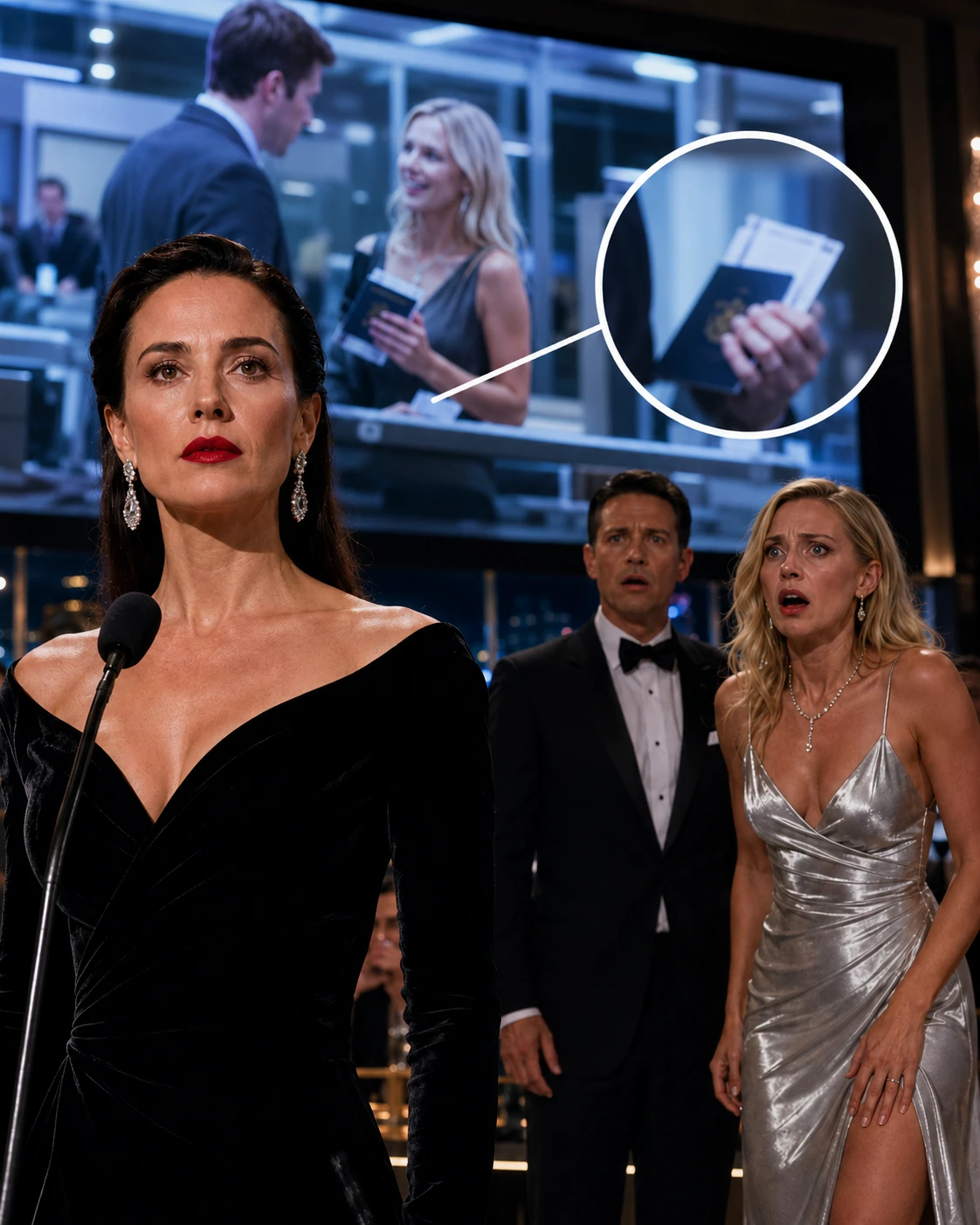
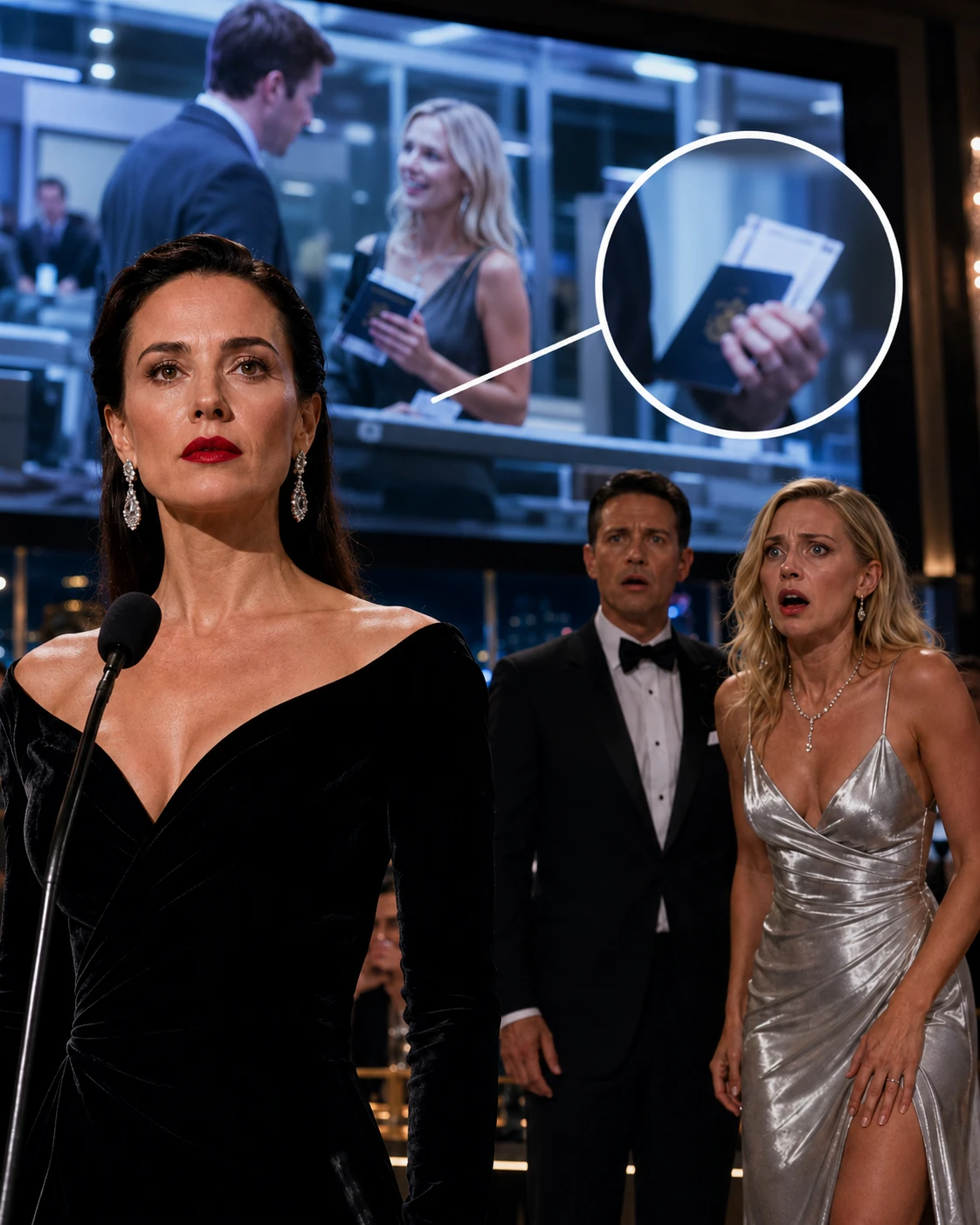
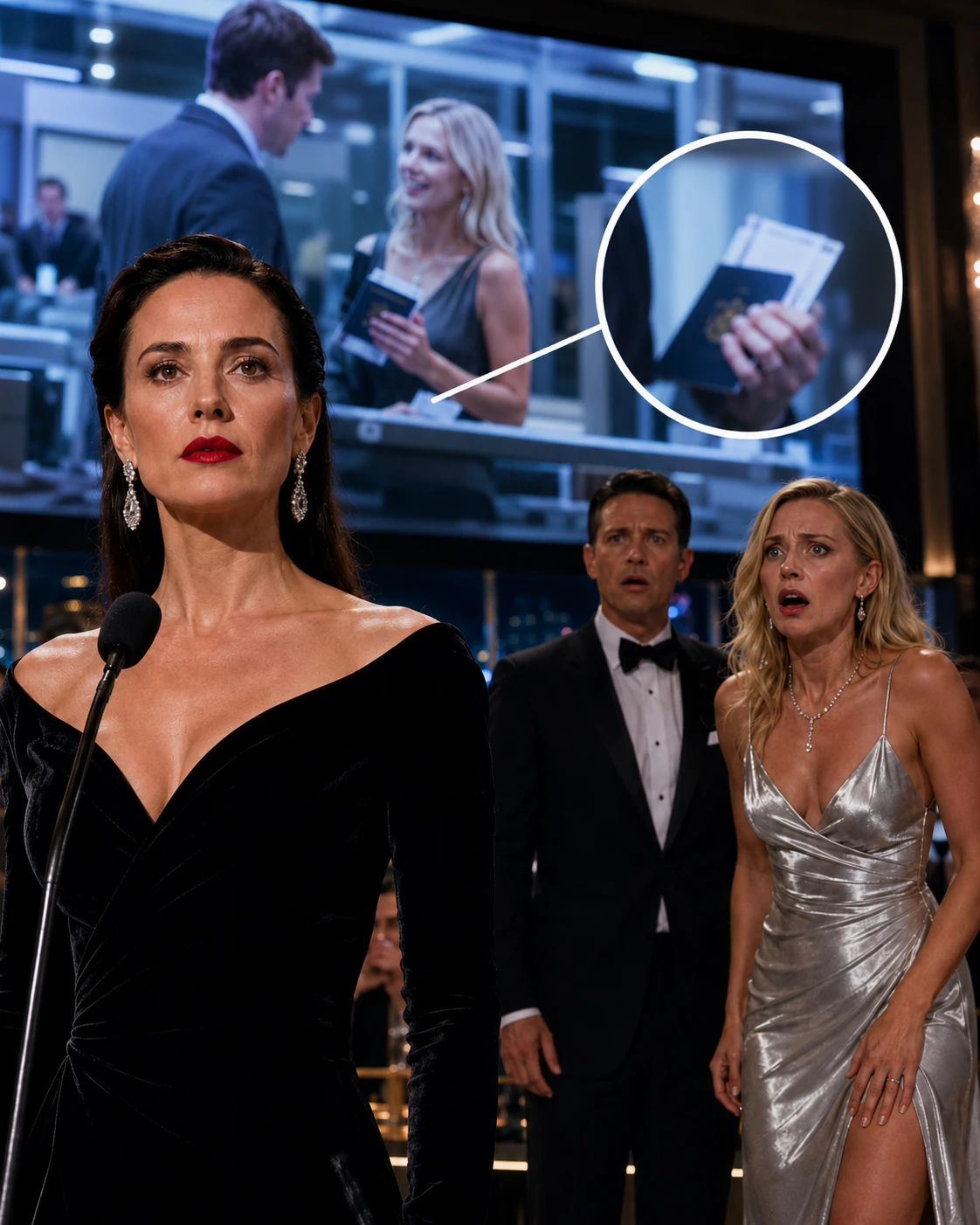
Behind me, the giant screen used for donor videos came alive.
Not with my face.
Not with Charles’s.
With airport security footage.
No sound at first. Just the time stamp. Logan International Airport. October 12. 10:42 p.m.
Madison appeared on screen, laughing beside Charles.
She held my passport.
She opened it.
She pointed at the photo.
Charles leaned in, said something, and both of them laughed harder.
The room went still.
Then came the second clip.
Madison at the counter, sliding the passport toward the airline agent.
The agent looking down.
Looking up.
Looking down again.
Charles touching Madison’s lower back.
The agent calling someone over.
Madison’s smile disappearing.
I let the footage play for twenty-three seconds.
Long enough to kill the lie.
Short enough to be elegant.
Then the screen went dark.
Madison’s face had lost all its color.
Charles looked at me as if I had set fire to the harbor.
I turned back to the microphone.
“My passport was removed from my locked private office,” I said. “A police report has been filed. An investigation is ongoing. I will not discuss details that belong with law enforcement.”
A flash went off.
Then another.
I raised one hand gently.
“But I will say this. Tonight’s gala supports women rebuilding their lives after violence, coercion, and financial control. So let me be very clear: no woman is property. No wife is a placeholder. No man’s reputation is worth more than a woman’s identity.”
No one moved.
Then, from the back of the room, Detective Ortiz stepped forward.
She was not in uniform.
She didn’t need to be.
Two officers followed.
Madison whispered, “No.”
I did not look at her.
One officer said her name.
The other asked her to come with them.
She began crying then. Real tears. Ugly tears. The kind cameras don’t love.
Charles grabbed my arm.
Only for a second.
Then he remembered where we were.
“Vivienne,” he hissed, “what have you done?”
I looked at his hand until he released me.
“What you should have done,” I said. “Told the truth.”
The officers escorted Madison out through the side entrance.
But the night was not finished.
Not even close.
Because the final donor video began to play.
This one did have sound.
Charles’s voice filled the ballroom.
“You don’t understand, Madison. Vivienne owns half the assets outright. We need access before the divorce. The passport mess is nothing. Once we’re in Paris, I’ll talk her into signing the transfer papers remotely. She trusts me when I make her sentimental.”
The audio crackled.
Then Madison’s voice: “And if she refuses?”
Charles laughed.
“Then we make her look unstable.”
A small sound moved through the crowd.
Not a gasp.
Worse.
Recognition.
The rich know conspiracy when it is wearing their cologne.
Charles turned toward the screen like he could strangle sound.
The recording continued.
Madison said, “I don’t want to be her forever.”
Charles replied, “You don’t have to be. Just long enough.”
The screen went black.
For one perfect second, no one breathed.
Then Eleanor Whitmore stood up from the front table and slapped her son across the face.
The sound cracked through the ballroom like a gunshot.
That was the photo that went viral.
Not Madison crying.
Not Charles exposed.
Eleanor’s white-gloved hand in midair.
Charles’s face turned by the force of his mother’s fury.
And me standing behind them in black velvet, calm as winter.
By morning, the internet had named it:
The Glass House Gala Takedown.
CHAPTER 5: THE FINAL TWIST IN THE SAFE
Scandals have weather patterns.
First comes lightning.
Then thunder.
Then flooding.
By Monday, every major outlet had a headline.
Boston CEO’s Affair Exposed After Mistress Accused of Passport Fraud.
Whitmore Foundation Gala Erupts in Scandal.
Wife Plays Airport Footage at Luxury Charity Event.
The clips spread everywhere.
Facebook.
Reels.
TikTok.
X.
People slowed down the footage, zoomed in on Charles’s face, lip-read Madison at the airport, analyzed my dress, my posture, my lack of tears.
The comments were brutal and strangely poetic.
She didn’t raise her voice. She raised the evidence.
That’s not revenge. That’s documentation.
Black velvet widow energy and the man isn’t even dead.
I did not read many of them.
Not because I was above it.
Because Marjorie told me not to.
The divorce moved quickly after that.
Charles resigned temporarily from Whitmore Holdings, which is what powerful men call falling when they still expect a cushion.
The board launched an internal review.
Madison’s attorney tried to paint her as manipulated. Perhaps she was. But manipulation does not explain a passport in your hand, a stolen document at a counter, or laughter on camera before an international flight.
The case did not become as dramatic as the internet wanted.
Real law rarely does.
There were charges. Negotiations. Statements. Consequences.
Madison received something she never expected when she reached for my name.
A criminal record.
Charles fought harder.
Not for the marriage.
For the money.
His attorneys argued that the audio recording was private. Marjorie argued it had been captured on a device in a shared office during discussion of fraudulent conduct affecting my assets. They argued about admissibility, context, consent, intent.
In the end, it did not matter as much as Charles hoped.
Because the final twist was waiting in his safe.
I found out about the safe from his tailor.
Not directly.
Men like Charles do not confess to tailors, but they do brag while being pinned into tuxedos.
A month before the gala, Charles had mentioned needing “special inner lining” in a travel jacket for “documents that mattered more than passports.”
The tailor, old-school and unimpressed, mentioned it to his wife.
His wife served on my literacy board.
By then, half of Boston had become very concerned about my well-being.
Information arrived in casseroles, flowers, and quiet phone calls.
The safe was in Charles’s study, behind a framed maritime painting inherited from his grandfather. I had known about it for years. I had never opened it. Not because I couldn’t.
Because marriage is partly choosing which doors not to test.
After the court granted temporary access to marital property records, Marjorie sent a forensic accountant and a locksmith.
Inside the safe were watches, bearer bonds, old family documents, and three envelopes.
The first contained copies of transfer papers Charles had planned to pressure me into signing in Paris.
The second contained forged drafts of emails, written as if they had come from me, suggesting emotional instability and voluntary asset transfers.
The third envelope contained a letter.
Handwritten.
Not by Charles.
By Madison.
Vivienne doesn’t even know about Hart Capital, does she? Charles, you said once we have control, you’ll leave her with the townhouse and enough money to keep quiet. I don’t want a piece of her life. I want all of it. The hotels. The fund. The name. The way people look at her when she enters a room. I want them to look at me that way.
I read that letter three times.
Not because it hurt.
Because it explained the passport.
Madison had not simply wanted Charles.
That would have been ordinary.
She wanted entry.
Into rooms, accounts, circles, bloodlines, influence.
She thought identity was a dress. A passport. A last name. A man’s hand at her back.
She had not understood that my life was not something Charles had given me.
It was something generations of women before me had built, guarded, expanded, and survived for.
My grandmother had cleaned houses in Georgia before she owned them.
My mother had played piano with bleeding fingers until the world called it talent.
I had smiled in rooms where men interrupted me, then bought the buildings where those rooms stood.
Madison wanted the shine.
She never asked about the fire.
The letter changed everything.
It showed intent.
It tied Madison to the asset scheme.
It proved Charles was not merely unfaithful, but financially predatory.
And it gave Marjorie Bell the happiest Tuesday of her career.
The settlement meeting happened in Manhattan, on the forty-second floor of a private legal office overlooking Central Park.
Charles arrived thinner.
Madison did not attend.
His lawyers looked exhausted.
Marjorie wore navy silk and the expression of a woman about to enjoy expensive tea.
I sat across from my husband for the last time.
For twelve years, I had known the shape of his hands. The scar near his thumb. The way he tapped his ring finger when impatient.
Now I looked at him and felt only a distant sorrow.
Not love.
Not hate.
Just the ache of having once mistaken hunger for home.
His lead attorney began with the usual language.
Reputational harm.
Mutual mistakes.
Private resolution.
Marjorie let him speak for eight minutes.
Then she opened the safe envelope.
The room changed temperature.
Charles did not look surprised.
That was how I knew the documents were real.
He looked cornered.
Marjorie laid out the transfer papers, the forged email drafts, and Madison’s letter.
Then she said, “My client is prepared to proceed publicly.”
Charles closed his eyes.
For the first time, he looked small enough to pity.
But pity is not the same as rescue.
I leaned forward.
“You once told me I had a comfortable life,” I said.
His eyes opened.
“I do,” I continued. “Because I built it carefully. Because I protected it. Because I loved people who taught me the difference between elegance and submission.”
His mouth trembled slightly.
“Vivienne—”
“No.”
One word.
Quiet.
Final.
“You do not get to use my name again. Not in interviews. Not in apologies. Not in statements about healing or privacy or regret. You do not get to turn my pain into your redemption arc.”
He swallowed.
“You’ll ruin me.”
I looked out at Central Park, where autumn trees burned gold against the gray city.
“No, Charles,” I said. “You planned to ruin me. I kept receipts.”
The settlement was signed before sunset.
I retained every asset under my maiden name.
Whitmore Holdings paid damages to the foundation for reputational harm.
Charles relinquished claims tied to my properties and investments.
He also agreed to a public statement accepting responsibility for conduct that had caused legal and personal harm.
It was bloodless.
It was elegant.
It was over.
That night, I stayed at The Carlyle.
Not because I needed luxury.
Because I had survived humiliation, betrayal, criminal intrusion, emotional manipulation, and a man who thought love meant access.
And I wanted good sheets.
At 11:40 p.m., I received one message from an unknown number.
It was Madison.
You took everything from me.
I stared at the sentence for a long time.
Then I typed back:
No. You tried to take what was never yours.
I blocked the number.
Then I slept for nine hours.
CONCLUSION: THE LIFE THAT FINALLY FIT
Spring arrived slowly in Boston.
The townhouse sold to a young couple from Chicago who loved the garden room. I kept the piano, my mother’s earrings, and the silver letter opener.
Everything else could go.
I moved into a restored brownstone on Commonwealth Avenue with tall windows, warm wood floors, and no locked rooms. Not because I no longer believed in locks.
Because for the first time in years, no one inside my home wanted to steal from me.
The foundation changed its name.
The Hart Women’s Fund now provides legal assistance, emergency housing, financial literacy, and identity protection support for women escaping coercive relationships.
At the opening luncheon, Detective Ortiz sat at my table.
So did Marjorie.
So did Eleanor Whitmore.
That surprised everyone.
Including me.
She arrived in dove-gray wool, carrying a small box.
Inside was the glove she had worn the night she slapped Charles at the gala.
“I thought you might want it,” she said.
I laughed for the first time in weeks.
A real laugh.
“No, Eleanor. I think that belongs in your family archive.”
She smiled sadly. “There are things I should have seen.”
“Yes,” I said.
“I’m sorry.”
I believed her.
Not fully.
But enough.
Forgiveness, I have learned, is not a door you leave open. Sometimes it is a window. Small. Screened. Letting in air, not danger.
Months passed.
The internet moved on, as it always does. New scandals. New villains. New women in black dresses refusing to cry on camera.
But sometimes strangers still stopped me.
At airports, especially.
Once, at JFK, a young woman in a hoodie approached me near security.
“Are you her?” she asked.
I smiled. “Depends who her is.”
“The passport wife,” she whispered.
I should have hated that name.
But I didn’t.
Because she wasn’t mocking me.
She was looking at me the way women look at a lighthouse after surviving rough water.
“I left my fiancé,” she said. “After your story. He had my Social Security card in his desk. I thought I was overreacting until I saw what happened to you.”
My throat tightened.
“You were not overreacting,” I said.
She nodded, eyes bright.
Then she hugged me quickly and disappeared into the crowd.
That was when I understood the real ending.
It was not Madison being charged.
It was not Charles losing power.
It was not the gala footage, the settlement, the headlines, or the way the world briefly applauded a woman for refusing to be erased.
The real ending was quieter.
It was a woman checking her documents.
A wife calling a lawyer.
A girlfriend changing her passwords.
A daughter asking her mother what financial safety looks like.
A stranger at an airport realizing that love should never require surrendering your identity.
As for me, I still travel.
Paris, eventually.
Not right away. I waited until the city no longer belonged to a memory.
I went alone in September and stayed at a small hotel near Saint-Germain with blue shutters and fresh flowers in the lobby. I walked along the Seine at sunset. I bought a black dress I did not need. I drank champagne that tasted nothing like heartbreak.
At passport control, the officer opened my document, looked at my face, then back at the page.
“Purpose of travel?” he asked.
I smiled.
“Pleasure.”
And for the first time in a long time, it was true.
Later that evening, from a balcony above a quiet Paris street, I looked down at the lights and thought of the woman Madison had tried to become.
My name in her hand.
My husband at her side.
My life treated like a costume she could steal if she reached fast enough.
I almost felt sorry for her.
Almost.
Then I remembered the laughter on the airport camera.
I remembered the locked drawer.
I remembered Charles saying I had a comfortable life.
And I lifted my glass to the city, to my mother, to my grandmother, to every woman who has ever been told to be quiet while someone tried to disappear her.
She wanted my life so badly, she tried to travel under my name.
CAPTION
The mistress wanted the wife’s identity. The wife gave her a criminal record.

