The snow beneath Mia’s body turned red before she even knew she was screaming.
For a few seconds, the whole world was only cold concrete, white sky, and the bitter smell of ice under her cheek.
Then the pain reached her.
It tore through her stomach in a hard, hot line, and she curled one hand under her belly while the other clawed at the frozen edge of the porch step.
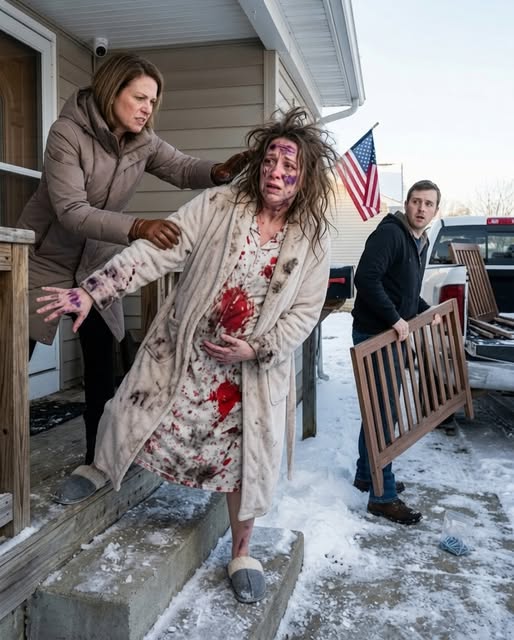
At the end of the driveway, her husband’s pickup rolled away with their daughter’s crib strapped in the bed.
The walnut side panels knocked softly against each other as the truck turned toward the street.
That sound hurt almost as much as the fall.
The crib was not from a store.
It was not something Evan could replace with a cardboard box and a receipt.
Mia’s father had built it with his own hands before he died.
Three days before her due date, that was the object Evan decided his sister deserved more.
Mia had woken that morning to the dry heat clicking through the vents and the smell of baby detergent coming from the laundry basket in the hallway.
The house was quiet in that fragile way winter mornings can be quiet, with the windows pale from frost and every floorboard sounding louder than usual.
She had been moving slowly for weeks.
Her back ached when she stood too long.
Her fingers had swollen enough that her wedding ring sat in a dish beside the sink.
She had laughed about it once, back when laughing still felt safe in that house.
Evan had not laughed with her.
He had glanced at her hand and said, “Don’t lose it. That ring wasn’t cheap.”
That was Evan by then.
Everything came back to what something cost, unless the person taking it was his mother or his sister.
Then it became family.
Mia’s father, Robert, had started building the crib seven months earlier, when his hands were already weaker than he wanted to admit.
He worked in the garage wearing an old flannel shirt, a knit cap, and the same stubborn expression Mia had seen on him every time something in the house broke.
He sanded the rails until they were smooth enough for a baby’s hand.
He carved the side curves himself, slowly, stopping when pain made him press his palm against the workbench.
Mia had begged him to rest.
He had smiled at her and said, “A grandpa gets one job before he goes. Let me do it right.”
On the inside of one leg, where no guest would ever see it, he engraved the date.
It was from the same week his doctor told him the treatments were no longer working.
Mia found the engraving the night after his funeral.
She sat on the nursery carpet with both hands on her belly and cried without making much sound, because grief had already taken up too much space in the house.
Evan had stood in the doorway for maybe thirty seconds.
Then he said, “You can’t keep falling apart every time you look at baby stuff.”
That should have warned her.
There are men who comfort you when your knees give out.
There are men who wait until you are too tired to fight and start moving the things you love.
By the week before her due date, Mia had learned to recognize Evan’s moods by the way he closed cabinet doors.
Soft meant he wanted something.
Loud meant he had already decided she was going to be blamed for it.
Patricia, his mother, had been at the house more and more.
She arrived without knocking, carrying coffee cups, church bulletins, and opinions nobody asked for.
She called Mia sensitive when Mia asked why money kept disappearing from the joint account.
She called Evan responsible when he paid his sister’s car insurance out of their savings.
She called Mia dramatic when Mia said she was afraid of going into labor in a house where nobody listened until she cried.
For months, Patricia’s daughter had been the center of every family conversation.
She was having twins.
She needed help.
She was overwhelmed.
She could not be expected to buy everything herself.
Mia had understood that babies were expensive.
She had understood fear.
What she had not understood was why another woman’s pregnancy made her own daughter’s things suddenly available.
The first sign came two weeks earlier, when Evan asked, too casually, whether Mia was “attached” to the rocking chair.
Mia had looked up from a hospital intake packet she was filling out at the kitchen table.
“That was my mom’s,” she said.
Evan shrugged.
“I’m just saying, my sister could use one.”
Mia wrote that down later.
Not because she was planning revenge.
Because she was starting to feel crazy, and paper had become the only place where reality stayed still.
She took screenshots of the bank account.
She saved receipts.
She photographed the nursery from every angle.
She made a dated log in her Notes app with times, amounts, names, and exact words when she could remember them.
She saved emails from Evan about bills that somehow became her responsibility.
She even found the manual for the porch security camera her father had installed before he got too sick to climb a ladder.
The camera had been his idea.
“Packages disappear,” he had told her.
Mia used to tease him for being paranoid.
That morning, the camera became the only witness in the family who did not lie.
At 8:17 AM, Mia walked into the nursery carrying folded blankets.
The room smelled like clean cotton and sawdust that had never completely left the wood.
Morning light came through the blinds in thin white stripes across the carpet.
At 8:19 AM, she saw the screws.
They were lined up in a neat row beside Evan’s boot.
One side of the crib was already separated from the frame.
Evan had a wrench in his hand.
Patricia stood in the doorway wearing a polished winter coat, her purse still hooked over her elbow.
For a second, Mia did not speak.
Her brain tried to make the scene into something else.
A repair.
A loose rail.
A surprise rearrangement.
Then Evan lifted the side panel and turned toward the hallway.
“What are you doing?” Mia whispered.
Evan did not startle.
He did not apologize.
He looked annoyed.
“My sister needs it more,” he said. “She’s having twins.”
Mia set the blankets down on the dresser because her hands had started to shake.
“That crib was made for our daughter.”
Patricia gave a small sigh, the kind she used when she wanted the room to know she was being patient with a difficult child.
“Your baby won’t know the difference.”
Mia looked at her.
“She will when I tell her who made it.”
Evan rolled his eyes.
“She’s a baby, Mia.”
“She’s his granddaughter.”
The room went quiet.
Outside, a truck door clicked in the driveway.
Mia realized then that this had not been a conversation.
It had been an operation.
They had picked the morning.
They had brought the truck.
They had waited until the crib was partly apart before they let her see it.
Not kindness.
Not a misunderstanding.
A plan with a wrench in its hand.
Mia stepped between Evan and the crib pieces, though her back burned and her stomach felt tight from the stress.
“Put it back together,” she said.
Evan laughed once.
It was a dry little sound.
“Or what?”
That was the voice that used to make Mia fold into herself.
It was the voice he used when he mocked her remote job.
It was the voice he used when he said his mother was only trying to help.
It was the voice he used when bills showed up in Mia’s name and he acted like she was petty for asking questions.
This time, she did not move.
Patricia walked past her and picked up the baby blanket from the rocking chair.
It was cream-colored, with a small stitched border.
Mia’s mother had made it years earlier and tucked it away in a cedar chest.
“We’re taking this too,” Patricia said.
Mia’s breath caught.
“That was my mother’s.”
Patricia looked at the blanket, then at Mia’s stomach.
“Don’t be selfish.”
The word hit harder than shouting would have.
Selfish was what they called her whenever she wanted to keep something.
Selfish was what they called boundaries.
Selfish was what they called memory when it belonged to her.
Evan carried the first crib panel down the hallway.
Mia followed because she could not imagine doing anything else.
She was in slippers and a robe over her nightgown.
The cold hit her as soon as the front door opened.
The porch boards were slick under her feet.
Snow crusted along the edges of the steps and glittered in the weak winter sun.
The small American flag mounted beside the porch snapped in the wind.
The mailbox stood at the end of the driveway beside Evan’s pickup, its black lid dusted white.
Evan loaded the crib panel into the truck bed.
The wood looked wrong there.
It looked exposed and humiliated, lying against a dirty tarp and a coil of old rope.
“Evan, please,” Mia said.
Her voice cracked on his name.
He tightened the strap over the crib pieces.
“Stop making this harder than it has to be.”
“It belongs to our baby.”
“My sister has two babies coming.”
“So buy her one.”
That made him turn.
His face had changed.
The irritation was still there, but under it was something meaner.
“With what money, Mia?”
She stared at him.
“The money that keeps disappearing?”
Patricia’s head snapped toward her.
Evan’s mouth tightened.
For one second, Mia thought he might finally admit it.
Instead, he said, “You really want to do this on the porch?”
Mia almost laughed.
Not because anything was funny.
Because he was stealing a handmade crib in broad daylight and still thought the embarrassment belonged to her.
Patricia came down the porch behind her.
“You married into this family,” she said. “Learn your place.”
Mia turned toward her.
“My place is beside my daughter.”
Patricia’s face hardened.
Then she shoved her.
It was quick.
Not theatrical.
Not the kind of shove people in movies make before everyone gasps.
It was practical and cruel.
A hand to the shoulder.
A sharp push.
Enough.
Mia’s slipper slid on the icy first step.
The sky flipped white.
The porch rail flashed past her face.
She tried to grab it, but her fingers caught only air.
Then the concrete hit her side.
All the breath left her at once.
For a moment, there was no sound.
Then pain opened through her stomach.
“Evan!” she screamed.
He froze beside the truck.
Mia saw his head turn.
She saw Patricia lean toward him.
“She’s acting,” Patricia hissed.
The truck door shut.
That was the sound Mia remembered later more clearly than anything.
Not the fall.
Not her scream.
The door shutting.
A clean, final sound.
Evan got in.
The pickup rolled backward, then forward.
The crib panels shifted in the bed as the truck headed toward the street.
Mia lay on the frozen concrete with one hand under her belly and watched him leave.
The first red spot appeared in the snow near her hip.
Then another.
Her phone was in the pocket of her robe.
She had put it there that morning because she had been timing contractions on and off for two days.
Her fingers were numb.
She misdialed twice.
The third time, 911 connected.
“What is the address of your emergency?” the dispatcher asked.
Mia tried to answer, but her teeth were chattering so hard the numbers came out broken.
The dispatcher stayed steady.
Mia gave her address.
She gave her name.
She said she was thirty-nine weeks pregnant.
The woman asked whether she was bleeding.
Mia looked down.
The snow under her hip had gone red.
“Yes,” she said.
Her own voice sounded far away.
“Please hurry.”
The dispatcher told her to stay on the line.
Mia heard typing.
She heard radio noise.
She heard her own breath turning ragged in her ear.
Then she looked up.
The security camera was under the porch eave, pointed straight at the steps.
The tiny red light was still on.
Something inside her went still.
A woman can spend years being called dramatic until evidence gives her back her own voice.
Mia pressed the phone harder to her ear.
“Please tell the police I have cameras,” she said.
The dispatcher paused for half a beat.
Then her voice changed slightly.
“Ma’am, help is on the way.”
Sirens rose in the distance.
At the far end of the block, Evan’s brake lights flashed red.
For the first time that morning, he understood there had been a witness he could not intimidate.
The pickup stopped.
Mia watched it through a blur of tears and pain.
Patricia’s head moved in the passenger seat.
Evan sat motionless behind the wheel.
Then the truck reversed.
Slowly.
Carefully.
Like caution could undo cruelty if it arrived fast enough.
Across the street, Mrs. Keller stepped onto her porch in a bathrobe.
She was a retired school secretary who brought banana bread every Christmas and knew everyone’s trash pickup day.
She put one hand over her mouth when she saw Mia on the ground.
Then she looked toward Evan’s truck.
Her face changed.
Mia would learn later that Mrs. Keller had heard the scream, seen the truck leave, and watched it reverse only after the sirens started.
That mattered.
Witnesses matter when a family has spent years teaching everyone to call your pain an attitude problem.
The first police cruiser turned the corner before Evan reached the driveway.
The ambulance came right behind it.
Evan climbed out of the pickup too quickly, both hands raised.
“Mia,” he called, voice cracking. “Tell them it was an accident.”
Patricia stayed near the truck for once.
Her mouth was open, but no words came out.
An officer stepped between Evan and the porch.
“Sir, stay where you are.”
Evan looked offended.
“That’s my wife.”
The officer did not move.
“Then you can wait while the paramedics reach her.”
Two paramedics came up the walkway with a stretcher.
One knelt beside Mia and started asking questions.
Name.
Pain level.
Due date.
Could she feel movement.
Mia tried to answer each one.
She kept looking toward the truck bed.
The crib was still there.
One panel had shifted loose, and the engraved leg faced up toward the gray sky.
Her father’s date was visible.
The paramedic followed her gaze.
His expression tightened, but he said nothing.
Police asked Mia what happened while the paramedics worked around her.
She told them Patricia shoved her.
She told them Evan saw her fall.
She told them they drove away.
Evan interrupted twice.
“She slipped.”
“She gets emotional.”
“She’s been under stress.”
The officer turned to him after the third interruption.
“Sir, stop talking.”
Mia had never heard anyone say that to Evan in her own driveway.
Patricia finally stepped forward.
“She is exaggerating. I barely touched her.”
Mrs. Keller called from across the street, “I saw the truck leave after she screamed.”
Patricia’s face drained.
Evan looked at the porch camera.
Mia saw the exact second his eyes found the red light.
That was the moment his confidence broke.
The ambulance doors closed around Mia before she heard what the officers said next.
Inside, everything became fluorescent light and gloved hands.
A paramedic placed an oxygen mask near her face.
Another checked her blood pressure.
Someone called ahead to the hospital intake desk and used words Mia never wanted connected to her baby.
Pregnant fall.
Bleeding.
Abdominal pain.
Possible trauma.
Mia gripped the blanket they put over her and tried to feel her daughter move.
At first, she felt nothing.
Then, faintly, a small pressure rolled under her palm.
Mia sobbed once.
The paramedic closest to her looked down.
“There she is,” he said softly.
At the hospital, the world became forms and monitors.
A nurse cut away the soaked edge of Mia’s robe with careful hands.
A hospital wristband snapped around her wrist.
An intake form slid onto a clipboard.
A doctor explained what they needed to check, but Mia heard every third word.
Her mind kept returning to the porch.
The shove.
The red light.
The crib in the truck.
Her father’s engraving facing the sky.
An officer came to the hospital before noon.
He took her statement while a monitor traced the baby’s heartbeat beside the bed.
Mia gave him her phone.
The porch camera clip had already synced to the app.
The timestamp read 8:31 AM.
Patricia’s hand was visible.
Mia’s fall was visible.
Evan turning toward her was visible.
Patricia’s voice was clear enough that the officer played it twice.
“She’s acting.”
The second time, the nurse in the corner stopped writing.
Her jaw tightened.
Mia stared at the ceiling because if she looked at anyone’s face, she would start crying again.
The officer asked whether she wanted the clip preserved as evidence.
“Yes,” Mia said.
Her voice was hoarse, but it did not shake.
They documented the injuries.
They photographed the bruising that had already started along her side.
They noted the bleeding.
They wrote down her due date, the address, the time of the 911 call, and the names of everyone present.
The police report did not call her sensitive.
It did not call her dramatic.
It called her the victim.
That word made her cry harder than she expected.
Evan tried calling seventeen times before 2:00 PM.
Mia did not answer.
Patricia called once.
Then she sent a text that said, You need to fix this before you ruin this family.
Mia took a screenshot.
Then she sent it to the officer.
Documentation had become muscle memory by then.
The doctor came in later that afternoon and said the baby was stable, but they wanted to monitor Mia closely.
Stress and trauma could change quickly this late in pregnancy.
Mia nodded.
She had never been so tired in her life.
That evening, her sister Sarah arrived with a duffel bag, Mia’s charger, clean clothes, and a face that looked like it had been holding back rage since the parking lot.
Sarah did not ask why Mia had stayed so long.
She did not ask how Mia had missed the signs.
She set the bag down, took Mia’s hand, and said, “You’re coming home with me after this.”
Mia started to say she did not know what to do about the house.
Sarah shook her head.
“The house can wait.”
“The crib,” Mia whispered.
Sarah’s eyes filled.
“We’ll get it back.”
Mia believed her because Sarah was not using comfort as a decoration.
She was already making calls.
By the next morning, the crib had been recovered from Evan’s sister’s garage.
One panel was scratched.
A corner had been dented.
The engraved leg was intact.
Sarah sent Mia a photo.
Mia touched the screen with two fingers and cried quietly in the hospital bed.
It was not just wood.
It was proof that someone had loved her daughter before she ever took a breath.
Evan was not allowed into the maternity ward without Mia’s permission.
Patricia tried to come anyway.
The hospital security desk turned her away.
Mia learned this from a nurse who said it like she was telling Mia the weather.
“Your mother-in-law is downstairs. We told her no.”
Mia waited for guilt to arrive.
It did not.
What arrived instead was relief so clean it almost hurt.
Two days later, Mia went into labor.
Sarah was beside her.
The same nurse who had heard the police video came in near dawn and tucked Mia’s hair back from her forehead.
“You’re doing fine,” she said.
Mia did not feel fine.
She felt split open by fear, grief, and a strength she had not known she still had.
But when her daughter finally cried, the sound cut through everything.
Not clean like violence.
Not final like a truck door shutting.
Alive.
Sharp.
Furious.
Mia named her Lily.
It was the name her father had liked most.
When Sarah placed Lily against Mia’s chest, the baby’s tiny fist curled into the hospital gown.
Mia looked down at her daughter’s face and thought of the crib waiting to be repaired.
She thought of the engraving.
She thought of the porch camera blinking red in the cold.
Evidence had given her back her voice.
But Lily gave her a reason never to hand it over again.
The legal process did not become simple just because the truth was recorded.
Nothing about family ever does.
There were statements.
There were follow-up questions.
There were copies of the police report, hospital records, photos, text messages, bank screenshots, and the security video.
There was Evan telling relatives that Mia had overreacted.
There was Patricia telling anyone who would listen that Mia had always wanted to turn Evan against his family.
Then people saw the clip.
Not everyone.
Not online.
Mia did not need a spectacle.
But the people who mattered saw enough.
The officer saw it.
The hospital saw the injuries.
Sarah saw Patricia’s text.
A family court clerk later stamped paperwork that made Evan’s access to Mia and Lily something he no longer controlled by volume, guilt, or his mother’s opinion.
For the first time in years, Mia’s life began to have locked doors that stayed locked.
Weeks later, Sarah and a neighbor helped Mia move the repaired crib into a small bedroom in Sarah’s house.
The room was not perfect.
The paint was old.
The closet door stuck.
A laundry basket sat in the corner because real life does not pause for healing.
But the crib stood under the window, warm in the afternoon light.
The dented corner had been sanded smooth.
The scratch was still faintly visible if you knew where to look.
Mia decided to leave it.
Some marks are not pretty, but they tell the truth.
She ran her fingers along the inside leg until she found her father’s engraving.
Lily slept in Sarah’s arms behind her, making tiny newborn sounds.
Mia bent down and whispered, “He made this for you.”
Sarah leaned against the doorway with tears on her cheeks.
For a long time, neither sister moved.
The house smelled like coffee, clean laundry, and baby shampoo.
Outside, a neighbor’s dog barked.
A school bus sighed to a stop at the corner.
The ordinary world kept going.
That was the strange mercy of it.
After all the fear, all the paperwork, all the pain, Mia discovered that peace did not arrive like a grand speech.
It arrived as a crib under a window.
It arrived as a locked phone full of saved evidence.
It arrived as her sister washing bottles at midnight without asking for praise.
It arrived as a baby breathing safely in a room where nobody called love selfish.
Years of being called dramatic had taught Mia to doubt her own pain.
The camera gave her back the facts.
Her daughter gave her back the future.
And whenever Lily grew old enough to ask about the small date engraved inside the crib, Mia knew exactly what she would say.
She would not begin with Evan.
She would not begin with Patricia.
She would not begin with the snow.
She would begin with the man in the garage, sanding walnut rails with aching hands, determined to leave his granddaughter something gentle in a world that had not always been gentle to her mother.
Then Mia would tell Lily the part that mattered most.
“This was made for you,” she would say.
“And nobody gets to take what was made for you just because they think you won’t fight for it.”