When my neighbor Darlene called me at 2:17 p.m., I almost ignored it.
I was halfway through a long shift at the dental office in Cedar Ridge, Ohio, my feet aching, my hair pinned up too tight, and my afternoon schedule running twenty minutes behind.
Darlene was not a casual caller.
She was a woman in her sixties who still believed in knocking on doors instead of texting, and if she was calling me in the middle of the day, it meant something had gone sideways.
The second I answered, she skipped hello.
‘Maris, there’s a moving truck in your driveway.’
I blinked at the tray of sterilized instruments in my hand.
‘What?’
‘Two men are carrying furniture inside your house,’ she said.
Then, after the smallest pause: ‘Your parents are there.
And your sister.
They used keys.’
For one ridiculous second, my brain offered every explanation except the real one.
Burst pipe.
Broken window.
Emergency.
Maybe my mother had sent people to help with something without telling me.
Then Darlene lowered her voice like she didn’t want the truck itself to hear her.
‘There’s a man with them,’ she said.
‘And a woman’s not with him, honey.
It’s your sister.
Two kids too.
It looks like they’re moving in.’
I left work so fast I forgot to clock out.
I grabbed my purse, muttered something useless to the office manager about a family emergency, and practically ran to my car.
My hands shook so hard I had to sit in the parking lot for ten seconds before I could get the key into the ignition.
That house was mine.
Legally, financially, emotionally mine.
I had bought it three years earlier after doing everything the hard way.
Double shifts.
Weekend shifts.
No vacations.
No takeout unless it was payday.
I spent my late twenties telling myself that every skipped dinner out, every patched hem, every extra hour in fluorescent light was a brick in something solid.
When I signed the closing papers, I cried in my car because nobody had handed me that life.
I had built it.
My parents never saw it that way.
To them, stability was communal when I had it and personal when Talia needed it.
My older sister had a talent for drifting from one crisis to another and somehow landing on cushions other people paid for.
Talia was beautiful, charming for exactly the first fifteen minutes, and allergic to the word no.
If she lost an apartment, it was because the landlord was unfair.
If she lost a job, it was because the manager felt threatened.
If she borrowed money, it was because someone who loved her should have offered it sooner.
I was the dependable one, which in my family never felt like praise.
It felt like punishment in nice wrapping.
The only reason my mother had a key to my house was because I had surgery two years earlier and she insisted on keeping an emergency spare.
I had almost taken it back later, but she acted wounded when I mentioned it.
‘I’m your mother, not a burglar,’ she’d said.
On the drive home, those words kept replaying in my head until they made me grip the steering wheel hard enough to hurt.
When I turned onto my street, I saw the
truck first.
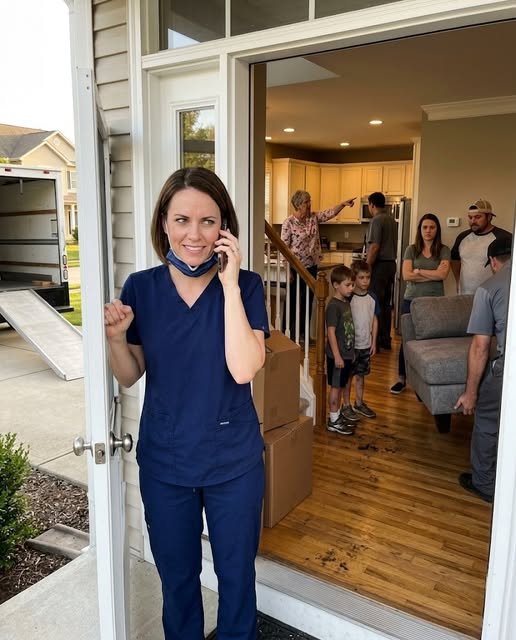
It was backed into my driveway at an angle, rear door open, ramp down, half a household exposed inside.
Plastic bins.
Mattress frames.
A fake ficus tree.
A bicycle with training wheels.
My front door stood wide open like the house had given up resisting.
I pulled over so sharply my tires brushed the curb.
The second I got out, I could hear them.
Boots on hardwood.
Cabinet doors opening.
Children running overhead.
The sound of my life being handled by people who had not asked.
I walked in and stopped dead in my own entryway.
Boxes were stacked against the wall where my console table should have been visible.
A stranger’s gray sectional was being maneuvered across my living room floor, one corner grinding over wood I had refinished myself.
My mother stood in the kitchen pointing toward cabinets as if she had personally designed them.
My father carried a lamp through the hall.
Talia stood by my fireplace laughing with a stocky man in a baseball cap.
Two children, maybe six and eight, tore down the stairs in muddy shoes and skidded into the dining room.
Nobody looked guilty.
I said the only thing my mouth could find.
‘What is this?’
Talia turned first, and the expression on her face was not shame.
It was annoyance, as if I had interrupted her timeline.
‘Perfect,’ she said.
‘You’re home.
This is Jace, and we needed somewhere temporary.’
I stared at her.
‘Temporary?’
My mother gave me a long exhale, the kind she used to make me feel irrational before I had even started speaking.
‘Don’t be dramatic.
You live alone in a four-bedroom house.
Your sister’s family needs space.’
I looked at the man in the cap.
‘Family?’
Talia folded her arms.
‘We got married last month.’
Nobody had told me.
Not one message.
Not one invitation.
Not even a blurry photo after the fact.
They had married, decided where they were going to live, found my emergency key, and started carrying pieces of another life into my house while I was cleaning other people’s teeth.
My father set the lamp on my side table and said, ‘It’s done, Maris.
Don’t make this ugly.’
Then Jace glanced around my living room, smiled like a man appraising a free upgrade, and said, ‘You don’t need all this space anyway.’
Everything in me went still.
I expected anger.
I expected panic.
What I felt instead was a strange, cold clarity.
It rolled through me so suddenly that the noise in the house seemed to dim.
I saw the open drawers.
My mail moved from the entry table.
The smudge on the wall where somebody had dragged a box.
My kitchen cabinets already half claimed by food that wasn’t mine.
It was all so deliberate, so confident, so completely built on the assumption that I would be too shocked or too soft to stop it.
I smiled.
I didn’t yell.
I didn’t touch anyone.
I turned around, walked back onto my porch, pulled out my phone, and called the sheriff’s non-emergency line.
‘I need officers at my home,’ I said, keeping my voice so steady it surprised me.
‘People have entered my property without permission and are attempting to move in.
They are relatives.
They do not live here.
I
want them removed.’
The dispatcher asked if there were weapons.
I said not that I knew of.
She asked if anyone was threatening me.
I said not yet.
She asked if I was the homeowner.
I said yes.
She told me deputies were on the way.
That one call changed everything because it took the situation out of the realm my family knew how to control.
They could bully me.
They could guilt me.
They could rewrite the story inside the family chat.
They could not charm their way around a property record.
I stayed on the porch and started taking pictures.
The moving truck.
The boxes.
My father unloading furniture.
My mother standing in my doorway.
Darlene came out across the street in gardening gloves and pretended to adjust a planter while very obviously watching everything.
When our eyes met, she lifted her phone slightly.
Later, I would learn she had already recorded the truck pulling up and my mother unlocking the front door.
Inside, they kept acting like victory was inevitable.
I heard Talia telling one of the kids, ‘The blue room is yours for now.’ I heard my mother say, ‘Put the pans over there, these cabinets are deeper than they look.’ Jace asked one of the movers to be careful near the fireplace.
It was the casualness of it that made my stomach twist.
They were not testing a boundary.
They were erasing one.
Two deputies arrived twelve minutes later.
The first was a broad-shouldered man with a patient face.
The second was a woman with a notepad already in her hand.
They stepped out, looked at the truck, the open front door, me in my scrubs on the porch, and the family gathering in the entry like actors scrambling to pick a script.
The male deputy asked, ‘Who owns the property?’
My mother answered before I could speak.
‘There’s been a misunderstanding.
This is a family matter.’
He looked at me instead.
I handed him my license.
Then I opened the county auditor’s website on my phone and pulled up the property record.
Same address.
Same parcel number.
My name alone.
I showed him my homeowner’s insurance app, then the utility account, then the mortgage statement I still kept bookmarked because I liked seeing proof of what I had done.
‘I am the owner,’ I said.
‘I did not give permission for anyone to enter, move property in, or stay here.’
The female deputy turned to Talia.
‘Do you have a lease, a written agreement, or any documentation showing consent to occupy the property?’
Talia’s chin lifted.
‘We’re family.’
‘That’s not what I asked.’
It was the first crack.
Jace looked from me to Talia, and the certainty began draining out of his face.
‘Hold on,’ he said.
‘You told me this house belonged to your parents.
You said your sister already agreed.’
Talia didn’t answer him.
She just snapped, ‘Obviously she’s making this difficult now.’
My mother stepped in.
‘Maris is overreacting.
She has all this space, and they only need somewhere temporary.’
The deputy said, ‘Ma’am, having extra rooms does not give anyone the right to enter a home without the owner’s permission.’
My father crossed his arms.
‘We had a key.’
‘A key is not consent,’ the deputy said flatly.
That was
the second crack.
The deputies went inside to document the scene.
I followed.
My family did too, close enough to crowd the hallway, still trying to turn everything into a disagreement instead of what it was.
One child had climbed onto my staircase landing and gone quiet.
The other stood near the dining room table hugging a stuffed rabbit, sensing enough tension to know this wasn’t normal.
The female deputy asked who had provided the key.
My mother admitted I had given her an emergency spare years ago.
I explained the circumstances.
Surgery.
Temporary use.
No permission to distribute access to anyone, ever.
She wrote that down.
Then, in my kitchen, the male deputy noticed the papers on the island.
They had been half covered by a purse and a box of cereal, but now I could see them clearly too.
A utility transfer request.
A school district enrollment packet.
A change-of-address form.
All using my address.
On top of the stack sat a yellow sticky note in my mother’s unmistakable handwriting: Main bedroom for Talia and Jace.
Blue room and guest room for kids.
Ask Maris later about garage shelves.
The deputy picked up the utility form.
Talia lunged a step too late.
‘Don’t touch that.’
He did anyway.
At the bottom of the form was a signature that was supposed to be mine.
It wasn’t even close.
The room changed.
Jace stared at the paper, then at Talia, and then at my mother.
‘What is that?’ he asked.
No one answered.
He took the form from the deputy’s hand, read it again, and his face went from confusion to something uglier and more exhausted.
‘You said she knew,’ he said to Talia.
‘You said this was arranged.’
Talia’s eyes flashed.
‘It was going to be fine if she had just stopped being selfish.’
Those words hung there for a full second.
Not if she had agreed.
Not if we misunderstood.
If she had just stopped being selfish.
Jace looked like he had just been hit with the truth hard enough to hear it ring.
The female deputy took the school forms next.
They were already filled out with the children’s names and my address listed as residence.
There was a blank line waiting for a signature.
My mother’s sticky note sat beside them like the most honest thing in the room.
The plan had been simple: move in first, ask later, and use pressure to make later meaningless.
The deputies told everyone to stop unloading immediately.
My father started arguing.
My mother demanded compassion.
Talia cried for exactly ten seconds, then switched back to anger when tears didn’t change anything.
Jace said nothing for almost a minute.
He just stood there with the forged utility form in one hand, staring at the woman he had married.
Then he asked the question I should have asked first.
‘Were you ever going to tell me the truth?’
Talia snapped back that she had done what she needed to do for the kids.
My mother jumped in and said I was heartless for involving law enforcement.
My father called it humiliation.
The male deputy cut straight through all of it.
He told them they were now in criminal trespass territory and that the apparent forged paperwork would be documented in the
report.
For the first time that day, my mother looked frightened.
The movers, who had clearly not signed up for family fraud, stopped dead and started loading everything back onto the truck.
The children cried because they thought they were losing a new home.
That part hurt.
I am not made of stone.
Watching kids realize adults have lied to them is a particular kind of ugliness.
But even in that moment, I knew exactly who had put them there.
Not me.
The adults who had promised them bedrooms in a house that was never theirs to offer had done that.
The deputies supervised while every box, every bin, every piece of furniture was taken back out.
My father muttered under his breath the entire time.
My mother alternated between pleading and blaming.
Talia called me cold, bitter, jealous, petty, miserable, and ungrateful, which would have been more effective if she hadn’t been saying it while standing in a doorway she had tried to steal.
Jace finally exploded when the children were buckled into the truck.
He turned to Talia in the driveway and said, loud enough for everyone to hear, ‘You told me this was your family’s house.
You told me your sister already offered it.
I gave up the apartment lead because you said we were moving here.’
Talia shouted that he should be on her side.
He answered, ‘I would have been, if you hadn’t lied to me too.’
That was the real collapse.
Not the deputies.
Not the paperwork.
The moment the one person she expected to stand beside her realized she had built the entire day on deception.
Once the truck was loaded, the deputies had them leave the property.
I signed a trespass complaint and gave a statement about the forged utility paperwork.
Darlene sent me the video from across the street.
Before the patrol cars even pulled away, I had a locksmith on the way.
By nightfall, every lock on the house had been changed.
The locksmith replaced the front, back, and garage entries.
The next morning I bought security cameras, a video doorbell, and window sensors I should have installed years earlier.
I also called an attorney.
I wanted to know exactly how to protect myself if my family tried to frame this as an informal arrangement or claim they had rights because they had moved property inside.
The attorney listened, then said the sentence I needed most: ‘You handled it correctly.’
Three weeks later, a detective followed up about the paperwork.
I provided copies of my actual signature from the closing documents and my utility account.
The forged transfer request had been submitted online and printed for the move.
Talia ended up facing misdemeanor charges connected to the false documentation.
My parents were furious that I had ‘taken it that far.’ I reminded them that I had not forged anything, entered anyone’s home, or tried to move a family into property I did not own.
That was the last long conversation we had.
The extended family did what extended family often does when they only get the version that flatters the loudest people.
For a few days, I was painted as the cruel sister who put children out.
Then Darlene, who feared absolutely no one, told two of my aunts she
had video of my mother unlocking my front door and directing movers inside while I was at work.
Amazing how fast moral outrage softens when evidence appears.
Jace called me once about a month later.
His voice sounded embarrassed and tired.
He said he had believed Talia because she told the lie with total confidence.
She had said the house had always been intended as a family property, that I was just living there until she got settled, that my parents wanted them there and I had already agreed but might ‘act weird’ when the time came.
He apologized for what he said in my living room.
He told me he and the kids were staying with his brother and that he and Talia were not doing well.
I told him I was sorry the children had been dragged into adult selfishness.
I meant that.
I also told him never to show up at my house again without permission.
He said he wouldn’t.
A few months passed, and the panic left my body slowly, like smoke after a fire.
I stopped jumping every time a truck slowed near my driveway.
I stopped checking the cameras from work every hour.
I repainted the scrape on the hallway wall.
I polished the mark their sectional had left on my hardwood.
I put my mail tray back where it belonged and bought myself a new lamp because the old one somehow felt contaminated by the day my father set it down like he owned the room.
The house felt like mine again, but not in the innocent way it had before.
Ownership had changed shape in my mind.
It was no longer just a mortgage statement, a deed, or the pride of having done something difficult.
It was also a line.
A line I had finally drawn in permanent ink.
My parents still tell people I chose property over family.
That version probably comforts them.
The truth is harder and much less flattering: I chose to stop confusing access with love.
I chose to stop treating entitlement like loyalty.
I chose to believe that the people who will take your house while you are at work are the same people who would take your peace, your privacy, and your future if you keep opening the door.
Sometimes, late at night, I still think about that yellow sticky note on my kitchen island.
Main bedroom for Talia and Jace.
Blue room and guest room for kids.
Ask Maris later about garage shelves.
That one sentence told me everything.
They had never planned to ask.
They had planned to present me with a completed invasion and make resistance look cruel.
Maybe that was the biggest betrayal of all.
Not that my sister wanted what I had.
Not that my parents helped her.
But that they all looked at my years of sacrifice and saw not a life I built, but an opening.
I kept the house.
I kept my boundaries.
I lost the illusion that family automatically means safe.
And even now, I still wonder what was worse: the moving truck in my driveway, or how naturally they all acted like I should thank them for taking my home.