PART 3 — THE CALL THAT CHANGED EVERYTHING
The radio exploded so loudly it made Emily jump.
“Unit 14 respond immediately.”
“Possible overdose.”
“Female unconscious.”
“Corner of Belmont and 8th.”
“EMS en route.”
Every officer develops a strange relationship with that sound.
Most people hear radio chatter as noise.
We hear possibility.
Car accidents.
Domestic violence.
Heart attacks.
Shootings.
The worst day of somebody’s life compressed into static and coordinates.
I grabbed the radio automatically.
“Unit 14 en route.”
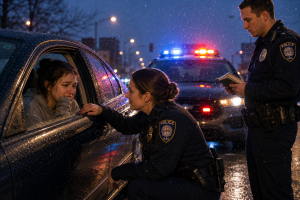
Then I looked back at Emily.
She still stood on the sidewalk clutching the straps of her backpack with red eyes and windblown hair.
For a split second, I saw panic return to her face.
Not because of the emergency.
Because she thought I was about to leave her standing there alone again.
And honestly?
I hated that I recognized that expression.
The expression people get when life has taught them help is always temporary.
“I have to go,” I told her gently.
She nodded too quickly.
“Of course.”
“I’m sorry.”
“You already did enough.”
That sentence bothered me.
Did enough.
Like kindness had a limit.
Like compassion worked on a meter.
I reached into my pocket and pulled out a business card.
Not the official department card.
My personal one.
The one I only gave out when somebody genuinely needed help beyond a police report.
I wrote something on the back.
Then handed it to her.
“If you get stuck tonight, call me.”
She looked confused.
“I can’t do that.”
“Yes, you can.”
“But—”
“Emily.”
“Listen carefully.”
Her eyes lifted toward mine.
“You are not bothering me.”
“You are not ruining my day.”
“And you are not alone right now.”
The wind whipped around us for a second.
Traffic moved through the intersection nearby.
Somewhere across campus, students laughed loudly outside a coffee shop.
Normal life continued while this exhausted young woman stood one missed exam away from watching her future collapse.
Finally she whispered,
“Okay.”
Then I got back into the cruiser and hit the lights again.
The sirens screamed as I pulled away.
In the rearview mirror, I watched Emily standing there on the sidewalk alone beside her backpack until the university buildings swallowed her from sight.
I told myself that would probably be the last time I ever saw her.
I was wrong.
The overdose call turned out to be a nineteen-year-old girl unconscious in a gas station bathroom.
Fentanyl.
Narcan saved her.
Barely.
By the time EMS took over and I finished paperwork, it was nearly six in the evening.
I had officially been on shift for almost fourteen hours.
My back hurt.
My eyes burned.
And all I wanted was to go home, microwave leftovers, and sit in silence for thirty minutes before bed.
Instead, while pulling into the station parking lot, I looked down at my phone and saw one voicemail.
Unknown number.
Something told me exactly who it was before I even played it.
“Hi, Officer.”
“It’s Emily.”
“I’m sorry to bother you.”
There it was again.
Sorry.
People who are drowning apologize too much.
“I just…”
“My car repair estimate came back.”
A long pause.
Then quietly:
“I can’t afford it.”
I leaned back against the seat and closed my eyes.
She continued quickly, like she was embarrassed to still be speaking.
“They said the engine problem is worse than they thought.”
“And if I don’t pick up the car by tomorrow, storage fees start adding up.”
“I know this isn’t your responsibility.”
“I just didn’t know who else to ask.”
That last sentence sat heavily in the silence of the cruiser.
I just didn’t know who else to ask.
Do you know how bad things have to get before somebody calls a cop because they literally have nobody left?
I rubbed my forehead and asked,
“Where are you right now?”
“At the library.”
“You’ve been there this whole time?”
“I didn’t want to spend money.”
“Emily.”
Another pause.
Then softly:
“I bought one coffee six hours ago.”
Jesus.
I looked at the clock.
6:12 p.m.
“You eaten?”
Silence.
That was answer enough.
“Stay where you are,” I told her.
“You don’t have to—”
“I know.”
“Stay there.”
Twenty minutes later, I found her sitting alone on the fourth floor of the university library surrounded by nursing textbooks and empty notebook pages.
She looked exhausted.
The kind of exhaustion that reaches beyond being tired.
Survival exhaustion.
She stood immediately when she saw me.
“You really came.”
Something about the surprise in her voice made my chest tighten.
I held up a takeout bag.
“Sit down.”
Her eyes widened slightly when she smelled the food.
Burger.
Fries.
Soup.
Nothing fancy.
But the way she stared at it told me she had not eaten a real meal in longer than she wanted to admit.
“I can pay you back,” she said immediately.
“No.”
“I mean it.”
“I know.”
“No.”
She laughed weakly.
Then after a few seconds she finally sat back down.
I watched her try to eat slowly at first.
Then faster once hunger overpowered pride.
That told me everything I needed to know.
People who are truly struggling always try to hide how hungry they are.
Halfway through the meal, she stopped suddenly.
“What?”
She looked embarrassed.
“I forgot what hot food tasted like.”
That sentence nearly broke me.
I leaned back in the chair and studied this young woman more carefully.
Twenty-one years old maybe.
Dark circles under her eyes.
Hair pulled into a rushed ponytail.
Hands rough from work.
Nursing notes highlighted in three different colors across the table.
And somehow still trying.
Still studying.
Still showing up.
Still fighting.
“You work at the diner near campus?” I asked.
She nodded.
“Nights and weekends.”
“How many hours?”
“As many as they’ll give me.”
“And school?”
“Full-time.”
“When do you sleep?”
She gave a tired laugh.
“That’s funny.”
Not bitter.
Just honest.
Then she surprised me by asking,
“Why did you become a cop?”
I looked out the library window for a moment.
Nobody had asked me that in years.
Not really.
Most people assume they already know the answer.
“I grew up poor,” I admitted finally.
Emily looked surprised.
“My mom worked double shifts.”
“My dad left when I was eleven.”
“There were years we barely kept the lights on.”
Her expression softened slightly.
“I didn’t know that.”
“Most people don’t.”
I looked at the students moving across campus below us.
“When I was sixteen, my mom got robbed walking home from work.”
Emily’s eyes widened.
“She was okay.”
“But I remember the officer who responded.”
I smiled faintly at the memory.
“He stayed two hours after his shift ended.”
“Fixed our broken front door himself.”
“Bought groceries.”
“Never made my mom feel ashamed.”
I shrugged slightly.
“I think part of me spent the rest of my life trying to become that guy.”
Emily stared down at her food quietly.
Then she whispered,
“I think you already did.”
That hit harder than I expected.
The library lights dimmed automatically for evening mode.
Around us, keyboards clicked softly while exhausted students studied for futures they prayed would eventually pay off.
Then Emily’s phone buzzed.
The second she looked at the screen, all the color drained from her face.
“What?”
She swallowed hard.
“It’s my landlord.”
She answered immediately.
“Hello?”
I watched her expression crumble slowly during the conversation.
“No, please.”
“I just need until Friday.”
“I told you financial aid comes next week.”
Pause.
Then:
“I understand.”
“I understand.”
By the time she hung up, her hands were shaking again.
“He’s changing the locks tomorrow.”
The words barely came out.
My stomach dropped.
“When’s your rent due?”
“It already was.”
“How much?”
She hesitated.
“Emily.”
“Eight hundred.”
I exhaled slowly.
Not because eight hundred was impossible.
Because I could already see exactly what was happening.
Tuition.
Books.
Food.
Gas.
Repairs.
Life.
Each thing alone survivable.
Together?
Crushing.
Then she quietly admitted something worse.
“If I lose the car too…”
“I don’t know how I’ll get to clinicals.”
“What are clinicals?”
“Nursing training at the hospital.”
“And if you miss them?”
“I fail the semester.”
There it was.
The entire future balanced on a dying car and eight hundred dollars.
I looked around the library.
Hundreds of students.
Some stressed.
Some privileged.
Some lost.
Some brilliant.
And somewhere inside all that noise sat one exhausted girl trying to become a nurse while secretly living out of a failing car.
I asked carefully,
“Does anyone know?”
She shook her head immediately.
“My professors think I commute from an apartment.”
“My friends think I’m staying with family.”
“My mom thinks I’m fine.”
“You haven’t told your mother?”
“She’s sick.”
The words came out quietly.
“She already works too hard.”
“She thinks college is my way out.”
She laughed bitterly again.
“I can’t tell her I’m sleeping in a parking garage.”
I stared at her for several seconds.
Then finally asked,
“Where are you sleeping tonight?”
Her eyes immediately lowered.
“In the car probably.”
“No.”
She looked up.
“What?”
“No.”
Confusion crossed her face.
“You can’t stay there tonight.”
“I’ll be okay.”
“No, you won’t.”
“I’ve done it before.”
“That doesn’t make it okay.”
She looked trapped between pride and exhaustion.
Then quietly:
“I don’t have anywhere else.”
And suddenly I understood something.
This was the moment.
The dangerous one.
The moment where a struggling person either meets help…
or learns the world will watch them sink politely.
I pulled out my phone.
She looked nervous immediately.
“What are you doing?”
“Calling someone.”
“Who?”
“My wife.”
Emily froze.
“No.”
“No, absolutely not.”
I ignored her and waited for my wife to answer.
“Hey,” she said immediately.
“You alive?”
“Barely.”
She laughed softly.
Then she heard my tone change.
“What happened?”
I looked at Emily sitting across from me clutching her backpack like it was armor.
Then I said quietly,
“I met a kid today who reminds me too much of us twenty years ago.”
Silence.
My wife understood faster than anyone else on earth ever could.
“Where is she?”
Across the table, Emily’s eyes widened.
“She?” my wife asked gently through the phone.
“Yeah.”
Another pause.
Then:
“Bring her home.”
Emily immediately shook her head violently.
“No.”
“No, I can’t.”
I held up one finger.
My wife continued,
“And before she says no, tell her I already made soup.”
Emily looked horrified.
“How does she know I’m saying no?”
My wife laughed through the phone.
“Because proud people always say no first.”
That almost made Emily cry again.
And honestly?
That was the moment everything changed.
PART 4 — THE NIGHT MY WIFE OPENED THE FRONT DOOR
Emily spent the entire drive to our house apologizing.
Not once.
Not twice.
Constantly.
“I’m sorry.”
“You really don’t have to do this.”
“I can leave after dinner.”
“I don’t want your wife thinking something weird.”
“I’m probably ruining your evening.”
By the fourth apology, I finally glanced over at her while stopped at a red light.
“Emily.”
She looked over nervously.
“You know what the worst part about survival mode is?”
Her fingers tightened around her backpack straps.
“What?”
“It teaches good people to feel guilty for needing help.”
She looked out the window after that.
The city lights reflected across the passenger-side glass while rain streaked downward in long silver lines.
I could practically see her trying not to cry again.
When we pulled into my driveway twenty minutes later, every light inside the house was already on.
Warm yellow light glowed through the curtains.
My wife always does that when someone’s coming over.
Makes the house look welcoming before they even step inside.
Emily stared at the front porch quietly.
“You don’t have to pretend everything’s okay in there,” I told her.
She laughed weakly.
“I wasn’t planning to.”
But the truth was, she already was.
People who survive by themselves become experts at pretending.
We walked up the porch steps.
Before I could even unlock the front door, it swung open.
My wife stood there wearing sweatpants, fuzzy socks, and one of my old college hoodies.
The smell of homemade soup drifted out behind her immediately.
And the second Emily saw her smile, something in her face changed.
Not relaxed exactly.
More like confused by kindness.
“You must be Emily,” my wife said gently.
Emily nodded awkwardly.
“Hi.”
My wife looked her over carefully.
Not judgmentally.
Mothers have a certain look when they spot exhaustion in someone young.
It bypasses logic entirely.
“You’re freezing,” my wife said immediately.
“Come inside.”
Emily stepped in slowly.
Then instantly looked down at her shoes.
“I can take these off.”
“You can if you want.”
Emily took them off anyway and lined them neatly beside the door.
That tiny detail hit me immediately.
Kids raised around unstable people learn how not to inconvenience anybody.
My wife noticed too.
I could tell.
“Soup’s almost done,” she said casually.
“And before you panic, yes, you’re staying the night.”
Emily’s head snapped up.
“No.”
“No, I can’t.”
“You can.”
“I really can’t.”
“You really can.”
Emily looked at me desperately like I was supposed to stop this.
I didn’t.
My wife folded her arms.
“Emily, how long have you been sleeping in that car?”
Silence.
Then quietly:
“Almost two weeks.”
“And when was the last time you slept in a real bed?”
Another silence.
That answer told us enough.
My wife softened immediately.
“Honey.”
“You’re staying.”
Honey.
That word nearly shattered Emily on the spot.
Because when was the last time somebody had spoken to her like she mattered instead of like she was a problem to solve?
She looked down fast.
“I don’t want to be a burden.”
My wife walked closer.
“You know something?”
“The people most afraid of being burdens usually carry the heaviest loads alone.”
Emily’s eyes instantly filled again.
I pretended not to notice and took her backpack gently from her shoulder.
It weighed almost nothing.
That bothered me more than I expected.
A whole life reduced to one exhausted backpack.
My wife led her toward the kitchen.
“Sit.”
“Eat.”
“And if you apologize one more time, I’m assigning you dish duty.”
That finally made Emily laugh a little.
Tiny.
But real.
The kitchen smelled like chicken soup, bread, garlic, and coffee.
Warmth.
Real warmth.
Not just temperature.
The kind people feel when they stop bracing for rejection.
Emily sat at the table carefully, like she still wasn’t convinced she belonged there.
My wife placed a huge bowl of soup in front of her.
Steam curled upward.
Emily stared at it for several seconds before touching the spoon.
“You don’t have to ration it,” my wife said softly.
Emily looked embarrassed immediately.
“I wasn’t.”
“Yes, you were.”
That silence again.
Then Emily admitted quietly,
“I’ve been trying to make food stretch.”
My wife sat across from her slowly.
“How bad is it really?”
Emily kept staring at the soup.
Finally:
“I had forty-three dollars left after tuition.”
“And family?”
“My mom lives three states away.”
“You can’t stay with her?”
Emily shook her head immediately.
“She’s sick.”
There was something in her voice when she said it.
Fear.
Protectiveness.
Guilt.
My wife noticed too.
“What kind of sick?”
Emily hesitated.
Then quietly:
“Kidney disease.”
The room went still.
“She works at a grocery store.”
“She keeps pretending she’s okay.”
“But I hear it in her voice now.”
She rubbed her hands together nervously.
“I can’t go back home.”
“If I quit school now, everything she sacrificed becomes meaningless.”
My wife looked toward me for one second.
That look.
The one married couples develop after years together.
Whole conversations inside one glance.
We both understood immediately.
This girl wasn’t stubborn.
She was terrified of becoming the reason her mother suffered for nothing.
Emily finally started eating.
Slowly at first.
Then faster.
Halfway through the bowl, she stopped suddenly.
“What?”
She looked embarrassed again.
“This is the first homemade meal I’ve had in months.”
My wife nearly cried right there.
Instead she stood up abruptly and cut more bread.
That’s what she does when emotions get too close to the surface.
She feeds people harder.
After dinner, my wife showed Emily the guest room.
Nothing fancy.
Just a small room with soft yellow walls, a bookshelf, and clean blankets.
Emily stood in the doorway frozen.
“You can close the door,” my wife told her gently.
Emily nodded.
But she still didn’t move.
Finally she whispered,
“I forgot rooms could feel safe.”
That sentence stayed with me long after she disappeared inside.
Around midnight, I got up for water.
The hallway light was still on.
As I passed the guest room, I noticed the door cracked slightly open.
Inside, Emily was asleep sitting upright against the headboard.
Fully dressed.
Shoes back on.
Backpack clutched tightly against her chest.
Like some part of her still expected to be told to leave at any moment.
I stood there quietly for several seconds.
Then my wife appeared behind me.
“She didn’t unpack,” she whispered.
“No.”
“She thinks this is temporary.”
I looked back toward the room.
“She’s probably learned everything is temporary.”
My wife’s eyes filled.
“She’s somebody’s daughter.”
That sentence hit me hard.
Because suddenly I pictured Emily’s mother lying awake somewhere three states away believing her daughter was safe at school while that same daughter had been sleeping in a freezing car trying not to lose everything.
My wife gently pushed the guest room door wider open.
Then quietly walked inside.
I watched her place an extra blanket over Emily’s shoulders.
The girl didn’t even wake up.
She was that exhausted.
The next morning changed everything.
I woke up around six expecting silence.
Instead I smelled coffee.
And heard quiet crying.
I walked into the kitchen.
Emily sat at the table holding her phone against her ear while tears rolled silently down her face.
“No, Mom.”
“I’m okay.”
“I promise.”
Pause.
Then:
“Yes, classes are fine.”
Another pause.
Emily looked up and saw me standing there.
She immediately turned away slightly.
Trying to hide the tears.
That told me the conversation wasn’t going well.
Then I heard a weak woman’s voice through the phone speaker.
“You sound tired, baby.”
Emily’s face crumpled instantly.
“No, I don’t.”
“You do.”
Silence.
Then the woman said something that made my stomach drop.
“Are you eating enough?”
Emily covered her mouth immediately.
Because mothers know.
Even across state lines.
Even through bad phone connections.
Even through lies.
They know.
Emily whispered,
“Yes.”
Her mother didn’t answer for several seconds.
Then quietly:
“You don’t have to protect me from the truth.”
The kitchen became painfully silent.
Finally Emily broke.
Not loud.
Not dramatic.
Just shattered.
“I’m trying so hard, Mom.”
That sentence nearly broke my wife beside me.
Emily cried into the phone while apologizing over and over.
“I didn’t want you worrying.”
“I didn’t want you getting sicker.”
“I thought I could fix everything.”
Her mother started crying too.
“I never wanted you carrying this alone.”
My wife stepped forward immediately and took the phone gently.
“Hi,” she said softly.
“My name’s Carol.”
Emily looked horrified.
But her mother sounded relieved instantly.
And suddenly I realized something heartbreaking.
This sick woman three states away had probably spent weeks terrified something was wrong but powerless to reach her daughter.
Carol smiled gently while speaking into the phone.
“She’s safe here.”
“She ate.”
“She slept.”
“And no, we’re not letting her disappear back into that car.”
Emily covered her face with both hands.
And for the first time since I met her…
She stopped trying to survive everything alone.
PART 5 — THE GIRL WHO NEVER ASKED FOR TOO MUCH
After the phone call with her mother, something inside Emily changed.
Not completely.
Trauma does not disappear overnight just because someone is kind to you once.
But the constant panic in her eyes softened slightly.
Like her body had finally realized it was allowed to stop running for a minute.
My wife made pancakes that morning.
Real pancakes.
Butter.
Syrup.
Blueberries.
Emily kept insisting she only wanted one.
My wife ignored her and gave her four.
By the second pancake, Emily started crying again.
At that point, my wife finally pointed a spatula at her and said,
“If you cry one more time over breakfast food, I’m making six more.”
That actually made Emily laugh hard enough to snort.
The poor girl looked horrified afterward.
My wife laughed too.
And suddenly the kitchen sounded normal.
Not tragic.
Not heavy.
Just human.
I stood near the coffee maker watching this exhausted nursing student slowly remember what safety sounded like.
And honestly?
That moment scared me a little.
Because once you start caring about somebody, you also become afraid for them.
Before leaving for class, Emily offered to clean everything.
Counters.
Dishes.
Floors.
She moved around the kitchen like someone trying to earn oxygen.
My wife finally grabbed both her shoulders gently.
“Emily.”
She froze immediately.
“You do not have to work for kindness here.”
That sentence hit hard enough that Emily could not answer.
She just nodded quickly and looked away.
At the university that afternoon, Emily texted me for the first time.
I almost laughed when I saw it because it was painfully formal.
“Hello Officer Reynolds.
Thank you again for your assistance.
I just wanted to let you know I made an A-minus on the exam.”
I stared at the message for several seconds.
Then replied:
“That’s great.
Also stop texting me like you’re filing a police report.”
Three dots appeared instantly.
Then:
“Sorry.”
I sent back:
“There it is again.”
A minute later:
“Okay.
Thank you.
And sorry for saying sorry.”
That one actually made me laugh out loud sitting alone in the cruiser.
Over the next few days, a strange rhythm developed.
Emily stayed in our guest room “temporarily.”
Temporary became four days.
Then seven.
Then two weeks.
Not because anyone officially decided it.
Because nobody could bring themselves to throw a drowning person back into deep water.
My wife started leaving small things outside the guest room door.
Clean towels.
A better pillow.
A sweatshirt when the weather turned colder.
One night I walked past and saw Emily asleep at the desk instead of the bed.
Nursing textbooks spread everywhere.
Flashcards.
Coffee cups.
Highlighted notes.
She had fallen asleep mid-sentence while studying.
My wife quietly placed a blanket around her shoulders.
Then whispered something I will never forget.
“She’s been surviving so long she forgot how to rest.”
That was exactly it.
Even safe, Emily still lived like disaster might kick down the door at any second.
She flinched whenever her phone rang late at night.
She apologized every time she used the washing machine.
She tried replacing groceries she barely touched.
She folded blankets so neatly it looked military.
One afternoon, my wife opened the fridge and noticed Emily had labeled a container:
“Please eat this before it goes bad.”
Inside sat half a sandwich.
Half.
My wife stared at it silently for several seconds.
Then she walked into the living room where Emily sat studying anatomy flashcards.
“Why did you save half a sandwich?”
Emily looked confused.
“I wasn’t that hungry.”
My wife folded her arms.
“Emily.”
Silence.
Then quietly:
“I’m used to saving food.”
That hit hard.
Because starvation changes people long after they start eating again.
Not just physically.
Mentally.
You begin treating food like uncertainty.
Like something temporary.
Fragile.
Dangerous to waste.
My wife sat beside her gently.
“How long were things bad before the car?”
Emily stared at the flashcards in her lap.
Then finally answered.
“Longer than I admitted.”
And slowly, piece by piece, the full story came out.
Her father had disappeared years earlier after gambling debts destroyed the family financially.
Her mother worked nonstop afterward trying to keep them afloat.
Emily became “the responsible one” early.
Too early.
Straight A’s.
Scholarships.
Part-time jobs.
Never causing problems.
She started working at fifteen.
Started helping pay bills at sixteen.
Started hiding stress from her mother at seventeen.
“Because she already looked tired all the time,” Emily admitted quietly.
Then came college.
Everyone celebrated like it was victory.
The smart daughter escaping poverty through nursing school.
But nobody talks enough about how expensive escaping poverty actually is.
Textbooks.
Scrubs.
Clinical fees.
Transportation.
Food.
Housing.
Every semester felt like balancing on ice one inch thick.
Then her roommate left unexpectedly after getting engaged.
Rent doubled overnight.
Emily picked up more diner shifts.
Then more.
Then overnight shifts.
Then stopped sleeping properly.
Then stopped eating properly.
Then started secretly sleeping in her car because tuition mattered more than rent.
By the end of the story, my wife was openly crying.
Emily immediately looked guilty.
“I’m sorry.”
“I didn’t mean to dump all this on you.”
My wife shook her head instantly.
“No.”
“No more apologizing for telling the truth.”
Emily stared down at her hands.
Then whispered something so quietly I almost missed it.
“I’m tired.”
Not physically.
Soul tired.
The kind that comes from carrying your entire future on your back while pretending the weight feels normal.
That night after Emily went to bed, my wife and I sat together quietly in the kitchen.
Rain tapped against the windows.
The clock above the stove ticked softly.
Finally my wife spoke.
“She reminds me of your sister.”
That surprised me.
My younger sister Rachel had died years ago.
Cancer.
But before that?
She had been exactly like Emily.
Too independent.
Too proud.
Too determined to carry pain privately.
“She does,” I admitted quietly.
My wife wrapped both hands around her tea mug.
“She’s been in survival mode for so long she thinks accepting help is weakness.”
I nodded slowly.
Then asked the question we were both avoiding.
“What happens when the semester ends?”
Silence.
Because we both knew.
Temporary safety still has expiration dates.
The next morning, something unexpected happened.
Emily got sick.
Not dramatic.
Not emergency-room sick.
But exhausted-body-finally-stopping sick.
She nearly fainted in the kitchen trying to make coffee.
One second she was standing there.
The next she grabbed the counter hard enough to knock over a mug.
I caught her before she hit the floor.
Her skin felt ice cold.
“Emily.”
“I’m okay.”
“No, you’re not.”
“I just stood up too fast.”
But her body was shaking.
My wife touched her forehead immediately.
“She’s burning up.”
Emily tried protesting again.
“I have clinicals today.”
“You have a fever.”
“I can’t miss clinicals.”
“You can barely stand.”
“I already missed one last semester.”
There it was.
Fear again.
Not fear of being sick.
Fear of falling behind.
Fear of losing momentum.
Fear that one pause could destroy everything she worked for.
My wife finally used her serious voice.
The one that even scares me sometimes.
“Emily Grace.”
Emily froze immediately.
My wife pointed toward the couch.
“You are not going anywhere.”
“But—”
“No.”
“I’ll fail attendance.”
“You’ll fail consciousness if you keep this up.”
Emily looked like she might cry from frustration.
Then suddenly she whispered:
“I don’t know how to stop.”
That sentence shattered the room.
Because underneath the grades and jobs and exhaustion was the real problem.
She genuinely did not know how to rest without feeling unsafe.
My wife sat beside her carefully.
“You know what happens when people spend too long surviving?”
Emily shook her head weakly.
“They stop believing they deserve care.”
Tears rolled down Emily’s face instantly.
Not loud tears.
Quiet ones.
The dangerous kind.
The kind people cry when they are finally too tired to pretend anymore.
For the next two days, Emily slept almost nonstop.
My wife made soup.
Tea.
Toast.
I watched this young woman slowly unravel from pure exhaustion like somebody who had been holding herself together through force of will alone.
At one point she woke up disoriented and apologized because she “slept too much.”
She had been asleep thirteen hours.
Thirteen.
That was not laziness.
That was collapse.
And during those quiet recovery days, our house began changing too.
Emily’s textbooks spread onto the kitchen table permanently.
Her shampoo appeared beside ours in the shower.
My wife bought extra coffee without thinking about it.
One evening I came home from shift and found Emily and my wife laughing together while baking cookies.
Flour everywhere.
Burned edges.
Smoke detector going off.
For the first time since meeting her, Emily looked young.
Actually young.
Not like a struggling student carrying a mortgage-sized amount of stress.
Just twenty-one.
That frightened me too in a strange way.
Because it revealed how much of her youth survival had stolen.
One Saturday morning, while helping my wife carry groceries inside, Emily suddenly asked:
“Officer Reynolds?”
“You can call me Tom, you know.”
She looked uncomfortable immediately.
“That feels illegal.”
I laughed.
“What’s up?”
She hesitated.
Then quietly:
“Why are you really helping me?”
There it was.
The question beneath everything.
Not:
What are you doing?
Why?
Why invest in somebody broken?
Why care this much?
Why open your home?
Why interrupt your own life?
I leaned against the kitchen counter thinking carefully before answering.
Finally I said:
“Because one bad month shouldn’t decide someone’s entire future.”
Emily looked down.
“And because?”
“And because somebody once helped my family when we were drowning.”
She looked back up slowly.
“What happened?”
So I told her.
About my mother working double shifts.
About eviction notices.
About cold winters with barely enough heat.
About the police officer who fixed our broken door after my mother got robbed.
About groceries appearing anonymously on our porch.
Emily listened silently.
Then whispered:
“So you’re paying it forward.”
I thought about that.
Then shook my head slightly.
“No.”
“I think I’m repaying a debt I never got to finish.”
That stayed with her.
I could tell.
But neither of us realized how much things were about to change.
Because three nights later, Emily got a phone call that made her entire face go white.
And after hearing what happened on the other end of that line…
She looked at me and whispered:
“I think my mom is dying.”
PART 6 — THE PHONE CALL AT 1:14 A.M.
The phone rang at exactly 1:14 in the morning.
I remember the time because I was still awake downstairs finishing paperwork from shift while the television played quietly in the background.
Upstairs, the house was silent.
My wife had gone to bed hours earlier.
Emily had fallen asleep at the kitchen table studying pharmacology flashcards before we finally convinced her to sleep in the guest room.
The ringtone shattered the quiet so suddenly that I actually jumped.
At first I almost ignored it.
Then I heard movement upstairs.
Fast movement.
Panic movement.
A bedroom door opening too quickly.
Bare feet hitting hardwood.
The sound of somebody breathing wrong before they even speak.
Emily appeared at the top of the staircase holding her phone in both shaking hands.
And the second I saw her face, my stomach dropped.
Somebody was hurt.
She answered before even reaching the bottom step.
“Mom?”
Silence.
Then:
“What?”
“No.”
“No, no, no…”
Her knees nearly gave out halfway down the stairs.
I stood instantly.
Emily grabbed the railing so hard her knuckles turned white.
“I’m coming.”
“I’m coming right now.”
Then she hung up.
For several seconds she just stood there shaking violently.
I stepped closer carefully.
“What happened?”
Her mouth opened twice before words finally came out.
“She collapsed at work.”
Every muscle in my body tightened.
“Who called you?”
“One of her coworkers.”
Emily’s breathing became ragged.
“She passed out in the stockroom.”
“They called an ambulance.”
My wife rushed downstairs at that exact moment wearing pajama pants and panic in her eyes.
“What happened?”
Emily turned toward her.
And suddenly all the strength holding her together snapped.
“I think my mom is dying.”
That sentence changed the entire atmosphere of the house instantly.
My wife wrapped both arms around her immediately while Emily broke apart sobbing into her shoulder.
“I should’ve been there.”
“I knew she was getting worse.”
“I knew it.”
My wife held her tighter.
“No.”
“No.”
“This is not your fault.”
Emily kept shaking her head violently.
“She kept saying she was fine.”
“She kept saying she was just tired.”
Then she looked at me with absolute terror in her eyes.
“She’s alone.”
That was the part destroying her.
Not just fear.
Distance.
Three states away while her mother was being loaded into an ambulance by strangers.
I grabbed my keys immediately.
“We’re going.”
Emily blinked.
“What?”
“We’re driving.”
“No.”
“No, I can’t ask you—”
“You didn’t.”
“But your work—”
“I’ll call in.”
“It’s seven hours away.”
“I know.”
My wife was already moving upstairs.
“I’m packing snacks.”
That’s who my wife is.
The world falls apart and she immediately starts preparing sandwiches.
Emily looked completely overwhelmed.
“You don’t have to do this.”
I stepped closer.
“Emily.”
“Listen carefully.”
She looked up at me through tears.
“You are not driving across three states alone at two in the morning after crying this hard.”
She opened her mouth to argue again.
Then stopped.
Because deep down?
She knew she couldn’t.
Within thirty minutes, we were on the road.
Rain hammered the windshield while highway lights streaked past in long blurry lines.
Emily sat curled in the passenger seat clutching her phone so tightly I thought it might crack.
My wife sat in back with blankets and coffee like she was preparing for war.
Nobody spoke much during the first hour.
Emily kept checking her phone every thirty seconds.
No updates.
No answers.
Just silence.
And silence is dangerous when someone you love is in the hospital.
Because your brain fills it with worst-case scenarios automatically.
Around 3:40 a.m., Emily finally whispered:
“What if she dies before I get there?”
The words hung heavy inside the car.
My wife leaned forward from the back seat immediately.
“She won’t.”
“But what if she does?”
Her voice cracked completely.
“What if the last thing I ever did was lie to her?”
That hit hard.
I glanced over briefly.
“She knows you love her.”
Emily wiped her face angrily.
“That’s not the same.”
No.
It wasn’t.
Because people always think they have more time.
More calls.
More visits.
More chances to tell the truth.
Then suddenly there’s an ambulance.
A hospital.
A phone call at 1:14 in the morning.
Emily stared out at the dark highway for a long time before speaking again.
“She kept asking if I was eating.”
“And I kept lying.”
My wife’s eyes filled instantly in the back seat.
“She knew,” she said softly.
Emily laughed bitterly.
“Moms always know, huh?”
“Yes,” my wife whispered.
“They always know.”
The rain got worse around dawn.
Traffic slowed.
Headlights smeared across wet pavement while exhausted truckers drifted between lanes.
Emily finally fell asleep around five in the morning.
Not real sleep.
Fear sleep.
The kind where your body shuts down for survival while your face still looks worried.
She curled against the passenger door clutching her phone against her chest.
My wife quietly reached forward and tucked another blanket around her shoulders.
Then whispered to me:
“She’s still just a kid.”
And honestly?
That was the cruelest part.
Life had forced Emily to become an adult so fast that everybody forgot how young she actually was.
By the time we reached the hospital, the sun was barely rising.
Gray morning light washed over the parking structure while exhausted nurses changed shifts near the emergency entrance.
Emily woke up disoriented the second the car stopped.
Then panic hit her all over again.
“We’re here?”
“Yeah.”
She practically ran inside before the doors fully opened.
The emergency room smelled like disinfectant, stale coffee, exhaustion, and fear.
Hospitals always smell the same.
Like people trying desperately not to lose someone.
Emily rushed to the front desk.
“My mom.”
“Teresa Bennett.”
“She came in by ambulance.”
The nurse typed quickly.
Then her expression softened slightly.
“She’s stable.”
Emily physically collapsed against the counter in relief.
Not dramatic.
Just all the tension leaving her body at once.
The nurse continued carefully.
“She’s upstairs.”
“They’re still running tests.”
Emily nodded rapidly while tears streamed down her face again.
A few minutes later, we stepped into Room 412.
And I will never forget the look on Emily’s face when she saw her mother lying there.
Teresa looked small.
Smaller than I expected.
Hospital gowns do that to people.
Machines beeped softly around the bed.
IV lines.
Monitors.
Pale fluorescent lights.
But the worst part was Teresa’s face when she saw Emily.
Guilt.
Not relief.
Guilt.
“Baby,” she whispered weakly.
“You shouldn’t have come all this way.”
Emily started crying immediately.
“Mom.”
Teresa looked past her then noticed me and my wife standing quietly near the doorway.
Confusion crossed her face.
Emily wiped her eyes quickly.
“This is Officer Reynolds.”
“And Carol.”
Teresa looked embarrassed instantly.
“Oh my God.”
“You brought strangers into this mess.”
My wife moved forward immediately.
“We’re not strangers anymore.”
That nearly made Teresa cry too.
Emily sat beside the hospital bed and grabbed her mother’s hand carefully like she was afraid she might disappear.
For several minutes neither of them spoke much.
They just looked at each other.
And honestly?
That silence said everything.
Fear.
Love.
Exhaustion.
Relief.
Finally Teresa whispered:
“You lost weight.”
Emily laughed through tears.
“So did you.”
That tiny joke nearly broke me.
Because even now, both of them were trying harder to protect each other than themselves.
The doctor arrived around eight.
Middle-aged.
Tired eyes.
Gentle voice.
He explained things carefully.
Severe exhaustion.
Untreated kidney complications.
Dangerously high blood pressure.
Malnutrition.
Stress.
“Her body has been under strain for too long,” he admitted.
Teresa stared toward the window quietly.
Emily immediately asked the question she feared most.
“Is she going to die?”
The doctor paused.
Then answered honestly.
“Not if she starts taking care of herself.”
That should have felt comforting.
Instead Teresa started crying softly.
Because everyone in that room understood the real problem immediately.
Taking care of yourself costs money.
Appointments.
Medication.
Time off work.
Rest.
All luxuries for people already drowning financially.
The doctor left us alone afterward.
Teresa looked ashamed almost instantly.
“I’m sorry.”
Emily shook her head hard.
“No.”
“I ruined your semester.”
“No.”
“You should be at school.”
“I should be here.”
Teresa’s voice cracked.
“I tried so hard to give you a better life.”
Emily burst into tears again.
“You did.”
“No.”
“I trapped you in all this.”
That sentence hit like a punch.
Emily stood up suddenly.
“You did not trap me.”
“Yes, I did.”
“You’re sleeping in your car trying to save yourself because I couldn’t keep us afloat.”
Silence.
Emily froze completely.
Teresa’s eyes widened.
The room went still.
She looked slowly toward her daughter.
“What?”
Emily’s face went white.
Because she had never told her.
Not fully.
Not honestly.
Teresa sat up too quickly.
“What do you mean sleeping in your car?”
“Mom—”
“What do you mean?”
And suddenly years of hidden suffering exploded open inside a tiny hospital room.
Emily cried while trying to explain.
Tuition.
Rent.
The roommate leaving.
Sleeping in parking garages.
Skipping meals.
Every sentence visibly shattered Teresa more.
“You were homeless?”
“No.”
“I had the car.”
Emily realized how ridiculous that sounded the second it came out.
Tears streamed down Teresa’s face.
“Oh my God.”
“I didn’t want you worrying.”
“So instead you suffered alone?”
Emily broke completely.
“I didn’t know what else to do.”
And then Teresa whispered the sentence that destroyed everyone in that room.
“I would rather lose everything than lose you.”
Silence.
Heavy silence.
The kind that changes people permanently.
Because suddenly both women realized the same terrible truth:
They had spent years secretly destroying themselves trying to protect each other.
And neither one had ever wanted that.
My wife quietly stepped out of the room crying.
I followed her into the hallway.
For several seconds neither of us spoke.
Then she looked at me and whispered:
“We can’t let them go back to surviving like this.”
I knew exactly what she meant.
And honestly?
I had been thinking the same thing since the library.
Back inside Room 412, Emily sat beside her mother holding her hand while morning light slowly filled the hospital windows.
For the first time since meeting her…
She looked less like someone running from disaster.
And more like someone finally too exhausted to keep pretending she was okay.
PART 7 — THE TRUTH ABOUT SURVIVAL
The hospital room changed after the truth came out.
Not loudly.
Nobody screamed.
Nobody blamed anyone.
But the air changed.
Because once people stop hiding pain from each other, everything becomes more honest.
Teresa looked at Emily differently after learning about the car.
Not with disappointment.
With heartbreak.
The kind only mothers carry.
She kept staring at her daughter like she was trying to memorize every exhausted detail she had missed through phone calls and forced smiles.
“You were sleeping alone in parking garages?”
Emily wiped her face quickly.
“It wasn’t always bad.”
“That’s not an answer.”
“I locked the doors.”
Teresa covered her mouth.
“Oh my God.”
Emily immediately reached for her hand.
“Mom, please.”
“I’m okay.”
“No.”
“You survived.”
“That’s different.”
Silence settled heavily between them.
Machines beeped softly in the background.
Outside the hospital room, nurses moved through the hallway with tired footsteps and coffee cups.
Normal life continuing beside private disasters.
Finally Teresa whispered:
“Why didn’t you tell me?”
Emily laughed weakly through tears.
“Because every time we talked, you sounded tired.”
“And?”
“And I couldn’t be one more thing hurting you.”
Teresa closed her eyes.
That sentence destroyed her.
You could see it happen physically.
Years of guilt arriving all at once.
“I failed you.”
“No.”
“Yes.”
“I promised myself your life would be bigger than this.”
Emily leaned closer immediately.
“It is bigger than this.”
“But look at what it cost you.”
Emily shook her head.
“No.”
“Look what it gave me.”
Teresa looked confused.
Emily glanced toward me and my wife standing quietly near the doorway.
“It brought me here.”
That nearly broke Carol completely.
She turned away pretending to fix her purse while secretly wiping tears.
I understood exactly why.
Because sometimes people enter your life so suddenly that your heart has not caught up yet.
One week earlier Emily had been a stranger speeding toward an exam.
Now we were standing in a hospital room three states away feeling protective enough to fight the universe itself for her.
Life moves strangely sometimes.
The doctor returned later that afternoon with more test results.
Teresa needed treatment immediately.
Medication adjustments.
Diet changes.
Monitoring.
Rest.
Real rest.
Not “sit down for twenty minutes then go back to work” rest.
The problem?
Teresa couldn’t afford to stop working.
The second the doctor mentioned reduced stress and recovery time, her eyes filled with panic.
“I can’t miss shifts.”
The doctor looked exhausted.
“I understand.”
“No, you don’t.”
“If I miss work, we lose the apartment.”
Emily looked down instantly.
There it was again.
Everything connected to survival.
Health became financial.
Financial became emotional.
Emotional became physical.
One problem infecting every part of life.
The doctor sighed softly.
“I’m not telling you this as a physician anymore.”
“I’m telling you as someone who’s watched too many people wait too long.”
“If you continue like this, your body will make the decision for you eventually.”
That scared her.
I could see it.
Not the illness itself.
Powerlessness.
The fear of becoming dependent on others.
After he left, the room stayed quiet for a long time.
Then Emily whispered:
“You can come stay with us.”
Teresa looked startled.
“What?”
“At the house.”
“No.”
“Absolutely not.”
“You need help.”
“I am not becoming charity.”
That word landed hard.
Charity.
Pride is complicated when you’ve spent years barely surviving.
People begin confusing help with humiliation.
My wife finally stepped closer.
“Teresa.”
Teresa looked toward her carefully.
“This isn’t charity.”
“What is it then?”
Carol smiled sadly.
“It’s what people are supposed to do for each other.”
Teresa’s eyes filled instantly.
But she still shook her head.
“I can’t impose.”
I finally spoke for the first time in several minutes.
“You know something I’ve learned as a cop?”
Teresa looked over.
“The people most afraid of being burdens usually spent their whole lives carrying everyone else.”
Silence.
Then tears.
Again.
Because truth does that sometimes.
It bypasses pride entirely.
That evening, Emily and Teresa talked privately while my wife and I sat in the hospital cafeteria drinking terrible coffee.
Neither of us touched the food.
“You already decided, didn’t you?” my wife asked quietly.
“About what?”
“Helping them.”
I stared into the coffee cup.
“I think we crossed that line days ago.”
She smiled slightly.
“Yeah.”
“I think so too.”
Then after a pause:
“You scared?”
I laughed softly.
“Terrified.”
“Why?”
Because I already knew.
This was no longer temporary.
Not emotionally.
People don’t survive together through fear, exhaustion, hospitals, midnight drives, and truth without becoming connected permanently somehow.
And honestly?
That kind of responsibility is frightening.
Because once you care deeply about someone, their pain starts mattering to you in dangerous ways.
“What if we can’t fix it?” I admitted quietly.
My wife reached across the cafeteria table and squeezed my hand.
“We’re not supposed to fix their whole lives.”
“Then what are we supposed to do?”
She smiled softly.
“Help carry the heavy parts for a while.”
God, I loved that woman.
Back upstairs, Teresa finally agreed to come stay with us temporarily after discharge.
Temporary.
That word again.
People use temporary when they’re afraid to hope for permanence.
Emily looked relieved enough to collapse.
That night, after Teresa finally fell asleep, Emily and I walked quietly through the hospital hallway toward the vending machines.
The hospital felt different after midnight.
Quieter.
Lonelier.
Machines humming softly.
Night nurses whispering.
Families sleeping awkwardly in waiting room chairs.
Emily leaned against the vending machine while staring at nothing.
“You know what the worst part was?”
“What?”
“Pretending everything was normal.”
Her voice echoed quietly down the hallway.
“Going to class while wondering where I’d park safely that night.”
“Smiling at customers while calculating gas money in my head.”
“Hearing other students complain about tiny things while I secretly wondered if I could afford shampoo.”
She laughed weakly.
“One girl in my class cried because her parents bought her the wrong apartment furniture.”
I smiled slightly.
“Ouch.”
“Meanwhile I was hiding ramen noodles in my backpack.”
The vending machine buzzed loudly.
Neither of us moved.
Then Emily asked quietly:
“Can I tell you something awful?”
“Sure.”
“There were nights in the car where I genuinely thought about quitting.”
I stayed silent.
Not because I didn’t care.
Because I knew she needed space to say it completely.
“Not life,” she clarified quickly.
“School.”
She wrapped her arms tightly around herself.
“I’d sit there freezing and think maybe this was the universe trying to tell me I didn’t belong there.”
My chest tightened.
“How close did you get?”
She stared at the floor.
“One online withdrawal form away.”
That hurt more than I expected.
Because somewhere out there are thousands of brilliant exhausted people standing one bad week away from losing futures they fought desperately for.
Not because they lack intelligence.
Because survival keeps interrupting opportunity.
Emily looked toward me carefully.
“You know what stopped me?”
“What?”
She smiled faintly.
“The exam.”
I frowned slightly.
“What do you mean?”
“If my car hadn’t broken down…”
“If you hadn’t pulled me over…”
“If I missed that final…”
She shrugged.
“I probably would’ve dropped out.”
The hallway suddenly felt very quiet.
Then she laughed softly through tired eyes.
“Crazy how life works, huh?”
No.
Not crazy.
Fragile.
Human lives change on tiny moments all the time.
One traffic stop.
One open door.
One stranger choosing compassion over convenience.
The next morning, Teresa was officially admitted for further treatment and observation.
Insurance issues immediately became a nightmare.
Bills.
Forms.
Coverage questions.
Emily looked ready to collapse again within hours.
That was when Carol quietly took over.
And let me tell you something about my wife:
Hospitals should fear organized middle-aged women with clipboards.
By noon she had:
- Contacted a social worker
- Organized Teresa’s paperwork
- Found financial assistance programs
- Argued with billing twice
- Forced Emily to eat a sandwich
- Made three phone calls that somehow terrified professionals into cooperating faster
Emily watched all this like someone witnessing magic.
“How is she doing that?”
I smiled.
“Your generation has social media.”
“Mine had women who weaponized determination.”
For the first time in days, Emily genuinely laughed.
Real laughter.
Not survival laughter.
Not polite laughter.
Relief laughter.
And honestly?
That sound healed something inside all of us.
Three days later, Teresa was discharged.
Weak.
Exhausted.
Still scared.
But stable.
The drive back to our town felt different than the drive there.
Quieter in a peaceful way.
Emily sat beside her mother this time instead of the front seat.
At one point I glanced in the rearview mirror and saw Teresa asleep against the window while Emily gently held her hand.
Like the roles had reversed completely.
Back at our house, my wife transformed the guest room overnight.
Extra blankets.
Better pillows.
Flowers.
Medication organizer.
Teresa cried immediately when she saw it.
“I can’t believe strangers are doing this for me.”
Carol corrected her gently.
“We stopped being strangers a while ago.”
That was the truth.
And deep down?
We all knew it.
The weeks afterward became something strange and beautiful.
Hard.
Messy.
Emotional.
But beautiful.
Teresa slowly regained strength.
Emily returned to classes.
Carol managed meals like feeding people was a competitive sport.
I worked shifts then came home to a house suddenly louder and warmer than it had been in years.
For the first time since meeting Emily…
She began acting her age sometimes.
Not always.
Trauma doesn’t disappear that easily.
But little moments started appearing.
Laughing too hard during movies.
Falling asleep on the couch while studying.
Arguing playfully with my wife about coffee strength.
One evening I came home and found music playing loudly in the kitchen.
Emily and Teresa were dancing badly while Carol burned garlic bread.
All three were laughing.
I stood in the doorway just watching them.
And honestly?
That moment hit harder than any dramatic speech ever could.
Because peace looks small from the outside.
Until you remember what someone survived to reach it.
But life was not done testing us yet.
Because two weeks later…
Emily opened her student financial aid portal.
And discovered something that made all the color leave her face instantly.
PART 8 — THE EMAIL THAT ALMOST DESTROYED HER AGAIN
I knew something was wrong the second Emily stopped breathing normally.
Not literally.
But that sharp frozen stillness people get when life suddenly punches them in the chest.
She sat at the kitchen table with her laptop open in front of her while rain tapped softly against the windows outside.
Carol was stirring soup.
I was halfway through reading the newspaper.
Teresa sat on the couch folding laundry slowly because she still tired easily.
Everything felt peaceful for once.
Then Emily whispered:
“No.”
Not loud.
Barely audible.
But every person in that room looked up instantly.
Her face had gone completely white.
“What happened?” Carol asked.
Emily kept staring at the laptop screen like she was reading a death sentence.
“No.”
“No.”
“No.”
She started clicking frantically.
Refreshing the page over and over again.
I stood up immediately.
“Emily?”
Her eyes filled with panic.
“My financial aid.”
The way she said those words made my stomach drop.
“What about it?”
She swallowed hard.
“It’s gone.”
Silence.
Carol walked over quickly and looked down at the screen.
Emily’s scholarship status had changed.
ACADEMIC PROBATION REVIEW.
Aid suspended pending attendance verification.
My pulse spiked immediately.
“What does that mean?”
Emily’s voice shook violently.
“It means they think I missed too many clinical hours.”
“But you were in the hospital with your mother.”
“It doesn’t matter.”
Her breathing became uneven.
“If they revoke the scholarship, I can’t pay tuition.”
“If I can’t pay tuition, I’m removed from the program.”
“If I’m removed from the program—”
She stopped.
Because she couldn’t say it out loud.
The entire future again.
One screen away from disappearing.
Teresa stood up too quickly from the couch.
“This is my fault.”
“No,” Emily snapped instantly.
“Yes.”
“If I hadn’t gotten sick—”
“Mom, stop.”
Tears rolled down Teresa’s face immediately.
“I ruined everything.”
Emily shoved the chair backward hard enough to hit the wall.
“Why does everyone keep saying that?”
The room went silent.
Emily looked horrified the second the words left her mouth.
Because she wasn’t angry at her mother.
She was drowning.
“There’s always something,” she whispered.
“Every time I get close to stability, something happens.”
Carol stepped toward her carefully.
“Emily.”
But suddenly all the fear she had been holding in for months exploded out.
“I can’t do this again.”
“I can’t sleep in that car again.”
“I can’t lose everything again.”
Her voice cracked completely.
“I’m so tired.”
Then she started crying so hard she could barely breathe.
Not graceful crying.
Panic crying.
The kind that comes from someone whose nervous system has been overloaded for too long.
Carol wrapped her arms around her immediately.
But Emily kept shaking.
“What if this is it?”
“What if this is where everything finally falls apart?”
I looked at the laptop screen.
Then at the email again.
Attendance review hearing required.
Three days.
That was all she had.
Three days before a committee decided whether years of work survived or disappeared.
I looked back at Emily.
And something inside me hardened immediately.
“No.”
Everyone looked toward me.
I folded the laptop shut gently.
“We’re not letting a computer-generated email decide your life.”
Emily wiped her face shakily.
“You don’t understand.”
“The nursing program is brutal.”
“They remove people all the time.”
“Then we fight.”
She stared at me.
Fight.
Like the possibility had not even occurred to her.
Because people who survive alone get used to accepting disasters quietly.
Carol pulled out a chair.
“Sit down.”
Emily obeyed automatically.
That’s how exhausted she was.
Carol sat beside her.
“First of all, you are not handling this alone.”
“Second, no more spiraling before soup.”
“Third…”
She pointed toward the laptop.
“We are going to figure this out one step at a time.”
Teresa looked guilty again.
“I should never have needed help.”
Emily immediately grabbed her hand.
“No.”
“No more of that.”
And suddenly I realized something important.
They were finally starting to protect each other honestly instead of self-destructively.
That mattered.
A lot.
The next morning, we drove to the university.
Emily looked physically sick during the entire ride.
She kept rereading policy pages on her phone while bouncing her knee anxiously.
“I should’ve emailed professors sooner.”
“I should’ve documented everything.”
“I should’ve handled this better.”
“You were helping your mother survive,” I reminded her.
“That’s not an excuse in nursing school.”
The bitterness in her voice surprised me.
Then she admitted quietly:
“They expect us to function like machines.”
The campus looked different this time.
Not hopeful.
Threatening.
Students moved between buildings carrying coffees and backpacks while Emily stared at the administrative office like it might execute her publicly.
Inside, fluorescent lights buzzed overhead while exhausted students waited in hard plastic chairs.
Emily checked in at the front desk.
The receptionist smiled politely until seeing the file.
Then her expression changed.
Professional sympathy.
Bad sign.
“We’ll call you shortly.”
Emily sat beside me gripping her folder so tightly the papers bent at the corners.
“I’m gonna throw up.”
“No, you’re not.”
“What if they remove me?”
“They won’t.”
“You don’t know that.”
No.
I didn’t.
That was the worst part.
For the first time since meeting her, I couldn’t simply fix the problem with action.
This wasn’t a tow truck.
A meal.
A safe place to sleep.
This was bureaucracy.
Cold systems built without compassion.
And those systems crush vulnerable people every day.
Finally the door opened.
“Emily Bennett?”
She stood so fast she nearly dropped the folder.
I stood too.
The administrator looked at me politely.
“Only the student may enter.”
Emily immediately panicked again.
“It’s okay,” I told her quietly.
“We’ll be right here.”
Her eyes met mine for one long second.
Fear.
Exhaustion.
Hope.
Then she disappeared inside.
The meeting lasted fifty-seven minutes.
I know because I checked the clock constantly.
When the door finally opened again, Emily stepped out looking numb.
Not crying.
Worse.
Empty.
My stomach dropped immediately.
“What happened?”
She didn’t answer.
Just walked silently past me toward the hallway exit.
I followed quickly.
“Emily.”
Still nothing.
Then suddenly she stopped near a vending machine and covered her face with both hands.
“They said maybe.”
That confused me.
“What?”
She looked up with devastated eyes.
“They said maybe.”
Tears spilled instantly.
“They’re reviewing whether my absences qualify as exceptional hardship.”
“They need documentation.”
“Medical verification.”
“Faculty approval.”
She laughed bitterly.
“Basically they’re deciding whether my life falling apart was acceptable enough.”
Anger flared inside me so fast it surprised even me.
Because somewhere inside that building sat people calmly debating whether a homeless student caring for her hospitalized mother deserved permission to continue becoming a nurse.
Emily slid down against the wall slowly until she sat on the floor.
“I can’t breathe.”
I crouched beside her immediately.
“Yes, you can.”
“No.”
“I’m so tired.”
Her whole body shook.
“I’ve worked so hard.”
That sentence destroyed me.
Because she had.
God, she had.
And still the world kept asking for more.
More proof.
More strength.
More endurance.
More suffering.
I sat beside her quietly on the floor against the vending machine like I didn’t care who stared.
“You know what I think?”
She wiped her eyes.
“What?”
“I think the world gets addicted to watching strong people survive impossible things.”
She stared at me silently.
“People start assuming they’ll keep surviving forever.”
“So they stop noticing how unfair the weight actually is.”
Emily’s mouth trembled.
“I don’t feel strong.”
“No.”
“You feel exhausted.”
Big difference.
That afternoon became a war.
Carol contacted professors.
I called every administrative number I could find.
Teresa cried twice believing she ruined everything.
Emily kept apologizing for existing in crisis.
By evening, our dining table looked like a legal office.
Medical records.
Attendance policies.
Emails.
Scholarship documents.
Carol wore reading glasses and fury.
Which, honestly, is one of the most dangerous combinations on earth.
At one point she looked up and said:
“These people are about to discover what happens when middle-aged women stop being polite.”
Emily laughed unexpectedly through tears.
That laugh mattered.
Because fear had almost swallowed her completely earlier.
Over the next forty-eight hours, something incredible happened.
People started showing up for Emily.
Her anatomy professor wrote a statement describing her as one of the hardest-working students in the program.
A clinical supervisor confirmed she never once complained despite obvious exhaustion.
A classmate admitted Emily secretly helped tutor struggling students for free.
Another professor revealed Emily regularly stayed late helping elderly patients during training shifts even when technically off the clock.
I watched Emily read those statements in stunned silence.
Because for the first time, she saw herself through other people’s eyes.
Not as someone barely surviving.
But as someone quietly extraordinary.
Then came the biggest surprise.
Her diner manager showed up at our house.
Big guy named Rick.
Covered in grease stains and coffee smell.
He stood awkwardly on the porch holding an envelope.
Emily looked shocked.
“What are you doing here?”
Rick scratched the back of his neck.
“You forgot your tips jar.”
Inside the envelope was cash.
A lot of cash.
Emily blinked repeatedly.
“What is this?”
Rick shrugged.
“Customers heard what happened.”
Her face went pale.
“You told people?”
“No.”
“Your coworker Jenna did.”
“And now half the diner’s mad at you.”
Emily looked confused.
“Why?”
“Because apparently you were helping everybody while secretly sleeping in your car and nobody knew.”
He shook his head.
“That’s rude, Emily.”
That nearly made Carol cry laughing.
Rick continued awkwardly:
“The nurses from the hospital came by too.”
“What?”
“They said you helped comfort some old guy during clinicals when his family never visited.”
Emily looked stunned.
Rick shoved the envelope toward her.
“Anyway.”
“People wanted to help.”
Her hands shook opening it.
Almost four thousand dollars.
Emily physically sat down.
“No.”
“No, this is too much.”
Rick folded his arms.
“Funny.”
“That’s exactly what you say every time somebody leaves extra in the tip jar for struggling customers.”
Emily stared at him speechless.
Then Rick said something none of us expected.
“You know why everybody likes you, kid?”
She looked up slowly.
“Because you never became cruel.”
Silence.
Heavy silence.
Rick shrugged again.
“Most people who struggle that hard get bitter eventually.”
“You didn’t.”
Then he pointed at her.
“You became kinder.”
“That’s rare.”
After he left, Emily cried quietly at the kitchen table for almost an hour.
Not from sadness.
Overwhelm.
Because kindness feels unbearable when you spent years expecting abandonment instead.
Three days later, the university finally called.
Emily stood in the kitchen gripping the phone with both hands while every person in the house froze.
“Yes.”
“Okay.”
“Yes, ma’am.”
Long silence.
Then suddenly her knees buckled.
Carol caught her instantly.
Emily covered her mouth.
And whispered:
“Oh my God.”
My heart nearly stopped.
“What?”
Tears exploded down her face.
“They approved it.”
The entire kitchen erupted.
Carol screamed.
Teresa sobbed.
I nearly knocked over a chair.
Emily kept crying into the phone while nodding rapidly.
“Yes.”
“Thank you.”
“Thank you so much.”
When she finally hung up, she just stood there shaking while tears streamed down her face.
“You’re staying in the program?” I asked carefully.
She nodded violently.
Scholarship restored.
Absences excused.
Academic probation removed.
The room exploded again.
Teresa collapsed into tears against her daughter while apologizing over and over.
Emily held her tightly.
“No.”
“No more apologizing.”
Then she looked toward us.
And quietly whispered:
“I thought my life was over.”
Carol walked over immediately and held her face gently.
“Honey.”
“Your life was never over.”
“You were just exhausted and alone.”
That sentence stayed with Emily.
I could tell.
Because for the first time since I met her…
She finally started believing survival might not have to hurt this much forever.
PART 9 — THE FIRST TIME SHE STOPPED LOOKING OVER HER SHOULDER
The strangest part about surviving trauma is how long your body keeps expecting disaster after the danger passes.
Even after the scholarship was restored…
Even after Teresa’s health stabilized…
Even after Emily stopped sleeping in parking garages…
She still startled every time her phone rang late at night.
She still apologized before asking simple questions.
Still looked nervous opening the refrigerator.
Still acted shocked whenever Carol bought her favorite coffee creamer without being asked.
Fear lingers.
Especially the kind built slowly over years.
But little by little, the house changed her anyway.
Not through speeches.
Through repetition.
Safe breakfast.
Safe sleep.
Safe conversations.
Safe silence.
That is how healing usually begins.
Quietly.
Two weeks after the scholarship decision, I came home from shift and found Emily asleep on the living room couch with an open textbook resting on her chest.
The television played softly in the background.
Rain tapped against the windows.
Carol sat nearby reading while Teresa folded towels slowly beside her.
Nobody was talking.
The whole room felt peaceful in a way that almost hurt to look at.
Then Carol glanced toward me and smiled carefully.
“She fell asleep without her shoes on.”
It took me a second to understand why that mattered.
Then I remembered.
The first night she stayed with us, she slept fully dressed with her shoes on and backpack clutched against her chest.
Ready to leave instantly if necessary.
Now?
Barefoot.
Asleep.
Safe enough to forget survival for a little while.
That nearly broke me.
Carol touched my arm softly.
“She’s finally resting.”
Emily woke up a few minutes later disoriented.
The second she realized she had accidentally slept for almost three hours, panic crossed her face.
“Oh my God.”
“I was supposed to study.”
“You needed sleep more,” Carol said.
“But my exam—”
“Emily.”
Carol gave her the look.
The one all mothers somehow develop universally.
“You cannot build a future on top of a destroyed body.”
Emily sighed heavily and rubbed her eyes.
Then quietly admitted:
“I don’t really know how to slow down.”
Teresa looked up from the towels.
“That’s my fault.”
Emily immediately shook her head.
“No.”
“Yes.”
“You grew up watching me work constantly.”
Teresa’s voice cracked slightly.
“You learned exhaustion before balance.”
That sentence hung in the room heavily.
Because it was true.
Children absorb survival habits from the adults around them.
Not through lessons.
Through observation.
Emily had spent years watching her mother sacrifice sleep, health, comfort, and peace just to keep life moving.
So she learned to do the same thing to herself.
Carol finally stood up.
“That ends now.”
Both women looked toward her.
“You know what this family needs?”
“Therapy.”
Emily blinked.
Teresa looked horrified.
“We can’t afford therapy.”
Carol folded her arms.
“We also couldn’t afford emotional collapse.”
“Yet here we are.”
I laughed despite myself.
Emily did too.
But the truth stayed in the room afterward.
Because survival had damaged both of them deeply in ways money alone couldn’t fix.
That weekend, Emily returned to clinical training for the first time since the hospital crisis.
She was terrified.
Absolutely terrified.
I drove her there because her car was still waiting on repairs she couldn’t yet afford.
The whole drive she bounced her knee anxiously.
“What if everybody knows?”
“About what?”
“The car.”
“The scholarship review.”
“Everything.”
I glanced over.
“You know something I’ve noticed?”
“What?”
“The people most worried about being judged are usually the least judgmental themselves.”
She stared out the window quietly.
Then whispered:
“I just don’t want to look weak.”
That hit hard.
Because exhausted people often confuse vulnerability with failure.
When we reached the hospital training center, Emily sat frozen for several seconds before getting out.
“You okay?”
“No.”
“Good.”
“That means you still care.”
She laughed nervously.
Then suddenly asked:
“Can I tell you something embarrassing?”
“Sure.”
“I almost quit nursing school three times.”
I looked at her carefully.
“But you didn’t.”
“No.”
“And honestly?”
“I don’t know why sometimes.”
I smiled slightly.
“Yes, you do.”
She frowned.
“No, I really don’t.”
“Yes, you do.”
Silence.
Then finally I said:
“Because even exhausted people still run toward what matters to them.”
That stayed with her.
I could tell.
She repeated it quietly to herself after getting out of the car.
Like maybe she needed permission to believe it.
That afternoon, something happened at the hospital that changed everything again.
Emily came home late.
Later than usual.
But not panicked.
Different.
Quiet.
Thoughtful.
Carol noticed immediately.
“What happened?”
Emily sat slowly at the kitchen table.
Then after several seconds she said:
“I met a patient today.”
That alone told us this mattered.
Nursing students see dozens of patients.
But some stay with you.
This one clearly had.
“She was eighty-two,” Emily continued softly.
“Heart failure.”
“No family visiting.”
She stared down at her hands.
“She reminded me of my grandmother.”
Carol sat beside her quietly.
“What happened?”
Emily swallowed hard.
“She was scared.”
Tears filled her eyes unexpectedly.
“And she kept apologizing.”
The room went still.
“Apologizing for what?” I asked.
Emily laughed weakly.
“For existing.”
“For needing help.”
“For bothering nurses.”
God.
That hit all of us at once.
Because every exhausted person eventually learns that same terrible habit.
The old woman apparently kept saying:
“I know everybody’s busy.”
“I don’t want to be trouble.”
Emily’s voice shook while retelling it.
“She needed someone to stay with her while they ran tests.”
“So I stayed after my shift ended.”
“How long?”
“Three hours.”
Carol smiled softly.
“That sounds like you.”
Emily wiped her eyes.
“She told me something before I left.”
“What?”
Emily looked toward the window.
“She said…”
‘The world teaches women to shrink themselves so nobody gets tired carrying them.’”
Silence filled the kitchen.
Then Emily whispered:
“I think I’ve been shrinking myself for years.”
Nobody answered immediately.
Because she was right.
Making herself smaller.
Needing less.
Feeling guilty for existing.
Apologizing for pain.
Survival had trained her to disappear politely.
And slowly, finally, she was beginning to see it.
That night, after everyone went to bed, I found Emily sitting alone on the back porch wrapped in a blanket staring at the sky.
The air smelled like rain and wet leaves.
I sat beside her quietly.
“You okay?”
She nodded slowly.
Then after a pause:
“Do you know what scares me now?”
“What?”
She laughed softly.
“Hope.”
I looked at her carefully.
“That’s honest.”
“I spent so long preparing for everything to fall apart…”
She pulled the blanket tighter around herself.
“…that now I don’t know what to do when good things happen.”
That sentence stayed with me.
Because healing sounds beautiful until you realize it requires learning entirely new ways to exist.
Trust.
Rest.
Joy.
Hope.
Those things become unfamiliar after enough struggle.
Emily looked toward me carefully.
“Can I ask you something?”
“Sure.”
“Why did you really stop helping?”
“What do you mean?”
“The officer who helped your family.”
I blinked.
Because honestly?
I had not talked about him in years.
Emily continued softly.
“You said he fixed your door.”
“Bought groceries.”
“Helped your mom.”
She hesitated.
“But something in your voice sounded sad when you talked about him.”
I stared out into the darkness quietly.
Then finally answered.
“He died.”
Emily’s face softened immediately.
“When?”
“About fifteen years ago.”
“What happened?”
“Heart attack.”
Silence.
Then I admitted something I had never said out loud before.
“I never got to thank him properly.”
The words surprised even me.
Because suddenly I realized that was true.
I became a police officer partly because of that man.
Built my entire life around the example he set.
Yet I never really told him.
Emily wrapped the blanket tighter around herself.
“I think he knew.”
“Maybe.”
“No.”
“I really think he knew.”
I looked at her.
Then she smiled faintly.
“People who quietly save others usually don’t do it for recognition.”
God.
That sounded older than twenty-one.
That sounded like someone who understood suffering deeply.
Weeks passed.
Then months.
And slowly, unbelievably…
Life became calmer.
Not perfect.
But calmer.
Teresa’s health improved steadily.
Emily’s grades climbed again.
Carol stopped pretending Emily was a “temporary guest” and started openly introducing her as “one of ours.”
Which made Emily cry the first time she heard it.
Naturally.
By spring semester, Emily no longer looked exhausted all the time.
Still tired sometimes.
Still stressed.
But different.
Alive again.
One afternoon I stopped by the diner where she worked and watched quietly from a booth while she moved between tables laughing with customers.
And for the first time since meeting her…
She looked light.
Not weighed down by invisible panic.
Just present.
Then I noticed something unexpected.
Every time she passed an elderly customer sitting alone, she slowed down slightly.
Extra coffee refill.
Extra conversation.
Extra patience.
Tiny acts of care.
The kind people only give when they know loneliness personally.
Rick, the diner manager, sat beside me eventually.
“She’s different now.”
I nodded.
“Yeah.”
He sipped coffee thoughtfully.
“Still works too hard though.”
“Some habits take time.”
Rick laughed softly.
“You know she paid for a customer’s meal yesterday?”
That surprised me.
“Why?”
“Guy looked embarrassed counting change.”
“She pretended the register messed up and covered it herself.”
I smiled despite myself.
There it was.
Kindness repeating itself again.
The same thing happened with me.
With the officer before me.
With Carol.
Help moving quietly from person to person like a relay race nobody talks about enough.
Then came graduation season.
Not Emily’s yet.
But close enough that nursing students started discussing hospital placements and future jobs constantly.
One night at dinner, Emily looked unusually quiet.
“You okay?” Carol asked.
Emily hesitated.
Then:
“There’s a residency opening at St. Matthew’s.”
That got my attention immediately.
St. Matthew’s was one of the best hospitals in the region.
Competitive.
Prestigious.
Hard to get into.
“That’s amazing,” Carol said instantly.
Emily laughed nervously.
“I probably won’t get it.”
“Why not?”
“Because everybody applying is brilliant.”
I leaned back in my chair.
“Emily.”
She looked over.
“You slept in a freezing car while carrying full-time nursing school and still fought your way back after almost losing everything.”
Silence.
“You’re not competing with ordinary applicants.”
“You already survived harder things.”
Her eyes filled unexpectedly.
Again.
Honestly, by that point our whole household cried constantly.
We had become emotional-support people.
Carol pointed her fork at her.
“Apply.”
Emily nodded slowly.
“Okay.”
But later that night, I overheard her crying quietly in the guest room anyway.
Not from sadness.
Fear.
Because when you’ve spent years barely surviving…
success becomes terrifying too.
What if she failed?
What if she didn’t deserve it?
What if stability disappeared again?
Trauma whispers those questions constantly.
And none of us knew yet…
That one phone call only three weeks later was about to change Emily’s life forever.
PART 10 — THE PHONE CALL THAT MADE HER DROP THE COFFEE MUG
The call came on a Thursday morning.
I remember because Carol had just burned toast for the second time while arguing with the weather forecast on television.
Emily sat at the kitchen counter wearing blue scrubs with wet hair and dark circles under her eyes from studying all night.
She looked exhausted again.
Not broken-exhausted like before.
Normal nursing-school exhausted.
Which was still alarming by ordinary human standards.
Teresa sat nearby sorting medication into one of those plastic weekly organizers while softly humming along to an old radio station.
For the first time in months, the house felt stable.
Bills were being paid.
The fridge stayed full.
No one was secretly sleeping in cars.
Nobody was hiding eviction notices inside backpacks.
Peace had finally started feeling believable.
Then Emily’s phone rang.
She glanced down casually while reaching for her coffee.
And froze.
Every bit of color vanished from her face instantly.
“What?” Carol asked immediately.
Emily stared at the screen like she was afraid touching it might change reality.
“It’s St. Matthew’s.”
The room went completely silent.
My stomach tightened instantly.
The residency program.
Emily’s hands started shaking so badly coffee splashed over the rim of her mug.
“Answer it,” Teresa whispered.
Emily looked terrified.
“What if it’s bad news?”
Carol blinked.
“Honey.”
“It’s a phone call.”
“Not a firing squad.”
Emily laughed weakly.
Then answered.
“Hello?”
Silence filled the kitchen.
All we could hear was the muffled voice on the other end and Emily’s increasingly stunned expression.
“Yes.”
“Yes, this is Emily Bennett.”
Long pause.
Then:
“Wait… what?”
Her free hand covered her mouth instantly.
Carol grabbed my arm so hard it hurt.
I could barely breathe myself.
Emily’s eyes filled with tears.
“You’re serious?”
Another pause.
Then suddenly she started crying.
Not panicked crying.
Disbelieving crying.
The kind people do when life finally gives them something good and their nervous system doesn’t know how to process it.
“Yes.”
“Yes, absolutely.”
“Thank you.”
“Thank you so much.”
She hung up slowly.
Then just stood there silently while tears rolled down her face.
Nobody moved.
Nobody wanted to break the moment.
Finally Teresa whispered:
“What did they say?”
Emily laughed through tears.
“I got it.”
Carol screamed immediately.
I’m not exaggerating.
Actually screamed.
Teresa burst into tears.
I nearly knocked over my coffee trying to stand up too fast.
Emily kept shaking her head like she genuinely couldn’t believe it.
“They picked me.”
Then she said the sentence that destroyed every person in the room.
“They said my professors wouldn’t stop talking about me.”
God.
That hit hard.
Because somewhere along the way, this exhausted homeless student secretly became extraordinary in other people’s eyes too.
Carol wrapped her in a hug so tight I thought she might crack ribs.
Teresa cried openly into both hands.
And Emily?
Emily looked overwhelmed in a way I had never seen before.
Because for the first time in years…
Her future suddenly felt bigger than survival.
That afternoon we celebrated with terrible grocery-store cake and cheap decorations Carol bought in a panic.
Emily kept insisting it was “too much.”
Naturally.
At one point she stood in the middle of the kitchen staring at the little congratulations banner hanging crookedly across the cabinets.
Then quietly admitted:
“No one’s ever celebrated me before.”
That sentence shattered the room all over again.
Teresa looked devastated instantly.
“We celebrated birthdays.”
“I know.”
“We celebrated graduation.”
“I know.”
Emily wiped her eyes carefully.
“But this feels different.”
Carol understood immediately.
Because birthdays are expected.
This?
This was recognition.
Recognition that Emily herself mattered beyond what she could survive.
That night, after everyone went to bed, I found Emily sitting alone in the backyard wrapped in a blanket staring up at the stars again.
It had become her spot.
The place she went whenever emotions got too big.
I sat beside her quietly.
“You okay?”
She laughed softly.
“No idea.”
Fair answer.
The night air smelled like cut grass and distant rain.
For a while we just sat there listening to crickets.
Then Emily whispered:
“I’m scared.”
“Of what?”
She stared upward.
“What if I lose this too?”
There it was.
Trauma again.
The constant expectation that happiness is temporary.
I leaned back in the chair.
“You know what I think?”
“What?”
“I think people who spend years surviving get addicted to preparing for disaster.”
Emily nodded slowly.
“Because if you expect bad things, they hurt less.”
“Does it work?”
She thought for a second.
“No.”
“Exactly.”
Silence settled between us comfortably.
Then she admitted something else quietly.
“When they called…”
“For one second I thought they were gonna tell me I didn’t deserve it.”
That hurt more than it should have.
Because even now, after everything she survived…
Part of her still believed success belonged to other people more than her.
I looked toward the house.
Warm lights glowing through windows.
Carol asleep on the couch probably.
Teresa finally resting peacefully upstairs.
Then back toward Emily.
“You know why they picked you?”
She shrugged weakly.
“Pity?”
I laughed.
“No.”
“Then why?”
“Because people trust nurses who understand pain.”
She looked over slowly.
I continued carefully.
“You know what hospitals can’t teach?”
“What it feels like to be scared.”
“To feel helpless.”
“To feel invisible.”
“To feel ashamed for needing help.”
Emily’s eyes filled slightly.
“You understand all of that now.”
“And instead of becoming cruel…”
“You became softer.”
The tears finally came again.
Quietly.
“I almost quit.”
“I know.”
“I was so close.”
“I know.”
She covered her face with both hands.
“If my car hadn’t broken down…”
There it was again.
That tiny moment.
That single traffic stop changing entire lives.
Not because I rescued her.
Because one act of kindness interrupted disaster long enough for her to keep going.
Emily looked at me carefully.
“You ever think about how weird life is?”
“All the time.”
“You were supposed to write me a speeding ticket.”
“Still technically should.”
She laughed softly.
“Instead you changed my entire life.”
I shook my head immediately.
“No.”
She frowned slightly.
“Yes, you did.”
“No.”
“You did.”
Silence.
Then I said the truth.
“I just left a door open.”
“You walked through it.”
That stayed with her.
I could tell.
Because she looked down quietly for several seconds afterward.
Then whispered:
“I want to do that for people someday.”
“You already are.”
“No.”
“I mean really.”
I smiled slightly.
“Emily.”
“You stayed three extra hours comforting a scared old woman who had no visitors.”
“You secretly paid for a stranger’s meal.”
“You spent years tutoring classmates for free.”
She opened her mouth to argue.
I held up a hand.
“You think kindness only counts when it’s dramatic.”
“It doesn’t.”
The wind moved softly through the trees around us.
Then Emily asked quietly:
“Can I ask something weird?”
“Sure.”
“If things had gone differently…”
“If I missed the exam…”
“If you gave me the ticket…”
She swallowed hard.
“Do you think anybody would’ve noticed if I disappeared?”
That question hit me like a punch.
Because deep down?
I knew exactly what she meant.
Not physically disappear.
Emotionally.
Academically.
Socially.
Would the world have noticed one more exhausted struggling student quietly giving up?
I answered honestly.
“Eventually.”
“But not fast enough.”
Emily looked down.
“That’s what scares me most.”
And honestly?
That scared me too.
Because there are thousands of Emilys everywhere.
People balancing futures on breaking points while pretending they’re fine.
The next few months passed quickly.
Emily started her residency at St. Matthew’s.
Long shifts.
Hard cases.
Stress.
Exhaustion.
But different now.
Purpose exhaustion.
Not hopeless exhaustion.
One evening she came home after a brutal hospital shift and sat at the kitchen table completely drained.
Carol immediately pushed soup toward her.
Emily laughed weakly.
“I think I watched three people die today.”
The room went quiet.
Nursing changes people fast.
Especially compassionate people.
Emily stared into the soup bowl silently.
Then whispered:
“I didn’t realize how much loneliness exists in hospitals.”
That stayed with all of us.
She began talking more about patients afterward.
Not names.
Not details.
Feelings.
The old man who pretended not to be scared.
The woman who apologized for needing help.
The teenager detoxing alone.
And slowly, Emily became the nurse everyone trusted most during difficult moments.
Not because she was technically perfect.
Because patients felt safe with her.
One night around midnight, she came home crying quietly.
I found her sitting at the kitchen table in scrubs stained with coffee and exhaustion.
“What happened?”
She wiped her face immediately.
“One of my patients died.”
I sat beside her.
She laughed bitterly.
“They teach you how to save people.”
“They don’t teach you what to do when you can’t.”
Then she admitted something else.
“She reminded me of my mom.”
That explained everything.
The patient had kidney disease too.
Same age range.
Same stubborn independence.
Emily had sat beside her after shift ended because the woman’s family lived too far away to arrive in time.
“She kept apologizing for bothering me.”
There it was again.
Always that.
People shrinking themselves even while dying.
Emily stared down at her hands.
“So I stayed.”
“How long?”
“Until the end.”
Silence.
Then she whispered:
“No one should leave the world feeling like a burden.”
God.
That girl had become something remarkable.
Not despite what she survived.
Because of it.
Years later, people would talk about Emily Bennett as one of the best nurses at St. Matthew’s.
Patients requested her by name.
Families hugged her in hallways.
Doctors trusted her instincts.
But what most people never understood was this:
Her kindness was born inside a freezing car.
Inside hunger.
Inside fear.
Inside nights where she believed nobody would notice if she disappeared.
That history stayed inside her forever.
One winter evening nearly three years after the traffic stop, I got called to assist another officer near the university district.
Young woman pulled over for speeding.
Crying.
Panic attack.
The scene looked painfully familiar.
The rookie officer beside the car looked annoyed.
I walked up slowly.
And through the windshield, I saw a terrified college student gripping the steering wheel with shaking hands.
For one brief second, it felt like time folding backward.
Then someone stepped around the ambulance parked nearby.
Blue scrubs.
Dark ponytail.
Calm eyes.
Emily.
She was working emergency response rotation that night.
The student looked at her desperately.
“I’m sorry.”
“I know I messed up.”
“I just can’t fail this exam.”
Emily froze slightly.
Then looked toward me.
We both started laughing softly at the exact same moment.
The rookie officer looked confused.
Emily stepped toward the student carefully.
“Hey.”
“Breathe.”
The girl looked terrified.
Emily crouched slightly beside the car window.
“What’s your name?”
“Maya.”
“What’s your major?”
“Nursing.”
That nearly sent me into another lifetime.
Emily looked back at me one more time.
Then quietly asked the girl:
“When’s your exam?”
“Twenty minutes.”
Emily smiled slowly.
And I knew exactly what she was about to do before she even said it.
“Okay,” she whispered gently.
“We’re gonna figure this out.”
PART 11 — THE NIGHT EVERYTHING CAME FULL CIRCLE
The young student behind the wheel looked exactly how Emily used to look.
Terrified.
Exhausted.
One bad moment away from collapsing completely.
Rain tapped softly against the roof of the car while traffic crawled past the flashing police lights.
The rookie officer beside me still held the ticket book in one hand looking unsure what to do.
Emily crouched beside the driver’s window carefully.
“What’s your name again?”
“Maya.”
“Okay, Maya.”
“Look at me.”
The girl tried.
But tears kept spilling too fast.
“I’m gonna lose my scholarship.”
Emily’s face changed slightly at those words.
Not dramatic.
Just understanding.
Deep understanding.
The kind only people who’ve stood near that cliff themselves recognize immediately.
“What happened?” Emily asked gently.
“My car battery died this morning.”
“I missed my bus.”
“My professor already warned me about attendance.”
“And now I got pulled over and—”
Her breathing broke apart completely.
The rookie officer looked uncomfortable.
Honestly?
He looked overwhelmed.
Because nobody trains you for moments like this.
Traffic law is easy.
Human desperation is harder.
Emily rested one hand gently against the edge of the car door.
“Maya.”
“Breathe first.”
“Talk second.”
The girl nodded shakily.
Then Emily glanced toward me.
That look passed between us instantly.
The memory.
The similarity.
The impossible feeling of watching history repeat itself.
I stepped beside the rookie officer quietly.
“You know what this reminds me of?”
He frowned slightly.
“What?”
I smiled faintly.
“A story I’ll tell you someday.”
Back at the car, Maya wiped her face quickly.
“I know I was speeding.”
“I’m sorry.”
Emily almost laughed.
There it was again.
Sorry.
Always sorry.
The rookie officer shifted awkwardly.
“She was doing forty-six in a twenty-five.”
Emily nodded.
Then looked at Maya carefully.
“You eaten today?”
Maya blinked in confusion.
“What?”
“Have you eaten?”
Silence.
Then quietly:
“Not really.”
Emily exhaled softly through her nose.
Exactly the same.
Exhaustion.
Panic.
Hunger.
Fear.
The whole terrible combination.
Then Maya admitted something else.
“I’ve been sleeping at the student library some nights.”
That hit me hard instantly.
Emily froze too.
The rookie officer looked confused.
“What do you mean sleeping there?”
Maya immediately looked ashamed.
“Just studying late.”
But we both recognized the lie immediately.
Emily leaned slightly closer.
“Late enough to sleep?”
Maya’s eyes filled instantly.
And there it was.
The truth.
Again.
She finally whispered:
“My roommate left.”
“I’m behind on rent.”
The rookie officer slowly lowered the ticket book.
Good.
He was learning.
Emily glanced toward me one more time.
And suddenly I realized something overwhelming:
She was no longer the scared girl in crisis.
She had become the calm voice helping someone else survive theirs.
That nearly broke me right there on the roadside.
Emily straightened slightly.
“When’s your exam?”
“Fifteen minutes.”
The rookie officer looked at me uncertainly.
Department policy technically mattered here.
So did discretion.
So did humanity.
I looked at him carefully.
Then said:
“You know what protecting and serving actually means?”
He hesitated.
“What?”
“It means understanding the difference between danger and desperation.”
The rookie officer stared at Maya for several seconds.
Then finally sighed.
“No ticket.”
Maya burst into tears immediately.
“No no no,” Emily said gently.
“That’s not the important part right now.”
She pointed toward the ambulance SUV parked nearby.
“Get in.”
Maya blinked.
“What?”
“You heard me.”
The rookie officer looked startled.
“Can we even do that?”
I smiled slightly.
“Guess we’re finding out.”
Ten minutes later, Emily sat beside Maya in the emergency response vehicle while lights flashed through wet city streets.
And honestly?
Watching them together felt surreal.
Because years earlier, Emily had sat in my cruiser exactly the same way:
- clutching her backpack
- terrified of losing her future
- apologizing for existing
Now she sat on the other side of that moment.
Calm.
Steady.
Safe enough to help someone else breathe.
Halfway across town, Maya looked at her nervously.
“Why are you helping me?”
Emily smiled softly.
And for one second I saw the exact same expression Carol used to wear while helping her.
Gentle understanding.
“Because somebody once helped me.”
Maya stared at her.
“What happened?”
Emily looked out the rain-streaked window quietly.
Then she laughed softly.
“It’s a very long story.”
When they reached campus, Maya looked moments away from fainting again.
Emily walked her all the way inside.
The professor at the lecture hall door looked irritated immediately.
Until Emily calmly said:
“Sorry she’s late.”
“She was involved in a medical emergency.”
Technically not untrue anymore.
The professor immediately stepped aside.
Maya stopped before entering the room.
Then suddenly hugged Emily hard.
Fast.
Desperate.
Emotional.
“Thank you.”
Emily hugged her back gently.
Then whispered something I barely heard standing nearby.
“One bad month doesn’t get to decide your whole life.”
God.
That sentence hit me harder than almost anything else ever had.
Because it was no longer my lesson.
It had become hers now too.
After Maya disappeared into the lecture hall, Emily stood quietly outside for several seconds.
Rain tapped softly against the hospital vehicle.
Students rushed across campus carrying coffees and laptops and futures they hoped would hold together.
Then Emily looked toward me.
Her eyes filled unexpectedly.
“You okay?” I asked.
She laughed weakly.
“That felt weird.”
“What did?”
“Seeing myself in somebody else.”
Yeah.
I understood that feeling too well.
On the drive back, she stayed unusually quiet.
Finally she admitted:
“I used to think survival made people hard.”
I glanced over.
“What do you think now?”
She smiled faintly.
“I think it makes compassionate people softer.”
That stayed with me.
Weeks later, Maya showed up at the hospital with coffee and a handwritten thank-you card.
Inside was a note.
I still remember every word.
“You probably don’t remember me as clearly as I remember you.
But that night, I genuinely thought my life was ending.
You looked at me like I was still worth saving anyway.
That mattered more than you know.”
Emily cried reading it.
Naturally.
Then she folded the card carefully and placed it inside the same drawer where she kept:
- her restored scholarship letter
- the St. Matthew’s acceptance email
- the first paycheck from nursing
- and one old faded business card with my phone number written on the back
The card from the night we met.
Years passed after that.
Good years.
Not perfect.
No life ever is.
But stable.
Teresa’s health stayed managed.
Carol kept unofficially adopting struggling people through aggressive kindness.
I got older.
Emily became one of the most respected nurses in the hospital.
And slowly, almost without noticing…
Our family expanded around her naturally.
Not through paperwork.
Not through biology.
Through survival.
Love.
Time.
One Christmas morning, Emily handed me a wrapped box before breakfast.
“You didn’t have to get me anything,” I told her.
“I know.”
Inside sat a framed photograph.
At first glance, it looked ordinary.
Just a picture of:
- me
- Carol
- Teresa
- and Emily
Standing in the kitchen laughing while flour covered the counters from some failed baking attempt.
But underneath the photo was a small engraved sentence.
Thank you for stopping me that day.
I stared at it silently for several seconds.
Then looked back up at her.
Emily’s eyes were already watery.
“I don’t mean the traffic stop,” she admitted quietly.
The room went completely silent.
And suddenly I understood.
Not the speeding.
Not the exam.
The spiral.
The loneliness.
The belief that nobody would notice if she disappeared quietly under pressure.
I stood up immediately and hugged her hard.
“Hey,” I whispered.
“You did the hard part.”
“You stayed.”
She laughed shakily against my shoulder.
“Barely.”
“Still counts.”
Carol was openly crying by this point.
Teresa too.
Honestly, all of us had become emotionally unstable people together.
But maybe that’s what family really is sometimes.
A group of people who witness each other honestly and stay anyway.
Three years later, I officially retired from the police department.
Big ceremony.
Plaques.
Speeches.
Cheap cake.
The usual.
I hate attention, so naturally the department made me stand in front of two hundred people while pretending not to sweat.
Near the end of the ceremony, they invited community members to say a few words.
I expected maybe a city council member.
Instead…
Emily walked onto the stage wearing navy-blue scrubs beneath a winter coat because she came straight from hospital shift.
The entire room quieted immediately.
She looked nervous holding the microphone.
Then she smiled toward me.
“A few years ago,” she began softly,
“Officer Reynolds pulled me over for speeding.”
The room laughed lightly.
“I thought my life was ending that morning.”
Silence settled slowly across the room.
“My car was failing.”
“My scholarship was hanging by a thread.”
“My mother was sick.”
“And I was secretly sleeping in parking garages trying not to lose everything I’d worked for.”
The room became completely still.
Emily’s voice shook slightly.
“He could’ve written me a ticket.”
“He could’ve treated me like another irresponsible college kid.”
“He could’ve looked away.”
She swallowed hard.
“Instead…”
“He saw me.”
God.
That nearly destroyed me right there.
Emily continued carefully through tears.
“And because one person chose compassion during the worst season of my life…”
“I became a nurse.”
You could hear people crying quietly across the room now.
Not dramatic crying.
Real crying.
The kind truth causes.
Emily smiled weakly.
“There’s this idea that heroes save people in giant dramatic moments.”
“But honestly?”
“Sometimes they just leave a door open long enough for exhausted people to walk through it.”
I completely lost composure at that point.
Totally gone.
The room stood applauding before she even finished speaking.
And through all that noise…
I suddenly thought about the officer who once helped my mother when I was young.
The man who fixed our broken door.
Bought groceries.
Stayed after shift.
He probably never imagined his kindness would echo this far either.
That’s the thing nobody tells you about compassion.
It multiplies quietly.
One person helps another survive.
That person later helps someone else.
Then another.
Then another.
Like lights turning on one by one in dark places.
After the ceremony, Emily hugged me outside the station while snow fell softly around the parking lot.
Then she laughed suddenly.
“What?”
“You know what’s weird?”
“What?”
“If you had given me that speeding ticket…”
I smiled.
“Yeah.”
“I probably would’ve paid it before fixing the engine.”
I laughed hard enough to scare a nearby officer.
Then Emily looked toward the snowfall quietly.
“You really changed my life.”
I shook my head again.
“No.”
She smiled softly.
“You still doing that thing where you refuse credit for anything?”
“Absolutely.”
She rolled her eyes.
Then after a long pause she whispered:
“Okay.”
“Then maybe what you really did…”
“…was remind me my life mattered before I forgot.”
And honestly?
That might’ve been the truest thing anyone ever said about the whole story.
PART 12 — THE LETTER THAT ARRIVED FIVE YEARS LATER
Five years after the traffic stop, I stopped carrying my badge.
Retirement settled on me strangely.
For the first few months, I still woke up at 4:30 in the morning automatically.
Still checked traffic when hearing sirens.
Still reached for a radio that was no longer clipped to my belt.
People think retirement feels peaceful immediately.
Honestly?
At first it just feels quiet.
Too quiet.
Carol adapted faster than I did.
Of course she did.
That woman could build purpose out of thin air.
She volunteered at the church pantry twice a week, organized donation drives like military operations, and somehow kept accidentally feeding every struggling college student within a twenty-mile radius.
Emily said she had become “a suburban vigilante armed with casseroles.”
Which was honestly accurate.
Emily herself changed too over those five years.
Not all at once.
Healing never happens dramatically.
It happens slowly enough that one day you suddenly realize somebody laughs easier than they used to.
That was Emily.
The panic left her eyes gradually.
The constant apologizing faded.
She started buying little things for herself without guilt.
Good coffee.
Better shoes.
Fresh flowers sometimes.
Tiny acts that meant:
I deserve comfort too.
That mattered more than she understood.
By year five, she had become one of the lead nurses in emergency intake at St. Matthew’s.
Doctors trusted her instincts completely.
Families searched for her face in waiting rooms.
New nurses followed her around trying to learn how she stayed calm during chaos.
But the thing everyone noticed most?
She remembered people.
Not just medical charts.
People.
The scared father pacing hallways.
The teenager pretending not to cry.
The exhausted woman apologizing for “being dramatic” while having chest pains.
Emily always stopped.
Always listened.
Always softened the room somehow.
One evening I visited the hospital bringing her coffee during a double shift.
The ER looked like controlled disaster.
Phones ringing.
Machines beeping.
Patients crying.
Stretchers moving everywhere.
And somehow, in the middle of all that noise…
Emily moved calmly through it like steady water.
Not rushed.
Not cold.
Present.
I stood quietly near the nurses’ station watching her kneel beside an elderly man gripping the side rails of a hospital bed.
“I know this is scary,” she told him gently.
“But you are not alone right now.”
That sentence hit me immediately.
Because years earlier?
Someone had said the same thing to her.
Not exactly the same words.
But the same feeling.
I suddenly understood something powerful in that moment:
Kindness survives through repetition.
It travels.
Changes shape.
Keeps moving forward.
Emily finally noticed me standing there and smiled instantly.
“There’s my retired traffic menace.”
I handed her the coffee.
“You look tired.”
“I am tired.”
“Difference?”
She laughed softly.
“Now I’m tired because I’m building something.”
“Not because I’m trying not to drown.”
God.
That sentence alone made every hard moment worth it.
A few months later, something unexpected happened.
A letter arrived at our house.
Handwritten.
No return address.
Carol opened it while I worked in the garage.
Then suddenly yelled:
“TOM.”
Not panic.
Shock.
I walked inside wiping grease off my hands.
“What?”
Carol stood frozen at the kitchen counter holding the letter with tears already forming in her eyes.
“You need to read this.”
Inside was a single folded page.
The handwriting looked shaky and uneven.
Dear Officer Reynolds,
You probably don’t remember me.
Five years ago, my daughter Maya got pulled over before a nursing exam.
A nurse named Emily helped her get there on time.
You both probably thought it was a small thing.
It wasn’t.
I sat down immediately.
Carol covered her mouth quietly.
The letter continued.
Maya was planning to quit school that week.
We didn’t know how bad things had gotten financially.
She was too ashamed to tell us.
That night, after you helped her, she came home crying and told us everything.
For the first time in months, she also sounded hopeful.
My chest tightened hard.
She graduated nursing school last spring.
Last month she started pediatric oncology.
Yesterday she told me she finally understands why strangers helped her that night.
She said:
“People kept leaving doors open for me when life kept trying to close them.”
Jesus.
I had to stop reading for a second.
The final paragraph destroyed me completely.
I just wanted you to know that your kindness did not stop with Maya.
Now she sits beside sick children every day and tells scared parents:
“You are not alone.”
I think that belongs to you too.
Thank you for seeing my daughter before the world convinced her she was invisible.
I stared at the page for a long time after finishing.
Then looked toward Carol.
Neither of us spoke immediately.
Because what do you even say after realizing one tiny choice echoed into hundreds of lives you’ll never meet?
That night, I drove to the hospital and found Emily near the cafeteria finishing paperwork.
I handed her the letter silently.
She read it slowly.
Then halfway through, tears started falling onto the page.
By the end she couldn’t even speak.
She just sat there crying quietly while hospital noise echoed around us.
Finally she whispered:
“I thought I was the only one.”
“The only one what?”
“The only one barely surviving.”
She wiped her eyes carefully.
“I didn’t realize how many people are secretly one bad week away from losing everything.”
That was true too.
Most struggling people don’t look dramatic.
They look normal.
Tired.
Quiet.
Embarrassed.
The world misses them constantly.
Emily folded the letter carefully.
Then looked up at me.
“You know what scares me now?”
“What?”
“How close I came to disappearing from my own life.”
I stayed silent.
Because honestly?
That scared me too.
If the car had started that morning…
If I ignored the speeding…
If pride kept her from accepting help…
An entire future could’ve quietly collapsed.
Not just hers.
Every patient she later comforted.
Every frightened family she later guided.
Every struggling student she later helped.
All of it connected.
Months later, St. Matthew’s invited Emily to speak at a nursing school orientation.
She almost refused.
“I hate public speaking.”
Carol rolled her eyes.
“You survived homelessness and nursing school.”
“You can survive a microphone.”
So Emily went.
The auditorium was packed with nervous first-year nursing students.
Some excited.
Some terrified.
Some probably already secretly struggling.
Emily stood at the podium gripping her note cards too tightly at first.
Then she looked out across the room.
And suddenly set the cards down.
“I almost didn’t become a nurse,” she admitted immediately.
The room went completely quiet.
She told them pieces of the truth.
Not every painful detail.
But enough.
Working nonstop.
Living out of her car.
Almost dropping out.
Believing exhaustion meant failure.
Then she said something that later spread across the entire campus.
“Struggling does not mean you don’t belong here.”
Students started crying almost immediately.
Emily continued softly:
“The world will try to convince you that needing help means weakness.”
“It doesn’t.”
“It means you’re human.”
One student in the front row covered her face crying.
Another nodded rapidly while wiping tears.
Emily looked around the room carefully.
“And if any of you are secretly drowning right now…”
“Please stop trying to survive alone.”
That line changed lives.
We know because students started emailing her afterward.
Messages like:
- “I thought I was the only one.”
- “I almost quit last semester.”
- “Your speech stopped me from giving up.”
Emily saved every email.
Every single one.
Not because she needed praise.
Because she understood what those students were really saying:
Thank you for making survival feel less shameful.
One winter night almost seven years after we first met, Emily came over for dinner wearing hospital scrubs and carrying a grocery bag full of food.
Carol frowned immediately.
“What’s all this?”
Emily smiled casually.
“Extra groceries.”
“For who?”
“There’s a nursing student in my building.”
Ah.
There it was.
The pattern again.
“She keeps pretending she’s fine,” Emily admitted.
“But she’s eating crackers for dinner and working two jobs.”
Carol looked emotional immediately.
“What are you gonna do?”
Emily smiled softly.
“Leave a door open.”
God.
I had to look away for a second after that.
Because suddenly I realized the story never really ended.
Not with the traffic stop.
Not with graduation.
Not with nursing.
It kept moving.
One exhausted person helping another survive long enough to breathe again.
Years later, people would ask me about my proudest moment as a police officer.
Big arrests?
Heroic rescues?
Dangerous calls?
Honestly?
None of those.
My proudest moment happened because I chose not to write a speeding ticket one rainy morning.
Because sometimes protecting and serving has nothing to do with punishment.
Sometimes it means recognizing when someone is carrying more than they can hold.
Sometimes it means understanding that desperation and danger are not the same thing.
And sometimes…
The most important thing you ever do for another human being…
is remind them they still deserve a future before they forget it themselves.
PART 13 — THE NIGHT EMILY FOUND A GIRL SLEEPING IN THE HOSPITAL STAIRWELL
It happened during a snowstorm.
The kind that makes the entire city feel quieter than normal.
Streetlights glowing through heavy snow.
Emergency rooms overflowing.
People slipping on sidewalks while pretending they are not cold.
Emily had worked sixteen hours already.
Two nurses called out sick.
A highway accident flooded the ER.
One elderly patient coded twice.
Another family screamed at staff because they had waited too long.
By midnight, her feet hurt so badly she could barely feel them anymore.
She sat alone near the vending machines rubbing her eyes while stale hospital coffee cooled beside her.
That was when she noticed the girl.
Curled up in the stairwell near the third-floor exit.
At first glance, Emily thought she was waiting for someone.
Then she looked closer.
Backpack as pillow.
Thin hoodie.
Sneakers soaked from snow.
Arms wrapped tightly around herself trying to stay warm.
And immediately…
Emily knew.
Some things become recognizable forever once you survive them yourself.
The girl looked up quickly the second she noticed Emily standing there.
Fear flashed across her face instantly.
The same fear Emily used to carry.
Please don’t make me leave.
Emily crouched slightly.
“Hey.”
The girl sat up too fast.
“I’m not bothering anyone.”
There it was again.
Always that first.
Not:
Hello.
Not:
Can you help me?
Just:
I promise I’m not a problem.
Emily’s chest tightened painfully.
“What’s your name?”
Silence.
Then:
“Jasmine.”
“You hurt?”
Jasmine shook her head quickly.
“No.”
“I’m just waiting.”
“For what?”
Long pause.
Then quietly:
“Morning.”
God.
That answer nearly broke her instantly.
Emily sat down on the stair beside her.
The hospital hummed softly around them.
Machines.
Footsteps.
Distant overhead pages.
Jasmine looked terrified now.
“You’re gonna call security, right?”
Emily smiled sadly.
“No.”
The girl looked confused.
“Then why are you sitting here?”
Because somebody once sat beside me instead of pushing me away.
But Emily didn’t say that out loud.
Instead she asked gently:
“How long have you been awake?”
Jasmine hesitated.
“Two days maybe.”
Emily frowned immediately.
“What?”
“I had exams.”
“How old are you?”
“Nineteen.”
College.
Of course.
Emily looked at the soaked backpack.
The cheap notebooks.
The pharmacy textbook sticking halfway out of the zipper.
“School?”
Jasmine nodded.
Then quietly admitted:
“I can’t go back to the apartment tonight.”
Emily already knew what came next before hearing it.
Roommates.
Rent.
Money.
Pride.
Fear.
The details always changed slightly.
The exhaustion never did.
Jasmine kept staring at the floor.
“I know how this looks.”
Emily almost laughed softly at that.
Because once upon a time she said those exact words too.
“No,” Emily replied gently.
“I think I know exactly how this looks.”
That made Jasmine finally look up.
Really look up.
And for one second, Emily watched the girl realize something important:
The person talking to her understood.
Not academically.
Not professionally.
Personally.
Emily stood slowly.
“Come on.”
Jasmine panicked immediately.
“Where?”
“Cafeteria first.”
“You look like you’re about to pass out.”
“I don’t have money.”
Emily smiled slightly.
“Good thing I do.”
Twenty minutes later, Jasmine sat across from her holding a tray full of eggs, toast, soup, fruit, and coffee while staring at it like she had been handed treasure.
Emily recognized that look instantly too.
People who are truly hungry never attack food dramatically.
They hesitate first.
Like they’re afraid it might disappear.
“You don’t have to eat slow,” Emily said softly.
Jasmine looked embarrassed immediately.
“I wasn’t—”
“Yes, you were.”
That silence again.
Then quietly:
“I’ve been trying to make groceries last.”
Emily leaned back in the chair slowly.
The fluorescent cafeteria lights buzzed overhead while snow hammered the hospital windows outside.
And suddenly it felt like sitting across from her younger self.
“What happened?” Emily asked gently.
Jasmine laughed weakly.
“Life?”
Fair answer.
Piece by piece, the story came out.
Financial aid delays.
A roommate moving out.
Two jobs.
Missed rent.
A landlord threatening eviction.
Sleeping in the campus library some nights.
Emily listened quietly through all of it.
No interruptions.
No judgment.
Then Jasmine admitted the worst part.
“I haven’t told my parents.”
“Why?”
“Because they already sacrificed too much getting me here.”
There it was again.
That terrible guilt.
The feeling that struggling makes you ungrateful somehow.
Emily looked down at her coffee cup for several seconds.
Then finally said:
“I used to sleep in my car.”
Jasmine froze.
“What?”
Emily smiled faintly.
“About seven years ago.”
The girl stared at her in disbelief.
“You’re joking.”
“No.”
“But you’re a nurse.”
“Now.”
Silence.
Then:
“What happened?”
Emily laughed softly.
“It’s a very long story.”
And for the next hour, she told her pieces of it.
Not all of it.
Just enough.
The speeding ticket.
The car.
The scholarship panic.
The fear.
The shame.
Jasmine cried halfway through.
Not dramatic crying.
Relieved crying.
Because hopeless people often feel less alone the second someone admits:
Me too.
Finally Jasmine whispered:
“How did you survive it?”
Emily thought about that carefully.
Then answered honestly.
“People helped me before I convinced myself I was invisible.”
That sentence landed hard.
You could see it.
Jasmine stared down at the cafeteria tray quietly.
Then admitted something heartbreaking.
“I think I already started feeling invisible.”
Emily’s throat tightened instantly.
Because yes.
That’s exactly what prolonged struggle does.
You stop imagining futures.
Stop asking for help.
Stop believing anyone would notice if you quietly disappeared.
Emily reached into her pocket slowly.
Pulled out her wallet.
Then removed something folded carefully behind her ID badge.
The old business card.
Mine.
The same card from the traffic stop all those years ago.
Edges worn now.
Ink fading slightly.
She looked at it for a second before smiling softly.
Then she handed Jasmine another card instead.
Her own.
Back handwritten across the back:
Call if things get bad.
Jasmine stared at it.
“Why are you helping me?”
Emily almost laughed.
Because life really does repeat itself sometimes.
She answered the same way I once answered her.
“Because one bad month shouldn’t decide your whole life.”
Jasmine cried immediately.
Hard.
The kind of crying people do when they realize they don’t have to survive alone for one more night.
Emily brought her home.
Of course she did.
Carol didn’t even blink when they walked through the front door at 2:17 a.m.
She simply looked at the soaked terrified college student standing beside Emily and said:
“You hungry?”
Jasmine burst into tears before answering.
Honestly?
At that point our house had basically become a rehabilitation center for exhausted people held together by soup and emotional support.
Teresa came downstairs half-awake wearing slippers and immediately started making tea.
Jasmine looked completely overwhelmed.
“You don’t even know me.”
Carol wrapped a blanket around her shoulders gently.
“Honey.”
“We know enough.”
That sentence destroyed the poor girl.
Later that night, after Jasmine finally fell asleep in the guest room, Emily sat quietly at the kitchen table staring at the old business card again.
I walked in for water and found her crying softly.
“You okay?”
She laughed weakly.
“Yeah.”
Then she held up the card.
“I finally understand something.”
“What?”
She looked toward the guest room where Jasmine slept safely for the first time in weeks.
“This was never really about rescuing people.”
I leaned against the counter.
“No?”
Emily shook her head slowly.
“It was about interrupting loneliness.”
God.
That might’ve been the smartest thing anyone ever said about the whole story.
Because loneliness is what nearly destroyed her in the beginning.
Not just poverty.
Not just fear.
Isolation.
The belief that suffering had to stay hidden.
Emily wiped her eyes carefully.
“You know something weird?”
“What?”
“I used to think surviving made me broken.”
I stayed quiet.
Then she smiled softly through tears.
“But maybe it just made me capable of recognizing pain faster.”
Outside, snow continued falling softly over the sleeping city.
Inside, one exhausted college student finally slept warm upstairs.
And at the kitchen table below…
another former exhausted college student finally understood why she survived.
FINAL PART — THE DOOR THAT STAYED OPEN
Jasmine stayed three nights.
Only three.
But sometimes three nights is enough to change the direction of someone’s life.
The first night, she barely slept.
Emily recognized the signs immediately.
The light footsteps.
The checking locks twice.
The constant apologizing.
Survival habits.
The second night, Carol caught her secretly trying to wash all the towels because she felt guilty “taking up space.”
The third night, Teresa found her crying quietly in the kitchen at 3 a.m. while staring into the refrigerator.
Not because she was hungry.
Because she had forgotten what it felt like to stop worrying about food.
Teresa sat beside her for almost an hour that night.
Two women from different generations.
Different lives.
Same exhaustion.
And sometime around sunrise, Jasmine admitted something she had never said out loud before.
“I don’t think I was scared of being homeless.”
Teresa looked at her carefully.
“Then what were you scared of?”
Jasmine stared down into her tea.
“That nobody would notice.”
God.
That sentence moved through the room like a ghost afterward.
Because every single person in that house understood it personally.
Emily understood it from the car.
Teresa understood it from years of silent sickness.
Carol understood it from watching people carry pain privately for decades.
And I understood it from years wearing a badge while watching exhausted people fall apart quietly in plain sight.
Nobody wants to become invisible.
But struggling people often do.
A week later, Emily helped Jasmine apply for emergency student housing assistance.
Carol helped her budget groceries.
Teresa helped her organize medication and stress reminders.
I fixed the brakes on her old car after discovering they were nearly gone.
And slowly, Jasmine started breathing differently too.
Not survival breathing.
Normal breathing.
The kind that reaches all the way into your lungs.
Three months later, she sent Emily a text message from campus.
Passed my finals.
Still here.
Thank you for seeing me.
Emily stared at that message for a very long time.
Then quietly whispered:
“There it is again.”
The pattern.
The door opening.
The light passing forward.
Years moved faster after that.
Funny how life does that once survival stops consuming every second.
Emily eventually became the nurse people asked for by name.
Not because she was flashy.
Not because she was perfect.
Because she stayed.
That mattered more than credentials ever could.
She stayed beside scared patients.
Stayed beside grieving families.
Stayed beside overwhelmed students.
Stayed beside lonely people who felt ashamed for needing care.
And somehow…
people always calmed down faster when Emily walked into the room.
One evening, nearly ten years after the traffic stop, I visited the hospital for something minor.
High blood pressure scare.
Carol insisted I was “too stubborn to age responsibly.”
Typical marriage stuff.
A young nurse escorted me into an exam room.
Nervous kid.
Probably twenty-two.
Hands shaking slightly while checking paperwork.
Then suddenly he looked at my chart and froze.
“You’re Officer Reynolds?”
I blinked.
“Retired.”
“But yeah.”
His eyes widened immediately.
“Oh my God.”
Now I was confused.
“What?”
The nurse laughed nervously.
“You probably don’t remember this.”
“But years ago…”
“My sister almost dropped out of nursing school.”
I stared at him carefully.
Then realization hit.
“Maya?”
He pointed at me instantly.
“Yeah.”
Jesus.
The world suddenly felt very small.
He shook his head laughing softly.
“She still talks about you and Emily constantly.”
I leaned back smiling.
“How’s she doing?”
His entire face lit up.
“She runs pediatric oncology now.”
Of course she did.
Some people survive pain and become exactly who hurting people need.
Before leaving the room, the nurse paused near the doorway.
Then quietly admitted:
“She told me something once.”
“She said one kind moment can echo through a person’s whole life.”
After he left, I sat there alone thinking about all the strange invisible connections between people.
One officer helps a struggling family.
Years later that boy becomes a cop.
That cop helps a terrified student.
That student becomes a nurse.
That nurse later saves another exhausted girl from disappearing into loneliness.
And somewhere down the line…
those people help others too.
Nobody sees the full chain while it’s happening.
That’s what makes kindness so powerful.
It keeps moving long after the original moment ends.
A few months later, Emily officially bought her first home.
Small place.
Nothing extravagant.
But when she got the keys, she cried harder than she did at graduation.
Because this time there was no fear attached.
No eviction notice.
No hidden panic.
No wondering where she would sleep next month.
Just keys.
Safe keys.
Carol cried too, obviously.
Honestly, Carol cried at grocery commercials by this point.
The night Emily moved in, she invited us over for dinner.
The house still smelled like fresh paint and cardboard boxes.
Half the furniture wasn’t assembled correctly.
One lamp leaned sideways.
The dining table wobbled slightly.
Perfect.
At one point during dinner, Emily disappeared into another room quietly.
When she came back, she held something in her hands.
The old business card.
Mine.
Still worn.
Still faded.
“I kept this the whole time,” she admitted softly.
I smiled.
“I know.”
“How?”
“You carried it everywhere.”
She laughed.
Then looked down at the card for several seconds.
“You know what’s strange?”
“What?”
“I used to think this card saved my life.”
I stayed quiet.
Then she looked around her little house.
At Carol laughing in the kitchen.
At Teresa finally healthy enough to tease everyone again.
At the warm lights.
The safe walls.
The future.
Then she smiled softly.
“But now I think it was really the first proof that maybe my life was worth saving.”
Nobody spoke after that.
Because honestly?
Nothing better could’ve been said.
Late that night, after dinner ended and boxes still sat stacked near the walls, Emily walked us to the front door.
Snow fell softly outside.
Just like the night she met Jasmine.
Just like the winters she used to survive inside her car.
Before we left, she hugged Carol tightly.
Then Teresa.
Then me.
And right before stepping back, she whispered something so quietly only I heard it.
“I don’t feel invisible anymore.”
God.
That was it.
That was the whole story right there.
Not the traffic stop.
Not the scholarship.
Not even the nursing career.
That.
A terrified exhausted girl who once believed nobody would notice if she disappeared…
finally understanding she mattered.
Years later, after Carol and I grew older and slower and retirement settled fully into our bones, we still kept one habit.
Every winter, on the first heavy snowfall, Emily came over for dinner.
No matter how busy she was.
No matter how chaotic the hospital became.
Soup.
Bread.
Bad movies.
Warm lights.
And every single year before leaving, she stopped near the front door and looked outside at the snow quietly for a moment.
Like she remembered.
The car.
The fear.
The loneliness.
The freezing nights.
The impossible exhaustion.
Then she would smile softly to herself before putting on her coat.
Because survival no longer haunted her.
It reminded her.
Reminded her to notice struggling people.
Reminded her to stay soft.
Reminded her that one open door can become an entire future.
And sometimes…
the loudest way to save someone’s life…
is simply refusing to let them believe they are alone.
THE MAN WHO WALKED BACK INTO THEIR LIVES
“I never got to thank him.”
The words sat quietly between us on the back porch while rain drifted softly through the darkness.
Emily looked at me carefully.
“You think about him a lot?”
“More than I admit.”
I leaned back in the porch chair slowly.
“When my mom was drowning financially, everybody disappeared.”
“Friends.”
“Neighbors.”
“Family.”
The wet wind moved through the trees softly.
“But that officer didn’t.”
“He kept showing up.”
Emily listened silently beneath the blanket wrapped around her shoulders.
“One winter, our power got shut off for three days.”
“I came home from school and found space heaters sitting on the porch with no note.”
I smiled faintly at the memory.
“My mom cried harder over those heaters than she did over the eviction notices.”
Emily swallowed hard.
“You never found out it was him?”
“Oh, we knew.”
“He just pretended we didn’t.”
That made her smile slightly.
Then I admitted something deeper.
“I think I became a cop because part of me hoped I’d eventually become the kind of person who changes somebody’s life quietly.”
Emily stared at the rain for several seconds.
“You did.”
I looked over.
She meant it.
Not dramatically.
Not emotionally.
Honestly.
And somehow that hit harder than anything else ever could.
Before I could answer, headlights suddenly swept across the front windows of the house.
A car pulled slowly into the driveway.
At almost midnight.
Emily frowned immediately.
“You expecting someone?”
“No.”
The porch light reflected across an older dark sedan.
The driver shut the engine off slowly.
Then nobody moved.
My instincts sharpened immediately.
Years as a cop teach you how to recognize hesitation.
And the man stepping out of that car looked terrified.
Middle-aged.
Thin.
Gray jacket soaked by rain.
Hands trembling slightly.
The second Emily saw his face…
All the color vanished from hers.
Not fear exactly.
Shock.
Pure shock.
“Oh my God,” she whispered.
I looked between them carefully.
The man stood frozen near the driveway like he suddenly regretted coming.
Then quietly said:
“Emily.”
Her breathing stopped.
Carol opened the front door behind us.
“What’s going on?”
Then she saw Emily’s face.
And understood instantly this was bad.
Very bad.
Emily stood up slowly from the porch chair.
I had never seen her look like that before.
Not scared.
Not exhausted.
Wounded.
Deeply wounded.
The man swallowed hard.
“You look like your mother.”
Emily’s voice came out barely above a whisper.
“What are you doing here?”
Silence.
Rain hit the driveway softly around him.
Then he said the one sentence that made my stomach tighten immediately.
“I heard Teresa was in the hospital.”
Emily laughed once.
A hollow sound.
“You heard.”
Not:
You came.
Not:
You called.
You heard.
The man looked down briefly.
“I didn’t know how bad things got.”
That changed something in Emily instantly.
All softness disappeared from her face.
“You didn’t know?”
Her voice sharpened.
“You vanished.”
Carol quietly moved beside me.
Neither of us interrupted.
Because this was not our moment.
This was old pain finally arriving at the front door.
The man took a shaky breath.
“I know I don’t deserve to be here.”
“You’re right.”
The words came fast.
Cold.
Instant.
I had never heard Emily speak like that.
Years of buried anger suddenly sitting right there beneath the surface.
The man nodded slowly like he expected it.
“I made mistakes.”
“Mistakes?”
Emily laughed again.
Still hollow.
“You gambled away our rent money.”
“You disappeared.”
“You left Mom working herself into the ground while I was still a kid.”
Every word hit him physically.
Good.
Some truths should.
“I know.”
“No.”
“You don’t.”
Tears suddenly filled Emily’s eyes again.
“But I do.”
That silence afterward felt massive.
Heavy enough to crush the porch itself.
The man looked older every second standing there.
“What happened to you?” Emily whispered.
That question surprised even him.
Because underneath the anger…
There was grief.
Not for who he was.
For who he should have been.
The man rubbed both hands over his face slowly.
“After I left… things got worse.”
Emily folded her arms tightly.
“I don’t care.”
But her voice cracked saying it.
Which meant she did.
At least a little.
That’s the cruel thing about parents.
Even the disappointing ones still live inside your heart somewhere.
“I got clean three years ago,” he admitted quietly.
Nobody answered.
“I’ve been working construction in Missouri.”
“I tried calling a few times.”
Emily stared at him in disbelief.
“A few times?”
“I didn’t think you’d want to hear from me.”
“So your solution was disappearing for eight years?”
Fair question.
No good answer existed.
The man looked toward the ground again.
“I was ashamed.”
Emily exploded.
“Mom worked herself sick!”
“I was sleeping in my car!”
“And you were ashamed?”
Her voice cracked loudly enough that Teresa suddenly appeared behind the screen door inside the house.
Weak.
Pale.
Confused.
“What’s happening?”
Then she saw him.
And froze completely.
The entire world stopped moving.
Teresa gripped the doorway so hard I thought she might collapse.
The man looked at her like somebody staring at a ghost.
“Teresa…”
She whispered his name slowly.
“David.”
Carol immediately moved toward Teresa in case she fell.
Honestly?
I was ready too.
Because the amount of pain suddenly standing in our driveway could have drowned an entire city.
David stepped forward slightly.
“You look tired.”
Teresa laughed softly through tears.
“You look guilty.”
Nobody moved.
Then suddenly Emily turned toward the house.
“I’m done.”
She walked inside immediately.
Fast.
Like she physically could not stand there one second longer.
Teresa looked torn apart watching her go.
Then she looked back toward David.
“Why now?”
That question nearly broke him.
“I heard from an old friend that you were hospitalized.”
“And I realized…”
His voice cracked.
“…I might run out of time before saying sorry.”
Teresa stared at him silently.
Rainwater rolled down his jacket while porch light reflected off exhausted eyes.
“You don’t get to walk back in here and act like guilt is redemption,” she whispered.
“I know.”
“No.”
“You don’t.”
Her own tears finally spilled over.
“You left us during the hardest years of our lives.”
David closed his eyes briefly.
“I know.”
Teresa shook her head slowly.
“Emily used to wait by the window for you.”
That hit him hard enough he physically stumbled slightly.
“She defended you for years.”
“Do you understand that?”
“She kept believing you’d come back.”
Carol quietly covered her mouth beside me.
David looked shattered now.
Good.
Again:
Some truths deserve weight.
“I wanted to come back a hundred times,” he whispered.
“But?”
“I hated myself too much.”
Teresa laughed bitterly.
“So you abandoned us to punish yourself?”
Silence.
Then the sentence that changed everything:
“I brought money.”
Emily reappeared instantly from inside the house.
Like rage itself had dragged her back to the doorway.
“What?”
David reached into his jacket slowly and pulled out an envelope.
“I’ve been saving.”
“I know it doesn’t fix anything.”
Emily looked disgusted.
“You think this is about money?”
“No.”
“Then why bring it?”
His eyes filled completely.
“Because it’s the first useful thing I’ve done for you in years.”
Nobody spoke.
The rain kept falling softly around all of us.
Finally Teresa whispered:
“How much?”
“Thirty-two thousand.”
The entire porch went silent.
Emily blinked hard.
“What?”
“I sold my truck.”
“Most of my tools.”
“I’ve been saving for years.”
He held the envelope with shaking hands.
“It’s yours.”
“For school.”
“For whatever you need.”
Emily stared at him like she genuinely did not know what to feel.
Anger.
Shock.
Suspicion.
Hope.
All fighting at once.
Then quietly she asked:
“Why now really?”
David’s face finally broke completely.
“Because I heard my daughter was homeless while becoming a nurse…”
Tears rolled down his face openly now.
“…and I realized I was still failing both of you even from far away.”
Nobody moved.
Nobody breathed.
Then he whispered the saddest sentence I had heard in years.
“I thought staying gone hurt less than watching me disappoint you again.”
Emily’s expression crumbled instantly.
Not forgiveness.
Not yet.
But understanding.
And understanding is dangerous when you’ve spent years trying to hate someone.
Teresa sat down heavily in the porch chair.
Emotionally exhausted already.
David looked at her carefully.
“I don’t expect forgiveness.”
“Good.”
“I just wanted one chance to do something right before it’s too late.”
Emily looked away immediately after hearing that.
Because underneath everything…
She was terrified he might disappear again.
And honestly?
So was I.
The rain finally slowed.
Nobody knew what to say next.
Then Carol quietly broke the silence.
“Well.”
“You can’t stand in the driveway all night.”
Everyone looked toward her.
Including me.
Carol folded her arms.
“What?”
“The man’s soaked.”
Emily looked horrified.
“Carol—”
“What?”
“I didn’t say he gets emotional redemption.”
“I said pneumonia helps nobody.”
That woman could disarm bombs with casserole energy.
David looked stunned.
“You’d let me inside?”
Carol shrugged.
“I let a homeless nursing student move in after one dinner.”
“My judgment’s clearly questionable already.”
And somehow…
Against all logic…
Emily laughed.
Tiny.
Broken.
But real.
The first crack in eight years of pain.
And none of us realized yet…
That this night would eventually become the thing that healed their entire family.
THE NIGHT THE TRUTH FINALLY CAME OUT
Nobody slept much after David walked back into their lives.
The house felt emotionally overcrowded.
Too many memories.
Too many regrets.
Too many years sitting silently between people who once loved each other deeply.
Carol eventually forced everyone to eat pie around midnight because apparently emotional collapse still requires dessert in her universe.
David sat at the far end of the kitchen table looking like a man attending his own funeral.
Emily barely looked at him.
Teresa looked exhausted just breathing near him.
And I sat quietly realizing this family had been bleeding from wounds nobody properly cleaned for years.
At one point David finally whispered,
“You kept the necklace.”
Teresa’s hand instinctively moved toward her neck.
Small silver cross.
Worn thin with age.
She looked away immediately.
“It was never about the necklace.”
David nodded slowly.
“I know.”
Silence again.
Then Emily suddenly stood up.
“I need air.”
She walked out the back door before anyone could stop her.
I waited about ten seconds before following.
Outside, the rain had finally stopped.
Everything smelled like wet pavement and cold grass.
Emily stood near the porch railing hugging herself tightly.
“You okay?”
“No.”
Honest answer.
She laughed weakly while wiping her face.
“I spent years imagining what I’d say if I ever saw him again.”
I leaned beside the railing quietly.
“And?”
“Turns out anger gets complicated when somebody looks broken.”
That was true.
Pain becomes messy when the person who hurt you also looks destroyed by it.
Emily stared into the dark backyard.
“You know the worst part?”
“What?”
“A tiny part of me is still happy he came.”
She looked ashamed admitting it.
Like loyalty to her own pain required permanent hatred.
“You’re allowed to feel that,” I told her quietly.
“He abandoned us.”
“Yes.”
“He let Mom suffer.”
“Yes.”
“He left me.”
I nodded slowly.
“All true.”
Emily’s eyes filled again.
“Then why do I still want him to stay?”
Because hearts are complicated.
Because children never fully stop wanting parents.
Because grief and love often live in the same room together.
But before I could answer, the back door opened again.
David stepped outside carefully.
Emily immediately stiffened.
“I can leave,” he said quietly.
“I didn’t mean to interrupt.”
She almost said yes.
I could see it.
But instead she whispered:
“No.”
“Just… don’t lie tonight.”
That hit him hard.
He nodded slowly.
“Okay.”
Nobody spoke for several seconds.
Then Emily finally turned toward him.
“Why didn’t you come back sooner?”
David looked older than ever standing under the porch light.
“Because every year that passed made it feel harder.”
“That’s not an answer.”
“No.”
“It’s cowardice.”
Emily folded her arms tightly.
“You know what Mom said after you left?”
David shook his head slowly.
“She told me you loved us.”
“She defended you for years while working herself into the ground.”
His eyes immediately filled.
Emily continued anyway.
“You know what I did?”
Silence.
“I believed her.”
David looked like he physically could not breathe.
“I waited by windows.”
“I checked parking lots.”
“I thought every strange car was yours.”
Tears rolled down Emily’s face openly now.
“And eventually I stopped missing you.”
“I started missing the idea of somebody who never really existed.”
That sentence nearly dropped him to his knees.
Because deep down?
He knew it was true.
David leaned heavily against the porch railing.
“I was addicted.”
Emily laughed bitterly.
“I know.”
“No.”
“You don’t.”
He looked toward the dark yard.
“My father gambled too.”
“Drank too.”
“Disappeared for days.”
Emily’s face hardened instantly.
“So you repeated it.”
“Yes.”
No excuses.
That surprised all of us.
David wiped rainwater and tears from his face roughly.
“I kept thinking I’d stop after one big win.”
“One lucky break.”
“One recovery.”
He laughed weakly.
“But addiction doesn’t work like that.”
Emily stayed silent.
“I lost jobs.”
“Lost apartments.”
“Lost every decent person who tried helping me.”
Then quietly:
“And eventually I lost the right to call myself your father.”
That one hurt.
Because he meant it.
The kitchen light behind us glowed warmly through the windows.
Inside, Teresa and Carol sat quietly pretending not to watch.
David looked toward Emily carefully.
“I heard about nursing school from your aunt years ago.”
Emily blinked.
“What?”
“I kept checking on you from a distance.”
That angered her instantly again.
“So you stalked our lives instead of joining them?”
Fair point.
David nodded slowly.
“I told myself you were better off.”
Emily’s voice cracked loudly.
“You missed everything.”
Silence.
“My graduation.”
“My birthdays.”
“Mom getting sick.”
She stepped closer.
“Do you know what it felt like watching her work double shifts while pretending she wasn’t in pain?”
David closed his eyes.
“No.”
“No, you don’t.”
Then Emily whispered the sentence that finally shattered him completely.
“I learned how to panic about bills before I learned how to drive.”
David covered his face immediately.
And for the first time since arriving…
He cried openly.
Not polite tears.
Not controlled ones.
Real grief.
The kind people cry when they finally stop hiding from what they destroyed.
“I’m sorry,” he whispered repeatedly.
“Oh God, I’m sorry.”
Emily cried too.
Because sometimes hearing the apology you waited years for hurts almost worse than never getting one at all.
After several minutes, David finally reached into his wallet slowly.
“There’s something else.”
He pulled out an old photograph.
Bent at the corners.
Worn thin.
Emily frowned slightly while taking it.
Then froze.
It was her.
Age maybe eight.
Missing front teeth.
Holding a stuffed rabbit.
Laughing wildly while sitting on his shoulders.
Emily stared at it silently.
“I carried that everywhere,” David admitted quietly.
She looked up sharply.
“Why?”
“Because it was proof I once had something beautiful before I ruined it.”
That silence afterward felt endless.
Then softly…
Dangerously softly…
Emily asked:
“Did you ever stop loving us?”
David looked horrified by the question.
“Never.”
“Then why was leaving easier than staying?”
And there it was.
The real wound.
Not abandonment.
Feeling unworthy of staying loved.
David’s voice cracked completely.
“Because every time I looked at you two…”
“…I saw people who deserved better than me.”
Emily shook her head instantly through tears.
“That was supposed to be your decision to fix.”
“Not ours to survive.”
God.
That line hit like lightning.
David physically sat down hard in the porch chair afterward like his legs gave out beneath him.
Inside the kitchen, Teresa finally opened the back door slowly.
Her eyes were red.
She had heard everything.
All of it.
David looked toward her immediately.
And suddenly twenty-five years of history stood face-to-face beneath one porch light.
Teresa stepped outside quietly.
Then said something none of us expected.
“You know what made me hate you most?”
David looked terrified to hear the answer.
“Not leaving.”
Silence.
“It was how hard Emily worked trying to become the kind of person nobody abandons.”
Emily’s face crumpled instantly.
Because it was true.
Straight A’s.
Overachieving.
Never needing too much.
Never asking for help.
She spent years trying to earn permanence.
Teresa wiped tears from her cheeks slowly.
“She thought if she became perfect enough… people would stay.”
David broke all over again hearing that.
“Oh God.”
“And even after everything,” Teresa whispered…
“…she still defended you.”
Emily looked away immediately.
Ashamed.
David stared at his daughter like he no longer recognized the depth of damage he caused.
Then quietly he asked:
“What do I do now?”
Nobody answered right away.
Because some damage cannot be fixed with one speech.
Or one apology.
Or one envelope full of money.
Finally Emily spoke.
“You tell the truth.”
“All of it.”
“No disappearing again.”
“No lies.”
“No excuses.”
David nodded immediately.
“Okay.”
“And if you leave again…”
Her voice cracked.
“…don’t come back this time.”
That landed hard enough the whole porch went silent again.
Because everybody understood.
This was the last chance.
Not at forgiveness.
At honesty.
David swallowed hard.
“I won’t disappear again.”
Emily stared at him for several seconds.
Trying to decide whether she believed him.
Then finally…
Very slowly…
She handed the old photograph back.
“No more watching us from far away.”
David looked stunned.
Like he genuinely never expected another chance to stand near his own family again.
And honestly?
Neither did I.
But healing rarely arrives cleanly.
Usually it limps through the front door carrying years of damage and asking quietly if it’s too late.
THE FIRST HOLIDAY THEY SPENT AS A FAMILY AGAIN
Three days after David came back into their lives, Emily still did not fully trust him.
Honestly?
None of us did.
Not because people cannot change.
Because abandonment leaves echoes.
And echoes do not disappear just because somebody suddenly sounds sincere.
But David stayed.
That mattered.
He helped Carol fix the leaking gutter without being asked.
Cooked breakfast badly one morning and nearly burned the bacon.
Drove Teresa to follow-up appointments.
Sat quietly at the kitchen table while Emily studied instead of demanding attention or forgiveness.
He stayed.
And slowly, the tension inside the house shifted from panic into uncertainty.
Which was progress.
One cold Thursday evening, I came home from shift and found something I never expected to see.
Emily and David sitting together at the kitchen table.
Not arguing.
Talking.
Quietly.
A photo album sat open between them.
David looked up nervously when I walked in.
Like he expected to be kicked out for existing.
Emily noticed too.
“You don’t have to look terrified every time somebody enters the room,” she told him.
He laughed awkwardly.
“I’m still getting used to being allowed here.”
That sentence carried more sadness than humor.
Carol appeared beside me carrying grocery bags.
“What are we looking at?”
Emily held up an old photograph.
Tiny Emily covered head to toe in mud while David laughed behind the camera.
“I fell in a pond five minutes after Mom told me to stay clean.”
Teresa walked in behind us and groaned immediately.
“You screamed like you were dying.”
“I was six.”
“You were dramatic.”
Emily smiled faintly.
“I wonder where I got that from.”
David looked down quietly after hearing that.
Still unsure whether he deserved inclusion in moments like this.
The truth?
He probably didn’t.
But healing is strange.
Sometimes people earn tiny pieces of trust one ordinary moment at a time.
Later that night, after everyone went upstairs, David stayed behind helping dry dishes.
The kitchen was quiet except for running water and the low hum of the refrigerator.
Then suddenly he spoke.
“She hates me less today.”
I glanced over.
“You noticed?”
“Yeah.”
He smiled sadly.
“She used sarcasm instead of anger.”
Honestly?
Fair observation.
David dried another plate slowly.
“I forgot what her laugh sounded like.”
That one hit hard.
Because you cannot recover lost years.
You only feel them sitting between conversations forever.
“She used to laugh all the time,” he whispered.
“When she was little.”
I leaned against the counter quietly.
“She still does.”
“When she feels safe enough.”
David stopped moving for a second after hearing that.
Safe enough.
He understood the meaning immediately.
The next morning brought another surprise.
Emily invited David to campus.
Not emotionally.
Not dramatically.
Casually.
Almost accidentally.
“I have clinicals until four,” she said while grabbing coffee.
“If you want to come see the nursing building afterward or something.”
David genuinely looked stunned.
“You want me there?”
Emily shrugged too quickly.
“I mean… if you want.”
That was the closest thing to an olive branch he had received in years.
He nodded immediately.
“I’d like that.”
The second she left for class, Carol looked at me with narrowed eyes.
“She’s trying.”
“Yeah.”
“She’s terrified.”
“Yeah.”
Carol sighed softly.
“Poor kid.”
And honestly?
That applied to both of them.
David spent the entire day nervous.
Nervous.
A grown man with gray in his beard pacing our living room because his daughter invited him to see her classroom.
That told me everything about how deeply he regretted missing her life.
At 3:50 that afternoon, we pulled into the university parking lot.
David adjusted his jacket at least twelve times.
“You look like you’re going to a job interview,” I told him.
“I’m more scared of this.”
Fair.
Very fair.
Emily met us outside the nursing building wearing blue scrubs and exhaustion.
But this time?
Not hopeless exhaustion.
Purpose exhaustion.
Different thing entirely.
David stared at her like he physically could not process the sight.
“My God.”
Emily frowned slightly.
“What?”
“You look like a nurse already.”
Something inside her softened instantly hearing that.
Not because the compliment was extraordinary.
Because fathers are supposed to notice things like that.
And she had missed hearing it for years.
She rolled her eyes slightly to hide emotion.
“Don’t make it weird.”
David laughed quietly.
“Sorry.”
She showed us around campus awkwardly at first.
Simulation labs.
Lecture halls.
Study rooms.
Everywhere we walked, students greeted Emily warmly.
“Hey Emily.”
“Thanks again for helping me study.”
“You working tonight?”
David noticed all of it.
The respect.
The affection.
The way people naturally trusted her.
At one point a professor stopped beside us smiling.
“There’s my future ICU superstar.”
Emily immediately looked embarrassed.
The professor glanced toward David and me.
“You family?”
David froze.
Emily hesitated only half a second before answering.
“Yeah.”
That single word nearly shattered him.
I saw it happen in real time.
Because after years of absence…
After years believing he permanently destroyed that relationship…
She still called him family.
The professor continued cheerfully:
“You should be proud.”
“She’s one of the best students we have.”
David looked openly emotional now.
“I am.”
And for the first time since returning…
I believed him completely.
Later, while Emily finished paperwork inside a classroom, David and I waited in the hallway.
Students rushed around us carrying coffee cups and stress.
David stared through the classroom window quietly.
“She really built all this herself.”
“She did.”
He nodded slowly.
“You know what kills me?”
“What?”
“She became strong in all the ways a kid shouldn’t have to.”
That truth landed heavily.
Because Emily’s resilience came with scars.
Overachieving.
Hyper-independence.
Fear of needing people.
Survival skills disguised as personality traits.
David rubbed both hands over his face slowly.
“I missed her becoming this person.”
“You did.”
No point softening it.
He deserved honesty now.
David swallowed hard.
“I don’t know how to live with that.”
Maybe you don’t, I thought.
Maybe some pain is supposed to stay painful.
That evening, something happened none of us expected.
Emily asked David a question during dinner.
A simple question.
But important.
“What was I like as a baby?”
The whole table went silent.
David looked stunned.
Then emotional.
Then terrified to answer wrong.
“You never slept,” he said softly.
Emily laughed immediately.
“Still true.”
“You hated carrots.”
“You loved cartoons.”
“You used to fall asleep on my chest every night while I watched baseball.”
Emily listened quietly.
Hungry for pieces of herself she lost when he disappeared.
Teresa watched both of them with tears in her eyes the entire time.
Because deep down?
She knew this mattered.
Not just reconciliation.
Identity.
Children deserve access to their own history.
Later that night, Carol pulled me aside while everyone cleaned up dinner.
“She’s beginning to forgive him.”
“You think so?”
“No.”
“I think she’s beginning to hope he stays.”
That scared me more.
Because hope creates vulnerability.
And vulnerability becomes dangerous when trust was broken once already.
But over the next few weeks…
David stayed.
Every day.
No disappearing.
No excuses.
No running.
He found construction work nearby.
Started helping pay groceries despite Carol fighting him about it constantly.
Fixed things around the house quietly.
Attended Teresa’s appointments.
Showed up.
Consistently.
And consistency heals things apologies never can.
One snowy evening in December, Emily came downstairs wearing pajamas and holding a mug of hot chocolate.
She looked around the living room.
Teresa asleep in the recliner.
Carol knitting badly while pretending she was good at it.
David helping me untangle Christmas lights while swearing under his breath.
The house glowed warm against the winter darkness outside.
Emily stood there silently for several seconds.
Then whispered something so quietly only I heard it.
“This feels fake.”
I looked over carefully.
“What does?”
She swallowed hard.
“All of it.”
The Christmas lights reflected softly in her eyes.
“People helping.”
“Nobody yelling.”
“Not being scared all the time.”
Her voice cracked slightly.
“I don’t think I realized how tense I lived until it stopped.”
That sentence nearly broke me.
Because surviving chaos long enough makes peace feel suspicious.
I stepped beside her quietly.
“You know what healing really is?”
“What?”
“Your body slowly learning the emergency is over.”
Emily looked around the room again.
At her mother sleeping safely.
At David laughing quietly while fixing tangled lights.
At Carol threatening to throw glitter at everyone if we ruined her decorations.
Then Emily whispered:
“I think this might be the first holiday I’ve ever looked forward to.”
And honestly?
That was the moment I realized the story was no longer about survival.
It was about rebuilding a life after survival finally ends.
THE CHRISTMAS MORNING THAT CHANGED EVERYTHING
The first snowstorm arrived three days before Christmas.
Heavy.
Silent.
Beautiful.
By sunrise, the entire neighborhood looked buried beneath soft white light.
Carol loved it.
Emily hated driving in it.
Teresa complained her knees could predict storms better than weather apps.
David stood outside at six in the morning trying to shovel the driveway like he was personally fighting winter itself.
And for the first time in a very long time…
The house felt alive.
Not just occupied.
Alive.
The kitchen smelled constantly like cinnamon, coffee, soup, or something Carol insisted “just needed another ten minutes” while smoke alarms disagreed violently in the background.
Emily had finals that week.
Which meant the dining table disappeared beneath flashcards, highlighters, anatomy notes, empty mugs, and stress.
Every time she thought nobody noticed, she bounced her knee under the table hard enough to shake the chairs.
Survival habits still lived inside her.
But now?
She was no longer surviving alone.
And that changes people slowly.
One evening around midnight, I walked downstairs for water and found Emily asleep at the table again.
Her cheek rested against an open textbook.
Christmas lights reflected softly across the window behind her while snow drifted outside.
The whole scene looked painfully peaceful.
Until I noticed something that nearly stopped my heart.
She had fallen asleep smiling.
Tiny smile.
Barely there.
But real.
No fear lines between her eyebrows.
No tension in her shoulders.
No shoes on.
No backpack clutched against her chest like an emergency exit.
Just sleep.
Real sleep.
And honestly?
I stood there for almost a full minute staring at that tiny smile because it felt like watching somebody slowly come back to life.
Carol appeared behind me quietly carrying a blanket.
“She did that yesterday too,” she whispered.
“What?”
“Smiled in her sleep.”
Carol gently draped the blanket over Emily’s shoulders.
“She’s finally dreaming about things besides survival.”
That sentence hit me harder than it should have.
Because trauma steals dreaming first.
People stop imagining futures when they spend too long just trying to survive the week.
The next morning, Emily nearly had a panic attack over Christmas gifts.
Not receiving them.
Giving them.
I walked into the kitchen and found her staring at a calculator beside her phone.
“What’s wrong?”
“I can’t afford this.”
I looked down.
She had a list.
Carol.
Teresa.
Me.
David.
Tiny gift ideas beside each name.
Scarves.
Books.
Coffee mugs.
A new winter hat for Teresa.
Nothing expensive.
But Emily looked devastated anyway.
“You don’t need to buy us anything.”
“Yes, I do.”
“No, you don’t.”
“Yes.”
“I live here.”
The way she said it made my chest tighten.
Like safety required payment.
Like love needed proving.
“You know what I think?” I asked quietly.
She rubbed her forehead tiredly.
“What?”
“I think somewhere along the line you learned relationships only last if you earn your place constantly.”
Emily froze.
Because I was right.
Children from unstable homes often become emotional employees in their own relationships.
Useful.
Helpful.
Never too expensive.
Never too needy.
She looked away quickly.
“I just don’t want to take advantage of anyone.”
“You haven’t.”
“But—”
“Emily.”
She looked up.
“You brought things into this house too.”
Confusion crossed her face immediately.
“What things?”
“Laughter.”
“Energy.”
“Purpose.”
“Hope.”
Her eyes instantly filled.
I continued anyway.
“You know how quiet this house was before you arrived?”
That surprised her.
Because she still could not fully understand her own impact on people.
“Carol started cooking real meals again because of you.”
“Teresa smiles more.”
“David’s trying harder than I’ve seen any man try in years.”
I smiled slightly.
“You changed this place too.”
Emily looked down immediately trying not to cry.
Then whispered:
“I didn’t know people could feel like home that fast.”
God.
That line stayed with me.
Because home is not walls.
Or furniture.
Or addresses.
It’s the first place your nervous system stops preparing for disaster.
A few days later, the nursing program released final grades.
Emily pretended she wasn’t nervous.
Which fooled absolutely nobody.
She paced the living room while refreshing her laptop every thirty seconds.
David looked more anxious than she did honestly.
At one point Carol finally snapped:
“If you hit refresh one more time, I’m hiding the computer.”
Emily stopped pacing briefly.
Then immediately refreshed again.
Twenty minutes later…
The portal updated.
And suddenly Emily stopped moving entirely.
Complete silence.
My stomach dropped.
“What?”
She stared at the screen.
Then slowly covered her mouth with both hands.
“Oh my God.”
Teresa stood up too quickly from the couch.
“What happened?”
Emily turned the laptop around.
Every course:
Passed.
Not barely.
Highest marks of her entire academic career.
Clinical distinction.
Dean’s recognition.
Top evaluation scores.
Carol screamed first.
Teresa burst into tears immediately afterward.
David looked stunned beyond speech.
Emily just sat there shaking while tears rolled silently down her face.
“I did it,” she whispered.
Not graduation yet.
Not fully finished.
But something enormous shifted inside her in that moment.
Because for the first time…
She stopped seeing herself as someone barely surviving school.
And started seeing herself as someone who truly belonged there.
David suddenly stood up and walked out of the room.
Emily looked confused immediately.
“What happened?”
I already knew.
A minute later, we heard quiet crying from the back porch.
Emily found him standing outside in the snow wiping tears from his face aggressively.
“You okay?”
David laughed weakly.
“No.”
Snowflakes landed softly across his jacket while Christmas lights glowed behind him through the windows.
“I missed all your school awards growing up.”
Emily stayed quiet.
“I missed science fairs.”
“Honor roll.”
“Birthdays.”
His voice cracked completely.
“And now suddenly I’m standing here watching my daughter become extraordinary.”
Emily looked down into the snow quietly.
Then softly asked:
“Why does that make you sad?”
David stared at her in disbelief.
“Because I should’ve been there from the beginning.”
Silence.
Then Emily whispered something that changed him forever.
“You’re here now.”
That destroyed him.
Absolutely destroyed him.
He cried openly in the snow while his daughter stood beside him under Christmas lights neither of them expected to see together again.
Inside the house, Carol quietly cried into a dish towel while pretending to clean counters.
Teresa sat silently holding her chest like her heart physically hurt from emotion.
And I stood near the window realizing something important:
Healing does not erase old pain.
It simply creates enough new memories that pain stops being the only thing left.
Christmas morning arrived quietly.
Soft snow.
Coffee brewing.
Music playing low from the kitchen.
Emily came downstairs wearing fuzzy socks Carol bought her two weeks earlier.
The same Emily who once slept in a freezing car now looked half-asleep and safe in oversized pajamas holding hot chocolate.
That alone nearly broke me.
Gifts covered the living room floor.
Nothing extravagant.
Mostly practical things.
Warm clothes.
Books.
Nursing supplies.
Handmade stuff.
Emily looked overwhelmed immediately.
“This is too much.”
Carol pointed toward the couch.
“Sit down before I throw wrapping paper at you.”
David sat awkwardly near the edge of the chair like he still wasn’t sure he deserved inclusion in any of this.
Then Emily handed him a small wrapped box quietly.
His eyes widened.
“You got me something?”
“Open it.”
Inside sat an old baseball glove.
Restored carefully.
Cleaned.
Repaired.
David stared at it in complete shock.
“You kept this?”
Emily shrugged slightly.
“You left it in the garage years ago.”
He looked like someone had punched straight through his chest.
“I thought Mom threw everything away.”
“She wanted to.”
“I hid some things.”
That silence afterward felt enormous.
Because suddenly everyone understood something heartbreaking:
Even at her angriest…
Even abandoned…
Even hurting…
Part of Emily never fully gave up on him.
David gripped the glove tightly while tears filled his eyes again.
Then he whispered:
“I don’t deserve you.”
Emily looked at him carefully for several seconds.
Then quietly answered:
“Probably not.”
That made everyone laugh through tears.
And honestly?
It was perfect.
Because forgiveness is not pretending pain never happened.
It’s choosing honesty and love to exist in the same room together.
Later that afternoon, while snow fell softly outside and everyone drifted through post-Christmas exhaustion…
Emily sat beside me quietly near the fireplace.
“You know what’s weird?”
“What?”
“I used to think success meant finally not needing anybody.”
I looked over carefully.
“And now?”
She watched her family laughing softly in the kitchen.
Teresa alive.
David present.
Carol happy.
Then she smiled faintly.
“Now I think success might just be having people who stay.”
And honestly?
After everything she survived…
I thought that was the wisest thing I had ever heard.
THE NIGHT EMILY FINALLY BROKE DOWN
By January, the house had developed routines.
Real routines.
Not survival schedules.
Not crisis management.
Life.
Carol made coffee before sunrise while humming badly off-key.
Teresa took medication at exactly eight every morning and complained about it every single time.
David left early for construction work carrying thermoses and guilt.
I rotated between shifts and exhaustion.
And Emily?
Emily studied.
Constantly.
But differently now.
Not like someone running from failure.
Like someone finally running toward a future she could actually picture surviving long enough to reach.
The change was subtle at first.
She laughed more.
Slept longer.
Stopped hiding food in napkins “for later.”
Started leaving textbooks around the house without apologizing for taking up space.
Tiny things.
But healing usually looks tiny before it looks dramatic.
One snowy Sunday afternoon, I came home early and found Emily asleep on the living room floor surrounded by flashcards.
Carol had covered her with two blankets and positioned a pillow under her head like she was protecting a wounded animal.
The fireplace crackled softly nearby.
Teresa sat in the recliner knitting badly while daytime television played quietly in the background.
And David?
David sat silently in the armchair just watching Emily sleep.
Not creepy.
Heartbroken.
The kind of expression fathers get when they realize how many moments they lost forever.
He looked up when I walked in.
“She studies until she physically crashes,” he whispered.
“Yeah.”
Silence.
Then:
“She got that from us.”
Not just him.
Both parents.
Work until collapse.
Keep going no matter what.
Ignore pain until your body forces acknowledgment.
Generational survival patterns passed down like inheritance.
David rubbed both hands together slowly.
“You know what scares me?”
“What?”
“She still thinks rest has to be earned.”
That hit hard because it was true.
Even now, safe and loved and housed…
Emily treated rest like a reward instead of a human need.
That night, something happened none of us expected.
Emily got accepted for a prestigious hospital internship.
A massive opportunity.
Competitive.
Career-changing.
The kind of thing nursing students dream about for years.
She opened the email at dinner.
Then just stared.
Carol immediately noticed.
“What?”
Emily blinked rapidly at the screen.
“I…”
“I got it.”
The whole table exploded instantly.
Carol screamed again.
Teresa cried immediately.
David nearly knocked over his water glass standing up too fast.
Emily laughed in complete disbelief.
“No way.”
“No way.”
She reread the email three times.
Then four.
Then suddenly stopped smiling.
The shift happened so fast it startled all of us.
“What’s wrong?” I asked carefully.
Emily’s face slowly lost color.
“The internship is in Chicago.”
Silence.
Big silence.
Three states away.
Teresa looked crushed immediately but tried hiding it.
“That’s amazing, baby.”
Emily nodded weakly.
“It starts in four months.”
David sat down slowly again.
Carol stopped smiling too.
Because suddenly everyone understood the same thing:
The house that healed her…
might only have her temporarily.
Emily stared at the email quietly.
Then whispered:
“I can’t leave.”
That surprised me.
“What?”
“I can’t.”
Carol frowned slightly.
“Emily, this is huge.”
“I know.”…………………………………………………………………………….