The gravel sounded too loud under her funeral shoes.
Every step made a dry, brittle crunch that reminded Margaret Hale of old bones breaking under pressure.
Dust rose against her black stockings and clung to the hem of the dress she had bought for her husband’s burial, not because she wanted a new dress, but because Robert had always hated the old one she wore to funerals.
The ditch beside the road smelled like damp dirt and early spring.
Robert would have noticed that.
He had been the kind of man who could find one decent thing in a bad morning, even if it was only the smell of rain in the soil or the way the porch flag snapped clean in a cold wind.
“The world’s trying again,” he used to say.
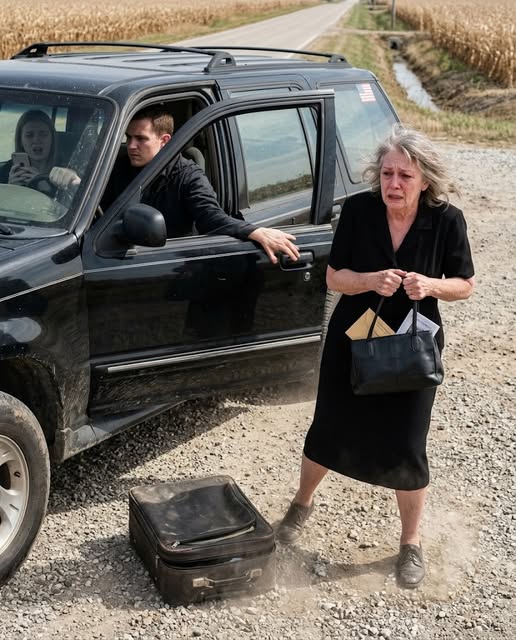
Margaret stood on the shoulderless road outside town, holding her purse with both hands, and watched her son’s SUV pull away.
Daniel drove forward slowly at first.
For one strange second, she thought he might stop.
Then the brake lights vanished around the bend, and the cornfields swallowed the road the way small towns swallow secrets.
She did not shout after him.
She did not run.
Her throat felt packed with dust, and her hands were steady in a way that would have frightened her if she had not already spent the last three days learning what quiet betrayal felt like.
Only three days earlier, she had stood beside Robert’s grave with the funeral program folded into a tight square in her palm.
The pastor had said kind things, though Robert had never been much of a church man.
The neighbors had come anyway.
They brought Costco trays, foil pans of baked pasta, plastic containers of cookies, paper plates, coffee, and all the soft, awkward sentences people offer when death is sitting in the room and nobody wants to look directly at it.
At the house, the kitchen smelled like deli chicken, lemon dish soap, and the coffee Margaret kept making because stopping made her hands shake.
People drifted from the living room to the dining room and back again.
They spoke in low voices near the refrigerator.
They touched her arm.
They told her Robert had been a good man.
They were right, but saying it out loud did not put him back in his recliner, where the cushion still held the shape of him from years of Sunday football and late-night invoices.
Daniel arrived in a dark suit that looked expensive and uncomfortable on him.
His wife had not come.
He said the flights were a mess, the traffic was worse, and the meeting he had moved for the funeral had already caused problems.
Margaret listened to him and wondered when her son had learned to speak of grief as if it were weather delaying a schedule.
Ashley arrived an hour later with sunglasses still pushed into her hair.
She hugged her mother carefully, one hand light on Margaret’s shoulder, the other keeping her black blouse from wrinkling.
“Oh, Mom,” she said.
It was the kind of sentence that sounded tender until Margaret noticed there was nothing after it.
For thirty-two years, the house on Briar Lane had been more than a house.
It had been where Margaret packed school lunches before the sun came up.
It had been where she wiped grape jelly off the counter while Robert argued with suppliers on the phone.
It had been where Daniel learned to ride his bike in the driveway, where Ashley cried after her first breakup, where Robert came home so tired from the warehouse that he sometimes fell asleep with one work boot still on.
It had been where they survived two recessions.
It had been where Margaret sat beside Robert during the cancer scare, holding a paper cup of hospital coffee that tasted like cardboard, promising him she was not scared even though both of them knew she was lying.
It had been where they built the business.
People talked about Robert as if he alone had made it happen, because he had been the one shaking hands and signing contracts and standing in front of employees at Christmas parties.
Margaret knew the other half of the story.
She knew the invoices paid at midnight.
She knew the names of customers who only answered when she called.
She knew which bank officer had extended grace in 2009 and which supplier had to be paid before everyone else.
She knew the password notebook had once lived in a kitchen drawer beside batteries and birthday candles.
She knew what trust cost because she had been spending it quietly for decades.
Daniel knew those things too, or at least he knew enough of them.
Margaret had given him keys before he earned them.
She had introduced him to customers who still called him “Robert’s boy” with affection in their voices.
She had showed him files, accounts, payroll systems, old mistakes, and old favors.
She had believed giving him access was the same as giving him a path.
Trust is a strange inheritance because the person receiving it can start believing it was always his to claim.
The first night after the funeral, Margaret poured coffee for everyone who remained.
The refrigerator hummed.
The dishwasher clicked through a cycle.
Someone had left a folded napkin under the leg of the dining table because it had wobbled for years, and Robert had always said he would fix it when he had time.
Daniel opened his laptop at that table.
The sound of the lid lifting made Margaret look over before he spoke.
“We should talk about next steps,” he said.
Margaret stared at him.
Next steps sounded like something from a staff meeting.
It did not sound like a son sitting in his mother’s kitchen the night after his father went into the ground.
Ashley stood near the sink, scrolling on her phone.
She looked up only after Margaret had stayed silent too long.
“Mom, Daniel’s just trying to make things easier,” she said.
“Easier for who?” Margaret asked.
Daniel sighed, and the sigh was familiar.
He had used that same sound as a teenager when Margaret reminded him to take out the trash, and again as a young man when Robert corrected him in front of the warehouse crew.
“We need to be practical,” he said.
Practical became the word of the night.
Practical about the house.
Practical about the business.
Practical about accounts, cars, signatures, bills, and decisions that had apparently already been discussed without her.
At 9:17 p.m., Daniel slid a printed list across the dining table.
Margaret noticed the time because the microwave clock was directly behind his shoulder.
The list had neat headings.
Household accounts.
Business accounts.
Vehicle titles.
Insurance policies.
Online access.
Asset review.
The words were clean and bloodless.
They had the same feeling as a hospital intake form, reducing a life to checkboxes while the person living it sat right there breathing.
Margaret read the list once.
Then she read it again.
She noticed what Daniel had included.
More important, she noticed what he had not.
There was no mention of Mary Caldwell.
There was no mention of the amended trust letter.
There was no mention of the deed transfer Robert had insisted on signing weeks earlier, sitting at Mary’s conference table with a blue pen in his hand and oxygen still catching a little in his chest from the stairs.
There was no mention of the emergency card tucked inside the sealed envelope in Margaret’s purse.
Daniel had always been good at sounding certain when he was missing the most important page.
“Mom,” Ashley said softly, “you shouldn’t have to handle all this by yourself.”
Margaret looked at her daughter’s polished nails and the diamond bracelet Robert had given her for her thirtieth birthday.
“I have been handling things by myself longer than you think,” she said.
Daniel’s mouth tightened.
He closed the laptop halfway, not enough to end the conversation, only enough to make his irritation visible.
“Nobody is attacking you,” he said.
That was when Margaret understood how the next few days would go.
They would use soft voices.
They would call control concern.
They would call pressure help.
They would speak over her, around her, and finally for her if she let them.
She went to bed that night without undressing.
Robert’s side of the mattress was cold.
His reading glasses still sat on the nightstand on top of a paperback mystery he had been halfway through when the final hospital stay began.
Margaret lay awake and listened to the house breathe around her.
The furnace clicked.
A branch scraped the upstairs window.
Somewhere down the hall, Daniel’s voice carried low through the guest room door while he talked on the phone.
She heard the word transfer.
She heard the word timing.
She heard her own name, followed by a silence so careful it told her everything.
At 6:40 the next morning, Ashley knocked once and came into the bedroom with a suitcase Margaret did not recognize.
It was gray, hard-sided, and too small for a woman who had lived in the same home for thirty-two years.
“We’re going to look at a place,” Ashley said.
Margaret sat up slowly.
“What place?”
“Just somewhere safe,” Ashley said.
Daniel appeared in the doorway behind her, already wearing his coat.
“It’s not a decision today,” he said. “Just come see it.”
Margaret looked from her son to her daughter.
The light behind them was pale and cold.
They stood together in the doorway like people delivering a policy, not asking a question.
“I’m not going anywhere,” Margaret said.
Daniel smiled.
It was not a warm smile.
It was a prepared one.
“Just come take a look, Mom,” he said. “It’s easier if we do this calmly.”
Calmly was a word Margaret had come to distrust.
People used it when they wanted obedience to look like peace.
They used it when they had already chosen the outcome and only needed the victim to stop making the room uncomfortable.
Margaret did not raise her voice.
She did not throw the suitcase back at them.
She did not tell Daniel that his father would have been ashamed to see him standing there.
She simply got up, washed her face, combed her hair, and put on the same black dress because she had not yet found the strength to choose ordinary clothes.
In the hallway, she paused beside the pencil marks on the doorframe.
Daniel, age six.
Ashley, age eight.
Daniel, age twelve, after a summer growth spurt that made Robert laugh and say they would need taller doorways.
Margaret touched the marks with two fingers.
Then she moved on.
In the dining room, the printed list was still on the table.
Beside her coffee mug lay a power-of-attorney form printed from Hamilton County Legal Services.
The title was centered at the top in bold letters.
Someone had placed a pen on top of it.
That small gesture offended her more than the form itself.
It assumed she would sign because a pen had been provided.
She walked past it.
In the junk drawer, under rubber bands, old keys, and a packet of stamps, Robert had once kept every bank envelope and handwritten attorney note.
That drawer was empty now.
Daniel must have searched it.
Margaret almost smiled.
Robert had predicted that too.
Two weeks before he died, he had sat in Mary Caldwell’s office with his coat folded across his lap and said, “If they come looking, they’ll look where they remember things used to be.”
Mary had looked at Margaret then.
“And where will the real documents be?”
“In her purse,” Robert had said.
Margaret had told him not to talk like that.
Robert had taken her hand.
“Meg,” he said, using the nickname only he used, “love them if you can. But don’t let them eat you alive.”
She had cried after that meeting in the car.
Robert had stared through the windshield at the courthouse flag moving in the wind and pretended not to notice until she was ready to breathe again.
Now, standing in her kitchen without him, Margaret picked up her purse.
It was heavier than it looked.
Daniel took the suitcase.
Ashley took nothing.
They moved through the front door together.
The little American flag Robert had stuck in the porch planter after Memorial Day last year was still there, faded at the edges, leaning slightly from the rain.
Margaret noticed Daniel did not hold the door for her.
The SUV smelled like leather, coffee, and the artificial pine tree hanging from the rearview mirror.
Ashley sat in the passenger seat.
Margaret sat in the back behind Daniel.
No music played.
No one talked about breakfast.
No one talked about sleep.
No one talked about Robert.
Daniel drove past the grocery store where Margaret had bought birthday cakes for both children, past the diner where Robert had met suppliers for twenty-five years, past the small brick building where the business had first rented two rooms before the warehouse.
Then he did not turn toward the assisted-living facility.
He turned away from town.
Margaret saw Ashley’s shoulders stiffen.
The assisted-living brochure was tucked into the seat pocket in front of her.
Its smiling gray-haired couple looked absurdly cheerful under the words “Comfort, Safety, Community.”
Nobody mentioned it.
The blinker clicked.
It was the loudest sound in the SUV.
Daniel’s jaw moved once as though he were chewing words he did not want to say.
Ashley’s fingers tightened around her phone.
The town thinned behind them.
The houses gave way to fields.
The shoulder disappeared.
The sky opened wide and blank over the road, the kind of sky that made a person feel small enough to be misplaced.
“Daniel,” Margaret said.
He did not answer.
“Where are we going?”
He drove another fifty yards.
Then he pulled over.
Gravel popped under the tires.
For a moment, no one moved.
Daniel put the SUV in park and turned halfway around in his seat.
His face had the unnatural calm of a man who had practiced cruelty until it sounded reasonable.
“This is where you get out,” he said.
Margaret looked at him for a long second.
Then she looked at Ashley.
Her daughter’s mouth opened.
Nothing came out.
That was the silence Margaret would remember.
Not Daniel’s order.
Not the road.
Not even the shock of the suitcase hitting the gravel.
It was Ashley’s silence, thin and frightened and convenient.
Margaret opened the door herself.
The cold air came in hard.
She stepped down carefully because the funeral shoes were not made for gravel.
Daniel got out, lifted the gray suitcase from the back, and set it beside her like a package being delivered to the wrong address.
“The house and the business are mine now,” he said.
His voice did not shake.
That was another thing she would remember.
“You’ll understand later,” he added.
Margaret almost laughed.
There are sentences that try to dress theft as wisdom, and that was one of them.
She looked at her son and saw the boy who once fell asleep against her shoulder during thunderstorms.
She saw the teenager who had wrecked Robert’s pickup and cried in the garage because he thought his father would stop loving him.
She saw the man standing in front of her now, choosing ownership over blood and calling it practical.
She could have told him everything then.
She could have told him that Robert had seen this coming when Daniel started asking too many questions about signatures and too few questions about his father’s pain.
She could have told him that Mary Caldwell had already filed what needed filing.
She could have told him that the deed he thought still carried Robert’s name had been transferred before the funeral program was even printed.
She did not.
Some truths are not meant to be thrown.
They are meant to be placed where the right person has to read them.
Daniel got back in the SUV.
Ashley looked at Margaret through the passenger window.
For one second, her face cracked.
Then she looked down at her phone.
The door shut.
Soft.
Final.
The SUV pulled away.
Dust rose behind it.
Margaret stood alone on the roadside with a suitcase she had not packed, no phone in her coat pocket, and no cash in the small black wallet Daniel had removed from the kitchen counter that morning under the excuse of “organizing things.”
Or so they believed.
She watched the SUV shrink until it became only a dark shape bending out of sight.
The air was cool against her cheeks.
A crow called somewhere beyond the ditch.
The world did not end.
That surprised her.
For three days, grief had felt like a room closing in.
Now the road was wide open, terrible and honest.
Her chest loosened for the first time since Robert died.
Not because the pain was gone.
It had barely begun.
It loosened because she finally understood the shape of what her children had done.
It was not confusion.
It was not stress.
It was not grief making people clumsy.
It was a cut.
A clean one.
A release, whether Daniel knew it or not.
Margaret reached into the deepest pocket of her purse.
Her fingers found the envelope by touch.
Thick paper.
Sharp corner.
Sealed flap.
Robert’s handwriting across the front.
For Margaret Only, Unless Needed.
The envelope had been signed at 2:13 p.m. on February 8.
Mary Caldwell had witnessed it.
The notary stamp had been pressed in blue ink.
There were three items inside that Daniel had never known existed because Robert had known his son well enough to leave him out of the room when it mattered.
The amended trust letter.
The emergency account card.
The deed transfer Daniel thought was still waiting to be claimed.
Margaret held the envelope against her chest for one breath.
Then another.
The wind lifted dust around her shoes and carried it across the road in a thin, pale sheet.
At the far end of the road, headlights appeared.
Margaret did not move.
The car was black.
It slowed long before it reached her, careful on the gravel, then stopped close enough that she could see the county courthouse parking sticker on the windshield.
The passenger window lowered.
Mary Caldwell leaned toward it, silver hair tucked behind one ear, her expression calm in the way of a woman who had spent thirty years watching families show their worst selves around money and death.
She looked first at Margaret’s shoes.
Then at the suitcase.
Then at the bend where Daniel’s SUV had vanished.
Finally, she looked into Margaret’s face.
Mary did not ask if Margaret was all right.
That would have been a foolish question, and Mary was not a foolish woman.
Instead, she asked the only thing that mattered.
“Did he say the words?”
Margaret lifted the sealed envelope.
The paper shook once in her hand, not from fear, but from the force of everything she had refused to say in the SUV.
Her husband was gone.
Her children had made their choice.
The road was empty except for dust, grief, and the one woman Robert had trusted to arrive at exactly the right time.
Margaret looked at Mary Caldwell through the open window and answered—

