The morning of my thirty-fourth birthday started with the kind of lie you tell yourself because it’s easier than facing what your gut already knows.
“It’s just brunch,” I muttered while I wrestled with my hair in the bathroom mirror. “A weekday brunch. People do that.”
People did not, in fact, usually do that. Not in my family. We were big on Sunday dinners, on holiday buffets, on chaotic potlucks where ten different aunts insisted their version of dumplings was the real one. But a Wednesday morning birthday brunch—at an expensive restaurant, no less—wasn’t our style.
Still, when Mom had called a week earlier and said, “Sweetheart, we’re taking you out on your actual birthday. Just us, the immediate family. Your father has a surprise,” I’d pushed aside the flicker of unease.
My parents loved a “surprise.” Surprises usually meant they had decided something “for my own good.”
I slid into a navy wrap dress, the one that made me look like I had my life perfectly together even on days I felt like a collection of to-do lists in human form. I checked the time. 10:06 a.m. I’d be fashionably late if I left now. Let them wait a little, I thought, and immediately felt guilty for a reason I couldn’t quite name.
The drive to the Ocean View Restaurant took fifteen minutes. The sky was stupidly beautiful—clear blue, a handful of thin clouds like someone had dragged a paintbrush across them. The closer I got to the marina, the more the air filled with that particular mix of salt and fuel, ocean and boat engines. It always made me think of possibility, of escape.
I’d escaped once already, in my own way. First to college, then to a tech consulting career that had me flying in and out of cities so often I started measuring time in airport codes. Over the years, I’d quietly shifted from just earning to building—taking bonuses and contract windfalls and parking them in real estate. A duplex here. A small apartment building there. A beach house on Seabreeze Lane that I’d fallen for the moment I’d stepped into its sun-washed living room.
Fifteen properties now. Seven states. A neat little empire inside an app on my phone.
My family knew I “did well,” but they didn’t know the numbers. That was by design. I’d learned early that in our house, money wasn’t just money. It was obligation. It was leverage. It was “family resources.”
And I was tired of being a resource.
I pulled into the restaurant parking lot, found a spot overlooking rows of white boats bobbing in their slips, and sat for a moment with my hands on the steering wheel. The Ocean View was my mother’s favorite spot. Floor-to-ceiling windows, white tablecloths, servers who somehow made asking if you wanted more coffee sound like a blessing.
Maybe, I told myself, the unease in my stomach was just about turning thirty-four. About realizing that, while my spreadsheet life looked impressive, my personal one could be summed up as: woman, laptop, suitcase, repeat.
I snorted softly. “Happy birthday, Natalie,” I said to my reflection in the rearview mirror. “Try not to start a fight before cake.”
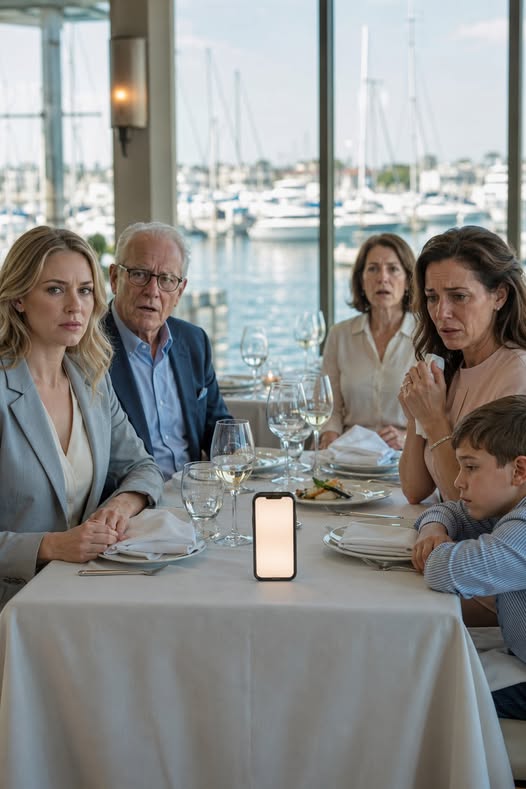
Inside, the hostess recognized me immediately. “Table for four,” she said, checking the list. “Your party’s already here. Right this way.”
The room was all bright light and muted conversation. Sunlight spilled over the water, threw glittering diamonds across the marina, and then poured into the restaurant, landing in golden rectangles on the hardwood floor. My parents had chosen a table right by the windows, naturally. Mom liked to be seen.
“There she is!” Mom stood as I approached, arms wide. Margaret Chin: perfectly curled hair, pearls at 10:15 a.m., a silk blouse in soft pink that made her look like she’d stepped out of a lifestyle magazine’s “elegant at any age” feature.
She smelled like Chanel and citrus when she hugged me. “Happy birthday, sweetheart.”
“Happy birthday, Nat!” My brother Connor’s voice boomed from across the table. He stood as well, knocking his napkin to the floor in his enthusiasm. His wife Rachel laughed, bending to retrieve it.
Dad stayed seated, but he smiled that big, satisfied smile he used when something in his head had clicked into place. Robert Chin: former engineer, current family problem-solver, self-appointed patriarch who believed absolutely that if people would just listen to him, everything would be fine.
“Order anything you want,” Mom said, squeezing my hand as I took my seat. “This is your special day.”
I glanced at my watch. “Special days usually happen on weekends,” I teased, picking up the menu. “Some of us have jobs, you know.”
“Oh, don’t be dramatic,” Mom chided lightly. “Your calendar looked clear this morning.”
Of course it did. She had access to my shared “family” calendar. I’d stopped putting anything important on it months ago, after she’d tried to organize a surprise party for my cousin using my one free weekend in a month-long client project.
“We wanted your actual birthday,” Dad said, unfolding his napkin with the precision of a man drafting blueprints. “Not some random Saturday.”
Connor practically vibrated with excitement across from me. His leg jiggled under the table, rattling the silverware. Rachel kept sneaking glances at him, eyes bright, lips curved in a secret smile.
I studied them for a moment. Connor wore a too-tight button-down that strained around his stomach, his tie a little crooked. Rachel looked like she’d stepped straight off Instagram—perfect hair in beachy waves, subtle contouring, a dress that probably cost more than my first month’s dorm rent and belonged to one of those brands that marketed themselves as “aspirational lifestyle.”
The server came, took orders for mimosas and coffee and all the overpriced egg dishes. We made small talk. Connor’s kids. Mom’s garden club. Dad’s retirement projects. The weather. The traffic. Everything safe and surface-level.
Beneath the chatter, a taut thread of anticipation hummed. It seemed to vibrate especially hard in Dad’s jaw, in the way Mom kept smoothing her napkin, in how Connor’s eyes darted from Dad to me and back again like he was waiting for a cue.
The mimosas arrived. The server poured with a flourish, the champagne catching the light in the tall flutes. I took a sip that was mostly orange juice and barely alcohol. Mom wouldn’t approve if I drank too much before noon.
Dad cleared his throat.
It was a specific kind of throat-clearing, the one that had preceded every “family announcement” of my childhood—new job, new house, new rules. The hairs on the back of my neck stood up in recognition.
“Now that we’re all here,” he began, his tone warm, “your mother and I wanted to talk to you about your birthday gift, Natalie.”
I set my fork down carefully. “You know you didn’t have to get me anything,” I said automatically.
“Nonsense.” Mom smiled, but it didn’t quite reach her eyes. “Thirty-four is an important year.”
Says who? I thought, but I just smiled politely.
Dad reached down beside his chair and pulled up a manila folder. Not a card. Not a wrapped box. A folder. Of papers.
Oh no.
My stomach dropped.
“We know you’ve been working very hard,” he continued, sliding the folder onto the table like a presentation deck in a boardroom. “Always traveling for your tech… consulting. Never really settled. So we’ve made a decision that will benefit the whole family.”
Here we go, I thought. There it was—the word that turned everything into a group project: family.
“Okay…” I said slowly.
“We’re selling the beach house,” Dad announced, beaming. “And we’ve found a buyer already.”
For a second, the words didn’t compute. They hung in the air between us, bright and incomprehensible, like a foreign phrase I almost recognized but couldn’t translate.
“The… beach house,” I repeated.
My mind flashed, unbidden, to Seabreeze Lane. To the three-bedroom Cape Cod with the weathered shingles and the wraparound porch and the blue front door I’d agonized over choosing. To the sound of waves at night through the open bedroom window. To the smell of sunscreen and grilled corn and the old wood floors that creaked in the hallway.
“Yes,” Dad said, misunderstanding my tone as neutral interest instead of the quiet terror it was. “We got an incredible offer. Nine hundred fifty thousand dollars. Can you believe it? On something we got for six-eighty? That’s almost three hundred thousand in appreciation. Remarkable, really.”
A distant part of me registered the numbers. Six hundred eighty thousand. The purchase price I knew far too well because I’d wired the funds myself six years earlier. No mortgage. I’d drained my savings, taken a calculated risk, and bought the beach house in cash.
“Selling it,” I said, my voice flatter now.
“Yes,” Mom jumped in. “And the closing is next week. It all came together so quickly. We wanted to tell you in person since you’ve been using it so much.”
“Using it,” I echoed.
“As a little getaway,” Mom said, waving her hand. “You know, working from home at the beach.” She smiled brightly, utterly oblivious.
Because to her, that’s what I’d been doing. Using the house. Borrowing it, like a kid borrowing the family car.
Connor could no longer hold his excitement in. “And the best part,” he cut in eagerly, “is that Mom and Dad are giving us the proceeds. All of it, Nat. So Rachel and I can finally open our restaurant.”
Rachel’s face lit up at the word “restaurant.” “We’ve already signed a lease,” she said, leaning forward. “Found the perfect space downtown. We put down deposits with the contractors and equipment suppliers. It’s all lined up.”
My heartbeat thundered in my ears. “You’ve… what?”
“Put everything together,” Connor said, grinning. “We close on the restaurant property the same day as the beach house sale. It’s going to be huge. I’m telling you, this is the one.”
Images of Connor’s previous ventures flickered through my mind: the frozen yogurt shop that lasted eight months, the “mobile car detailing service” that mostly involved him borrowing Dad’s SUV and disappearing, the e-commerce business that had been more “com” than “merce.”
“Your parents are so generous,” Rachel added, resting her hand on Connor’s arm. “We couldn’t have done this without them.”
The mimosas suddenly tasted like acid in my throat.
I took a small, measured sip to buy time. “That’s… quite a plan.”
“We knew you’d understand,” Mom said, radiating approval. “You’ve always been so practical. So focused on your career. Connor needs this opportunity. He’s struggled so much trying to find his path.”
There it was again: Connor’s journey, Connor’s path, Connor’s third or fourth or fifth chance. Somehow, my path was always assumed to be fine, self-sustaining, needing no support.
I drew a slow breath. “When did you list the beach house?”
“About two months ago,” Dad said. “We didn’t want to bother you with the details. You’re always so busy with work.” He gestured at the folder. “We handled everything—photos, showings, negotiations. Found a lovely couple from Portland who fell in love with the place the moment they saw it. Young professionals. Good money. They plan to use it as a vacation home.”
I stared at him.
He spoke with the confidence of someone who had every right to orchestrate the sale of a property.
And he did not.
“You’re telling me,” I said, carefully, “that you listed the beach house. Conducted showings. Accepted an offer. Scheduled a closing. And committed the proceeds to Connor and Rachel. Without telling me.”
“We’re telling you now,” Mom said, like that made it reasonable. “In person. On your birthday. We thought it would be a nice surprise.”
A laugh bubbled up in my chest. I swallowed it.
“And you’ve already… spent the money,” I said, looking at Connor.
“Not spent,” Connor said quickly. “Committed.” He ticked items off on his fingers. “Restaurant lease. Equipment deposits. Contractor agreements. But it’s all contingent on the closing. Obviously.”
“Obviously,” I repeated.
“So you’re about two hundred thousand dollars deep in commitments,” I said, “based on selling a property in one week.”
“Two hundred forty thousand,” Rachel corrected cheerfully. “But it’s fine. The closing is locked in. The buyers already did their inspection, the appraisal came back great. It’s basically done.”
In the strangest, calmest part of my brain, a switch flipped.
The part that ran numbers, scrutinized contracts, checked contingencies. The part that had built my empire one careful acquisition at a time.
I reached for my phone.
“Dad,” I said, my voice steady in a way that surprised even me, “who did you use as the listing agent?”
He brightened, misinterpreting my interest as validation. “Sharon Mitchell. Coastal Realty. She’s been wonderful. Got us multiple offers over asking.”
I opened my property management app. Fifteen little thumbnails appeared, each one a tiny picture of a building with a label beneath: Clearwater Properties #1, #2, #3. The beach house sat in the second row. 847 Seabreeze Lane.
Beneath each property, a series of small icons showed occupancy, rental income, maintenance tickets…and a little shield icon for fraud alerts and unauthorized activity.
I swiped out of the app and into my contacts, searching for “Sharon.” There she was. I had her number saved, not because I’d worked with her, but because a couple of years earlier she’d cold-called me about “potential interest in selling” after seeing my LLC on county records. I’d kept it. Just in case.
I tapped the number.
The phone rang. Mom watched me like I’d stood up and started juggling.
“Natalie,” she whispered harshly. “What are you doing?”
“Solving a problem,” I said.
Sharon answered on the second ring. “Hello, this is Sharon.”
“Hi, Sharon. It’s Natalie. Natalie Chin.”
A beat of polite confusion. “I’m sorry, who—”
“We spoke a while back,” I prompted. “You reached out about possibly listing 847 Seabreeze Lane?”
Recognition dawned in her voice. “Oh! Yes, of course. Ms. Chin. How can I help you?”
“I’m sitting with my family right now,” I said, keeping my tone conversational. “They’ve just informed me they’re selling the property at 847 Seabreeze, and that you’re the listing agent.”
“Yes, I am,” she said briskly. “We’ve actually got it under contract. Closing is scheduled for next week. I think your parents mentioned—”
“They listed it under their names?” I interrupted.
“Yes,” she said. “Robert and Margaret. Very nice people. They had keys, detailed information—”
“Sharon,” I said, every word now edged with steel I didn’t bother to hide, “I need you to pull the county property records for 847 Seabreeze Lane. Right now.”
A pause. “Of course,” she said slowly. “Do you mind if I put you on a brief hold?”
“Go ahead,” I said, hitting the speaker icon and placing the phone in the middle of the table.
My family stared at it like it might explode.
“What is this?” Connor demanded. “Nat, what are you doing?”
“Being practical,” I said softly. “You know. Like I always am.”
“Sweetheart,” Mom said, her voice tighter now, “you’re making a scene.”
“We’re in a restaurant,” Dad added, cheeks flushing. “Can we not–”
Sharon came back on the line.
“Ms. Chin?” she said, voice changed—cautious, all the bright sales-woman cheer stripped away. “I’ve pulled the records.”
“And?” I asked.
“The property at 847 Seabreeze Lane is owned by…” She trailed off. When she spoke again, her tone was very different. “Clearwater Properties LLC. Registered agent: Natalie Mei Chin.”
Silence slammed down over the table.
I watched my father’s face as the words landed. Color drained from his cheeks. His jaw moved soundlessly, like he was chewing invisible glass.
“That’s what I thought,” I said, my voice very calm now. “Sharon, my parents do not own that property. They never have. Any listing agreement they signed is fraudulent. The sale needs to stop immediately.”
“Oh my God,” Sharon breathed. Somewhere on her end of the line, a chair creaked. “Ms. Chin, I—I’m so sorry. They presented themselves as the owners. They had keys, photos, detailed knowledge of the property. I assumed—”
“As you can imagine,” I said, staring straight at Dad, “they’ve spent quite a bit of time there.”
He opened his mouth. Closed it.
“Sharon,” I continued, “I need you to contact your broker right away. The sale cannot proceed. I am the legal owner, and I have not authorized any listing or sale.”
“I understand completely,” she said, all business now. “I’m calling my broker the moment we hang up. We’ll cancel the listing and notify the buyers immediately. Again, Ms. Chin, I’m terribly sorry. I’ll also be conducting an internal review of how this—”
“Thank you,” I said. “Please confirm via email that the listing has been canceled.”
“Of course.”
I ended the call.
The restaurant noise washed back in—the clink of cutlery, the low murmur of conversation, the distant hiss of the espresso machine. At our table, though, there was only silence thick enough to chew.
“You…own the beach house?” Dad finally managed.
“Yes,” I said. “I do.”
“But we’ve been using it for years,” Mom sputtered. “Your father and I, Connor and the kids…we always thought—”
“That it was family property?” I finished.
She gestured helplessly. “Well, yes. I mean, the way we’ve all used it—”
“I bought that house six years ago,” I said. “Cash. No mortgage. In the name of my LLC, Clearwater Properties. I pay the taxes. I pay the insurance. I pay the utilities and the roof repairs and the new water heater and the sand removal after every storm. I own it. Not you. Not ‘the family.’ Me.”
Connor lurched to his feet so fast his chair scraped loudly against the floor, turning heads at nearby tables. “This is insane,” he exploded. “You let us believe we could sell it. You never said anything about—about owning it in some secret company.”
“I didn’t ‘let’ you believe anything,” I said, looking up at him. “You never asked. At no point did anyone say, ‘Hey, Natalie, is this house in your name? Is it okay if we sell it?’”
“We thought it was Dad’s,” Connor insisted, jabbing a thumb in our father’s direction. “He’s the one who handles this stuff. He’s the one who—”
“Signs paperwork he doesn’t read?” I suggested. “Commits other people’s property to your business ventures without verifying ownership?”
“That’s not fair,” Mom snapped. “Your father would never—”
“He just did,” I said.
Rachel had gone pale. Her hand trembled on the stem of her mimosa glass. “We’ve put down deposits,” she whispered. “The lease. The equipment. We can’t get that money back. What are we supposed to do?”
Something in me twisted. For a moment, I saw not the woman who’d cheerfully corrected the amount of their commitments but a person looking at the collapse of a dream. Then another part of me—the part that had pulled all-nighters and eaten at my desk and almost broken under the strain of building my business—rose up hard in response.
“That,” I said, “is something you should have considered before committing two hundred and forty thousand dollars based on selling a house you don’t own.”
“It was a misunderstanding,” Dad said, struggling to regain his smooth, reasonable tone. “Even if you’re technically the owner—”
“Stop,” I said.
He blinked. “Excuse me?”
“Stop calling it ‘technical.’” I picked up my phone again. “There’s nothing technical about it.”
As if on cue, my screen lit up. A text banner slid across.
Suspicious activity detected on property 847 Seabreeze Lane. Transaction flagged and frozen pending owner verification.
I turned the phone so Dad could see.
“My property management system has fraud alerts,” I said. “The moment Sharon tried to push the closing paperwork through, it pinged my bank. They’ve frozen everything until I confirm. Which, of course, I won’t.”
Dad stared at the message like it was in another language.
“We didn’t know it was fraud,” he said hoarsely. “We thought it was family property. We thought we were doing something good for your brother.”
“You were going to take something that didn’t belong to you,” I said. “Sell it. Give the money to someone else. And you never thought to check whose name was on the deed.”
Connor’s face was red now, a mottled anger that reminded me of the tantrums he’d thrown as a kid. “You’re really going to let us lose everything?” he demanded. “Your own brother? After everything our family has done for you?”
I almost laughed. “Everything you’ve done for me,” I repeated softly. “Like what? Raise me? That’s basic parenting, not a loan. Pay for college? I had scholarships and worked three jobs. Help me start my business? I built it from a laptop in my studio apartment.”
“You’re twisting things,” Mom said, her voice shaking.
“No,” I said. “For years, you’ve treated my success like it was community property. Like it was this pot we all could dip into when Connor’s latest idea needed seed money. I told you no. Repeatedly. So this time, you just…didn’t ask.”
“You’re banning us from the beach house?” Connor blurted. “On your birthday? What kind of person does that?”
“The kind of person,” I said, gathering my bag, “whose family just attempted to steal her property to fund yet another of your failed ventures.”
I stood.
“Natalie, sit down,” Dad ordered, using that tone that had once made me freeze mid-step as a child. “We can talk about this.”
“We are talking,” I said. “And I’m done.”
I took a fifty from my wallet and set it by my untouched plate. “This is for my coffee and the entertainment.” I met each of their eyes in turn. “The beach house is mine. Access is revoked. Effective immediately.”
Then I walked out, my heart pounding, the echo of my heels sharp on the polished floor.
Outside, the bright sunshine felt like stepping into another world. Boats bobbed gently, indifferent. Gulls wheeled and cried overhead. My reflection swam faintly across the restaurant’s glass as I passed, my shoulders squared in a way I didn’t entirely feel yet.
I made it to my car before the shaking started.
I closed the door, hands gripping the steering wheel so tightly my knuckles whitened. For a long moment, I just sat there, staring at the marina.
They tried to sell my house.
Not ask me to sell it. Not discuss options. Not talk about a loan or an investment or a family partnership.
They had acted as if my asset was theirs.
My phone rang, jolting me. An unknown number flashed on the screen, local area code.
I swallowed and hit accept. “Natalie speaking.”
“Ms. Chin? This is Detective Alejandro Ramirez with the financial crimes unit,” a calm voice said. “Your bank flagged a possible real estate fraud involving a property on Seabreeze Lane. Do you have a moment to talk?”
I let out a short, disbelieving sound. Of course they had.
“Yes,” I said. “I do.”
He asked for verification details, then continued. “Our fraud department received an alert that someone attempted to initiate a sale on 847 Seabreeze Lane without matching the registered owner information. Can you confirm whether you authorized the sale of this property?”
“I did not,” I said. “My parents attempted to sell it without my knowledge or permission.”
There was a small pause. “Your parents?” he repeated.
“Yes,” I said, very tired all of a sudden. “They believed—incorrectly—that it was ‘family property.’ It’s not. It’s owned by my LLC. They signed a listing agreement as if they were the owners and proceeded all the way to closing.”
“I see,” Ramirez said, and I sensed him shifting mental gears. “Were they aware that they weren’t legally on the deed?”
I thought of Dad’s face in the restaurant when Sharon read out the property record. The way his certainty had crumbled.
“I believe they assumed my father owned it,” I said. “That’s what my brother said, anyway. They were wrong. But until today, I think they genuinely believed it.”
“Understood.” The detective cleared his throat. “In cases like this, Ms. Chin, we can proceed with charges for attempted fraud and forgery, if you wish to press them.”
The idea of my parents in handcuffs flashed across my mind, absurd and terrifying. Mom’s trembling hands. Dad’s face, slack with shock. Connor’s rage.
A younger version of me might have said, “No, no, forget it, it was just a misunderstanding.” A part of me still wanted to say that—to smooth it over, to make it easier for everyone but me.
But another part, the part that had watched them plan to hand over nearly a million dollars of my equity without a second thought, spoke louder.
“I don’t want to press charges at this time,” I said slowly. “But I do want the incident documented. On record. If anything like this is attempted with any of my properties in the future, I won’t be so generous.”
“That’s reasonable,” Ramirez said. “We’ll close this case as ‘no charges filed,’ but make note of the situation. If your bank flags any further suspicious activity, we’ll be in touch.”
“Thank you,” I said.
We ended the call.
I leaned my head back against the seat and closed my eyes. My pulse was finally starting to come down from hummingbird speed to something like human.
After a few minutes, I opened my property management app again. Fifteen properties. Seven states. A total value of four point two million dollars, according to the last valuation snapshot.
On the map view, they dotted the screen like little flags of all the lives I’d touched without anyone really knowing. Families lived in those units. People cooked dinner in kitchens I’d renovated, argued in living rooms I’d painted, slept under roofs I’d repaired.
None of it had been handed to me. None of it was a gift from my parents or a lucky lottery win. It was ten years of hustle, of working full-time while managing contractors on lunch breaks, of using vacation days to oversee closings, of watching friends blow paychecks on trips while I quietly wired another down payment.
My phone buzzed again. This time it was a series of messages.
Mom: Sweetheart, please call us. We can work this out.
Dad: That detective is blowing things out of proportion. Don’t be rash.
Connor: You’re really going to let me lose everything? After everything our family has done for you?
I stared at the last one for a long time.
After everything our family has done for you.
I thought about what “everything” actually meant.
The childhood of being the “good one” so they didn’t have to worry. The assumption that I’d be okay, that I didn’t need help, that my success was somehow inevitable and therefore unremarkable. Meanwhile, Connor’s every semi-functional day was celebrated like a miracle.
They’d paid more for his failed business attorney fees than they had contributed to my entire college education.
They’d offered to cover his rent in his thirties; I’d paid my own starting at nineteen.
Everything our family has done for you.
I blocked his number.
The fallout came fast and messy.
By the end of the week, Connor and Rachel had lost their deposits. The landlord for the restaurant space kept the first and last month’s rent because they were pulling out after signing. The contractors kept their non-refundable booking fees. The equipment supplier cheerfully informed them that per their agreement, the twenty-percent down payment was, regrettably, not recoverable.
Two hundred forty thousand dollars evaporated in a flurry of emails and phone calls.
Mom called it a “family tragedy” and cried on the phone to relatives. Dad framed it as a misunderstanding. In their retelling, the details shifted. The forgery of ownership morphed into something like a technical oversight; my refusal to hand over my asset became cold, selfish cruelty.
Cousins I barely knew sent texts like, Family sticks together. or Nat, why are you doing this to your brother?
None of them asked, “Why did your brother think it was okay to sell your house?”
No one asked, “Why did your parents sign papers for a property that wasn’t theirs?”
I blocked most of them too.
Three days after the brunch, my attorney, Jessica Park, called.
“Your father’s lawyer reached out,” she said without preamble. “You’re going to love this.”
“Hit me,” I said, lying on the couch with my laptop open and my brain too fried to focus on code or contracts.
“They’re claiming you gave them verbal permission to sell the beach house,” Jessica said. “That you told them, quote, ‘Do whatever you want with it, I don’t really use it.’”
I sat up. “I said nothing even remotely like that.”
“I know,” Jessica said dryly. “Last year you sent your parents an email reminding them to let you know when they were staying there so your cleaner could schedule around them. The email specifically referred to it as ‘my place.’”
“I remember,” I said. “Mom replied with something about bringing extra towels.”
“Exactly,” Jessica said. “We have a paper trail establishing your ownership and your view of it as your property. Nothing about shared family control. But here’s the ask: they want you to go through with the sale. Then transfer the proceeds to Connor as a ‘family loan.’”
I laughed. Actually laughed. “They want me to sell my investment, hand the equity to Connor, and call it a loan I’ll never see again.”
“Pretty much.”
“No,” I said. “Absolutely not.”
“That’s what I told them,” Jessica said, amusement in her voice. “But you should know they’re threatening to sue. Their theory is promissory estoppel—claiming you made promises or created reasonable expectations, causing them to incur costs.”
“For trying to sell my house?” I asked.
“For leading them to believe it was family property,” she clarified. “They’re arguing that by allowing everyone to use it freely, by not explicitly telling them they didn’t own it, you gave them the impression they could manage it as a family asset.”
My jaw clenched. “Let them sue,” I said. “We both know there’s nothing there.”
“I agree,” Jessica said. “But it’s going to be a pain, not gonna lie. I’ll file a motion to dismiss as soon as they file, but be prepared for some drama.”
The lawsuit landed two weeks later: Robert and Margaret Chin v. Natalie Mei Chin. Alleging breach of a verbal contract, detrimental reliance, promissory estoppel. Connor listed as a third-party beneficiary seeking damages for his lost restaurant.
Reading my own name on the defendant line felt surreal. Like I’d been recast in a family drama I hadn’t auditioned for.
We filed our response. Jessica’s motion to dismiss was brutal in its precision. She attached copies of the deed, the LLC registration, every email where I referred to the beach house as “my property.” Screenshots from the property management app with my name as owner. A summary of the fraud alert and the detective’s report.
The hearing was set for a Tuesday morning. I took the day off and wore my best gray suit, the one that made me feel like I could walk through fire and file a well-formatted report about it afterwards.
The courtroom was smaller than I’d imagined. Less Law & Order, more DMV with wood paneling. My parents sat at the plaintiff’s table with their attorney. Mom’s eyes were red; Dad’s jaw was tight. Connor sat behind them, in the gallery, his face pale and drawn.
I sat at the defense table with Jessica, my spine straight, hands folded.
When the judge took the bench, we all rose.
The arguments were brief. Jessica argued that there was no evidence of any contract, verbal or otherwise. That my parents had never been on the deed. That they had signed a listing agreement falsely representing themselves as owners.
“They are essentially asking this court,” she concluded, “to reward them for attempting to sell property they did not own, then to punish the actual owner for refusing to go along with it.”
My parents’ attorney tried to spin it. He talked about “understandable family assumptions,” about “patterns of use,” about “reasonable expectations” created by years of shared vacations. He spoke of Connor’s hopes, of the “devastating financial loss” he’d suffered.
The judge, a woman with steel-gray hair and glasses perched low on her nose, listened patiently. Then she picked up the deed.
“This is not complicated,” she said. “The property in question is owned solely by Clearwater Properties LLC, with Ms. Chin as registered agent. The plaintiffs’ names do not appear on this or any related document.”
She looked over her glasses at my parents. “You had no legal right to sell this property,” she said. “You incurred expenses in anticipation of receiving proceeds from a sale you had no authority to conduct. That is not Ms. Chin’s responsibility. That is yours.”
She turned to their attorney. “The court finds no evidence of a verbal contract, no writings, no emails suggesting Ms. Chin authorized any sale or transfer of funds. The plaintiffs’ claim is without merit.”
Her gavel came down with a crisp crack. “Motion to dismiss granted. Case dismissed with prejudice. Plaintiffs are ordered to pay the defendant’s reasonable attorney fees.”
Fifteen thousand dollars, as it turned out.
Outside the courthouse, the sky was overcast, the air heavy. My parents walked out together, silent. Connor followed a few steps behind, looking like someone had taken all the air out of him.
He caught my eye and strode over, shoulders tense.
“Are you happy now?” he demanded. “You’ve destroyed everything. The restaurant. My chance. The family.”
“I didn’t destroy anything,” I said quietly. “You chose to commit two hundred and forty thousand dollars based on selling something you didn’t verify you owned. You signed contracts without doing basic due diligence. That’s not on me.”
“We’re family,” he said, and the word came out like a weapon. “Family doesn’t do this to each other.”
“Family doesn’t commit fraud against each other,” I returned. “Family doesn’t try to steal someone’s house because they made sloppy assumptions.”
“I wasn’t—”
“Did you check the deed?” I asked. “Once. At any point. Did you go down to the county records office or pull it up online and confirm the names on the title before you started signing leases and writing checks?”
He worked his jaw. “Dad—”
“Dad is not the county recorder,” I said. “Dad is not the bank. You are a grown man, Connor. At some point, you have to stop blaming everyone else for the consequences of your choices.”
Rachel appeared at his elbow, tugging on his arm. “Let’s go,” she said sharply, eyes glittering with fury. She looked at me like I was something unpleasant on the bottom of her shoe. “I hope you’re proud of yourself,” she spat.
“I am,” I said. “I’m proud that I built something worth protecting. And I’m proud that I protected it from people who thought they were entitled to it.”
They walked away.
Six months later, I sold the beach house.
Not because of them. Not because of pressure or guilt or some ridiculous notion of “sharing.” I sold it because the market was hot, because an investor approached me with an offer of 1.1 million, and because I’d been eyeing some multi-unit properties in Denver that promised better cash flow than a single vacation home.
When the wire hit my business account, I looked at the numbers for a long, quiet moment. Then I bought two rental properties in Denver: an eight-unit building near a university and a four-unit in a rapidly gentrifying neighborhood.
Every penny of that beach house equity went into deals that had nothing to do with my parents or my brother or Rachel’s dream restaurant.
Dad found out anyway, of course. News travels fast through family grapevines. I got an email a week after the Denver closings.
You sold it and didn’t even offer us a share, he wrote. That tells us everything we need to know about you.
I stared at the line for a long time, then closed the email without replying.
Mom tried a different tack. Her email was softer.
I miss my daughter, she wrote. Can we please talk?
I sat with that one for days.
Finally, I replied with one sentence.
When you can acknowledge what you did was wrong, we can talk. Not before.
Three dots appeared, then vanished. No response came.
Connor filed for bankruptcy. Again. His second in less than a decade. Rachel left him six months after that, taking the kids to Ohio to live with her mother. I heard about it through a cousin’s social media post.
My parents downsized to a condo as legal fees and repeated bailouts strained their retirement accounts. The stories about me in the extended family kept swirling—some painting me as a villain, some claiming it was all a “hurtful misunderstanding.”
Meanwhile, my business thrived. I landed a long-term contract with a major client that gave me enough predictability to plan my investments even more strategically. My property portfolio grew from fifteen units to twenty-two, then twenty-five. I hired a virtual assistant. Then a bookkeeper. Then a part-time property manager.
I started dating someone who didn’t flinch when I talked about LLCs and cap rates. Who didn’t make jokes about “finding a rich husband” when I discussed my goals. Who understood that boundaries weren’t cruelty—they were self-respect.
A year to the day after the infamous birthday brunch, a letter arrived.
Not an email. Not a text. A letter. Handwritten. In my father’s distinctive, precise engineer’s handwriting.
I held the envelope for a moment before opening it, feeling the weight of it—literal and metaphorical.
Natalie, it began.
I’ve spent the last year trying to understand how we ended up where we are.
Your mother and I genuinely believed the beach house was family property. Not legally—I understand now that legally, it has always been yours. But morally. Emotionally. We believed that because we had used it for family gatherings, because we had made memories there, it belonged to all of us.
We were wrong.
Those three words made me blink.
The house was yours. The choice to share it was yours. We took your generosity for granted and then betrayed it by trying to take something you had never offered to give.
Connor has learned some very hard lessons this year. So have I.
I am sorry we tried to sell your property. I am sorry we sued you. I am sorry we put our wants above your rights.
I don’t expect your forgiveness. I just wanted you to know that I understand now. You were not being cruel. You were protecting what you had built. I should have been proud of that instead of trying to take it from you.
Love, Dad.
I read it three times.
It was not a perfect apology. There were still hints of justification, of “morally” this, “emotionally” that. But he’d written the important parts too: We were wrong. It was yours. We betrayed your generosity. I am sorry.
I didn’t respond immediately. But I didn’t throw the letter away either. I put it in a drawer with a few other things I couldn’t quite let go of: an old photo of us at the beach house, Connor at eighteen and me at twenty, both sunburned and laughing; a Mother’s Day card I’d drawn in crayon when I was seven; my first business card from when I’d gone freelance.
Two months later, on a quiet Thursday afternoon between client calls, I picked up my phone and typed a text to Mom.
Coffee?
Her reply came almost instantly. Yes. Please. Saturday? 10 a.m.? Anywhere you like.
We met at a coffee shop downtown that neither of us had any history with. Neutral ground. It was one of those places with exposed brick, plants in mismatched pots, and a menu full of drinks that were technically coffee but mostly adjectives.
Mom looked older than I remembered. Not dramatically. Just smaller somehow. Less certain. The lines around her mouth were deeper; her posture more hesitant.
When she saw me, her face crumpled, and she hurried forward to hug me. She held on longer than she ever had before, fingers digging into the back of my jacket.
“I’ve missed you,” she whispered.
I swallowed around the lump in my throat. “I’ve missed you too.”
We ordered coffee and sat at a small table by the window. For a minute, neither of us spoke. The silence between us was thick with everything that had happened and everything we hadn’t said.
“I read Dad’s letter,” I said finally.
She exhaled. “He meant every word,” she said. “We both did.”
She wrapped her hands around her cup like it was an anchor. “Natalie, we were wrong,” she said. “About the beach house. About Connor’s restaurant. About a lot of things.” She managed a weak smile. “About thinking we could still tell you what to do at thirty-four.”
“It was more than wrong,” I said softly. “It was fraud.”
She flinched at the word, but she nodded. “I know,” she said. “I hate hearing it put like that. But I know.”
“What made you…see it differently?” I asked.
She stared into her coffee. “Watching your father read the judge’s ruling,” she said. “Listening to her say out loud that we had no right to sell it.” She gave a small, humorless laugh. “And then meeting with our financial advisor and seeing the numbers on paper. Realizing how much of our retirement we’d spent bailing Connor out. Realizing how we’d expected you to just…fix things.”
She looked up at me, eyes bright. “You were always the responsible one,” she said. “From the time you lined up your stuffed animals in neat rows and made charts about whose turn it was to take out the trash.” A fond smile flickered across her face. “We took advantage of that. We told ourselves you ‘didn’t need as much’ because you were capable. It was unfair. It was easier to make you the adult, even when you were a child.”
Something cracked open in my chest.
“What’s happening with Connor?” I asked after a moment.
She sighed heavily. “He’s working construction,” she said. “Day labor sometimes. Trying to pay off what the bankruptcy didn’t wipe clean. He shares a small apartment with a friend now. Rachel took the kids to Ohio. He sees them once a month, if he can afford the flight.”
She blinked away tears. “He’s learning what rock bottom feels like,” she said. “I don’t know if it will stick. I hope it does.”
“It’s hard to watch your child suffer,” I said quietly.
“Especially when they did it to themselves,” she murmured. “But yes. It is.”
We sat in silence for a bit, listening to the whir of the espresso machine, the low murmur of other conversations, the occasional clink of cups.
“Can you forgive us?” she asked eventually, voice barely above a whisper.
I took a breath.
“I don’t know yet,” I said honestly. “But I’m willing to try. With boundaries.”
She frowned slightly. “Boundaries?”
“Rules,” I clarified. “For how we deal with each other. Clear ones.”
“We can do that,” she said quickly. “Just tell me what they are.”
“No more assumptions about my property,” I said. “No more treating what I own as a family resource. If I choose to share something—money, a house, my time—it’s a gift, not an obligation. And if I say no, that’s the end of the conversation. No guilt. No campaigns to ‘make me see reason.’”
She nodded slowly. “Okay.”
“No more bailing Connor out,” I added. “If he starts another business, if he takes on more debt, that’s between him and his creditors. Not between him and me. Not between him and your retirement.”
She opened her mouth, closed it, then nodded again. “Okay,” she repeated.
“And if anything like the beach house ever happens again,” I said, “if anyone in this family tries to touch my assets without my permission, I will press charges. I need you to understand that.”
Her throat bobbed. “I understand,” she said. “It won’t happen again.”
She reached across the table, then hesitated, her hand hovering near mine. “I love you, Natalie,” she said. “I’m proud of what you’ve built. I should have said that years ago. I should have asked how I could support you instead of assuming your success meant you owed us.”
Tears pricked my eyes.
I let her take my hand.
“I love you too, Mom,” I said.
It wasn’t forgiveness. Not fully. But it was the first step toward something that might become a new kind of relationship—one where I wasn’t a walking ATM disguised as a daughter.
Over the next year, my empire grew.
Twenty-five properties. Then thirty. I purchased a small commercial building and leased it to a local daycare. I did a joint venture with another investor on a mixed-use project. I set up a trust, updated my will, made sure that if anything happened to me, my assets would go exactly where I wanted them to—not into some vague “family pot.”
I kept everything in writing. Every property in an LLC. Every agreement with signatures and dates and terms so clear even a judge half-asleep could parse them.
Connor eventually sent me a text. Just one.
I get it now, it read. What you were protecting. I’m sorry I tried to take it.
I stared at it for a long time.
Thank you, I replied.
We weren’t suddenly close. He didn’t become my favorite person. But something in the tension between us loosened, just a little.
The beach house was gone. The blue-doored, sun-washed house where we’d built sandcastles and blown out birthday candles and, apparently, built an entire mythology of “family property” on top of my silent labor.
Sometimes I missed it—the way the light filtered through the kitchen in late afternoon, the smell of the ocean right before a storm, the sound of the screen door snapping shut behind me. But then I’d glance at my portfolio and see the buildings in Denver, in Seattle, in Austin. I’d see the steady rent deposits, the increase in equity, the diversification of my risk.
The beach house had taught me something I didn’t know I still needed to learn.
My success is mine.
Mine to build. Mine to protect. Mine to share, or not, on my terms.
Not a prize my family had “earned” by raising me. Not a resource to be quietly redistributed to cover my brother’s choices. Not a communal pot my parents could dip into whenever someone’s dream needed funding.
People often say that money changes you. That wasn’t true for me.
What money changed was how loudly I could say no.
It let me enforce boundaries in ways I’d never been able to before. It turned vague discomfort into firm lines. It exposed which relationships were built on mutual respect and which ones were built on the assumption that I would always, always give.
And it showed me something else—something I might never have believed if I hadn’t lived it.
Sometimes, protecting what’s yours doesn’t just save your bank account.
Sometimes, it’s the only way to save yourself.
THE LETTER FROM INSIDE THE EMPIRE
The lawsuit was over.
The beach house was gone.
Connor was rebuilding his life.
Mom and Dad were slowly earning their way back into Natalie’s world.
For the first time in years…
Everything was quiet.
Normal.
Peaceful.
At least that’s what Natalie believed.
One rainy Tuesday morning, nearly eight months after the courthouse ruling, Natalie sat in her downtown office reviewing quarterly reports.
Twenty-seven properties.
Eight states.
Millions in assets.
Hundreds of tenants.
The empire had grown larger than she ever imagined.
The girl who once worked from a tiny apartment kitchen table now owned buildings she sometimes forgot she owned.
The thought made her smile.
Then her assistant knocked.
“Got something strange for you.”
Natalie looked up.
“Strange how?”
The assistant handed over a certified envelope.
No return address.
No company logo.
Nothing.
Just her name.
Then the assistant shrugged.
“It came from one of your own LLC mailing addresses.”
The smile vanished.
Immediately.
Because that made no sense.
After the beach house disaster, Natalie had become obsessive about paperwork.
Every property.
Every account.
Every signature.
Every transfer.
Everything was monitored.
Nothing happened without her knowledge.
Nothing.
Then why would one of her companies send her a letter she never approved?
The office suddenly felt colder.
Natalie carefully opened the envelope.
Inside was a single sheet of paper.
Nothing else.
No explanation.
No greeting.
No signature.
Just one sentence.
The moment she read it…
The blood drained from her face.
Because the message said:
You’re looking at the wrong theft.
The room disappeared.
Completely.
Natalie read it again.
And again.
And again.
Then she flipped the paper over.
Nothing.
Blank.
No clues.
No fingerprints.
No explanation.
Only that sentence.
Her phone immediately came out.
Within minutes she was calling her bookkeeper.
Then her property manager.
Then her attorney Jessica.
Nobody knew anything.
Nobody had sent the letter.
Nobody had authorized it.
Nobody recognized it.
By lunch, Natalie should have forgotten about it.
A prank.
A mistake.
A weird coincidence.
But she couldn’t.
Because something about the wording bothered her.
You’re looking at the wrong theft.
Not:
Someone stole from you.
Not:
Watch your accounts.
Not:
You’re being robbed.
Instead:
You’re looking at the wrong theft.
As if someone believed she had already discovered a crime.
Just not the right one.
That night Natalie couldn’t sleep.
So she did what she always did when something felt wrong.
She opened the numbers.
All of them.
Every account.
Every property.
Every LLC.
Every tax filing.
Every maintenance payment.
Every insurance record.
Everything.
Hours passed.
Midnight came.
Then one o’clock.
Then two.
Then finally…
Something appeared.
Tiny.
Almost invisible.
A payment.
Then another.
Then another.
The amounts were small.
A few hundred dollars.
Then a few thousand.
Spread across years.
Different properties.
Different vendors.
Different states.
Small enough that nobody would notice.
Small enough that nobody had noticed.
Until now.
Natalie’s heart started pounding.
Then she opened another report.
And another.
And another.
The pattern grew.
Larger.
Clearer.
More terrifying.
Because suddenly she wasn’t looking at a mistake.
She was looking at a system.
The numbers stretched back seven years.
Seven years.
Long before the beach house.
Long before Connor.
Long before the lawsuit.
Someone had been quietly siphoning money out of her empire.
One transaction at a time.
One invoice at a time.
One fake expense at a time.
Natalie immediately called Jessica.
Even though it was 2:37 in the morning.
Jessica answered on the third ring.
Half asleep.
“What happened?”
Natalie swallowed hard.
Then whispered:
“I think somebody’s been stealing from me.”
Silence.
Then:
“How much?”
Natalie looked at the total.
The number sitting at the bottom of her screen.
The number that made her stomach drop.
Then she whispered:
“Almost six hundred thousand dollars.”
The room disappeared.
Because suddenly…
The beach house wasn’t the biggest betrayal in her life.
Not even close.
Jessica sat upright immediately.
“What?”
Natalie’s hands shook.
Then:
“Someone’s been doing it for years.”
A pause.
Then:
“And whoever it is knows my system.”
Another pause.
Then:
“Really knows it.”
Silence filled the office.
Then Jessica asked the question.
The question that made Natalie’s blood run cold.
“Who has access?”
Natalie froze.
Because suddenly…
Faces started appearing.
Employees.
Managers.
Contractors.
Partners.
People she trusted.
People who had been around for years.
People who knew everything.
Then her eyes landed on one name.
One name that appeared repeatedly.
Across dozens of transactions.
Across multiple properties.
Across seven years.
The same name.
Again.
And again.
And again.
Natalie’s breathing stopped.
Because she knew him.
Trusted him.
Had trusted him for years.
Then her phone buzzed.
A new email.
No subject line.
No signature.
Just a single attachment.
And one sentence.
The sentence that changed everything.
Now you’re finally looking at the right theft.
Attached beneath it…
Was a photograph.
A photograph of someone walking out of one of Natalie’s buildings carrying a box of financial records.
Someone Natalie knew.
Someone Natalie trusted.
Someone she had spoken to only yesterday.
THE PHOTOGRAPH
The office disappeared.
Completely.
Natalie couldn’t breathe.
Couldn’t blink.
Couldn’t move.
Because staring back at her from the screen…
Was a photograph.
And the man carrying the box wasn’t a stranger.
He wasn’t a criminal.
He wasn’t someone she’d never met.
He was someone she trusted.
Someone who had been part of her company for years.
Then Natalie whispered:
“No…”
The word barely escaped.
Then:
“Not him.”
Because the photograph showed Ryan Mercer.
Her Chief Financial Officer.
The world stopped.
Ryan wasn’t just an employee.
He was one of the first people she hired.
The man who stayed when the company was small.
The man who helped organize acquisitions.
The man who attended holiday dinners.
The man who knew every account.
Every property.
Every transaction.
Every secret.
Then Jessica’s voice came through the phone.
“Natalie?”
Silence.
Then:
“Who is it?”
Natalie’s hands shook.
Then she whispered:
“Ryan.”
The line went dead silent.
Immediately.
Jessica knew Ryan.
Everyone did.
Ryan was trusted.
Respected.
Reliable.
The last person anyone would suspect.
Then Jessica finally spoke.
Slowly.
Carefully.
Like she was choosing every word.
“Don’t call him.”
Natalie froze.
Then:
“What?”
“Don’t call him.”
Another pause.
Then:
“Not yet.”
The room disappeared.
Because Jessica was right.
If Ryan was involved…
Warning him would be a mistake.
The next morning Natalie arrived at headquarters before sunrise.
The building was empty.
Quiet.
Dark.
Exactly how she wanted it.
Then she walked directly into the records room.
The room Ryan supervised.
The room from the photograph.
The room where the mysterious box had disappeared.
Then she stopped.
Because something was missing.
Immediately.
A shelf.
One entire shelf.
Empty.
Natalie’s stomach dropped.
Because the photograph was real.
Very real.
Then she pulled old inventory logs.
Property audits.
Archived records.
Everything.
Hours passed.
Then finally…
She found it.
A gap.
A very specific gap.
Files from seven years ago.
Gone.
Every one of them.
The exact year the thefts started.
Natalie sat back in her chair.
Heart pounding.
Because somebody wasn’t just stealing money.
Somebody was hiding evidence.
Then her phone buzzed.
Again.
Unknown sender.
Another email.
Another message.
Only four words.
Ask about Clearwater Plaza.
The room froze.
Because Clearwater Plaza was one of her first commercial properties.
A property she rarely thought about anymore.
Then she immediately opened the file.
And the blood drained from her face.
Because Ryan’s name appeared everywhere.
Approvals.
Invoices.
Vendor contracts.
Repair authorizations.
Everything.
Then one invoice caught her attention.
$48,750.
Emergency structural repairs.
Seven years ago.
Natalie frowned.
Because she remembered that project.
Barely.
Then she clicked the vendor information.
And felt her pulse explode.
Because the company didn’t exist.
Not anymore.
Not anywhere.
No website.
No license.
No tax registration.
Nothing.
It was like the business had vanished.
Then Jessica arrived.
Coffee in one hand.
Legal pad in the other.
Natalie immediately showed her the invoice.
Jessica studied it.
Then looked up.
Then whispered:
“This company was fake.”
The room disappeared.
Because suddenly…
They had proof.
Not proof Ryan stole the money.
But proof someone did.
Then Jessica pointed at another detail.
A signature.
Small.
Easy to miss.
Then Natalie looked closer.
And froze.
Because it wasn’t Ryan’s signature.
It belonged to someone else.
Someone higher.
Someone with authority.
Someone who had approved the payments.
Then Natalie whispered:
“That can’t be right.”
Jessica looked pale.
Then:
“Natalie…”
A pause.
Then:
“Who was your business partner seven years ago?”
The world stopped.
Completely.
Because seven years ago…
Before she owned everything…
Before she bought him out…
Natalie had one partner.
One.
Then a name entered her mind.
A name she hadn’t thought about in years.
A name that made her blood run cold.
Ethan Brooks.
The man who helped start the company.
The man who sold his shares.
The man who disappeared.
The man nobody had heard from since.
Silence filled the office.
Then Natalie opened the attachment again.
The photograph of Ryan carrying the records box.
This time she noticed something she missed before.
Someone standing in the background.
Partially hidden.
Out of focus.
Watching.
Then she zoomed in.
Closer.
Closer.
Closer.
And the room disappeared.
Because the blurry face wasn’t Ryan.
It wasn’t an employee.
It wasn’t security.
It wasn’t a tenant.
It was Ethan.
The partner who vanished seven years ago.
The partner everyone thought was gone.
Standing inside one of Natalie’s buildings.
Only three weeks earlier.
Then another email arrived.
Immediately.
The final message contained only one sentence.
Ryan isn’t the mastermind. He’s protecting one.
THE PARTNER WHO CAME BACK
The office disappeared.
Completely.
Nobody moved.
Nobody breathed.
Nobody spoke.
Because the photograph was still on the screen.
And standing in the background…
Partially hidden.
Slightly blurred.
Was Ethan Brooks.
The man who disappeared seven years ago.
The man Natalie believed she’d never see again.
Then Jessica whispered:
“You’re sure it’s him?”
Natalie couldn’t answer immediately.
Because she already knew.
She knew the way he stood.
The way he tilted his head.
The way he kept one hand in his pocket.
Seven years hadn’t changed that.
Then she whispered:
“It’s Ethan.”
The room froze.
Because dead partnerships don’t usually come back to life.
Seven years earlier…
Natalie and Ethan had built the company together.
Long days.
Long nights.
No guarantees.
No investors.
No safety net.
Just two ambitious people chasing one dream.
At first, it worked.
Really worked.
Then things changed.
Slowly.
Then all at once.
Ethan stopped showing up.
Stopped answering calls.
Stopped attending meetings.
Stopped caring.
Or at least that’s what Natalie believed.
Then one day he sold his shares.
Took his money.
And vanished.
No explanation.
No goodbye.
Nothing.
Natalie spent years angry.
Years believing Ethan abandoned everything they built.
But now…
Looking at the photograph…
A terrible question entered her mind.
What if he didn’t leave voluntarily?
The office became silent.
Then another email arrived.
Unknown sender.
No signature.
No subject line.
Just a single file.
A PDF.
Attached.
Then one sentence.
Read page 47.
Natalie’s pulse exploded.
Because the file was enormous.
Thousands of pages.
Old company records.
Then Jessica immediately opened it.
Skipped ahead.
Page 47.
And the room disappeared.
Because it wasn’t an accounting document.
It was a contract.
A buyout contract.
The contract Ethan signed before leaving.
Or supposedly signed.
Natalie stared at the signature.
Then her stomach dropped.
Hard.
Because she had seen Ethan’s signature hundreds of times.
Checks.
Contracts.
Bank documents.
Everything.
And this wasn’t it.
Not even close.
Then Jessica whispered:
“That’s forged.”
Silence.
Absolute silence.
Then:
“Somebody forged Ethan’s signature.”
The office disappeared.
Because suddenly…
Ethan may never have sold his shares.
Natalie leaned back.
Trying to process what she was seeing.
Then her phone rang.
Unknown number.
Nobody moved.
Nobody spoke.
Then Jessica nodded.
“Answer it.”
Natalie swallowed hard.
Then pressed ACCEPT.
Silence.
For several seconds.
Nothing.
Then finally…
A man’s voice.
Low.
Careful.
Nervous.
Then:
“Don’t hang up.”
The world stopped.
Because she recognized the voice immediately.
Then Natalie whispered:
“Ethan?”
Silence.
Then:
“Yeah.”
The room disappeared.
Because after seven years…
Ethan Brooks was on the phone.
Natalie stood so quickly her chair nearly fell.
Then:
“Where have you been?”
Silence.
Long silence.
Then Ethan answered.
The answer nobody expected.
“Hiding.”
The office froze.
Then:
“From who?”
Another pause.
Then:
“The same people stealing from you.”
Natalie’s blood ran cold.
Immediately.
Then Ethan continued.
Then:
“Ryan didn’t steal the money.”
The room froze.
Because suddenly…
The entire story changed.
Then:
“Ryan has been trying to stop them.”
Another pause.
Then:
“That’s why they’re watching him.”
Natalie couldn’t breathe.
Because every answer created ten new questions.
Then Ethan lowered his voice.
Almost to a whisper.
Then said the sentence that changed everything.
“The theft isn’t about money.”
The world stopped.
Completely.
Then Jessica grabbed a pen.
Then:
“What does that mean?”
Silence.
Then Ethan answered.
The answer that made Natalie’s blood run cold.
“They’re stealing properties.”
The room disappeared.
Because six hundred thousand dollars wasn’t the goal.
It was the distraction.
Then Ethan continued.
Fast now.
Urgent.
Like time was running out.
Then:
“Look at property number 112.”
Natalie immediately opened the database.
Property 112.
A small warehouse.
Nothing special.
Nothing valuable.
Or so she thought.
Then Ethan whispered:
“Look at the ownership documents.”
Natalie clicked.
Opened the file.
And froze.
Because according to the records…
She didn’t own it anymore.
The warehouse had been transferred.
Three years ago.
Without her knowledge.
Without her signature.
Without her approval.
Then Ethan said the one thing that terrified everyone.
“Property 112 isn’t the only one.”
Silence.
Absolute silence.
Then another email arrived.
Immediately.
This time not from the anonymous sender.
Not from Ethan.
From Ryan.
The subject line contained only three words.
THEY FOUND ME
The room disappeared.
Completely.
Because suddenly…
Whatever Ryan had been hiding from…
Had finally caught up with him.
THEY FOUND RYAN
The office disappeared.
Completely.
Nobody moved.
Nobody breathed.
Nobody spoke.
Because staring at the screen…
Was Ryan’s email.
Three words.
Only three.
THEY FOUND ME
Natalie’s pulse exploded.
Immediately.
Then she clicked the message.
Nothing else.
No explanation.
No location.
No attachment.
No second email.
Just those three words.
Jessica stood.
Already reaching for her phone.
Then:
“Call him.”
Natalie didn’t hesitate.
She immediately dialed Ryan’s number.
The call went straight to voicemail.
Then she called again.
And again.
And again.
Nothing.
The room became silent.
Terrifyingly silent.
Then Ethan’s voice returned through the speaker.
Lower now.
More urgent.
Then:
“You need to leave.”
Natalie froze.
Then:
“What?”
“Leave the office.”
Another pause.
Then:
“Now.”
The blood drained from Natalie’s face.
Because Ethan sounded afraid.
Actually afraid.
Then Jessica asked the question.
The question everyone was thinking.
“Who are they?”
Silence.
Long silence.
Then Ethan answered.
The answer nobody wanted.
“People who don’t leave witnesses.”
The room disappeared.
Completely.
Then the office lights flickered.
Once.
Twice.
Then went out.
The entire floor went dark.
Natalie’s heart stopped.
For one terrifying second.
Then emergency lights activated.
Red lights.
Dim lights.
The kind that made everything feel wrong.
Jessica immediately looked toward the hallway.
Then:
“That’s not good.”
Because the rest of the building still had power.
Only their floor was dark.
Then Ethan shouted through the phone.
“GET OUT OF THERE!”
The world froze.
Because Ethan never shouted.
Never.
Then Natalie heard something.
A sound.
Faint.
Metal.
A door opening somewhere down the corridor.
Click.
Then footsteps.
Slow.
Steady.
Coming closer.
Nobody moved.
Nobody breathed.
Nobody spoke.
Then another sound.
The elevator.
Opening.
Ding.
Natalie’s stomach dropped.
Because nobody should have been on that floor.
Not at 8:13 p.m.
Not after hours.
Not during a partial power outage.
Then Jessica grabbed Natalie’s arm.
Then whispered:
“Back exit.”
Natalie nodded.
Immediately.
They moved quickly.
The emergency lights painted the hallway red.
The office suddenly felt like a maze.
Every shadow looked dangerous.
Every corner looked wrong.
Then another phone notification appeared.
A text.
Unknown number.
The message contained only one sentence.
You should have ignored the letter.
The room disappeared.
Because suddenly…
Whoever sent the anonymous messages wasn’t helping Natalie.
They were warning her.
Or manipulating her.
Then Jessica stopped walking.
Immediately.
Then:
“Natalie.”
Her voice barely escaped.
Then:
“Look.”
At the end of the hallway…
Outside Ryan’s office…
Someone was standing there.
Watching.
Not moving.
Not speaking.
Just watching.
The emergency lights flashed.
Once.
Twice.
Then steadied.
The figure disappeared.
Gone.
As if it had never been there.
Natalie’s pulse hammered.
Because she knew she wasn’t imagining things.
Jessica saw it too.
Then Ethan spoke again.
Breathing hard now.
Then:
“Did you see someone?”
Natalie froze.
Because she never told him.
Nobody did.
Then:
“How do you know that?”
Silence.
Then Ethan answered.
The answer that made her blood run cold.
“Because I saw him too.”
The world stopped.
Completely.
Then Ethan continued.
Then:
“Check Ryan’s office.”
Jessica immediately shook her head.
“No.”
But Natalie was already moving.
Ryan’s office sat at the end of the corridor.
The door was slightly open.
Just enough.
Natalie pushed it.
Slowly.
Carefully.
Then the room disappeared.
Because Ryan’s office was empty.
The desk.
The chair.
The computer.
Everything looked normal.
Except for one thing.
Ryan’s laptop sat open.
The screen still glowing.
And on the monitor…
A single message.
Typed in giant red letters.
STOP DIGGING
Silence.
Absolute silence.
Then another line appeared beneath it.
As if someone were typing in real time.
Letter by letter.
Right in front of them.
N…
A…
T…
A…
L…
I…
E…
Natalie stopped breathing.
Because whoever was doing this…
Was watching.
Right now.
Then the final sentence appeared.
The sentence that changed everything.
Ryan never betrayed you.
A pause.
Then another line.
I did.
The room disappeared.
Because beneath the message…
A name suddenly appeared.
A name Natalie never expected to see.
A name from her own family.
A name she trusted.
A name she loved.
CONNOR
CONNOR’S CONFESSION
The office disappeared.
Completely.
Nobody moved.
Nobody breathed.
Nobody spoke.
Because glowing on Ryan’s computer screen…
Was a single name.
A single impossible name.
CONNOR
The world stopped.
Completely.
Natalie stared.
Blinking.
Waiting for the letters to change.
For reality to correct itself.
For something—anything—to make sense.
But the name remained.
Connor.
Her brother.
Jessica was the first to speak.
Then:
“No.”
A pause.
Then:
“Absolutely not.”
Natalie wanted to agree.
She wanted to believe it was fake.
A trick.
A setup.
Anything.
Because Connor was reckless.
Irresponsible.
Immature.
But criminal?
No.
Not Connor.
Then Ethan’s voice crackled through the phone.
Quiet.
Careful.
Then:
“I was afraid of this.”
The room froze.
Then Natalie whispered:
“You knew?”
Silence.
Long silence.
Then:
“Not everything.”
Another pause.
Then:
“But enough.”
Natalie’s stomach dropped.
Immediately.
Then:
“Tell me.”
Ethan sighed.
The kind of sigh that comes from carrying a secret too long.
Then:
“Three years ago I started seeing his name.”
The room froze.
Then:
“Small contracts.”
Another.
“Vendor approvals.”
Another.
“Property access logs.”
Jessica immediately stepped forward.
Then:
“Connor doesn’t work for the company.”
Ethan answered instantly.
“Exactly.”
The room disappeared.
Because Connor should never have appeared in company records.
Ever.
Then Natalie remembered something.
A memory.
Small.
Harmless.
At least it seemed harmless at the time.
Two years ago.
Christmas.
Connor had borrowed her office keycard.
Only for a few minutes.
He claimed he left his phone charger inside.
Natalie never thought twice about it.
Then another memory.
A year later.
Connor helping Dad organize old paperwork.
Spending hours inside her office.
Unsupervised.
Then another.
Then another.
Then another.
The room suddenly felt smaller.
Because the pieces were connecting.
Then Jessica opened access records.
Started searching.
Fast.
Methodical.
Relentless.
Then she froze.
Immediately.
Then whispered:
“Oh my God.”
Natalie looked over.
And felt the blood drain from her face.
Because Connor’s security badge appeared 47 times.
Forty-seven.
Connor never worked there.
Never.
Then another discovery.
Even worse.
Each visit happened shortly before suspicious transactions.
The office disappeared.
Because suddenly…
This wasn’t coincidence.
Then Natalie’s phone rang.
Everyone jumped.
The screen lit up.
One name.
CONNOR
Nobody moved.
Nobody breathed.
Nobody spoke.
Then Jessica whispered:
“Put him on speaker.”
Natalie answered.
Immediately.
Silence.
For several seconds.
Nothing.
Then finally…
Connor spoke.
His voice sounded broken.
Destroyed.
Terrified.
Then:
“Natalie.”
A pause.
Then:
“You need to listen.”
The room froze.
Because this wasn’t the Connor she knew.
This wasn’t anger.
This wasn’t entitlement.
This was fear.
Then Natalie whispered:
“Where’s Ryan?”
Silence.
Then Connor answered.
The answer nobody expected.
“Alive.”
The room stopped.
Then:
“For now.”
Jessica immediately grabbed a pen.
Then:
“What does that mean?”
Connor exhaled.
Shakily.
Then:
“It means I messed up.”
Another pause.
Then:
“Really messed up.”
Natalie’s hands trembled.
Then:
“What did you do?”
Long silence.
Then Connor answered.
The answer that shattered everything.
“I never stole from you.”
A pause.
Then:
“I helped somebody who did.”
The office disappeared.
Because somehow…
That was worse.
Then Connor continued.
Voice cracking now.
Then:
“Three years ago somebody approached me.”
Another pause.
Then:
“They knew I needed money.”
Another.
Then:
“They knew about my debts.”
Natalie’s stomach tightened.
Because Connor always had debts.
Always.
Then:
“They paid me.”
Silence.
Then:
“To get information.”
The room froze.
Then Jessica whispered:
“Who?”
Connor’s breathing became shaky.
Almost panicked.
Then:
“I don’t know his real name.”
The world stopped.
Because suddenly…
The mastermind remained hidden.
Then Connor whispered something.
Something that made Natalie’s blood run cold.
“But Ryan knows.”
Silence.
Absolute silence.
Then:
“And that’s why they’re trying to kill him.”
The office disappeared.
Completely.
Then another voice suddenly appeared on the line.
Not Connor.
A stranger.
Cold.
Calm.
Dangerous.
Then the stranger laughed.
Softly.
And spoke directly into the phone.
“Family reunions are always so emotional.”
Nobody moved.
Nobody breathed.
Nobody spoke.
Then the stranger continued.
“Tell Natalie I’m looking forward to meeting her.”
Click.
The call disconnected.
The room became silent.
Terrifyingly silent.
Then Natalie’s phone buzzed.
One new message.
One photograph.
Recently taken.
Only seconds old.
The image showed Ryan.
Tied to a chair.
Alive.
Terrified.
And taped to the wall behind him…
Was a piece of paper.
With six handwritten words.
COME ALONE IF YOU WANT HIM
THE ADDRESS
The office disappeared.
Completely.
Nobody moved.
Nobody breathed.
Nobody spoke.
Because on Natalie’s phone…
Was a photograph of Ryan.
Alive.
Terrified.
Tied to a chair.
And behind him…
Six handwritten words.
COME ALONE IF YOU WANT HIM
The room froze.
Because suddenly…
This wasn’t fraud anymore.
This wasn’t theft anymore.
This was kidnapping.
Jessica immediately grabbed the phone.
Then:
“Absolutely not.”
Natalie looked up.
Then:
“What?”
Jessica pointed at the screen.
Then:
“You are not going alone.”
Connor was still trying to call back.
Again.
And again.
And again.
Natalie ignored every call.
Because right now…
Ryan mattered more.
Then Ethan’s voice came through the speaker.
Calm.
Focused.
Then:
“Zoom in.”
Natalie frowned.
Then:
“What?”
“The picture.”
A pause.
Then:
“Zoom in.”
The room became silent.
Then Natalie enlarged the image.
Slowly.
Carefully.
Looking for something.
Anything.
At first she saw nothing.
Just concrete walls.
A chair.
A hanging light.
Dust.
Then Ethan whispered:
“The corner.”
Natalie zoomed again.
Closer.
Closer.
Closer.
And froze.
Immediately.
Because painted on the wall…
Barely visible beneath layers of dirt…
Was a faded logo.
A blue triangle.
Inside a white circle.
The blood drained from Ethan’s face.
Immediately.
Then:
“Oh no.”
Natalie looked at him.
Then:
“What is it?”
Silence.
Then Ethan whispered:
“I know where Ryan is.”
The world stopped.
Completely.
Then Ethan continued.
Voice shaking now.
Then:
“Warehouse Nine.”
The room froze.
Then:
“The old shipping terminal.”
Another pause.
Then:
“I haven’t seen that logo in seven years.”
Natalie’s pulse exploded.
Because seven years.
Again.
Everything always led back seven years.
Jessica immediately opened a map.
Then found it.
Warehouse Nine.
Abandoned.
Outside city limits.
Near the river.
Then another text arrived.
Unknown number.
One sentence.
Only one.
You have one hour.
The room disappeared.
Because suddenly…
The countdown had started.
Then Connor called again.
This time Natalie answered.
Immediately.
Connor sounded panicked.
Actually panicked.
Then:
“Natalie, listen to me.”
A pause.
Then:
“Do not go.”
Natalie froze.
Then:
“Why?”
Connor’s breathing became uneven.
Then he whispered:
“Because Ryan isn’t the target.”
Silence.
Absolute silence.
Then:
“You are.”
The world stopped.
Completely.
Natalie felt her stomach drop.
Then:
“What are you talking about?”
Connor swallowed hard.
Then answered.
The answer nobody expected.
“The money was never the goal.”
The room froze.
Because Ethan said the same thing.
Then Connor continued.
“The properties were never the goal.”
Jessica looked up.
Immediately.
Then:
“The company was never the goal.”
Natalie’s pulse hammered.
Then:
“Then what is?”
Long silence.
Terrifying silence.
Then Connor whispered:
“Your signature.”
The office disappeared.
Because suddenly…
Everything made sense.
The fake transfers.
The stolen properties.
The forged contracts.
The missing documents.
The years of manipulation.
Someone needed legal control.
And they couldn’t get it without Natalie.
Then Connor said the sentence that changed everything.
“Dad signed something before he died.”
The world froze.
Because nobody had mentioned their father.
Not once.
Then Connor continued.
“And whatever he signed…”
A pause.
Then:
“They’re still looking for it.”
Natalie stopped breathing.
Because suddenly…
This wasn’t about money.
It wasn’t about Ryan.
It wasn’t even about the company.
It was about something their father left behind.
Something powerful enough to destroy lives.
Something people were willing to kidnap for.
Then another text arrived.
A photograph.
Fresh.
Recent.
Taken seconds ago.
Ryan again.
Still alive.
Still tied up.
But this time there was something else.
Something nobody noticed before.
A file folder sitting on a table beside him.
The image was blurry.
But not blurry enough.
Natalie zoomed in.
Closer.
Closer.
Closer.
And the world disappeared.
Because typed across the front of the folder…
Were four words.
THE HARRISON TRUST FILE
Natalie’s heart stopped.
Because Harrison was her father’s last name.
And she had never heard of that file.
Not once.
THE HARRISON TRUST
The office disappeared.
Completely.
Nobody moved.
Nobody breathed.
Nobody spoke.
Because on Natalie’s phone…
Was a photograph of Ryan.
Tied to a chair.
Terrified.
And beside him sat a folder.
A folder labeled:
THE HARRISON TRUST FILE
The words echoed through the room.
Again.
And again.
And again.
Because Harrison was her father’s name.
And Natalie had never heard of any trust.
Not once.
Jessica immediately stood.
Then:
“We need to know what that file is.”
Natalie nodded.
But her stomach felt sick.
Because her father had been gone for six years.
And yet somehow…
He was still at the center of everything.
Then Connor spoke through the phone.
Quietly.
Like he was remembering something.
Then:
“I saw it once.”
The room froze.
Immediately.
Then Natalie whispered:
“What?”
Connor swallowed hard.
Then:
“Years ago.”
Another pause.
Then:
“Dad had a metal lockbox.”
The office disappeared.
Because Natalie remembered it too.
A black lockbox.
Always hidden.
Always locked.
Always off limits.
Then Connor continued.
Then:
“One night I asked what was inside.”
A pause.
Then:
“He got angry.”
Another.
Then:
“Really angry.”
Natalie’s father almost never got angry.
Which made the memory worse.
Then Ethan suddenly spoke.
Then:
“Wait.”
Silence.
Then:
“Did your father own land?”
Natalie frowned.
Then:
“A little.”
Another pause.
Then:
“Mostly farmland.”
The line went silent.
Immediately.
Then Ethan whispered:
“That’s impossible.”
Natalie’s pulse exploded.
Then:
“What?”
Ethan sounded pale.
Terrified.
Then:
“The properties they’re stealing.”
Another pause.
Then:
“Every single one sits near your father’s old land.”
The world stopped.
Completely.
Jessica immediately opened a map.
Started comparing locations.
Property after property.
Transfer after transfer.
Stolen asset after stolen asset.
Then her face went white.
Immediately.
Because Ethan was right.
Every stolen property surrounded one specific area.
Like pieces of a puzzle.
Like somebody was building something.
Then Jessica whispered:
“They’re not stealing random properties.”
The room froze.
Then:
“They’re creating a boundary.”
Natalie looked at the map.
And suddenly saw it too.
The stolen buildings.
The warehouses.
The empty lots.
The commercial spaces.
Together they formed a circle.
A huge circle.
Around one piece of land.
Her father’s land.
The office disappeared.
Because suddenly…
The properties weren’t the prize.
The land was.
Then another email arrived.
Unknown sender.
No subject.
No signature.
Just a scanned document.
The first page made Natalie’s blood run cold.
Because it carried her father’s signature.
A real signature.
Not forged.
Not copied.
Real.
Then she read the title.
And the world stopped.
Because the document was called:
The Harrison Family Trust
Silence.
Absolute silence.
Natalie scrolled.
Page after page.
Legal language.
Financial terms.
Property records.
Then she reached the final section.
And felt her stomach drop.
Hard.
Because the trust wasn’t protecting money.
It wasn’t protecting buildings.
It wasn’t protecting investments.
It was protecting mineral rights.
The room froze.
Then Jessica whispered:
“No way.”
Natalie frowned.
Then:
“What?”
Jessica looked terrified.
Then pointed toward a geological survey attached to the file.
Then:
“Your father discovered something.”
A pause.
Then:
“Something valuable.”
Natalie stared.
Trying to understand.
Then looked at the report.
And immediately felt the blood drain from her face.
Because beneath her father’s land…
Was one of the largest undeveloped lithium deposits in the region.
The office disappeared.
Completely.
Billions of dollars.
Not millions.
Billions.
Then Connor whispered:
“Oh my God.”
Everything suddenly made sense.
The thefts.
The fake transfers.
The missing records.
The forged signatures.
The kidnapping.
The surveillance.
The years of manipulation.
Nobody wanted the company.
Nobody wanted the money.
Nobody wanted Ryan.
They wanted the land.
Then Natalie reached the final page.
The last page of the trust.
The page her father personally signed.
The page nobody was supposed to see.
And the world disappeared.
Because beneath the signature…
Was a handwritten note.
A note written directly to Natalie.
If you’re reading this, they found the trust.
The room froze.
Completely.
Then:
Trust no one who profits from my death.
Another line.
Not even family.
Silence.
Absolute silence.
Then the final sentence.
The sentence that changed everything.
The real owner isn’t you.
Natalie stopped breathing.
Because the next line revealed a name.
A name nobody expected.
A name that made Connor gasp.
A name that made Jessica go pale.
A name that changed everything.
PRIMARY BENEFICIARY: OLIVIA HARRISON
The room disappeared.
Because Olivia Harrison wasn’t dead.
Wasn’t missing.
Wasn’t forgotten.
She was Natalie’s older sister.
The sister everyone believed died twenty years ago.
OLIVIA
The office disappeared.
Completely.
Nobody moved.
Nobody breathed.
Nobody spoke.
Because staring back from the trust document…
Was a name.
A single impossible name.
PRIMARY BENEFICIARY: OLIVIA HARRISON
The world stopped.
Completely.
Natalie stared at the screen.
Again.
And again.
And again.
Waiting for the letters to change.
They didn’t.
Because Olivia Harrison was supposed to be dead.
For twenty years.
Connor looked like he might faint.
Then:
“That’s impossible.”
The words barely escaped.
Then:
“We buried her.”
The room froze.
Because they had.
Or at least they thought they had.
Twenty years earlier…
Olivia Harrison disappeared during a family camping trip.
She was sixteen.
Smart.
Funny.
Fearless.
Natalie’s hero.
The big sister who taught her how to ride a bike.
The big sister who always defended Connor.
The big sister who made every room brighter.
Then one day…
She vanished.
Weeks of searching followed.
Police.
Volunteers.
News crews.
Helicopters.
Nothing.
Then three months later…
A body was found.
Badly damaged.
Impossible to identify visually.
The authorities declared it Olivia.
The case was closed.
The funeral happened.
Life moved on.
Or at least everyone pretended it did.
Then Ethan whispered:
“What if it wasn’t her?”
The room disappeared.
Because suddenly…
Nobody could prove it was.
Natalie’s father refused to discuss Olivia after the funeral.
Ever.
Not once.
Not even on birthdays.
Not even on anniversaries.
Not even when Natalie asked.
Then another memory surfaced.
A memory she hadn’t thought about in years.
A week before he died…
Her father sat alone on the porch.
Holding a photograph.
Crying.
Natalie had never seen him cry before.
Never.
Then he looked up and whispered something.
Something she didn’t understand at the time.
“I hope she forgives me.”
The room froze.
Because suddenly…
The sentence meant something.
Then another email arrived.
Unknown sender.
Immediately.
The subject line contained only one word.
OLIVIA
Nobody moved.
Nobody breathed.
Nobody spoke.
Natalie opened it.
And felt the blood drain from her face.
Because attached was a photograph.
A recent photograph.
Not old.
Not twenty years old.
Not even two years old.
Recent.
Very recent.
The image showed a woman standing outside a coffee shop.
Dark hair.
Green jacket.
Sunglasses.
At first Natalie didn’t understand.
Then she zoomed in.
Closer.
Closer.
Closer.
And the world disappeared.
Because the woman had Olivia’s face.
Twenty years older.
But Olivia’s face.
Connor actually stepped backward.
Then:
“No.”
A pause.
Then:
“No way.”
Then another attachment.
A second photograph.
This one showed the same woman entering an office building.
Then a third.
Then a fourth.
Months of surveillance photographs.
The room froze.
Because somebody had been watching Olivia.
Then Jessica opened the final attachment.
A PDF.
Only one page.
Natalie’s pulse exploded.
Because the document was a driver’s license.
Name:
Olivia Harrison
Status:
ACTIVE
The world stopped.
Completely.
Then beneath the license information…
Was a current address.
And a city.
A city less than two hours away.
Silence.
Absolute silence.
Then Connor whispered:
“She’s alive.”
The words barely escaped.
Then:
“She’s actually alive.”
Natalie couldn’t breathe.
Because after twenty years…
After funerals.
After grief.
After loss.
Her sister might be alive.
Then another message appeared.
Not an attachment.
Not a photograph.
Just a sentence.
A single sentence.
She’s the reason they’re stealing the land.
The office disappeared.
Because suddenly…
The lithium deposit.
The trust.
The kidnappings.
The thefts.
The forged signatures.
Everything.
Everything.
Everything.
Led back to Olivia.
Then one final message arrived.
The last message.
The message that changed everything.
Olivia doesn’t know she’s being hunted.
Attached beneath it…
Was a live photograph.
Taken seconds ago.
Olivia walking toward her car.
And standing behind her…
Watching.
Was the same man Natalie saw outside Ryan’s office.
The same man from Warehouse Nine.
The same man from the conspiracy.
And in his hand…
Was a gun.
THE HUNT
The office disappeared.
Completely.
Nobody moved.
Nobody breathed.
Nobody spoke.
Because on Natalie’s screen…
Was a live photograph.
Not old.
Not yesterday.
Not even an hour ago.
Live.
Olivia walking toward her car.
Unaware.
Unprotected.
And twenty feet behind her…
A man holding a gun.
Natalie’s heart stopped.
Completely.
Then exploded back to life.
“WHERE IS SHE?”
The words ripped out of her throat.
Jessica was already grabbing her keys.
Connor was shouting through the phone.
Ethan was demanding the image metadata.
Everybody moved at once.
Then another message arrived.
Immediately.
The anonymous sender again.
You have twelve minutes.
The room froze.
Because whoever was sending the messages wasn’t watching from far away.
They were there.
Near Olivia.
Watching everything happen.
Natalie zoomed into the image.
Searching.
Looking.
Praying for something useful.
Then she froze.
Immediately.
Because reflected in Olivia’s car window…
Was a street sign.
Jessica recognized it first.
Then:
“Westbridge.”
A pause.
Then:
“Downtown Westbridge.”
Natalie was already running.
The elevator ride felt endless.
The parking garage felt endless.
The drive felt endless.
Every red light felt like betrayal.
Every second felt stolen.
Then another message appeared.
Eight minutes.
Natalie’s hands tightened around the steering wheel.
Because after twenty years…
She wasn’t losing Olivia again.
Not now.
Not ever.
Westbridge appeared ahead.
Traffic.
Buildings.
People.
Life continuing normally.
Completely unaware.
Then Natalie saw the coffee shop from the surveillance photos.
And froze.
Because Olivia was there.
Standing beside a silver SUV.
Digging through her purse.
Looking for her keys.
Completely unaware.
And the man was there too.
Walking toward her.
Calmly.
Slowly.
Purposefully.
The gun hidden beneath his jacket.
Natalie’s pulse exploded.
Then:
“OLIVIA!”
The scream echoed across the parking lot.
Olivia turned.
Confused.
Startled.
Then the man turned too.
And the world stopped.
Because Natalie recognized him.
Immediately.
Not from the office.
Not from Warehouse Nine.
Not from the photographs.
From somewhere much older.
Much older.
Then the memory hit her.
A funeral.
Twenty years ago.
A man standing beside her father.
Watching from a distance.
Never crying.
Never speaking.
Just watching.
The same face.
Older now.
But the same face.
Then Olivia saw the gun.
Everything happened at once.
People screamed.
Cars stopped.
Someone dropped a coffee.
The man reached inside his jacket.
Then suddenly—
CRASH!
A black pickup truck slammed into the side of his car.
Metal exploded.
Glass shattered.
People screamed.
The gunman stumbled backward.
And a familiar voice shouted:
“GET HER OUT OF HERE!”
Natalie froze.
Because climbing out of the truck…
Bleeding.
Bruised.
Alive.
Was Ryan.
The parking lot disappeared.
Because Ryan wasn’t captured anymore.
Ryan had escaped.
Then Ryan pointed directly at the gunman.
Then screamed:
“HE WORKS FOR VICTOR!”
The world stopped.
Completely.
Victor.
The name they thought was buried.
The name hidden behind the conspiracy.
The name nobody fully understood yet.
Then the gunman looked directly at Natalie.
And smiled.
Actually smiled.
Then he whispered something.
Something only Natalie could hear.
Six words.
Six horrifying words.
Your father started this, not us.
The blood drained from Natalie’s face.
Immediately.
Because suddenly…
Everything they believed might be wrong.
Then police sirens echoed in the distance.
Growing louder.
Closer.
Closer.
The gunman looked toward the sound.
Then toward Natalie.
Then toward Olivia.
And ran.
Disappearing into the crowd.
Gone.
But not before dropping something.
A folder.
A thick brown folder.
Natalie picked it up.
Hands shaking.
Heart pounding.
And immediately felt her blood run cold.
Because stamped across the front in red ink were four words.
HARRISON TRUST — ORIGINAL FILE
The parking lot disappeared.
Completely.
Because whatever was inside that folder…
Contained the truth.
The real truth.
The truth someone had been willing to kill for.
THE ORIGINAL FILE
The parking lot disappeared.
Completely.
Nobody moved.
Nobody breathed.
Nobody spoke.
Because lying in Natalie’s hands…
Was the folder.
The folder.
The one everyone had been chasing.
The one Ryan had nearly died protecting.
The one a gunman had been willing to kill for.
Stamped across the front in red ink were four words.
HARRISON TRUST — ORIGINAL FILE
The world stopped.
Completely.
Police sirens echoed around them.
Officers rushed through the parking lot.
People shouted.
Paramedics arrived.
But none of it mattered.
Because after seven years…
The truth was finally within reach.
Ryan leaned against the damaged truck.
Bleeding from a cut above his eye.
Exhausted.
Then whispered:
“Open it.”
Natalie looked at him.
Then:
“Ryan—”
He shook his head.
Immediately.
Then:
“Open it.”
The parking lot disappeared.
Because Ryan already knew.
Whatever was inside…
It was bad.
Minutes later…
Everyone gathered inside a conference room at the police station.
The folder sat in the center of the table.
Untouched.
Waiting.
Then Olivia looked at Natalie.
For twenty years they had been strangers.
For twenty years they had been separated by lies.
Yet somehow…
They already felt like sisters again.
Then Olivia nodded.
Then:
“Let’s find out.”
Natalie opened the folder.
Slowly.
Carefully.
Terrified.
The first page appeared.
And immediately…
Everything changed.
Because the Harrison Trust wasn’t created six years ago.
It wasn’t created twenty years ago.
It was created thirty-two years ago.
Long before Natalie.
Long before Connor.
Long before Olivia disappeared.
Then Jessica frowned.
Then:
“Why would your father create a trust before any of you were born?”
The room froze.
Because it made no sense.
Then Natalie turned the page.
And her blood ran cold.
Because attached to the document…
Was a geological survey.
Old.
Very old.
Then another.
And another.
And another.
Maps.
Land records.
Ownership transfers.
Government permits.
Then Olivia whispered:
“What are we looking at?”
Ryan answered.
Immediately.
“The lithium deposit.”
The room froze.
Then Ryan pointed to a map.
Then:
“The deposit was discovered decades ago.”
A pause.
Then:
“Before Victor.”
Another.
Then:
“Before the mayor.”
The world stopped.
Because suddenly…
The conspiracy was older than everyone thought.
Then Natalie turned another page.
And immediately felt sick.
Because the next document wasn’t financial.
It wasn’t legal.
It was personal.
A letter.
Written by her father.
The room became silent.
Terrifyingly silent.
Then Natalie began reading.
If you are reading this, I have failed.
Silence.
Then:
I tried to keep the land protected.
Another line.
I tried to keep my family safe.
The room froze.
Then:
But they got closer every year.
Natalie’s hands started shaking.
Then:
Victor Hale was never the leader.
The world stopped.
Completely.
Because Victor wasn’t the mastermind.
Then who was?
Natalie kept reading.
Victor worked for them.
Silence.
Then:
The mayor worked for them.
Another.
The lawyers worked for them.
Another.
Even some police officers worked for them.
The room disappeared.
Because suddenly…
The conspiracy wasn’t one man.
It was an organization.
Then Olivia whispered:
“Who?”
Natalie turned the page.
And immediately felt the blood drain from her face.
Because attached was a photograph.
Old.
Yellowed.
Nearly forgotten.
A group photo.
Eight people standing together.
Smiling.
Celebrating.
Then Ryan leaned forward.
And froze.
Immediately.
Then:
“No.”
Jessica looked closer.
Then froze too.
Because among the eight people…
Was Victor Hale.
And beside him…
The mayor.
And beside them…
Someone nobody expected.
Natalie’s father.
The room disappeared.
Completely.
Then Connor whispered:
“Dad was part of it.”
Silence.
Absolute silence.
Then Natalie turned the photograph over.
And found a handwritten note.
Written by her father himself.
The note contained seven words.
The worst mistake of my life.
The tears instantly filled Natalie’s eyes.
Because suddenly…
Her father wasn’t the hero.
And he wasn’t the villain.
He was both.
Then she reached the final page.
The final page hidden inside the original file.
The page nobody was supposed to find.
And the world stopped.
Because it wasn’t a document.
It wasn’t a contract.
It wasn’t evidence.
It was a list.
A current list.
Recent.
Updated only three months ago.
A list of living members still involved.
Then Olivia looked down.
And immediately turned pale.
Because one name was circled in red.
One name.
One active leader.
One person still running everything.
A person Natalie knew.
A person she trusted.
A person sitting in that very room only yesterday.
Then Ryan whispered:
“Oh my God.”
Because the name at the top of the list was:
JESSICA REYNOLDS
The room disappeared.
Completely.
Because Jessica was sitting right beside them.
THE WOMAN BESIDE HER
The police station disappeared.
Completely.
Nobody moved.
Nobody breathed.
Nobody spoke.
Because written at the top of the list…
Circled in red ink…
Was one name.
One impossible name.
JESSICA REYNOLDS
The world stopped.
Completely.
Natalie stared.
Again.
And again.
And again.
Waiting for the letters to change.
They didn’t.
Because Jessica Reynolds was sitting right beside her.
The room became silent.
Terrifyingly silent.
Then Connor whispered:
“No.”
The word barely escaped.
Then:
“No way.”
Ryan looked sick.
Actually sick.
Because Jessica had worked beside him for years.
Reviewed contracts.
Built legal defenses.
Protected the company.
Saved them countless times.
Then Olivia slowly looked up.
Toward Jessica.
And froze.
Because Jessica wasn’t shocked.
Not really.
She wasn’t confused.
She wasn’t asking questions.
She wasn’t denying anything.
She was simply staring at the file.
Like she had seen it before.
Natalie’s stomach dropped.
Immediately.
Then Natalie whispered:
“Jessica?”
Silence.
Then:
“Tell me this isn’t real.”
The room disappeared.
Because Jessica never answered.
Instead…
She slowly closed her eyes.
Then opened them again.
And the expression on her face changed.
Completely.
The friendly attorney disappeared.
The trusted advisor disappeared.
The woman Natalie thought she knew disappeared.
Then Jessica quietly whispered:
“I hoped you’d never find that file.”
The world stopped.
Completely.
Connor actually stood up.
Then:
“What?”
Ryan looked stunned.
Olivia looked terrified.
Natalie couldn’t breathe.
Then Jessica slowly pushed her chair back.
Nobody moved.
Nobody stopped her.
Because nobody could process what was happening.
Then Jessica looked directly at Natalie.
Tears filling her eyes.
Real tears.
Then:
“I never wanted it to happen like this.”
The room froze.
Because suddenly…
This wasn’t a villain speech.
This was regret.
Then Natalie whispered:
“You’re involved?”
Jessica looked down.
Then nodded.
The blood drained from everyone’s face.
Immediately.
Then:
“How long?”
Silence.
Long silence.
Then Jessica answered.
The answer that shattered everything.
“Since before I met you.”
The room disappeared.
Because suddenly…
Everything was a lie.
The friendship.
The partnership.
The trust.
Years of trust.
Then Ryan whispered:
“You used us.”
Jessica immediately shook her head.
Then:
“No.”
A pause.
Then:
“At first.”
The room froze.
Because there was an “at first.”
Then Jessica continued.
Voice breaking now.
“I was assigned to monitor Natalie.”
Silence.
Absolute silence.
Then:
“Monitor the trust.”
Another.
“Monitor the properties.”
Another.
“Monitor the family.”
The world stopped.
Completely.
Then Natalie whispered:
“Assigned by who?”
Jessica closed her eyes.
Then answered.
“The Circle.”
Nobody moved.
Nobody breathed.
Nobody spoke.
Because nobody had ever heard the name.
Then Jessica pointed at the photograph from the original file.
The photograph showing the eight founders.
Then:
“They called themselves The Circle.”
A pause.
Then:
“Victor wasn’t the leader.”
Another.
“The mayor wasn’t the leader.”
Another.
“Your father wasn’t the leader.”
Then Jessica’s face went pale.
Then she whispered:
“The leader is still alive.”
The room disappeared.
Because suddenly…
The real mastermind had never been exposed.
Then Ryan stepped forward.
Then:
“Who is it?”
Jessica looked terrified.
Actually terrified.
Then:
“You don’t understand.”
Another pause.
Then:
“I’ve spent years trying to protect Natalie.”
Connor laughed bitterly.
Then:
“Protecting her?”
Jessica nodded.
Then:
“Every lawsuit I stopped.”
Another.
“Every fake transfer I delayed.”
Another.
“Every investigation I redirected.”
The room froze.
Because suddenly…
Some of the things that saved Natalie…
Were Jessica.
Then Jessica looked directly at Natalie.
And whispered:
“The anonymous emails.”
Natalie’s heart stopped.
Because suddenly…
She knew.
Then Jessica nodded.
“I sent them.”
The world disappeared.
Completely.
The letters.
The warnings.
The photographs.
The clues.
All of them.
Jessica.
Then Olivia whispered:
“Why?”
Jessica’s eyes filled with tears.
Then:
“Because your father saved my life.”
Silence.
Absolute silence.
Then Jessica reached into her purse.
Slowly.
Carefully.
And removed an old photograph.
The moment Natalie saw it…
Her blood ran cold.
Because the photograph showed her father.
Much younger.
Standing beside a teenage girl.
Jessica.
Then she whispered:
“Twenty-two years ago…”
A pause.
Then:
“He got me out.”
The room froze.
Then:
“Out of what?”
Jessica swallowed hard.
Then answered.
The answer that changed everything.
“The Circle.”
Nobody moved.
Nobody spoke.
Nobody breathed.
Then suddenly—
BANG!
The police station windows exploded.
Glass flew everywhere.
People screamed.
Officers reached for weapons.
And the room disappeared.
Because attached to the shattered window…
Was a sniper’s laser.
A red dot.
Moving.
Slowly.
Until it stopped directly on Jessica’s chest.
Then her face went white.
Immediately.
Because she knew exactly what it meant.
Then Jessica whispered six horrifying words.
“They know I told you.”
THE SNIPER
The police station disappeared.
Completely.
Nobody moved.
Nobody breathed.
Nobody spoke.
Because a red laser dot rested directly over Jessica’s heart.
Perfectly still.
Perfectly precise.
Perfectly deadly.
Then Jessica whispered:
“They know I told you.”
The world stopped.
Completely.
BANG!
Another window exploded.
Glass shattered across the room.
Officers dove for cover.
People screamed.
Tables overturned.
Chaos erupted.
Natalie grabbed Olivia.
Ryan tackled Connor.
The room became a blur of noise and panic.
Then Jessica shouted:
“DOWN!”
Everyone hit the floor.
Immediately.
The laser vanished.
Then reappeared.
Moving.
Searching.
Hunting.
The blood drained from Natalie’s face.
Because this wasn’t intimidation.
This was an execution.
Then one officer shouted:
“Roof across the street!”
Another:
“SWAT NOW!”
The room disappeared.
Because suddenly…
The Circle wasn’t hiding anymore.
They were declaring war.
Jessica crawled toward Natalie.
Then grabbed her arm.
Hard.
Then:
“Listen to me.”
Natalie stared.
Terrified.
Then Jessica whispered:
“If something happens to me…”
A pause.
Then:
“Go to the lake house.”
The room froze.
Then Natalie whispered:
“What lake house?”
Jessica looked shocked.
Actually shocked.
Then:
“Your father never told you?”
The world stopped.
Because apparently there was another secret.
Then Jessica reached inside her jacket.
Pulled out a small brass key.
Old.
Worn.
Scratched.
Then pressed it into Natalie’s hand.
“Lake Hollow.”
Silence.
Then:
“Cabin 17.”
Another pause.
“Everything is there.”
The room disappeared.
Because somehow…
After all this time…
Her father had another hiding place.
Then another gunshot echoed.
Closer.
Louder.
And suddenly—
Jessica screamed.
Natalie’s heart stopped.
Because Jessica fell backward.
The room froze.
Completely.
Then Ryan lunged toward her.
Blood.
There was blood.
Natalie couldn’t breathe.
Because for one horrible second…
She thought Jessica had been shot.
Then Ryan grabbed her shoulder.
Looked.
Checked.
And shouted:
“She’s hit!”
The world disappeared.
Paramedics rushed forward.
Officers surrounded the room.
Jessica’s breathing became shaky.
Weak.
Then she grabbed Natalie’s hand.
Desperately.
Then whispered:
“The leader isn’t who you think.”
Natalie’s tears instantly filled her eyes.
Then:
“Who?”
Jessica swallowed hard.
Then:
“The Circle has only one rule.”
A pause.
Then:
“The leader never appears in the records.”
The room froze.
Because suddenly…
Every file.
Every list.
Every document.
Might be incomplete.
Then Jessica whispered:
“Look for the missing founder.”
Natalie stared.
Then:
“What missing founder?”
Jessica smiled sadly.
Then:
“There were nine.”
The world stopped.
Completely.
Because every photograph showed eight people.
Always eight.
Then Jessica whispered:
“One was removed.”
Silence.
Then:
“One was erased.”
Another.
“One was more powerful than all the others.”
The room disappeared.
Because suddenly…
The real mastermind wasn’t Victor.
Wasn’t the mayor.
Wasn’t anyone on the list.
It was the person missing from it.
Then Jessica’s eyes began closing.
Natalie squeezed her hand.
Then:
“Jessica!”
Jessica forced her eyes open one final time.
Then whispered six words.
The six words that changed everything.
“Trust Olivia. Trust nobody else.”
The room froze.
Then Jessica lost consciousness.
The paramedics rushed her away.
The doors slammed shut.
The sirens faded into the distance.
And for the first time all day…
Silence returned.
Then Olivia looked at Natalie.
Then slowly reached into her pocket.
And removed something.
Something she had hidden the entire time.
An old photograph.
The moment Natalie saw it…
Her blood ran cold.
Because it wasn’t a photograph of eight founders.
It was a photograph of nine.
And the ninth person standing in the center…
Had been carefully cut out.
Only their arm remained visible.
Then Olivia turned the picture over.
And found a handwritten note.
A note written by their father.
The note contained five terrifying words.
I should have stopped her.
The world disappeared.
Because the missing founder wasn’t a man.
The missing founder…
Was a woman.
CABIN 17
The police station disappeared.
Completely.
Nobody moved.
Nobody breathed.
Nobody spoke.
Because lying on the table…
Was a photograph.
A photograph of nine founders.
Not eight.
Nine.
And one person had been cut out.
Deliberately.
Carefully.
Erased.
Then Olivia whispered:
“Dad kept this hidden.”
The words barely escaped.
Natalie stared at the torn photograph.
The empty space.
The missing face.
The missing founder.
The missing woman.
Then she turned the picture over again.
And read her father’s handwriting.
I should have stopped her.
The room froze.
Because suddenly…
Everything pointed toward the same person.
Not Victor.
Not the mayor.
Not Jessica.
Her.
The missing woman.
Then Connor whispered:
“Who was she?”
Nobody answered.
Because nobody knew.
Not yet.
Three hours later…………………………………….
CONTINUE READ NEXT PART 👉 “We’re selling the beach house,” Dad announced at my birthday brunch, beaming. My brother clapped, his wife gushed about their new restaurant, and my parents proudly revealed they’d already found a buyer for ‘our’ family place and committed every penny. I took one sip of my mimosa, opened my real estate app, and put the agent on speaker. Thirty seconds later, everyone learned the truth: the beach house, the LLC, and the 15-property empire were all mine….