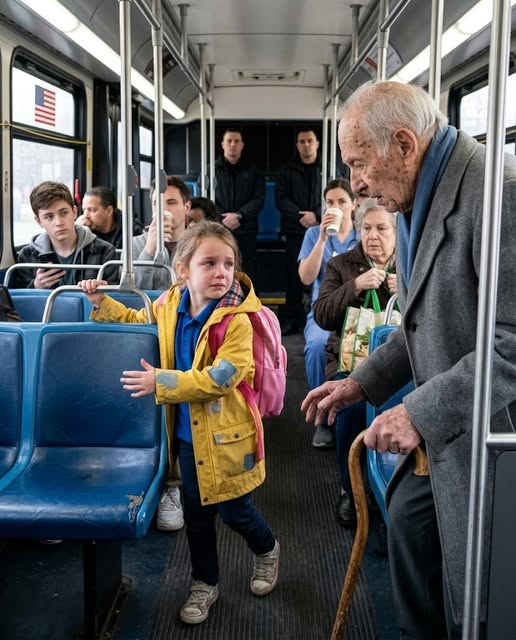
You can sit in my seat — said the little girl to the trembling old man; his bodyguards were watching him.
The morning Emily Torres rode Route 78 alone for the first time, the bus smelled like damp jackets, coffee gone lukewarm in paper cups, and the sharp metal scent of the rail everyone grabbed when the driver hit the brakes.
She was seven years old, small for her age, with a pink backpack hugged tight against her chest and a yellow raincoat her mother had patched three times near the sleeve.
That sleeve bothered her when she moved.
The edge of the patch scratched her wrist.
But her mother had sewn it by hand after a twelve-hour day, so Emily never complained.
Sarah Torres had woken her at 5:22 that morning, before the sun had properly come up, before the apartment heater stopped making that tired knocking sound behind the wall.
The kitchen light buzzed overhead.
A half-empty jar of peanut butter sat beside two slices of toast.
Sarah had packed Emily’s lunch in a brown paper bag and written her name across the front with a marker that was almost dry.
“Big letters,” Emily had said, trying to smile.
“So nobody takes it by mistake,” Sarah told her.
They both knew nobody wanted a peanut butter sandwich and an apple with a soft spot.
Still, Sarah folded the bag carefully.
Care was the only thing she had in abundance.
Rent was due Friday.
The electric bill had a red notice tucked in Sarah’s purse.
The market counter had called the night before and told Sarah she could take the early shift or lose hours for the whole week.
So at 6:18 a.m., she knelt beside Emily at the Route 78 stop and held both of her shoulders.
“You get off right after the pedestrian bridge,” Sarah said.
“I know,” Emily whispered.
“Count five stops.”
“I know.”
“Don’t talk to anyone unless you have to.”
“I know, Mom.”
“And sit close to the driver.”
That one mattered most.
Sarah said it twice.
She had walked the route with Emily three times the week before, counting out the stops in a voice that tried to sound playful and failed every time.
Mothers know when they are asking too much of a child.
Poverty makes them ask anyway.
Sarah zipped Emily’s raincoat and smoothed the patched sleeve with her thumb.
“You call me from the school office if anything feels wrong,” she said.
Emily nodded with the seriousness of someone accepting a mission much bigger than her body.
“I can do it.”
Sarah kissed her forehead.
The kiss was quick because the bus was already sighing to a stop, but Emily felt the worry in it.
She climbed the steps, dropped two coins into the fare box, and looked back once.
Her mother stood on the sidewalk in her work shoes and black jacket, one hand lifted, her smile held together by force.
Emily waved.
Then the doors folded shut.
She sat in the second row by the window, exactly where she had been told.
One stop passed.
She counted it on her thumb.
Two.
She counted it on her pointer finger.
Three.
By the fourth stop, the bus had filled with people who all looked like they were carrying private weather.
A man in a faded warehouse hoodie leaned against the rear door, eyes closed.
Two high school students shared one pair of earbuds and whispered over a cracked phone screen.
A nurse in blue scrubs held a paper coffee cup with both hands, her thumb rubbing the cardboard sleeve until it started to peel.
An older woman with grocery bags kept shifting them between her knees because one bag had a torn handle.
A teenage boy sat in the reserved seat near the front, watching videos without headphones.
Nobody looked especially mean.
That was the part Emily noticed later.
People did not have to be cruel to fail someone.
Sometimes they only had to stay comfortable.
At the fourth stop, the old man climbed on.
He did not look powerful.
He did not look rich.
He wore a gray coat that hung loose on his shoulders, a plain blue scarf, and dark shoes polished so carefully they looked out of place on a city bus floor.
His wooden cane tapped once on the step.
Then again.
His hand trembled around the handle.
The driver waited, impatient but not unkind, while the man pulled himself up.
The bus was already full.
The teenage boy in the reserved seat glanced at him, then looked back at his phone.
The nurse saw him.
The warehouse worker saw him.
The older woman with grocery bags saw him and pressed her lips together.
No one moved.
The old man reached for the pole.
His fingers closed around it, pale and thin, the knuckles rising under skin like little stones.
The bus jerked away from the curb.
His cane slipped sideways.
For one terrible second, his whole body tipped forward.
Emily’s breath caught.
The nurse lifted her coffee cup as if she might reach out, but the moment had already passed.
The old man caught himself.
Barely.
The bus kept going.
Emily looked at her seat.
It was her safe place.
Her mother’s instructions pressed against her ribs.
Sit close to the driver.
Don’t talk to anyone.
Count five stops.
She wrapped both hands around her backpack strap.
The old man tried to steady his breathing.
He was pretending he was fine.
Adults did that a lot, Emily had learned.
Her mother pretended she was fine when she came home smelling like fryer oil and cheap soap.
Her teacher pretended not to notice when Emily saved half her lunch for later.
The landlord pretended to be sorry when he taped notices to doors.
The old man pretended he was not afraid of falling.
Emily knew pretending when she saw it.
She stood up.
The bus swayed under her feet.
Her pink backpack bumped her knees.
“Sir,” she said.
The old man looked down.
His eyes were light brown and wet at the edges.
“You can sit in my seat,” Emily said. “It’s closer to the door.”
Several people heard her.
Nobody spoke.
The teenage boy’s video kept playing, tinny and bright from the phone speaker.
The old man stared at Emily as if he had misheard.
“Are you sure, little girl?”
“Yes,” Emily said.
Her voice was low, but it did not shake.
“I can hold on tight.”
She stepped aside.
The old man lowered himself into the seat with painful care.
His cane rested between his shoes.
His hand brushed the patched sleeve of her yellow raincoat.
He noticed the stitches.
He noticed the backpack pressed to her chest.
He noticed the way she put one foot wide and one foot back to balance herself, like someone had taught her how not to fall.
“Thank you,” he said.
Emily nodded.
“What’s your name?”
“Emily,” she said.
Then she added, because children often offer the truest version first, “My mom calls me Em when she’s tired.”
The old man’s mouth softened.
“I’m Michael.”
“Mr. Michael?”
“If you want to be formal.”
“My grandma says you talk respectful to older people,” Emily said. “So, Mr. Michael.”
The old man laughed.
It was a quiet sound, rough at the edges, like it had been stored away too long.
“Your grandma sounds wise.”
“She makes cornbread and never burns it,” Emily said. “So yes.”
Two rows behind them, a man in a black jacket shifted in his seat.
Another man in a black jacket sat beside him, his phone face down in his palm.
They had boarded before Mr. Michael.
They had been watching him since 5:53 a.m., when he left the side entrance of a private building without his usual car.
They had followed at a distance when he walked to the bus stop.
They had watched him refuse help.
They had watched him climb onto Route 78 like any other old man with a cane.
They were not passengers in the ordinary sense.
They were protection.
And protection has a strange way of becoming control when powerful men grow old.
The first man, Daniel, kept his eyes on Emily’s hands.
The second, Chris, kept his eyes on Mr. Michael’s face.
Neither of them had expected a child.
Neither of them had expected the old man to look at that child like he had just been given evidence in a case he had almost lost.
The bus rolled past a gas station, a shuttered diner, and a school crossing sign blinking yellow in the gray morning light.
Emily counted another stop.
Four.
She whispered it so softly only Mr. Michael heard.
“You’re counting?” he asked.
“My mom said five stops,” Emily said.
“First time riding alone?”
Emily hesitated.
She had been told not to talk to anyone.
But she had already given him her seat, and he looked kind, and he was old enough that he reminded her of her grandfather in photographs.
“Yes,” she said.
“Is your mom working?”
“Breakfast shift,” Emily said. “She makes sandwiches and coffee and sometimes people get mad if the line is long, but she says that doesn’t mean they’re mad at her.”
Mr. Michael’s hand tightened on the cane.
“What does your mom do when people get mad?”
Emily shrugged.
“She says, ‘Have a good day,’ even if they don’t.”
The old man looked out the window.
His reflection trembled slightly in the glass.
Daniel leaned toward Chris in the back row.
“Sir is talking too much,” he murmured.
Chris did not answer.
He was looking at the girl’s patched coat.
There are details money teaches people to stop seeing.
A sleeve mended three times.
A lunch bag folded too carefully.
A child who knows exactly how many stops stand between her and safety.
Mr. Michael had spent most of his life in rooms where people stood when he entered.
Conference rooms.
Boardrooms.
Charity dinners where his name appeared on printed programs.
County meetings where men twice Emily’s size lowered their voices before speaking to him.
Yet that morning, on a crowded Route 78 bus, the only person who moved for him was a seven-year-old girl who had every reason to stay seated.
“Were you afraid?” he asked.
Emily looked down at her shoes.
One lace was fraying near the end.
“A little,” she admitted.
Then she glanced at him.
“But you needed it more than me.”
Mr. Michael closed his eyes.
The bus noise seemed to drop away for him.
For a moment, he was not a powerful man testing his guards or a wealthy old man proving some private point to himself.
He was simply a person who had been seen.
At 6:31 a.m., the bus passed the small public school sign near the corner.
Emily noticed it and lifted her hand.
“Almost,” she whispered.
At 6:33, she pulled the yellow stop cord.
It made a dull bell sound at the front.
The driver glanced in the mirror.
Emily shifted her backpack higher on her shoulders.
“You’ll be okay getting off?” Mr. Michael asked.
“Yes,” she said. “There’s a crossing guard after the bridge.”
The bus slowed.
The doors opened with a sigh.
Emily stepped down carefully, one hand on the rail.
The morning air moved around her raincoat.
She reached the sidewalk, then turned back once.
“Get there safe, Mr. Michael!” she called.
The old man lifted one hand.
The doors closed.
The bus pulled away.
Emily became smaller in the window, walking toward the school crossing with her backpack bouncing and her yellow sleeve flashing every few steps.
No one spoke for almost a full block.
Then Daniel leaned toward Chris and said, “She wasn’t supposed to notice him.”
Mr. Michael heard it.
His head turned slowly.
Daniel froze.
Chris looked down at the phone in his palm.
“Say that again,” Mr. Michael said.
Daniel’s face changed.
Not fear exactly.
Recognition.
The expression of a man who has stepped on a wire and only now heard it click.
“I meant no one was supposed to interfere, sir,” Daniel said.
“That is not what you said.”
The old man’s voice had lost its softness.
The nurse near the front stopped rubbing her coffee sleeve.
The teenage boy in the reserved seat turned off his video.
The older woman with grocery bags stared at the floor as if the scuffed rubber mat had suddenly become fascinating.
Power does not always arrive with shouting.
Sometimes it arrives when a frail old man asks a quiet question and trained men forget how to breathe.
Chris opened a small black notebook.
It was the first mistake.
He had meant to check something quickly.
He had meant to keep it hidden low against his thigh.
But Mr. Michael saw the top page.
Route 78.
6:18 a.m.
Second row.
And under it, written in clean block letters, was Sarah Torres.
Mr. Michael extended his hand.
Chris did not move.
Daniel whispered, “Give it to him.”
Chris passed the notebook forward.
The bus hit a pothole, and the pages fluttered under Mr. Michael’s thumb.
There were other names.
Other times.
Other routes.
But Sarah’s name sat at the top of that page beside a notation that made Mr. Michael’s jaw tighten.
Market counter.
Early shift.
Child rides alone.
The old man read it twice.
Then he looked at the men who had followed him for forty minutes and had watched a little girl do what an entire bus would not.
“Who gave you this?” he asked.
Daniel swallowed.
“We were told to observe only.”
“That was not my question.”
Chris looked toward the driver, then away.
Nobody on the bus wanted to be involved.
Everybody was involved now.
The nurse set her coffee cup on the floor because her hands were shaking too hard to hold it.
The teenage boy shoved his phone into his hoodie pocket.
The old woman with grocery bags finally looked up.
Mr. Michael tapped the notebook once with his finger.
“Who put that mother’s name in your notes?”
Daniel’s mouth opened.
No sound came out.
The bus rolled through another intersection, past a mailbox with a small American flag sticker on its side, past a row of porches still wet from morning mist.
Ordinary things kept passing the windows as if something extraordinary were not unfolding between vinyl seats and metal poles.
At last Chris said, “Your office received a request.”
“My office receives many requests.”
“This one came through the foundation desk.”
Mr. Michael went very still.
The foundation was supposed to help families like Sarah’s.
Rent assistance.
School supplies.
Emergency grocery cards.
Not surveillance.
Not lists of children riding buses alone.
Not mothers marked by shift times and financial pressure.
“From whom?” he asked.
Chris’s eyes flicked to Daniel.
That was the second mistake.
Mr. Michael saw it.
He had spent too many years across tables from men who thought hesitation was invisible.
“Daniel,” he said.
Daniel closed his eyes for half a second.
Then he said, “Your nephew asked for a vulnerability review.”
The words landed strangely on the bus.
Most people did not understand them.
Mr. Michael understood every syllable.
A vulnerability review was what people called it when they wanted to know who could be pressured, bought, embarrassed, or used.
It was a clean phrase for a dirty habit.
“And Sarah Torres?” he asked.
“She applied for assistance three weeks ago,” Daniel said. “Her file was flagged.”
The nurse covered her mouth.
The older woman muttered, “Lord have mercy.”
Mr. Michael looked down at Emily’s name written nowhere on the page and somehow present in every line.
A child had given him her seat.
His own family had put her mother in a file.
There are moments when a life divides itself cleanly into before and after.
For Mr. Michael, it did not happen in a boardroom or a hospital or a lawyer’s office.
It happened on a crowded morning bus, with a wooden cane between his shoes and a patched yellow sleeve still vivid in his mind.
“Call my driver,” he said.
Chris reached for his phone.
“No,” Mr. Michael said.
Chris stopped.
“Call my nephew.”
Daniel went pale.
“Sir, he is in the 7:00 meeting.”
“Then interrupt him.”
The old man handed the notebook back, but only after tearing out the page with Sarah’s name.
He folded it once.
Then again.
He placed it inside his coat pocket like evidence.
The bus driver pulled toward the next stop and finally said, “Mister, do you need me to call somebody?”
Mr. Michael looked at him in the mirror.
“Not yet.”
Daniel had the phone to his ear now.
His hand shook.
That was when everyone on the bus understood something had shifted.
The powerful man was not the one being protected anymore.
He was the one deciding what protection meant.
When the call connected, Daniel lowered his voice.
“He wants you.”
There was a pause.
Then Daniel held the phone out.
Mr. Michael did not take it right away.
He looked through the front window toward the direction Emily had gone.
The school was out of sight now.
But he could still picture her turning back, small and brave, calling for him to get there safe.
He took the phone.
His nephew’s voice came through bright and irritated.
“Uncle Michael, this really isn’t the time.”
The old man’s face did not change.
“You are right,” he said. “The time was three weeks ago when you put a working mother in a file and sent men to watch her child.”
Silence.
Everyone close enough to hear stopped moving.
Then the nephew said something Daniel could not make out.
Mr. Michael listened.
His fingers tightened around the phone.
“No,” he said. “Do not call legal. Do not call communications. Do not call anyone who knows how to turn shame into paperwork.”
The nurse’s eyes filled with tears.
The teenage boy looked down at his shoes.
The old woman with grocery bags nodded once, like she had been waiting years to hear a man with power say something plain.
Mr. Michael continued.
“You will pull Sarah Torres’s assistance application yourself. You will bring it to my house by noon. You will bring every note attached to it. And if one page is missing, I will know.”
His nephew started to protest.
Mr. Michael cut him off.
“Then you will explain to me why a seven-year-old child had more honor on a city bus than the adults using my name from behind a desk.”
He ended the call.
For several seconds, nobody spoke.
The bus doors opened at the next stop.
No one got off.
No one got on.
The driver waited, confused, then closed the doors again.
Mr. Michael handed the phone back to Daniel.
“You both watched her,” he said.
“Yes, sir,” Daniel whispered.
“You watched her mother put her on that bus.”
“Yes, sir.”
“You watched that child count her stops.”
Daniel’s eyes lowered.
“Yes, sir.”
“And you watched her give me her seat.”
Neither man answered.
They did not have to.
Mr. Michael leaned back carefully, suddenly looking old again.
Not weak.
Just tired in the way people become tired when they realize the rot has been close to them for a long time.
“Find Sarah Torres,” he said.
Chris nodded quickly.
“Sir, do you want us to bring her in?”
The old man’s eyes sharpened.
“No.”
Chris went still.
“You will not scare that woman,” Mr. Michael said. “You will not show up at her job like debt collectors. You will not make her feel watched. You will call the foundation desk and have her application approved before her lunch break.”
Daniel looked up.
“And after that?”
“After that,” Mr. Michael said, “I will go to the market counter myself.”
Sarah did not know any of this.
At 8:04 a.m., she was wiping coffee rings from the counter while a man in a work vest complained that his sandwich had too much mustard.
At 8:17, she checked her phone and saw no calls from the school.
That was the measure of a good morning now.
No emergency.
No nurse.
No principal.
No stranger saying her child had missed her stop.
At 9:12, her manager told her someone from the assistance foundation was on line two.
Sarah’s stomach dropped.
She had applied three weeks earlier after the electric notice came.
She had hated every box on that form.
Monthly income.
Overdue balance.
Dependents.
Reason for hardship.
There was never enough room in a box to write the truth.
The truth was that she was tired.
The truth was that she could work and work and work and still lose ground.
The truth was that her daughter had started asking why the lights flickered when the microwave ran.
Sarah picked up the phone with a napkin still in her hand.
“This is Sarah.”
The woman on the other end sounded nervous but kind.
“Ms. Torres, I’m calling about your emergency assistance application.”
Sarah closed her eyes.
“I can send another pay stub if that’s the problem.”
“No, ma’am. That won’t be necessary.”
Sarah opened her eyes.
The market noise blurred around her.
“Your application has been approved,” the woman said.
Sarah gripped the counter.
“The electric balance will be paid directly by end of day, and there is also a grocery card available for pickup. We can mail it, or you may collect it at the front desk.”
Sarah could not speak.
The woman waited.
Then she added, softer, “There was also a note added to your file.”
Sarah’s throat tightened.
“What note?”
“It says, ‘For the mother of the child on Route 78.’”
Sarah looked down at the napkin in her hand.
It had torn clean through where her fingers held it.
“What does that mean?” she whispered.
“I’m not sure,” the woman said. “But Mr. Michael asked that you be told your daughter arrived safely.”
Sarah sat down on a crate behind the counter.
Her manager called her name from the register, then stopped when he saw her face.
For the first time in months, Sarah cried where someone could see her.
Not the secret kind in the bathroom with the faucet running.
Not the silent kind into a pillow after Emily fell asleep.
This was different.
This was a body finally setting down a weight.
At 11:56 a.m., Mr. Michael’s black car pulled up outside the market.
He did not send Daniel in first.
He did not send Chris.
He stepped out slowly with his cane and walked through the front door like any other customer.
A small bell rang above him.
Sarah looked up from wrapping sandwiches.
She knew him at once, though she had never met him.
Emily had described him at school pickup when Sarah asked about the bus.
“He had a blue scarf,” Emily had said. “And he said Grandma sounds wise.”
Now the old man with the blue scarf stood at her counter.
Sarah wiped her hands on her apron.
“Can I help you?”
Mr. Michael removed his hat.
That old-fashioned gesture almost undid her.
“Mrs. Torres?”
“Ms.,” she said automatically, then wished she had not corrected him.
“Ms. Torres,” he said. “My name is Michael.”
“I know,” Sarah whispered.
He nodded.
“Your daughter gave me her seat this morning.”
Sarah’s eyes filled.
“I told her to stay close to the driver.”
“She did.”
“I told her not to move.”
“She made a better decision than many adults around her.”
Sarah pressed one hand over her mouth.
“I’m sorry if she bothered you.”
Mr. Michael’s face changed.
It was not anger at Sarah.
It was grief at the fact that apology had been her first instinct.
“She honored me,” he said.
Sarah looked away because kindness from strangers can feel dangerous when life has trained you to expect a bill attached.
Mr. Michael placed a folded page on the counter.
It was not a check.
It was not a contract.
It was the torn notebook page with her name on it.
“I owe you an apology,” he said.
Sarah stared at the writing.
Route 78.
6:18 a.m.
Second row.
Her own name beneath it.
Her face drained of color.
“What is this?”
“A mistake made by people using my authority,” Mr. Michael said. “And one I intend to correct completely.”
Sarah’s manager had gone silent by the register.
A customer near the coffee station pretended not to listen and failed.
Mr. Michael did not lower his voice.
“Your assistance application should never have been treated as a weakness to study,” he said. “It should have been treated as what it was: a working mother asking for a bridge.”
Sarah’s lips trembled.
“I didn’t want to ask.”
“I know.”
“No, you don’t,” she said, and the words came out sharper than she meant.
Daniel shifted near the door.
Mr. Michael lifted one hand without looking back, stopping him.
Sarah swallowed.
“I’m sorry.”
“Don’t be,” Mr. Michael said. “That may be the first honest thing anyone has said to me today.”
Sarah looked at the folded page again.
Then she looked at the old man.
“My daughter doesn’t know anything about this.”
“She shouldn’t have to.”
“She’s seven.”
“I know.”
Sarah’s voice broke.
“She packed half her lunch back into the bag last week because she thought I needed dinner.”
The words slipped out before she could stop them.
The market seemed to go still.
Mr. Michael closed his eyes.
When he opened them, they were wet.
“Then I am even more in her debt,” he said.
What happened after that did not fix Sarah’s whole life overnight.
Stories like this should not lie about hardship.
One approved bill does not erase years of being underpaid.
One powerful apology does not make rent cheaper.
One kind old man does not rebuild a system that taught a mother to apologize for needing help.
But it changed the next day.
And sometimes the next day is the only miracle a tired person can hold.
The electricity stayed on.
A grocery card arrived.
Sarah’s foundation file was rewritten, not as a vulnerability review, but as emergency support.
The nephew who ordered the review was removed from the program before the week ended.
Daniel and Chris gave written statements.
The foundation desk changed its intake process so assistance applications could not be accessed for private reviews without written approval and a recorded reason.
Those were the official things.
Emily cared about none of them.
What she cared about was that on Friday afternoon, her mother picked her up from school with dry eyes and a paper bag from the diner counter.
Inside were two grilled cheese sandwiches, still warm, and a small cup of tomato soup with the lid taped down.
“Special occasion?” Emily asked.
Sarah smiled.
“Someone reminded me we deserve dinner.”
Emily accepted that answer because children know when not to press too hard.
A week later, a package arrived at their apartment.
No gold ribbon.
No fancy announcement.
Just a plain box with Emily’s name written on the label.
Inside was a new yellow raincoat.
Folded beneath it was a small note.
Thank you for seeing me.
Mr. Michael.
Emily held the coat against herself and ran her fingers over the sleeve.
No patch.
No scratch.
Sarah watched from the doorway, one hand over her mouth.
The old patched coat stayed on the hook for a long time after that.
Not because they needed it anymore.
Because Sarah could not bring herself to throw away the thing that proved what had happened.
A sleeve mended three times.
A crowded bus.
A child who counted five stops and still noticed somebody else almost falling.
Years later, Sarah would still say that was the morning her daughter taught an old man something and reminded her mother of something too.
Kindness is not weakness.
It is evidence.
And sometimes the smallest person on the bus is the only one brave enough to move.

