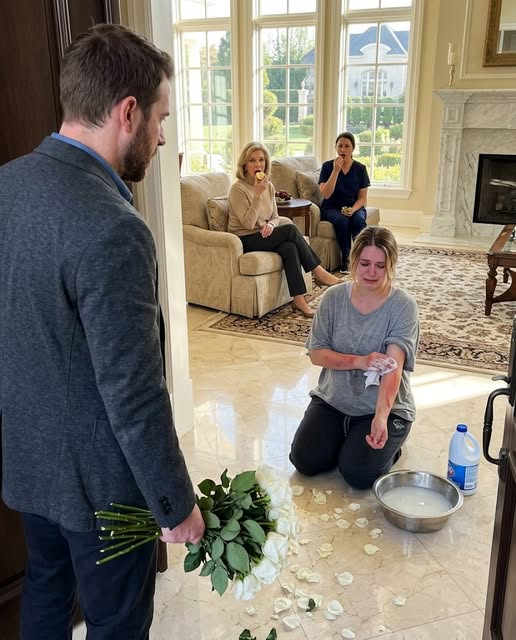
I came home early with white roses, expecting to surprise my seven-month pregnant wife.
A finance meeting ended ahead of schedule, and for the first time in weeks I decided not to call first.
Audrey had texted me that morning that the house felt too quiet, and she always said white roses made even our stiff, expensive rooms feel kind.
I remember thinking, as I parked, that I had been gone too much.
I remember promising myself that I would make dinner, rub her feet, ask about the baby names list we kept pretending to hate.
Then I opened the front door and smelled bleach before I saw anything, and every good thought I carried inside died at once.
The bouquet slipped out of my hand and scattered across the marble.
A silver basin sat on the floor.
Beside it was Audrey, barefoot, seven months pregnant, kneeling on the cold tile with one hand braced under her belly and the other dragging a soaked rag across her forearms.
Her skin was angry and red, rubbed raw in places.
Tears ran down her face, but she made almost no sound.
That silence was what froze me.
It was not the silence of shock.
It was the silence of someone who had learned that crying too loudly would only make everything worse.
She flinched at the soft thud of the roses as though the petals had struck her.
Her shoulders curled inward.
Her eyes flew to me, then instantly down.
“I’m almost clean,” she whispered, scrubbing harder.
“Please don’t let them be upset.
I’m almost done.
I promise.” The way she said it broke something in me.
Audrey was one of the gentlest people I had ever known.
She apologized when strangers bumped into her.
Hearing terror in her voice inside my own home felt like stepping into a nightmare built specifically for me.
Behind her, Helen, the private maternity nurse my mother had found through one of her charitable boards, sat in an armchair eating slices of pear from a crystal dish.
My mother was beside her, spine straight, pearls at her throat, a linen napkin across her lap as though she were attending a boring recital rather than watching my pregnant wife kneel on the floor.
Neither woman looked startled enough.
That told me more than anything else.
Surprise would have meant this was a scene gone wrong.
Their calm meant this was familiar.
“Mr.
Hayes,” Helen said, rising with the smooth composure of someone used to authority, “your wife became emotional again.
She insisted she felt contaminated.
We were trying to calm her before she upset herself further.” My mother added, almost wearily, “She’s been difficult all afternoon.
Pregnancy can make some women theatrical.” I kept my eyes on Audrey.
“By calling her disgusting?” I asked.
My voice sounded strange even to me, flat and cold.
“By telling her that no one in this family would ever believe the word of an orphan over yours?” Helen’s face twitched.
My mother stopped breathing for half a second.
I bent and took the rag from Audrey’s shaking hand.
When I eased her to her feet, the sleeve of her cardigan slid back.
Bruises bloomed along her upper arm, old and new layered together in yellow, violet, and green.
Finger marks.
Not
one grab in a moment of temper.
A pattern.
A history.
I looked at her other arm and saw smaller bruises near the elbow, half hidden beneath the chemical burns.
Something hot and clean moved through me, too precise to be called rage.
This had been happening for more than one afternoon.
Someone had built a routine of cruelty around my wife while I was gone.
I guided Audrey behind me, reached back, and turned the deadbolt.
Then I used the wall panel to engage the interior security locks.
Our front and rear doors clicked shut throughout the house.
Helen stood up fully.
“You cannot lock us in,” she said.
“Watch me,” I replied.
I sent one message to security telling them no one left the property without my direct permission.
I called Audrey’s obstetrician, told the nurse on call that my pregnant wife had chemical burns and severe distress, and followed instructions to flush her skin with cool water immediately.
Then I called our family attorney and said, “Come to my house.
Bring a recorder.
And call the police.”
My mother finally found her voice.
“Have you lost your mind?” she snapped.
“You’re humiliating us over a hysterical misunderstanding.” I turned and looked at her fully for the first time.
“No,” I said.
“I think that’s what you’ve been trying to do to my wife.” Audrey swayed beside me.
I took her into the downstairs laundry room because it had the deepest sink and the brightest light.
I rinsed her arms while she bit her lip so hard I thought she might draw blood.
She kept whispering apologies between breaths.
Every apology felt like another indictment.
When the worst of the bleach was washed away, I wrapped her in clean towels and crouched in front of her.
“Tell me everything,” I said.
“Right now.
No protecting anyone.
No fear.
Tell me.”
At first she shook her head.
Not because she didn’t want to speak, but because terror had settled so deeply into her that defying it looked impossible.
Then she glanced toward the hall where my mother stood and folded in on herself.
“Please don’t leave me alone with her again,” she said.
I promised I wouldn’t.
That seemed to open some hidden door.
The words came out in bursts.
My mother had started visiting nearly every afternoon when she learned Audrey was often alone while I was at the office.
She said she wanted to “help prepare her for motherhood.” Helen began coming with her two weeks later.
They took Audrey’s phone during “rest hours” so she wouldn’t be overstimulated.
They corrected how she sat, ate, walked, folded clothes, spoke to staff, even how she laughed.
If she cried, Helen wrote down that she was unstable.
If she protested, my mother called her ungrateful and threatened to tell me she was having dangerous episodes.
Today’s punishment began over a box of baby clothes.
My mother had brought an heirloom christening blanket from my father’s side of the family and said Audrey’s hands were sticky from body cream.
Audrey reached for the fabric anyway, and my mother recoiled as though she’d witnessed a crime.
She told Helen to get the bleach and said, in front of my wife, “If she wants to carry this child under my roof, she
will learn what clean means.” Audrey said she refused at first.
Then Helen gripped her arm, hard enough to bruise, and my mother told her that if she kept resisting, they would make sure every doctor and every court in the city knew she was too unstable to keep her baby after delivery.
So Audrey did what terrified people do.
She obeyed.
As she spoke, the last several months rearranged themselves in my head with sickening clarity.
The long sleeves in warm rooms.
The way Audrey’s voice changed whenever my mother came by.
The canceled lunches.
The sudden habit of asking whether I was disappointed in her.
The day I found her crying in the nursery and she laughed it off as hormones.
The way she once reached for my phone and then stopped, saying it was nothing.
I had noticed every piece and assembled none of it.
My mother had spent my whole life teaching people to mistake control for care.
I had been arrogant enough to think marriage made me immune to that lesson.
The house had been fitted with a quiet backup camera system after a break-in the winter before.
The obvious cameras were outside and in the entry hall.
My mother knew those.
What she had forgotten were the smaller interior units tucked into service corners and the nursery monitor that recorded audio whenever it sensed voices.
I opened the feed on my phone with Audrey beside me.
The first clip that mattered showed only the service hallway, empty except for a cart of folded towels.
But the voices were clear.
Helen asked, “What if she calls him?” My mother answered, “Then take the phone.
Tell her my son despises weakness.
By the time he notices anything, she’ll look unstable enough for any judge.”
My hands tightened around the phone until my knuckles ached.
Then I opened the second recording.
This one showed my mother standing in the nursery, one manicured hand gliding over the crib railing.
Helen stood beside her with a tablet.
My mother said, “We document every tearsome episode, every refusal, every fixation.
Third trimester is ideal.
Once the baby comes, she’ll either crumble or overreact.
Either way, I get proof that the child needs civilized guardians.” Helen asked whether that was necessary.
My mother laughed softly.
“Necessary? No.
Effective? Absolutely.
Girls like her spend their lives begging to be chosen.
Take away certainty and they do the rest for you.” Beside me, Audrey stopped breathing for a second.
When I walked back into the sitting room and played the recordings out loud, Helen went pale first.
My mother tried the oldest trick she knew: indignation.
“You recorded me in my own son’s house?” she demanded, as if privacy were the crime in the room.
I said nothing.
I let the second clip finish.
Then I held out my hand.
“Give me every note, every report, every message you’ve written about my wife.” Helen stared at my mother.
My mother stared back, and in that look was the full anatomy of cowardice.
Helen finally reached into her leather tote and pulled out a slim folder.
It was filled with dates, fabricated incidents, and observations written in medical language to make abuse sound clinical.
My mother stepped forward.
“She is not fit for this
family,” she said, dropping the mask entirely now that she could feel control slipping.
“She is sentimental, needy, and weak.
She came from nothing, and people who come from nothing cling to children like life rafts.
I was trying to save my grandchild from being raised by panic.” I had known my mother was class-conscious.
I had known she disapproved of Audrey’s years in foster care, her modest background, the fact that she never learned to perform wealth politely.
I had not known she was capable of waging war on a pregnant woman to preserve what she called blood.
Audrey made a small sound behind me, not fear this time, but recognition.
She had heard all of it before.
The paramedics arrived first, followed by two police officers and our attorney, who had come straight from his office.
While the paramedics checked Audrey and called for transport, the officers photographed her arms, the basin, the rag, the spilled bleach, and the bruises on both arms.
Helen, seeing the room turn against her, began talking too fast.
She handed over her phone.
There were messages from my mother telling her to “tighten the routine,” to “note every crying spell,” and to “remind her that orphan girls should be grateful for correction.” One text, sent the night before, said, “Tomorrow we finish this.
I want her scrubbed out of that nursery for good.” My attorney closed his eyes when he read it.
Even he looked shaken.
My mother still tried to command the scene.
She told the officers they were being manipulated by a hormonal woman and an overreacting husband.
One of the officers pressed play on the nursery recording again and let my mother’s own voice fill the room.
That finally ended her performance.
The handcuffs went on Helen first because she had put her hands on Audrey.
My mother watched that happen and seemed honestly stunned that money, posture, and a famous last name were not magic spells.
When an officer asked her to turn around, she said, “Do you have any idea who I am?” I answered before anyone else could.
“Yes,” I said.
“Now I do.”
At the hospital, Audrey’s burns were treated, the baby monitored, and every hour felt like a year.
The doctor said the baby was fine, that the exposure had been on Audrey’s skin rather than inhaled in a confined space, but she wanted Audrey observed overnight because of the stress and contractions.
When the room finally quieted, Audrey stared at the blanket over her knees and said, “I tried to tell you.” The shame in her voice was unbearable because it did not belong to her.
She told me my mother had convinced her I would think she was unstable, dramatic, unfit.
She had started writing messages to me and deleting them before sending because Helen always seemed to know when she reached for her phone.
Later, when I got access to her cloud drafts, I found them: half-finished lines saying, “Please come home early,” and “I don’t think your mother likes being alone with me,” and once, simply, “I’m scared.”
I sat beside her and realized there are apologies too small for the damage they are trying to reach.
I told her the truth anyway.
I told her I had failed her
every time I saw fear and called it hormones, every time I accepted my mother’s help without asking what it cost, every time I let work become an excuse for absence.
Audrey cried then, properly cried, the kind of crying that shakes through the ribs when someone finally believes you.
She leaned her forehead against mine and whispered, “Just don’t ever hand me back.” I promised her I never would.
It was the simplest promise I had ever made and the only one that mattered.
The weeks that followed stripped my mother’s life down to its real size.
We got a protective order.
I changed every lock, code, and staff permission attached to the house.
Helen accepted a deal and testified, which meant prosecutors had her notes, her texts, and her admission that my mother had hired her not for medical care but for documentation and control.
The charges were ugly and deserved: assault, coercive abuse, conspiracy, falsifying medical observations.
My mother was removed from the hospital board she bragged about, then from two charities, then from the family company’s advisory seat when the other trustees heard the recordings.
Reputation had always been the altar where she worshipped.
Watching it collapse was the first consequence she understood.
She asked to see me once before the hearing.
Against my attorney’s advice, I went.
She sat across from me in a gray visitation room with no pearls, no perfect lighting, no audience to charm.
For the first time in my life she looked merely human, and somehow that made her more frightening.
She did not apologize.
She called what she had done discipline.
She said Audrey would have ruined me with need, that marriage had made me soft, that a child from our family deserved a mother who knew how to be shaped.
When I asked whether she ever once cared that Audrey was in pain, she answered, “Pain teaches.” That was the moment something final went dead in me.
I stood up and told her, “You taught my wife to beg for permission to feel safe.
Do not ever call what you did love.”
The recordings, the fake reports, Helen’s testimony, the paramedic photographs, and Audrey’s own statement made the rest straightforward.
My mother was convicted.
Helen lost her license permanently.
There were articles, whispers, invitations that disappeared, relatives who suddenly remembered they had always disliked my mother’s severity.
None of it mattered as much as the quiet in our house after the doors were changed.
Real quiet, not the tight, fearful kind Audrey had lived inside.
The first time she napped on the sofa without startling awake, I had to turn away because gratitude and grief hit me so hard I could barely breathe.
Our daughter arrived five weeks later, furious and healthy, with a cry loud enough to command the entire maternity wing.
Audrey laughed through her tears when she heard her.
We gave her Rose as a middle name.
Not because I wanted to sanctify the day I dropped white roses on the floor, but because Audrey said she refused to let that afternoon take everything beautiful from us.
We moved out of the old house before the baby was three months old.
In the new place, there were no inherited rules, no locked expectations, no rooms my
mother had touched.
There was therapy, and slowness, and the patient work of teaching Audrey that care does not come with humiliation attached.
A year later, white roses sat in our kitchen again.
One stem, then two, then a small vase by the window.
Audrey chose them herself.
Sometimes people ask whether blood should matter, whether a mother deserves forgiveness because she is a mother.
I think about that more than I used to.
Then I remember the sound of Audrey whispering, “I’m almost clean,” while bleach dripped from her hands.
The biggest red flag was never my mother’s cruelty.
It was how elegantly she wrapped cruelty in concern and expected the rest of us to call it love.
I don’t wonder anymore whether cutting her off was too harsh.
I only wonder what would have happened if I had come home one hour later.

