My family called me the ugly high school graduate and erased me from their lives before the cake at my graduation party had even been cut.
I was eighteen then, standing in my parents’ backyard in Ohio wearing a blue dress I had bought from a clearance rack with money earned from babysitting. My name was Hannah Whitaker, and I had just become the first person in my family to earn a full college scholarship.
I truly believed they would finally be proud of me.
Instead, my mother, Denise, looked me over and sighed. “At least she’s smart. God knows beauty skipped her.”
My father, Alan, laughed into his beer.
My younger sister, Sloane — sixteen years old and already treated like a princess — tilted her head and smirked. “You look like somebody’s substitute teacher.”
Everyone laughed.
Cousins. Aunts. Neighbors. People eating the food meant to celebrate my scholarship while watching me shrink smaller and smaller in front of them.
I remember quietly asking, “Why would you say that?”
My mother’s smile disappeared instantly. “Don’t be dramatic, Hannah. We’re joking.”
But it was never really a joke when I was the punchline.
Two weeks later, I left for college carrying two suitcases, $312, and no ride from my parents. By Thanksgiving, my bedroom had become Sloane’s “beauty room.” By Christmas, my name was missing from the family card. By the following summer, relatives spoke about me in the past tense, like I had moved away and become inconvenient to remember.
Eventually, I stopped begging.
Eleven years passed.
I became Dr. Hannah Whitaker, a reconstructive surgeon in Boston specializing in facial trauma and burn recovery. I learned how much pain people carried inside mirrors. I learned beauty was never as simple as cruel people liked to pretend. I built a life filled with quiet mornings, loyal friends, and patients who reminded me every day that dignity could be stitched back together piece by careful piece.
Then an ivory invitation arrived.
Sloane Whitaker and Nathan Reed request the honor of your presence at their wedding.
No handwritten note. No apology. Just my name printed neatly like I had never been erased at all.
I almost threw it away.
But something inside me decided to go.
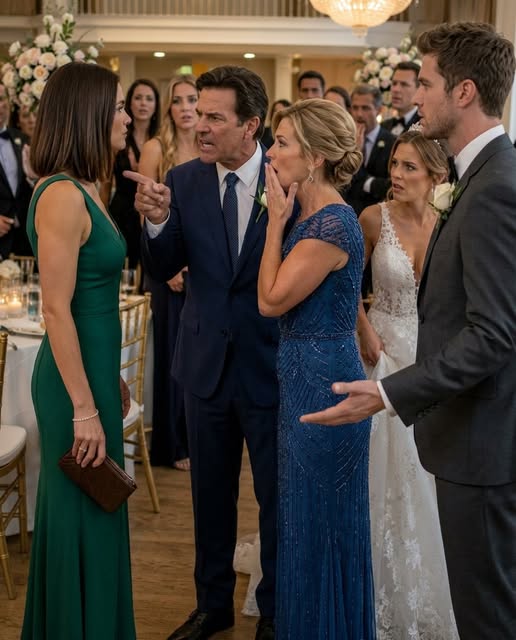
The wedding took place at a vineyard outside Columbus. The moment I walked into the reception hall wearing a tailored emerald gown, the room shifted. My mother’s smile froze. My father stopped talking mid-sentence. Sloane turned pale beneath her flawless bridal makeup.
Then the groom turned around.
Nathan Reed stared at me like he had seen a ghost.
And in front of everyone, he asked, “Hannah… why didn’t you tell me Sloane was your sister?”
For a moment, nobody understood what had just happened.
Sloane’s fingers tightened around Nathan’s arm. “You know her?”
Nathan never looked at Sloane. His eyes remained fixed on me.
“Yes,” he said quietly. “Dr. Whitaker saved my brother’s face after the accident.”
The room fell silent.
Then I remembered Nathan — not from childhood or family gatherings or parties, but from a hospital hallway three years earlier. His younger brother, Evan Reed, had been brought in after a factory explosion outside Worcester. Half of his cheek and jaw had been destroyed. His parents were terrified. Nathan stood outside the operating room with blood on his shirt asking if his brother would ever look like himself again.
I told him the truth.
Not immediately. Not perfectly. But enough to leave room for hope.
Evan needed six surgeries.
I performed four of them.
By the end, he could smile again.
Nathan stepped closer toward me. “My family talks about you like you’re a miracle.”
My mother made a strange choking sound.
Sloane laughed nervously. “That’s funny. Hannah never mentioned knowing you.”
“I haven’t spoken to Hannah in eleven years,” my father said sharply, like my absence was some stain I personally created.
Nathan finally turned toward him. “Why?”
The question sounded simple.
That was exactly what made it dangerous.
My mother’s face flushed immediately. “Families drift apart.”
I smiled faintly. “Is that what we’re calling it now?”
Sloane’s eyes flashed. “Don’t start drama at my wedding.”
“I didn’t start anything,” I replied calmly. “Your fiancé asked a question.”
Nathan looked between Sloane and my parents. “You told me your older sister was unstable. You said she cut everyone off because she was jealous of you.”
My chest tightened.
There it was.
The rewritten version of me.
My mother stepped in quickly. “Nathan, this isn’t the time.”
But Nathan’s voice remained calm. “I think this is exactly the time. Because the woman you described as bitter and broken is the same woman my brother credits with giving him his life back.”
Whispers started spreading through the guests.
Sloane’s perfect bridal smile cracked apart. “You’re embarrassing me.”
“No,” Nathan answered quietly. “I’m asking why your family lied.”
My father stood abruptly. “Young man, be careful.”
Nathan turned fully toward him. “I am being careful. I’m about to marry into this family.”
The words landed heavily.
For the first time in my life, I watched someone outside our bloodline refuse to swallow the version of me they had spent years selling.
And strangely, it hurt more than I expected.
Because after years of silence, being defended doesn’t immediately feel like victory.
It feels like grief waking up inside your ribs and asking why you had to survive so long without anyone witnessing it.

