My family left for London on the morning of my wedding.
By the time I stepped into the small stone chapel in northern Virginia, they were somewhere over the Atlantic with matching passports, oversized coffees balanced on their tray tables, and absolutely no idea what they had chosen to miss.
What stung was not even the trip itself.
It was how ordinary the decision must have felt to them.
My mother texted the cancellation the way people reschedule hair appointments. My father called it unfortunate timing. Lydia sent a selfie in the airport lounge with a neck pillow around her shoulders and a wink in the caption, as if we were all still participating in the same harmless family joke.
Three empty seats waited in the front row while I stood in a white dress holding a bouquet so tightly my fingers shook around the stems.
My name is Elena Ward.
I was thirty-five that spring, old enough to understand that patterns do not become accidents simply because the people causing them smile while they happen.
My family had never specialized in dramatic cruelty. They never screamed. Never disowned me. Never said the sharp, obvious things that make outsiders immediately understand damage.
What they mastered instead was something quieter.
Delay.
Minimization.
Substitution.
They had an almost artistic ability to treat my life as something permanently movable. Every important moment could apparently be celebrated later, after the vacation, after the easier weekend, after Lydia’s newest emergency, after my father’s golf schedule settled down, after my mother’s social calendar stopped orbiting other people’s plans.
There was always another time.
When I was seventeen, they missed my scholarship ceremony because Lydia had a dance showcase across town.
My mother promised we would “make it special later.”
Later turned into takeout Chinese at the kitchen counter while Lydia talked about costumes for two straight hours.
When I made captain during my service years, they sent flowers with a card that said traffic downtown sounded terrible.
When I was recognized at work for leading a response team through a brutal winter crisis that had exhausted half the department, my mother asked me to text pictures because she and my father already had dinner reservations with friends.
No one ever looked me in the eye and said I did not matter.
That was what made it confusing for so long.
They simply behaved as though my importance required no participation from them.
I was the reliable daughter.
The practical daughter.
The one who understood.
The one who could absorb disappointment without making everybody uncomfortable afterward.
For years, I mistook that role for maturity.
I told myself I did not need applause.
I told myself independence was strength.
I convinced myself it was noble to be the person who expected less from others and therefore never burdened them with guilt.
But eventually you realize there is a difference between being strong and being emotionally abandoned in slow motion.
By the time I met Mark, I had become frighteningly good at making myself easy to neglect.
He noticed before I did.
We met at a charity board meeting in Washington during a freezing February rainstorm. I attended in uniform after coming directly from work. He arrived in a plain navy suit that looked expensive only if you understood tailoring.
He introduced himself simply.
“Mark Bennett.”
No résumé attached. No performance.
He asked about my work, and when I answered, he listened all the way through.
Not politely.
Not performatively.
Actually listened.
Most people waited for their turn to speak. Mark listened like details mattered because they belonged to me.
By the end of the evening, he knew where I had served, which parts of the job I loved, which losses still stayed with me, and why I always carried peppermint gum in my pocket during emergencies.
I knew far less about him.
Only that he was calm in a way that steadied rooms.
Funny in a dry, deliberate way that appeared without warning.
And completely uninterested in becoming the center of attention.
I learned the rest slowly.
Careful people reveal themselves in layers.
Mark had built a legal career so respected that people around Washington lowered their voices when they mentioned him. Not out of fear. Out of instinct.
He had been a federal prosecutor.
Then senior counsel.
Then a nominee for a seat on the United States Court of Appeals for the Fourth Circuit.
The confirmation process had dragged on for months beneath political delays, hearings, background investigations, and endless procedural theater.
My family never really absorbed any of it.
At dinners, my father would vaguely ask what Mark was working on, and halfway through the answer Lydia would interrupt to show vacation photos or my mother would pivot into some story about a friend’s renovation project.
They heard the word lawyer and mentally filed him beside tax accountants and corporate consultants.
Background noise.
I remember one dinner especially clearly.
Mark was explaining, carefully and without ego, that the timing of the Senate vote remained uncertain and could affect our wedding week schedule.
Lydia barely looked up from her phone before asking whether London hotels charged extra for early check-in.
My mother immediately became interested in that instead.
The conversation drifted away.
Mark never reacted outwardly, but I watched him do that tiny pause people do when they realize they have disappeared from a room while still physically sitting inside it.
That pause hurt me more than anger would have.
When I told my parents we were engaged, my mother kissed my cheek and immediately asked whether the chapel had enough parking nearby.
My father said, “He seems solid,” in the exact tone men use when discussing refrigerators.
Lydia sent heart emojis and three links to boutique London hotels because she had found a “crazy flight deal.”
I remember standing alone in my kitchen after that phone call ended.
The engagement ring flashed in the window light while I stared at my reflection over the sink.
It felt strangely lonely to receive the happiest moment of my life with the emotional intensity of a weather update.
Still, some stubborn part of me believed the wedding would be different.
Weddings are different, right?
Surely there are moments so obvious that even habitual neglect cannot miss them.
I kept believing that right up until the day before the rehearsal dinner.
The message arrived in the family group chat at 10:14 a.m.
We are leaving for London tomorrow morning.
I reread it three times.
Another message followed immediately after.
This trip has been planned forever. We will celebrate you when we get back.
Then Lydia added a plane emoji.
My father reacted with a thumbs-up.
That was it.
No apology call.
No hesitation.
No recognition that they were announcing they would miss my wedding.
I sat at the kitchen island staring at the screen while memories returned one after another with painful precision.
Another time.
Another time for birthdays.
Another time for graduations.
Another time for promotions.
Another time for helping me move after my apartment flooded.
Another time for the dinner where I needed support after losing a colleague.
Always another time.
And somehow I had spent years rearranging my own hurt into something reasonable enough for them to live beside comfortably.
I should have yelled.
I should have finally said all the things I had swallowed since childhood.
Instead, I sent them the chapel address, ceremony time, and reception details.
Then I put my phone facedown and finished the seating cards.
That was how Mark found me later that night.
Sitting beneath the pendant light in our kitchen with three blank spaces in front of me.
My mother’s name.
My father’s name.
Lydia’s name.
He looked at the cards, then at my face.
He did not insult them.
Did not offer fake optimism.
Did not say they would regret it someday.
Instead, he quietly placed a mug of tea beside my elbow and said, “If they don’t come, we will still be surrounded by the right people.”
Then he kissed the top of my head and went back to checking florist delivery confirmations because real love often looks less like grand speeches and more like somebody calmly helping you continue breathing through disappointment.
The morning of the wedding arrived cold and brilliantly clear.
The sky over northern Virginia looked almost severe in its brightness.
I wore a simple dress because I wanted the day to feel honest instead of theatrical.
Harper, my supervisor, met me near the side entrance of the chapel.
He offered me his arm without making a scene out of it.
He had worked beside me long enough to understand exactly what those empty seats cost me.
“You ready?” he asked quietly.
I surprised both of us by answering yes.
Not because I was unhurt.
But because I was finally beginning to understand that hurt did not get to own every part of me anymore.
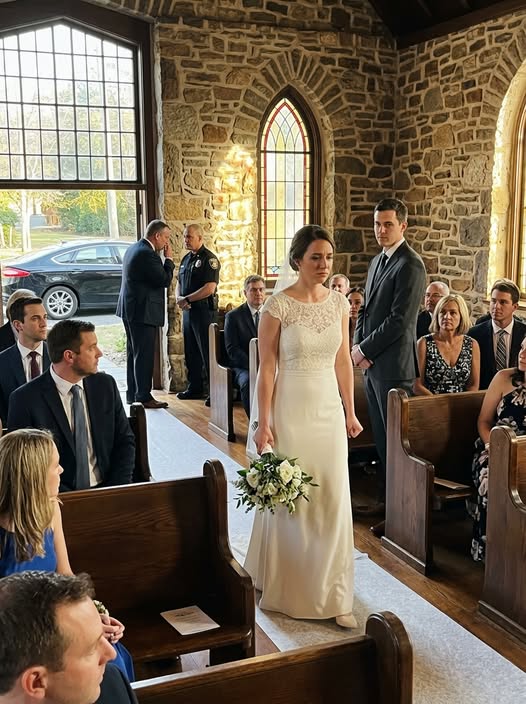
When the chapel doors opened, I expected a modest gathering.
Instead, I stepped into a room so composed it changed my breathing.
The front rows were filled with judges, clerks, senior officers, public servants, and longtime colleagues from both our worlds.
Dark suits.
Pressed uniforms.
Quiet conversation.
Nobody checking phones.
Nobody distracted.
Everyone fully present.
There was discreet security near the entrances and windows, subtle enough not to disrupt the atmosphere but unmistakable if you noticed details.
And then my eyes found the three empty seats.
For one sharp second, the ache returned all over again.
Mark stood at the altar waiting for me in a dark suit, hands folded lightly in front of him.
The moment he saw me, his entire expression softened.
That look steadied me more than anything else in the room.
The music began.
I took one step.
Then another.
Halfway down the aisle, a black sedan rolled slowly past the chapel windows outside.
A suited man stepped out first, scanning automatically before opening the rear passenger door.
The room did not gasp.
It did something quieter.
People straightened unconsciously.
Attention shifted.
Harper leaned closer beside me.
“Keep walking,” he murmured.
So I did.
The man entering behind the security detail was Justice Daniel Mercer.
Even outside legal circles, his name carried weight.
Inside them, it carried gravity.
He had mentored Mark years earlier and rarely attended private events at all.
Two months before the wedding, he had called Mark personally and said that whether the confirmation succeeded before or after the ceremony, he would try to be there.
Neither of us truly believed someone at his level actually would.
But there he was.
Justice Mercer slipped into the front row with a simple nod, no performance attached to it.
The ceremony began.
We had written our own vows.
Mine trembled at first.
Then steadied.
Mark’s voice never wavered once.
There was a moment just after the officiant welcomed everyone when the words landed across the chapel with startling force.
“We gather today to witness the marriage of Elena Ward and the Honorable Mark Bennett.”
A subtle ripple moved through the room.
Not surprise exactly.
Recognition.
Sometime that morning, before I arrived, Mark’s confirmation had officially cleared.
He had become Judge Bennett at dawn.
And still, standing there across from me, he looked at me as though that title mattered less than the promises he was making.
That mattered to me more than the title itself ever could.
After the ceremony, the chapel finally exhaled.
People smiled openly.
Several wiped tears discreetly.
Justice Mercer signed the marriage register as a witness alongside Harper.
Someone photographed the four of us near the chapel entrance with the Virginia sky bright behind us.
The wedding had intentionally been kept private.
No press.
No formal announcement planned until Monday.
But Washington operates like its own nervous system.
Information moves through it almost instantly.
By the time we reached the reception hall, my phone was vibrating nonstop inside my bag.
I ignored it during the speeches.
Ignored it during the first dance.
Ignored it while Mark’s chief clerk hugged me and whispered she had never seen him happier.
Ignored it while we cut cake beneath warm hanging lights.
When I finally checked the screen later that evening, I found eleven missed calls and nineteen messages.
Most were from my family.
Lydia’s messages evolved in stages.
First confusion.
Then panic.
Then embarrassment.
Why is your wedding all over legal Twitter?
Dad says that’s Justice Mercer in the photo.
Elena why does Google say your husband was confirmed to the Fourth Circuit this morning?
My mother left a voicemail that somehow sounded breathless and offended simultaneously.
My father texted:
You should have told us.
I stared at the message for a very long time.
Because the tragedy of it was almost perfect.
I had told them.
Over and over.
I had explained what Mark did.
I had talked about the hearings.
I had explained why the confirmation process mattered.
They simply never listened long enough for the information to become real until the rest of the world started reacting to it.
Their attention had always depended on external validation.
Suddenly other people considered my life important, so now they wanted retroactive participation.
I did not call them back that night.
For once, I refused to let their panic invade something beautiful.
Instead, I stayed beside my husband beneath soft reception lights while guests slowly drifted home.
Later, after sunset, Mark and I slipped outside together.
The air smelled faintly of spring grass and candle wax.
Warm strands of lights glowed overhead.
He asked quietly, “Do you want to talk about London?”
“Not yet,” I answered.
He nodded immediately, accepting the boundary without pushing further.
Not yet was enough for him.
The next morning, before leaving for a quiet weekend near the Chesapeake, I finally called my parents from the front porch while Mark loaded luggage into the car.
My mother answered instantly.
She sounded distressed.
But underneath it, I heard something uglier.
Embarrassment.
“Elena, why would you let us leave without explaining?” she demanded. “Do you know how this looked when people started sending photos?”
I stared at the hydrangeas lining the walkway.
Then I asked the only question that mattered.
“How what looked?”
Silence.
In the background, Lydia said loudly enough for me to hear:
“Mom, just tell her we didn’t know he was important.”
There it was.
The entire truth stripped clean.
I closed my eyes.
“That is the problem,” I said quietly. “You think the mistake was missing an important man. The mistake was missing your daughter.”
My father took the phone next.
He sounded calmer, but tired.
He said they “didn’t realize the wedding was that serious.”
The sentence was so absurd I almost laughed.
“Serious isn’t the point,” I told him. “Love is.”
Then years of swallowed disappointment finally surfaced.
I reminded him about the scholarship ceremony.
The promotion dinner.
The birthdays.
The emergencies.
The decades of another time.
I told him those empty seats did not hurt because Mark had status.
They hurt because I had spent my entire life hoping there would finally be one moment where they chose me without needing the world to convince them first.
They returned from London four days later and asked to meet.
Part of me wanted to refuse forever.
Another exhausted part wanted to say yes simply to stop carrying the weight of it.
Mark told me he would support either choice.
In the end, I agreed to meet them at a café in Alexandria.
Neutral territory.
No childhood dynamics.
No family house.
No escape routes through routine.
My mother arrived in a camel coat that probably cost more than my wedding dress.
My father looked visibly older than he had the previous week.
Lydia wore oversized sunglasses indoors until she realized nobody else was performing.
The apology started badly.
My mother blamed timing.
Lydia said I could have communicated more clearly.
I let them continue until they had fully constructed the fragile tower of excuses they needed to protect themselves.
Then I dismantled it piece by piece.
I reminded Lydia about the birthday dinner where Mark discussed the confirmation vote and she interrupted him to ask about London hotels.
I reminded my mother that she once worried more about whether Senate hearings would interfere with bridal brunch reservations than whether either of us was surviving the pressure.
I reminded my father that he joked quiet men were usually just paper-pushers.
None of them denied it.
What changed the room was not my anger.
It was my father’s honesty.
He rubbed his hand over his face and finally said, “We thought you’d be fine no matter what we did.”
Even Lydia looked stunned by that sentence.
He kept talking quietly after that.
He said I had always seemed self-contained.
Capable.
Less fragile than the rest of them.
Lydia needed rescuing.
My mother needed emotional management.
He convinced himself I needed nothing at all.
“That wasn’t trust,” he admitted. “That was laziness.”
For the first time in my life, he sounded ashamed instead of defensive.
My mother cried after that.
Not delicately.
Messily.
The kind of crying people do when they finally recognize themselves clearly and dislike what they see.
Lydia did not cry.
She asked whether we were cutting them off entirely.
I told her I was done participating in a family structure where my role was to absorb neglect silently to keep everybody else comfortable.
I said contact would not continue normally because normal was exactly what created this.
If they wanted a place in my life, they would have to build it intentionally.
The same way everyone else in that chapel already had.
Boundaries are less dramatic than revenge.
There were no cinematic exits.
No screaming in the rain.
No perfect moment where everyone transformed overnight.
There were months of smaller things instead.
My father calling when he promised he would.
My mother attending charity events important to me without complaining or leaving early.
Apologies that arrived without excuses attached afterward.
Questions that sounded genuinely interested instead of socially required.
Lydia changed slowest.
For a long time, every conversation drifted back toward status.
The wedding guests.
Justice Mercer.
The robe.
The court.
The photographs circulating online.
Every time she did it, I ended the conversation.
Eventually she stopped asking about prestige and started asking about my actual life.
That difference mattered.
Through all of it, Mark never weaponized his position.
Never flaunted the robe.
Never enjoyed their guilt.
At home, he remained exactly who he had always been.
The man stacking dishes while I unlaced my heels.
The man who noticed silence without demanding explanations for it.
The man who understood that care is usually repetitive, quiet, and deeply unglamorous.
Months later, when my parents had shown enough consistency to deserve cautious trust, we invited them to dinner.
Not a holiday.
Not an event.
Just dinner.
Pasta.
Candles.
Bread warming in the oven.
Lydia arrived last and looked around our dining room almost suspiciously, as if expecting hidden luxury or some dramatic evidence of elite political life.
Instead she found ordinary peace.
Mark chopping basil in the kitchen.
My father opening wine carefully with trembling concentration.
My mother arranging bread on the table.
Harper stopping by briefly to return a borrowed book.
No performance.
No spectacle.
Just presence.
Halfway through dessert, my mother reached across the table and finally said the one sentence I had needed for years.
“We didn’t miss a judge that day,” she whispered. “We missed you.”
It did not erase anything.
Some hurts do not vanish simply because they are acknowledged.
But it was the first time she had spoken the truth without trying to soften, excuse, or decorate it.
And that mattered.
I still do not know whether forgiveness is a doorway or a staircase.
I only know it was never something they automatically deserved because we shared blood.
And it was never something I owed just to keep peace inside the family.
It arrived slowly, if it arrived at all.
Through consistency.
Through changed behavior.
Through presence.
Some wounds become scars that still ache in bad weather.
Some empty seats remain visible even after the room fills again.
But on the morning I walked up that chapel hill in northern Virginia, surrounded by people who had chosen to stand beside me, I finally understood something I wish I had learned much younger.
Family is not built from last names.
Or obligation.
Or history alone.
It is built from attention.
From effort.
From showing up when it counts.
And sometimes the clearest warning sign is not cruelty at all.
It is how easily people convince themselves they can love you later.