Three days before Christmas, I learned that the woman I had spent twenty-eight years trying to please had been waiting for the perfect moment to hurt me.
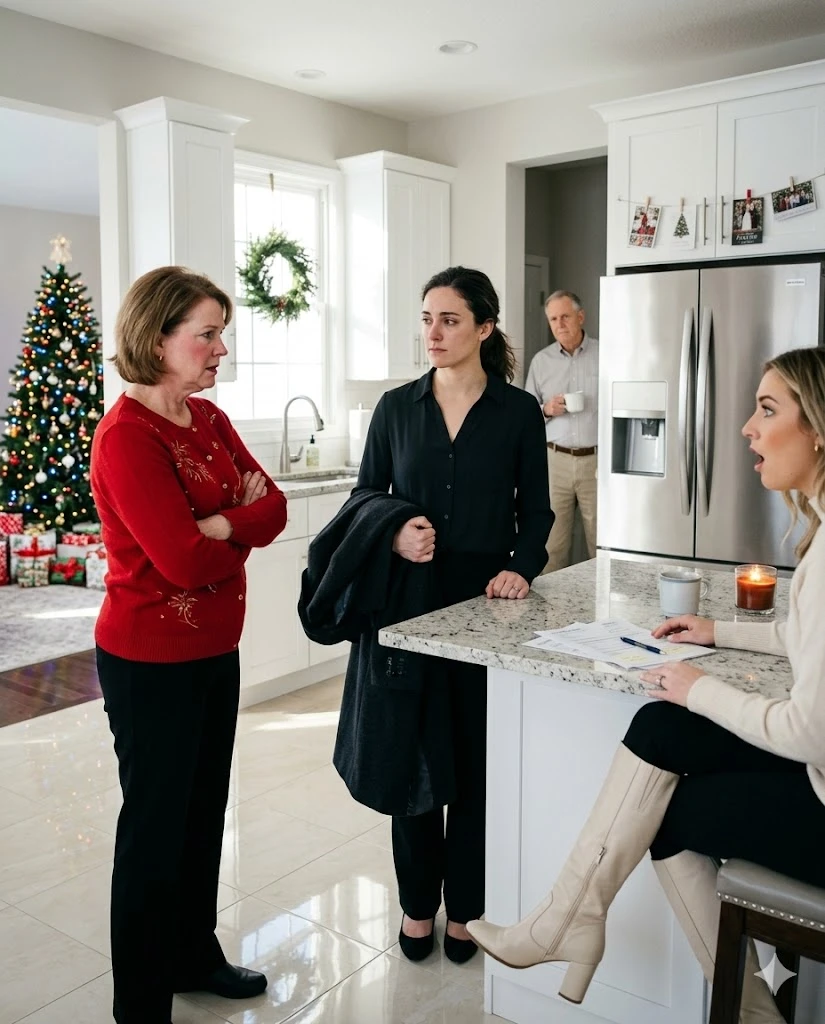
It happened in my mother’s kitchen, under bright pendant lights, beside a cinnamon candle burning too heavily for a room that had never felt warm to me.
My name is Natalie Mercer, though later I would learn that Mercer had never truly belonged to me in the way I had been taught to believe.
I was standing with a cup of coffee cooling in my hands while my sister Brooke performed distress beside the stainless steel refrigerator.
Her cream-colored designer boots looked new.
Her mascara was untouched.
Her lower lip trembled every time my mother glanced toward her, like they had rehearsed the same helpless expression before I arrived.
The paperwork sat spread across the granite counter between us.
Twenty-five thousand dollars.
A luxury SUV.
A monthly payment bigger than my own rent had been when I first moved to Chicago.
My mother, Diane Mercer, tapped the document with one polished nail.
“Just sign it, Natalie,” she said.
She spoke as if she were asking me to pass a serving spoon, not attach my credit and financial future to Brooke’s latest disaster.
Brooke sniffed.
“It’s only until I rebuild my credit.”
That sentence might have worked if I had not spent years watching her call every consequence temporary.
Two maxed-out cards had been temporary.
The personal loan she stopped paying had been temporary.
The apartment lease my father quietly covered had been temporary.
Her emergencies always had a way of becoming everyone else’s responsibility.
“You mean after the two maxed-out cards and the personal loan you stopped paying?” I asked.
Brooke’s face tightened instantly.
“You always judge me.”
“No,” I said. “I just read contracts before signing them.”
The kitchen lights reflected off the polished countertops my mother loved showing off to guests.
Granite imported from Italy, she always bragged.
The funny thing about working in finance is that your brain starts storing dates even when your heart wishes it would not.
You remember when someone remodeled a kitchen.
You remember when tuition payments happened.
You remember when a parent said there was no money for you, then somehow found money for someone else.
My mother crossed her arms.
That posture had ruled my childhood more than any law.
When Diane Mercer crossed her arms, everyone in the house learned to calculate what would make her least angry.
“Your sister needs help,” she said.
“Then she needs a cheaper car.”
Brooke shoved her chair back hard enough to scrape the tile.
“You think you’re better than everyone because you moved to Chicago and got some corporate job.”
“I think I’m responsible.”
Wrong answer.
The air changed.
Even my father, Arthur, who had been pretending to check something near the hallway, looked down into his coffee like it might hide him.
Then my mother smiled.
Not the holiday smile she used for neighbors.
Not the soft smile she gave Brooke when Brooke cried.
This was smaller.
Sharper.
Cruel.
“Well,” she said, “if that’s your attitude, don’t bother coming to Christmas until you apologize.”
I felt something inside me go quiet.
For years, Christmas had been the season where I tried hardest.
I brought the right gifts.
I offered to help in the kitchen.
I ignored Brooke’s digs about my job and my apartment and my single life.
I swallowed my mother’s little punishments because some childish part of me still believed one perfect holiday might make me feel chosen.
This time, I reached for my coat.
“Fine.”
That was when she said it.
Calmly.
Almost pleasantly.
“Actually… surprise. It’s time you heard this. You were adopted.”
The room went perfectly still.
Even Brooke stopped moving.
The refrigerator compressor hummed behind her, absurdly loud in the silence.
My father closed his eyes.
That was how I knew it was true before anyone proved it.
I stared at my mother, really stared, and saw not guilt, not tenderness, not the grief of a woman forced into a difficult truth.
I saw satisfaction.
She wanted me devastated.
She wanted me to collapse.
She wanted all the years of trying to become visible to sharpen into one final proof that she still controlled the ground beneath my feet.
Instead, something inside me unlocked.
Like a deadbolt sliding free after years.
“Thank God we aren’t related,” I said.
The smile vanished from her face.
Brooke’s mouth fell open.
“What did you just say?”
“I said thank God,” I repeated. “Because for twenty-eight years, I thought there was something wrong with me.”
Nobody moved.
“I thought maybe I was selfish, cold, difficult, impossible to love,” I continued. “I kept wondering why nothing I did was enough while Brooke could destroy everything she touched and still get treated like a princess.”
Brooke made a disgusted sound.
My mother’s cheeks flushed.
“We fed you,” she snapped. “We clothed you. We gave you a home.”
“And you reminded me constantly,” I said. “Every birthday. Every argument. Every favor. You treated love like a debt collector.”
My fingers tightened around my coat sleeve until the wool wrinkled beneath my hand.
There is a kind of anger that does not explode because it has already learned the shape of every room.
Mine had lived quietly for years.
Now it stood up.
“Do you know the worst part?” I asked. “I still kept trying to earn it.”
For one brief second, my mother looked uncertain.
Then the mask returned.
“If you walk out that door, you are no longer part of this family.”
I laughed once.
Softly.
Almost with relief.
“I never really was.”
Then I walked out.
The December wind hit my face like ice water.
For the first time in my life, I could breathe without wondering who would charge me for the air.
The drive back to Chicago took four hours through freezing rain and dirty snowbanks along the interstate.
My phone buzzed nearly the whole way.
Mom.
Brooke.
Mom again.
Arthur once.
Brooke twice.
I ignored them all.
By the time I reached my apartment, I was not crying.
That surprised me.
I had cried over smaller things in that family.
A forgotten birthday.
A graduation where Brooke’s breakup somehow became the main event.
A Thanksgiving where my mother told guests I was “practical, not affectionate,” as if withholding warmth from a child could later be blamed on the child.
But that night, I did not cry.
I thought.
People lie.
Paperwork usually does not.
If Diane had hidden something as enormous as my adoption for twenty-eight years, what else had she hidden in drawers, offices, court files, and bank statements?
Three weeks later, I stood in the Cook County records office holding a sealed envelope containing my original birth records.
The paper smelled old, dusty, and official.
That smell mattered.
It did not smell like my mother’s cinnamon candles.
It smelled like something that had no reason to flatter anyone.
My biological mother’s name sat in faded black ink across the top.
Eleanor Vance.
I stared at those two words for a long time.
They looked elegant.
They looked impossible.
They looked like a door I had never known I was allowed to knock on.
The file said Eleanor and her husband, Daniel Vance, had died when I was still very young.
It also referenced a custodial trust established by my biological grandparents for my benefit.
That line stopped me cold.
Trust.
Benefit.
Beneficiary.
I worked in financial analysis.
Tracing transactions was literally my job.
Numbers tell stories if you know where to look, and they are far less sentimental than people.
I requested every record I could legally obtain.
Then I hired a probate attorney named Marianne Cole for one consultation, which became three, then became a formal review.
Marianne was not dramatic.
She wore gray suits, used yellow sticky notes with terrifying precision, and had the gift of making silence feel expensive.
On January 18, she slid the first copy of the trust ledger across her desk.
“Were you aware this account existed?” she asked.
“No.”
Her expression did not change.
“That may become important.”
Three nights later, I sat at my kitchen table surrounded by cold takeout containers, printed records, and glowing spreadsheets.
Outside my window, Chicago glittered in the hard blue cold.
Inside, my childhood began reorganizing itself into columns.
The first transfer appeared in August 2012.
Thirty-five thousand dollars withdrawn from the custodial trust account established in my name.
Same month Diane remodeled her kitchen.
Granite countertops.
Imported fixtures.
Italian tile.
I remembered asking about college application fees that year and being told money was tight.
My stomach dropped.
I kept digging.
September 2015.
Fifty thousand withdrawn.
The exact semester Brooke started attending her private college in California.
Another transfer.
Twenty thousand.
Brooke’s Europe trip after graduation.
Another.
Fifteen thousand.
Credit card consolidation.
Then smaller amounts.
Furniture.
Dental work.
A luxury handbag Diane later claimed was a gift from Arthur.
Each withdrawal had authorization.
Each authorization had signatures.
Diane Mercer.
Arthur Mercer.
Sometimes a note described the expense as “household support related to ward welfare.”
Ward.
I sat with that word for a long time.
Not daughter.
Ward.
There is a moment when betrayal stops hurting and becomes evidence.
That was the moment.
By afternoon the next day, Brooke emailed me at work.
Nat please. The bank is repossessing my car Friday. Mom said you have money saved. I just need temporary help.
I stared at the screen.
The audacity might have been funny if it had not been built on the bones of my life.
I opened a new document.
By sunset, the attachments were ready.
Probate trust documents.
Historical withdrawal ledgers.
Property renovation invoices.
Tuition records.
A drafted civil complaint for fiduciary fraud and embezzlement.
Then Marianne called.
“There is one more item in the probate packet,” she said. “It appears to be a sealed personal letter from Eleanor Vance. Addressed to you.”
I drove to her office so fast I barely remembered parking.
The envelope was cream-colored and fragile at the corners.
My name was written on the front in handwriting I did not recognize.
To Natalie, when she is old enough to ask why.
My hands finally shook.
Inside, my biological mother wrote as if she knew time would be stolen from her.
She told me that she loved me.
Not in a dramatic way.
In ordinary details.
She wrote that I liked sleeping with one fist under my cheek.
That Daniel sang badly but kept trying because it made me laugh.
That my grandparents wanted me protected if anything happened to them.
Then came the sentence that changed everything again.
“If Diane and Arthur ever tell you there was nothing left, ask for the annual trust statements. They are legally required to preserve them.”
I read it twice.
Then a third time.
My biological mother had known enough to warn me.
Or perhaps she had simply known people.
Either way, she had tried to leave me a thread back to myself.
Diane had cut it.
Brooke called while I was still sitting in Marianne’s parking lot.
This time, I answered.
“Natalie,” Brooke sobbed. “Please. My car is being taken Friday.”
“Did you know?” I asked.
Silence.
Not confusion.
Not outrage.
Silence.
That was the answer.
Finally she whispered, “Mom said it was basically family money.”
Family money.
My dead biological grandparents’ money.
My education money.
My safety net.
My proof that someone had loved me before I learned to beg for scraps.
I hung up.
Back at my apartment, I opened the email draft.
I addressed it to Diane Mercer, Brooke Mercer, and Arthur Mercer.
I attached everything.
Then I typed:
You spent my biological family’s money for years while telling me there was nothing left for my education.
You stole from an orphaned child to fund vacations, remodels, and Brooke’s lifestyle.
I will not file this lawsuit under one condition.
You will never contact me again.
No calls.
No holidays.
No emergencies.
No apologies.
If any of you attempt to reach me after today, I will forward every document to the district attorney’s office.
Happy holidays.
Natalie.
I hovered over the button.
Then I added one more line.
Eleanor Vance loved me better in one letter than you did in twenty-eight years.
I hit send.
Ten minutes later, my phone started exploding.
Mom.
Dad.
Brooke.
Again.
Again.
Again.
By the end of the hour, I had seventy-three missed calls.
Panic sounds very different from arrogance.
Diane left the first voicemail.
Her voice was high, furious, breathless.
“How dare you accuse us after everything we sacrificed?”
Arthur left the second.
“Natalie, please call. This can be discussed privately.”
Brooke left the third.
“You’re ruining my life over money you didn’t even know existed.”
That one almost made me laugh.
They still believed the crime was my discovery, not their theft.
I forwarded the voicemails to Marianne.
Then I blocked Brooke.
I did not block Diane or Arthur immediately.
Part of me wanted evidence if they threatened me.
Part of me, smaller and more embarrassing, wanted to hear whether one apology would appear.
It did not.
What came instead was strategy.
Diane sent a long email claiming the withdrawals had supported my upbringing.
Marianne replied with a spreadsheet demonstrating that the dates and amounts corresponded to Brooke’s expenses and home improvements.
Arthur claimed he had only signed what Diane placed in front of him.
Marianne replied that fiduciary responsibility did not disappear because a husband preferred not to read.
Brooke claimed she never understood where the money came from.
Marianne replied with the August 2012 authorization naming Brooke as transfer beneficiary.
After that, the messages changed.
Less outrage.
More begging.
Then offers.
Diane offered to “explain in person.”
Arthur offered to repay a small portion over time.
Brooke offered to stop asking for car help if I would “drop the legal threats.”
I realized then that none of them wanted forgiveness.
They wanted containment.
They wanted the documents to stay quiet.
They wanted my pain private, because private pain had always been their favorite version of me.
I filed the civil complaint in February.
Not because I needed revenge.
Because silence had already cost me twenty-eight years.
The case did not move like a movie.
There were filings, delays, affidavits, account requests, bank subpoenas, and letters written in language so dry it almost disguised the cruelty underneath.
But numbers kept doing what numbers do.
They stayed where the Mercers had left them.
The kitchen remodel invoice matched the trust withdrawal within six business days.
Brooke’s tuition payment matched another withdrawal within forty-eight hours.
A travel agency invoice matched the Europe transfer.
Credit card consolidation records matched the fifteen thousand.
Diane’s lawyer tried to argue that the trust had indirectly benefited me because household stability benefited all children in the home.
Marianne looked at me after reading that argument and said, “They are calling theft shelter.”
That became the sentence that carried me through mediation.
At the first settlement conference, I saw my mother for the first time since Christmas.
She looked smaller.
Not weaker.
Just less mythological.
Brooke sat beside her, crying silently in a way that might once have pulled me across the room.
Arthur would not meet my eyes.
Diane did.
“You destroyed this family,” she said.
I waited.
Marianne touched my sleeve, a quiet reminder to let counsel speak.
But I answered anyway.
“No. I documented what you did to it.”
Diane’s face tightened.
“You were always ungrateful.”
For the first time, the word did not land.
It floated past me like a paper scrap.
There are insults that only work while you are still auditioning for love.
I had stopped auditioning.
The settlement came two months later.
They agreed to repay a significant portion of the trust funds, sign a written admission of improper withdrawals, cover part of my legal fees, and relinquish any claim to future contact or family obligation.
The district attorney referral remained my choice if they violated the agreement.
Diane cried when she signed.
I did not.
Arthur tried to apologize in the hallway.
“I should have stopped it,” he said.
“Yes,” I answered. “You should have.”
He waited for more.
There was nothing more to give.
Brooke sent one final message from a new number.
“So that’s it? I lose my sister over money?”
I stared at it for a long time.
Then I replied once.
“No. You lost me when you knew.”
I blocked that number too.
After the settlement, I did something I had postponed for weeks.
I searched for Eleanor Vance’s family.
My biological grandparents were gone, but my mother had a younger sister named Ruth.
She was seventy-two, living in Vermont, and when I called her, she went silent after I said my name.
Then she cried.
Not delicately.
Not performatively.
She cried like someone who had been waiting beside a phone for twenty-eight years.
“We looked for you,” Ruth said. “We were told the adoption was closed and that contact would harm you.”
I closed my eyes.
Another lie.
There are families made from blood that still behave like strangers.
And there are strangers who say your name once and make it sound like a home you never knew you had.
Ruth sent photographs.
Eleanor holding me in a yellow blanket.
Daniel asleep on a couch with me on his chest.
My grandparents standing behind a birthday cake with one candle.
I printed the photos and placed them on my desk.
Not because they erased the past.
Because they returned witnesses to it.
The money eventually arrived in installments.
It helped, of course.
Money always matters, especially when someone has stolen the version of your life it was meant to protect.
But the money was not the part that changed me most.
The letter did.
Eleanor’s letter became proof that I had not imagined wanting tenderness.
Someone had loved me before I became useful.
Someone had planned for me.
Someone had written “my darling Natalie” without asking me to co-sign anything, fix anything, earn anything, or apologize for existing.
The next Christmas, I did not go to Diane’s house.
I did not wait for an invitation.
I did not wonder whether Brooke got another car.
I flew to Vermont and spent Christmas with Ruth.
Her house smelled like pine, coffee, and woodsmoke.
Nothing was imported from Italy.
Nothing gleamed for guests.
A crooked angel sat on top of the tree, and Ruth apologized for the gravy twice even though it was perfect.
During dinner, she asked if I wanted to hear stories about Eleanor.
I said yes.
She told me my mother hated olives, loved thunderstorms, and once drove three hours to return a lost dog to its owner.
She told me Daniel cried at commercials and built terrible bookshelves.
She told me they had wanted me fiercely.
After dinner, Ruth handed me a small box.
Inside was a silver locket with a photograph of Eleanor and Daniel.
“It was supposed to be yours,” she said. “I kept it in case.”
In case.
Those two words nearly broke me.
Someone had kept something for me without turning it into a debt.
I cried then.
Not like I had lost.
Like I had finally been allowed to grieve the right people.
Months later, I changed my legal middle name to Eleanor.
I kept Natalie because it was mine now, regardless of who had spoken it first.
But I added Eleanor because love, once recovered, deserves somewhere official to live.
People sometimes ask why I did not pursue criminal charges after the civil settlement.
The honest answer is complicated.
Part of me wanted to.
Part of me still might have if the agreement had been violated.
But the repayment, admission, and permanent severance gave me what I needed most at that moment.
A record.
A boundary.
A life no longer funded by silence.
I share this story because betrayal in families often arrives dressed as obligation.
Co-sign this.
Forgive that.
Help your sister.
Respect your mother.
Keep the peace.
Come to Christmas.
But peace built on theft is not peace.
It is a hostage note with wrapping paper.
If someone uses family as a weapon, you are allowed to put the weapon down.
If someone reveals the truth only to hurt you, you are allowed to use that truth to free yourself.
And if the people who raised you kept score of every meal, every coat, every roof, maybe what they gave you was not love.
Maybe it was leverage.
For years, I thought family was something you survived.
Something you earned by sacrificing enough pieces of yourself.
I was wrong.
Blood alone means nothing.
Adoption alone means nothing.
Shared holidays mean nothing if they are built on fear, debt, and silence.
Love proves family.
So does honesty.
So does the person who keeps a locket for twenty-eight years just in case you come looking.
My mother thought telling me I was adopted would break me.
Instead, it explained me.
It explained why I had always felt like an unpaid invoice in Diane Mercer’s house.
It explained why Brooke’s needs became emergencies while mine became character flaws.
It explained why I had spent my whole life trying to earn a place in a family that had been spending the only inheritance my real family left me.
Diane wanted my devastation.
She got my investigation.
Brooke wanted my signature.
She got my silence forever.
Arthur wanted privacy.
He got a legal record.
And me?
I got Eleanor’s letter.
I got my own money back.
I got Christmas in Vermont.
I got to breathe.
Most of all, I got the truth.
Not the cruel version my mother weaponized in her kitchen.
The real one.
The one written in faded ink by a woman who loved me enough to leave instructions.
The one hidden in ledgers my adoptive family thought I would never read.
The one that finally taught me this:
Sometimes the family you lose was never really yours.
And sometimes the truth that was meant to destroy you becomes the first thing that ever sets you free.

