By the time Amelia Carter stepped into her sister’s graduation party in downtown Nashville, she had already survived the worst thing her family had ever done to her.
They had convinced her, for a while, that she was exactly who they said she was.
A failure.
A disappointment.
A dropout too unstable to finish what she started and too embarrassing to keep around.
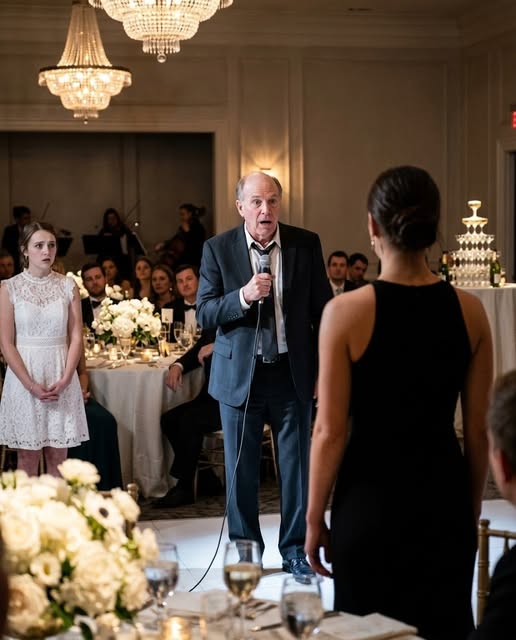
The ballroom was soaked in expensive light.
Crystal chandeliers glittered above white floral arrangements the size of small trees.
A string quartet played near the bar.
Servers in black drifted past with trays of champagne.
Everything about the room was designed to announce success, discipline, money, pedigree.
It was exactly the sort of event her parents loved.
A celebration that doubled as a performance.
Amelia paused just inside the entrance and let the room settle around her.
Five years ago, she would have folded under the pressure of being there.
Her shoulders would have rounded.
Her eyes would have gone to the floor.
She would have felt herself becoming smaller with every breath.
Not tonight.
Tonight, she stood in a fitted black dress with her hair pinned back and her makeup clean and understated.
She looked like a woman who belonged anywhere she decided to stand.
No one recognized her.
That almost made her laugh.
She had inherited her father’s dark eyes and her mother’s cheekbones, but time had changed the rest.
So had peace.
So had hunger, humiliation, long work nights, and the kind of self-made confidence that doesn’t come from praise but from surviving without it.
Across the room, her younger sister Cassandra glowed in white.
The medical school graduate was receiving congratulations like she had been practicing for this moment her entire life.
She hugged professors.
She smiled for pictures.
She tilted her head just enough when older guests praised her dedication.
She looked beautiful.
She also looked exactly the way she had always looked when the spotlight was on her: completely at home.
Amelia’s mother floated between tables in pale blue silk, one hand light on each guest’s arm, greeting people with polished warmth.
Her father stood near the center of the room, laughing too loudly, clapping men on the shoulder, performing pride for anyone who would watch.
Amelia watched them all and felt something strange.
Not grief.
Not even anger, at first.
It felt more like observation.
As if she were finally seeing them from the outside instead of from the child-sized place she had once occupied inside their judgment.
When Amelia was twenty-two, she had left school midway through her degree in graphic design.
That was the family headline.
The part they repeated to friends.
The easy version.
The harder truth had started long before that.
Her father never respected what she loved.
When she brought sketches to the dinner table in high school, he called them doodles.
When she won a local design award her sophomore year of college, he said it was nice, but asked when she planned to pursue something serious.
Her mother was worse in quieter ways.
She spoke in comparisons, not insults.
Why can’t you be more focused like Cassandra? Why does everything seem so hard for you? Why do you always make things emotional?
Cassandra, younger by three years, grew up inside a different climate.
She was pretty in the neat, polished way their mother understood.
She was excellent at school.
She chose medicine, and with that choice came immediate respect.
Discipline.
Prestige.
A future that made her parents walk taller in public.
Amelia tried not to resent her.
She often failed.
By the end of college, Amelia’s anxiety had become a private collapse.
She stopped sleeping properly.
She stopped eating regularly.
Her thoughts turned loud and frantic.
Assignments took ten times longer than they should have because she would stare at a screen until panic made her hands shake.
She told her mother once that she thought something was wrong, that she didn’t feel like herself anymore.
Her mother sighed and told her everybody gets stressed.
Her father told her not to use mental health as an excuse for laziness.
Those words stayed in her body even after the night she packed one suitcase and left.
That night, she had stood in the foyer of the family home with tears she refused to let fall.
Her father told her that dropping out meant she was throwing away every opportunity they had paid for.
Her mother, furious and cold, said the sentence Amelia would hear in her head for years after.
“You’re nothing but an ugly college dropout.
Don’t you dare show your face at this family again.”
Cassandra stood in the hallway and watched.
She did not speak.
Amelia left with a dead phone battery, a half-full wallet, and enough pride to keep walking.
The first year after that was brutal.
She slept on a friend’s couch in a cramped apartment where the heat rattled all night.
She waitressed breakfast shifts, folded clothes at a department store, and cleaned offices after midnight.
In between, she taught herself new design software through free tutorials online.
She made logos for hair salons, food trucks, dog groomers, anyone who needed work cheap and fast.
She took clients who questioned every invoice and asked for endless revisions.
She saved everything she could.
There were nights she cried into a pillow because she was hungry and too proud to ask for help.
There were mornings she woke up with a clenched jaw and told herself to keep moving, just one more day.
The turning point came quietly.
A neighborhood bakery hired her for a rebrand.
The owner loved the work and recommended her to a restaurant group.
That group sent her to a local developer.
The developer recommended her to a boutique hotel.
Amelia’s portfolio sharpened.
So did her rates.
She learned how to present concepts with authority, how to say no to bad clients, how to build systems instead of surviving one project at a time.
At twenty-five, she moved into her first apartment alone.
At twenty-six, she hired a freelance copywriter, then a junior designer.
At twenty-seven, she signed the lease on a small office with frosted glass and her agency name on the door: Archer Lane Creative.
She had chosen the name because it sounded strong and directional, nothing like the frightened version of herself that had once begged to be understood.
She did not tell her family.
At least, she never contacted them.
Which was why the invitation to Cassandra’s graduation party shocked her.
The envelope arrived on thick cream paper with gold lettering.
No
handwritten note.
No apology.
No explanation.
Just an invitation.
Amelia almost threw it in the trash.
Then she imagined her parents toasting their success, speaking about resilience and sacrifice as if they had modeled either one.
She imagined Cassandra smiling while guests praised the family.
And she realized she wanted to see them.
Not to reconcile.
To measure the distance.
So she went.
At first, she stayed near the edges of the room, accepting a glass of wine and saying little.
Then one of her father’s colleagues approached her on the terrace.
The woman smiled warmly and said, “You must be connected to the Carters.
I’ve heard so much about their older daughter.
Such a remarkable success story.”
Amelia felt a prickle go down her spine.
The woman went on, cheerful and unaware.
Mr.
Carter always talks about her.
He keeps samples of her design work in his office.
Apparently she’s overseas these days, expanding the business.
Too busy to come tonight.
Amelia listened in complete stillness.
That was when she understood the full shape of the betrayal.
Her family had not simply erased her.
They had taken the life she built after they threw her away and turned it into a polished anecdote that made them look like proud, supportive parents.
Somewhere along the way, they had learned enough about her success to harvest it for social value.
She was useful to them only once she had become impressive.
When she returned inside, she caught Cassandra speaking with a circle of classmates.
“My sister just made some bad choices,” Cassandra said, voice soft with fake sadness.
“My parents did everything they could.
At some point, you can’t help someone who doesn’t want help.”
Amelia stood behind a pillar and listened, the words hitting harder than she expected.
Cassandra wasn’t repeating a family line because she was trapped.
She was repeating it because it benefited her too.
Because being the good daughter only worked if someone else played the bad one.
Then Amelia saw someone else in the room.
Professor Howard.
He had been one of her professors during her best semester, the one who had once held up her branding project in class and said, “This is what it looks like when talent is disciplined by instinct.” He had emailed her twice after she withdrew, asking if she was all right.
She had never answered, too ashamed.
Now he spotted her from across the ballroom and froze.
“Amelia?” he said when he reached her.
She smiled, suddenly emotional.
“Hi, Professor.”
He stared at her for a second, then looked around the party as if trying to understand what she was doing there.
Before he could ask, another man joined them—the dean of the medical school, introduced moments earlier by a mutual client who happened to know Amelia’s agency.
The dean had already asked for her business card.
He needed a full rebrand for a community outreach initiative and had heard she was the best creative director in the city.
Then Amelia’s father stepped onto the stage and tapped a spoon against his glass.
The room quieted.
He began with praise for Cassandra, naturally.
Brilliant.
Tireless.
Compassionate.
The future of medicine.
Guests smiled and nodded.
Cassandra lowered her chin with practiced humility.
Then came the line that made Amelia’s blood
go cold.
“We are also proud tonight of our older daughter, who couldn’t be with us because she’s overseas expanding her successful design company.
She has always made us proud.”
For a split second, the room remained still.
Professor Howard looked at the stage.
Then at Amelia.
The dean followed his gaze.
“You know her?” the dean asked quietly.
Amelia set down her glass.
“You have no idea,” she said.
What happened next began almost by accident.
Professor Howard, who had spent thirty years in academia and had no patience for public fraud, said her name aloud.
Clearly.
“Amelia Carter.”
Heads turned.
The quartet faltered.
Cassandra’s smile vanished.
Amelia’s mother went rigid, her expression shifting so quickly from composure to alarm that Amelia almost admired it.
Her father stared into the crowd, still holding the microphone, until his eyes finally landed on Amelia.
The look on his face was unforgettable.
He looked like a man seeing a ghost he had already used in a speech.
Amelia started walking toward the stage.
Guests parted without being asked.
Her mother moved first, slipping through the crowd with that same gentle smile she used to deliver private cruelty.
“Amelia,” she said under her breath when she reached her, fingers digging lightly into Amelia’s forearm, “this is not the place.”
Amelia looked down at her mother’s hand until she let go.
“It became the place when he put me in his toast,” Amelia said.
Onstage, her father recovered enough to force a laugh.
“There seems to be some confusion,” he said into the microphone.
The dean stepped forward before Amelia could answer.
Confusion was clearly not a word he appreciated.
“I don’t think so,” he said.
He lifted Amelia’s business card between two fingers.
“This is the creative director I was just speaking with.
The one recommended to us for a major institutional contract.” He glanced at her father.
“If your daughter has been overseas all this time, who exactly has been presenting her work at your office?”
A murmur spread through the room.
Amelia turned sharply to her father.
So that part was true.
He had been showing her portfolio.
Her mother inhaled once, quietly.
Then the final crack opened from an unexpected place.
One of Cassandra’s friends, a woman named Elise whom Amelia vaguely recognized from social media, stepped forward clutching her phone and a folded printout.
She looked pale and furious.
“I think everyone should see this,” Elise said.
She unfolded the paper and handed it to the dean, then to Professor Howard.
It was an email screenshot.
Sent that afternoon from Cassandra’s private address to Elise and two other friends.
Amelia only needed to see the first few lines to understand what it was.
In the email, Cassandra had warned her friends that if an “unstable older sister” named Amelia appeared at the party, they were to tell staff she was not invited.
She described Amelia as bitter, manipulative, and known for making scenes.
She also wrote, with astonishing carelessness, that their father might need to “smooth things over” by continuing the family story that Amelia was traveling abroad, because “people respond better to successful distance than messy truth.”
The line that killed the room came next.
“She built something decent in design,” Cassandra had written, “so at least Dad
can finally use that.”
Silence spread outward like a spill.
Amelia looked at her sister.
Cassandra had gone white.
Her father demanded the paper.
The dean did not hand it over.
Professor Howard read the most damning lines aloud, not loudly, but with enough clarity that the nearest tables heard every word.
Those tables repeated it to the next tables.
Within seconds, the ballroom was full of whispers too sharp to hide.
Amelia’s father attempted outrage.
He said the email was being taken out of context.
He said this was a family matter.
He said Amelia had always been difficult.
Every sentence made him look smaller.
Then Amelia did something he had never expected her to do.
She took the microphone from his hand.
Not with force.
With calm.
The room fell silent again.
“My father is right about one thing,” she said.
“I am his older daughter.
And yes, I left college.
What he forgot to mention is that I left after years of being told what I loved didn’t matter, after asking for help and being mocked for struggling, and after being thrown out of my family home.”
She turned slightly, just enough to include her mother and sister in the line of sight.
“For five years, none of them called to see if I was alive.
But apparently they kept close enough watch to collect my work, rewrite my life, and present my success as proof of their parenting.”
No one moved.
“I built my company without their money, their support, or their name.
The only thing they gave me was the certainty that if I wanted a life, I would have to build one where their voices could no longer reach me.”
Her voice did not shake.
That, more than anything, changed the room.
Because there was no hysteria for them to dismiss.
No breakdown to point at.
Just a woman speaking plainly about what had been done to her.
She handed the microphone back to the stunned event coordinator instead of to her father.
Then she stepped off the stage.
The aftermath came quickly.
Two members of the hospital board approached Amelia before anyone from her family could stop them.
One apologized for what she had just been forced to endure.
The other asked if she would still be willing to discuss the branding contract the following week.
The dean, embarrassed but direct, said he wanted to work with her precisely because she had handled herself with more composure than anyone else in the room.
Professor Howard squeezed her shoulder and said, “I should have kept writing until you answered.”
Amelia smiled through the sting in her eyes.
“I’m glad you stopped me tonight instead.”
Across the ballroom, the celebration had collapsed into clusters of whispers.
Cassandra was crying now, mascara threatening at the corners, while her friends kept their distance.
Amelia’s mother attempted to speak to several guests and was met with the polite, freezing smiles reserved for people who have just been exposed.
Her father stood alone for a full thirty seconds before he seemed to realize no one was coming to rescue him.
He came to Amelia at last near the exit.
For one irrational instant, some ancient part of her thought maybe this was it.
Maybe the apology.
It wasn’t.
“You
humiliated this family,” he said.
Amelia almost laughed.
“No,” she answered.
“I introduced them.”
He stared at her, speechless.
Her mother joined him, voice low and urgent.
“Whatever happened, it did not need to happen in public.”
Amelia looked at her carefully.
“That is the first honest thing you’ve said in years.
Of course you didn’t want it public.
Public truth ruins private myths.”
Cassandra approached last.
Her face was blotched, her composure gone.
“I was trying to protect them,” she said.
Amelia held her gaze.
“From what?”
Cassandra opened her mouth, then closed it.
From the answer, Amelia thought.
From having to admit they chose one daughter by destroying the other.
Amelia left before anyone could try again.
Outside, the Nashville air felt warm and electric.
The noise of the city moved around her like normal life continuing, indifferent to family drama and chandeliers and ruined speeches.
She stood on the sidewalk for a moment and let herself breathe.
Her phone buzzed.
It was an email from the dean’s office confirming a meeting for Tuesday.
A second message came from Professor Howard: Proud of you.
Always was.
Then a third, from an unknown number.
Her mother.
We need to talk.
Amelia stared at the screen.
Five years ago, that message would have had the power to drag her straight back into the old ache.
Now it just looked late.
She did not answer that night.
In the weeks that followed, several things happened.
The medical school signed with Archer Lane Creative.
The project became her agency’s largest contract to date.
A few guests from the party quietly reached out to her with versions of the same sentence: We had no idea.
Cassandra’s graduation photos never appeared online.
Her father’s professional circle grew noticeably cooler.
The colleague who had told Amelia how proudly he spoke of her later admitted, mortified, that he had believed every word.
Her parents sent messages that moved through familiar stages—defensiveness, blame, selective memory, then the careful language of people who want reconciliation without accountability.
Amelia ignored most of them.
Cassandra sent one long email three weeks later.
It included excuses, tears in typed form, claims about pressure and expectation, and one line that mattered.
I knew it was wrong, but it was easier when the story made me look good.
That sentence, brutal in its honesty, was the closest thing Amelia ever got to the truth from her sister.
She never fully reconciled with any of them.
That surprised some people.
They liked clean endings, public scenes followed by forgiving embraces.
But Amelia had learned something harder and more useful than forgiveness on command.
An exposed lie is not the same thing as a repaired wound.
Months later, she passed a mirrored wall in her office and caught her own reflection—upright, focused, carrying a portfolio for a client presentation.
For one second she saw the girl with the suitcase layered beneath the woman she had become.
Not erased.
Integrated.
That was the part her family never understood.
They thought they had defined her by rejecting her.
In reality, they had only revealed themselves.
And even now, if Amelia let herself think about that ballroom, the moment that stayed with her most was not her father’s cracked smile or her mother’s panic or Cassandra’s collapse.
It
was the instant before she spoke, when the entire room still believed the story they had told.
Sometimes that is the clearest red flag of all: not the cruelty itself, but how effortlessly some people can decorate it and call it love.
Whether her parents deserved forgiveness stopped being the real question.
The real question was why it had taken her so long to realize that surviving them was never the same thing as needing them back.

