I was sixty-five years old when I finally used the bank card Richard left me in the family court hallway.
By then, the card had been sitting in a shoebox for five years.
I had looked at it on nights when I had nothing in the fridge but a jar of mustard and one egg.
I had looked at it after cleaning houses until my knuckles cracked open from bleach.
I had looked at it the first winter the room above the garage grew so cold that my breath fogged near the window.
Every time, I put it back.
People might call that stubborn.
Maybe it was.
But some things are not money when they first touch your hand.
Some things are an insult with numbers embossed on the front.
Richard and I were married for thirty-seven years.
That is almost a whole adult life.
It is long enough to learn the sound of a man’s footsteps when he is angry, the exact amount of milk he wants in his coffee, the way his shoulder tightens before he says something cruel and then claims he was only being honest.
It is long enough to raise children together, bury parents together, buy appliances on payment plans, sit through school concerts, fight over bills, whisper in hospital waiting rooms, and build a life so repetitive it feels permanent.
Then one day, Richard decided he wanted a different ending.
He did not shout when he left.
That would have been easier to remember as cruelty.
He was calm.
He was neat.
He had filed the papers, divided the accounts, moved his better jackets out of the closet, and rehearsed his new voice before the hearing.
The family court hallway in Chicago smelled like burnt coffee, old paper, wet coats, and the lemon cleaner somebody had used too heavily near the bathrooms.
Fluorescent lights hummed above us.
A bailiff called names from a doorway.
A young couple argued quietly beside a vending machine.
I remember all of that because my mind grabbed small things to keep from grabbing his sleeve.
The divorce decree was still warm from the printer.
I held it in both hands, even though the paper was only a few pages.
It felt heavier than a suitcase.
Before he left, he reached into his wallet and took out a bank card.
He put it in my palm.
“Here you go,” he said.
He had the softest voice when he was being the coldest.
“This should be enough for you to survive for a few months.”
I looked down at the card.
There was a sticky note wrapped around it with a four-digit PIN written in his square, impatient handwriting.
He did not say he was sorry.
He did not say he wished things had been different.
He did not even ask where I was going to sleep that night.
He just gave me a card and turned me into a loose end.
I wanted to throw it back at him.
I wanted to tell him that thirty-seven years of marriage deserved more than a plastic rectangle and a sentence.
I wanted to remind him of the fever he had at forty-two when I sat up for three nights counting his breaths.
I wanted to remind him of our daughter’s braces, our son’s broken arm, the winter his hours got cut and I stretched one chicken into four dinners.
I did not say any of it.
I had learned that some people do not hear your pain as pain.
They hear it as proof that they still matter.
So I closed my hand around the card and nodded once.
Richard walked toward the elevators.
His shoes made a clean tapping sound on the hallway floor.
He never looked back.
That was the first time I understood how a person could be abandoned in a public place and still feel invisible.
I found the room above the garage three days later.
It belonged to a woman from church whose nephew had moved out and left behind a twin mattress, a folding chair, and a little table with one bad leg.
The ceiling slanted low over the bed.
The radiator clanked like it had opinions.
When it rained, water came through near the window frame and collected in a mixing bowl I kept on the floor.
The first night, I sat on the mattress with my coat still on and opened my purse.
The divorce papers were folded in half.
My bus pass was tucked in the side pocket.
Richard’s card sat at the bottom like a dare.
I picked it up.
I turned it over.
I read the sticky note again.
Then I put it in a shoebox with my birth certificate, old photos of the kids, a spare key, and a Social Security card I had carried since before laminated cards were common.
I told myself I would use it only if I had no other choice.
That was the first lie.
Over the next five years, I had many other choices.
Bad ones.
Painful ones.
Humiliating ones.
But choices.
I cleaned homes where the refrigerators had entire drawers for cheese.
I scrubbed glass shower doors while women younger than my children complained about streaks I could not see without my reading glasses.
I watched an elderly man on Sundays so his daughter could go grocery shopping and sit in her car for ten minutes without anyone needing her.
I collected cans from alleys on mornings when the city was still gray and quiet.
I learned which grocery store marked down bread after 7 p.m.
I learned how to make instant noodles feel like a meal by adding a boiled egg when I had one.
I learned which laundromat had machines that gave two extra minutes if you hit the button twice.
I told my children I was fine.
Emily never believed me all the way.
She has my mother’s eyes and my old suspicion.
“Mom, do you need anything?” she would ask.
“No, sweetheart,” I would say.
“I’m good.”
Daniel asked less often, but when he did, he sounded like he had been carrying the question around all day.
“Seriously, Ma. Tell me.”
I never did.
Not because they would not help.
They had helped.
Emily sent grocery cards when she could.
Daniel paid my phone bill twice and pretended he had done it by accident.
But they had children, rent, car payments, dental bills, and the regular American math that keeps a family tired.
I was their mother.
I was supposed to be the person who said things were handled.
So I handled them.
I kept the card in the shoebox.
Sometimes, on nights when my stomach cramped from eating too little, I took it out and looked at it under the lamp.
I would tell myself it was three thousand dollars.
Not a fortune.
Not security.
Just a short bridge.
Then I would hear Richard’s voice.
Enough for you to survive for a few months.
And the bridge would turn back into a slap.
Maybe that sounds foolish.
Maybe hunger should have made me practical faster.
But a woman can survive poverty and still refuse to let the person who discarded her write the final receipt.
The card stayed untouched.
Then, a few days before everything changed, I fainted outside my door.
I had been carrying a small bag of groceries, mostly rice, bananas, canned soup, and a loaf of bread with a discount sticker on it.
The neighbor’s mailbox leaned at the edge of the driveway.
I remember seeing it twice, then not at all.
My keys hit the concrete first.
The soup cans rolled under the porch steps.
Somebody’s dog started barking.
When I opened my eyes, Mrs. Alvarez from the downstairs unit was kneeling beside me with one hand on my shoulder.
“Sarah,” she kept saying.
“Stay with me.”
I wanted to tell her I was fine.
That was my favorite sentence.
It had gotten so much use that it barely meant anything anymore.
But my mouth would not make the words.
At the hospital intake desk, a nurse wrapped a paper band around my wrist and asked questions while I stared at the scuffed floor.
Name.
Date of birth.
Emergency contact.
Insurance.
Current medications.
Pain level.
I had never liked rating pain.
Pain is not a number.
Pain is a room you have been living in so long you stop noticing the wallpaper.
The doctor came in after the blood work.
He was younger than my son.
That made me feel old in a new way.
He looked at the chart, then at me, and his face changed.
Not dramatically.
Doctors learn not to scare you with their faces.
But something in his eyes sharpened.
“If you don’t take care of this now,” he said, “things could get worse very quickly.”
I tried to ask how quickly.
He answered with instructions instead.
Follow up.
Medication.
Rest.
More testing.
Do not skip meals.
Do not ignore dizziness.
Do not wait if symptoms return.
He handed me a discharge packet and a prescription.
The paper felt official and useless at the same time.
Medicine costs money.
Follow-up visits cost money.
Rest costs money when the hours you lose are the hours that buy groceries.
That night, I sat on the edge of my bed in the room above the garage and listened to rain tap the window.
The radiator knocked.
The bowl under the leak filled drop by drop.
I took the shoebox from the closet.
Inside were old proofs of a life that had kept shrinking.
Birth certificate.
Divorce papers.
School photos.
A Mother’s Day card with Emily’s handwriting from third grade.
Daniel’s Little League picture with one missing front tooth.
Richard’s bank card.
The plastic had a dull look now, like it had aged in the dark.
I held it for a long time.
I thought about the doctor’s face.
I thought about my children getting a phone call they were not ready for.
I thought about every meal I had skipped to protect a pride no one could see.
Pride has its place.
It can keep you standing when shame wants you on the floor.
But pride cannot fill a prescription.
Pride cannot read a lab result and change it.
Pride cannot drive you to an appointment or pay for another night of monitoring.
I put the card in my purse.
The next morning, I wore my cleanest sweater.
It was navy blue, with one cuff stretched out and a tiny mended spot near the hem.
I pinned my hair back, although the gray pieces around my face refused to stay where I put them.
I checked the bus schedule twice.
The bank was not far, but the trip felt like walking into a room where Richard was still waiting to laugh at me.
The branch sat on a busy street with a glass front and a little American flag near the entrance.
Inside, the air was cold enough to make my hands stiff.
The floor smelled freshly mopped.
Somewhere behind the counter, coffee had burned in a pot.
There were three people in line ahead of me.
A man in work boots deposited a check.
A young mother bounced a baby on her hip while trying to find something in her wallet.
An older man argued softly about a fee.
Normal life was happening all around me.
That almost made it worse.
My emergency was just another Tuesday morning.
I stood there with the card in my purse and the prescription folded beside it.
A wall clock showed 10:42 a.m.
I remember the time because I stared at it whenever my courage started to leave.
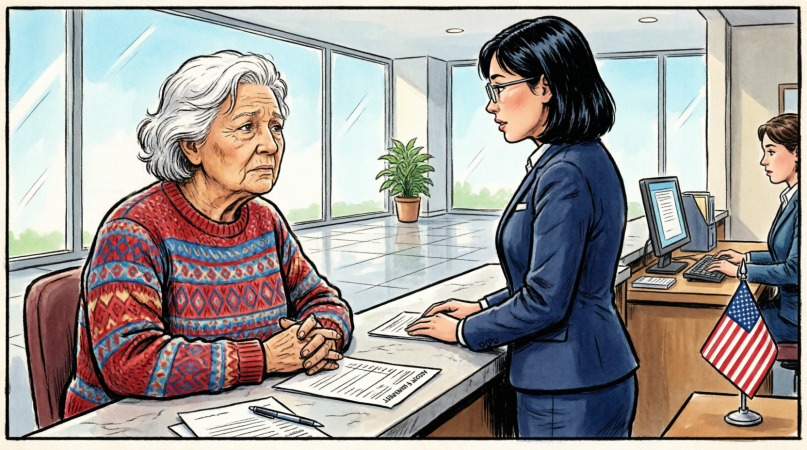
When the young teller called me forward, I almost turned around.
She could not have been more than twenty-four.
Her hair was pulled back neatly, and she wore a small necklace shaped like a star.
“Good morning,” she said.
“How can I help you?”
I took out the card.
My hand shook, so I placed it on the counter instead of handing it to her.
“I want to withdraw everything, please.”
She smiled and picked up the card.
“Of course.”
There are moments when you can feel the future pause.
This was one of them.
She typed the numbers.
She looked at the screen.
The automatic smile stayed on her face for one second too long.
Then it faded.
She typed again.
Her eyes moved from the screen to the card, from the card to my ID, and from my ID back to the screen.
“Can you confirm your full legal name for me?” she asked.
I did.
She asked for my date of birth.
I gave it.
She asked whether I had any other account information.
“No,” I said.
“My ex-husband gave me that card five years ago.”
The word ex-husband changed something in her expression.
She kept her voice careful.
“Ma’am,” she said, “there aren’t three thousand dollars here.”
I felt the counter under my palms.
Hard.
Cool.
Too clean.
For one second, I was back in the family court hallway with Richard’s voice in my ear.
This should be enough for you to survive for a few months.
Of course, I thought.
Of course he lied.
Of course the final cruelty would be small and stupid and perfectly timed.
I heard myself ask, “Then how much is there?”
The teller did not answer.
That was the first thing that truly frightened me.
If the account had been empty, she could have said so.
If the card had expired, she could have said so.
If there were ten dollars and twelve cents, she could have printed a receipt and avoided eye contact.
Instead, she swallowed.
Then she looked past me toward the glass office behind the counter.
“I need my manager,” she said.
Every person who has ever had too little money knows the humiliation of being passed to a manager.
It makes you feel like a problem with shoes.
I stepped back from the counter.
My purse strap slid down my arm.
The teller left her station and went to the office.
Through the glass, I saw her speaking to a woman in a dark blazer.
The woman looked toward me.
Then she looked down at whatever was on the screen.
Then she stopped moving.
I have seen people pause before bad news.
This was different.
This was recognition.
The manager came out slowly, carrying a sealed envelope.
It was cream-colored and thick, the kind people use when they want paper to feel important.
Across the front, in handwriting I knew even from several feet away, was my full name.
Sarah Carter.
Not Mrs. Richard Carter.
Not an account number.
Not a case file.
My name.
My legs felt unreliable.
The manager did not hand it to me immediately.
She set it on the counter beside the old bank card.
The young teller stood behind her, pale and silent, one hand pressed to the edge of the desk.
“Mrs. Carter,” the manager said, “before we go any further, I need you to understand something.”
The branch noise seemed to drop away.
The printer stopped.
The line behind me blurred.
Even the air-conditioning sounded far away.
I looked at the envelope.
Richard had written my name on it.
Five years earlier, I would have said I knew every version of his handwriting.
The fast grocery-list scribble.
The tight signature on tax forms.
The large block letters he used on boxes when we moved.
This was different.
The letters looked slower.
Careful.
Almost afraid.
“What is this?” I asked.
The manager glanced at the teller, then back at me.
“It was left with instructions,” she said.
My mouth went dry.
“What instructions?”
She took a breath.
“That it should only be given to you if you came in person with the original card.”
The original card.
The one I had hated.
The one I had refused.
The one I had kept anyway.
For five years, I had thought the card was the end of my marriage.
Now it sat beside a sealed envelope like it had only been the key.
I reached for the counter because the floor seemed to tilt.
The bank manager moved as if she might come around to help me, but I shook my head once.
Not yet.
I did not want anyone touching me while Richard’s handwriting stared up from the counter.
The teller whispered, “I’m so sorry.”
I do not know what she was sorry for.
The confusion.
The delay.
The numbers she had seen.
The fact that a stranger had accidentally witnessed the moment my past cracked open.
The manager slid a printed account history halfway toward me.
I saw dates.
I saw deposit lines.
I saw more than one.
I saw Richard’s name in a column where I had expected nothing but emptiness.
My breath caught so sharply it hurt.
Five years of refusing the card.
Five years of hunger, cold rooms, taped shoes, and lies told gently to my children.
Five years of believing I had been priced at three thousand dollars and dismissed.
The envelope waited beside my hand.
Inside it was the part Richard had not said in court.
Inside it was the sentence he had left behind when he walked to the elevators without turning back.
The manager touched the edge of the seal.
“Are you ready for me to open it?” she asked.
I looked at my name in Richard’s handwriting.
Then I looked at the bank card.
Then I realized the cruelest thing he had done might not have been leaving me.
It might have been letting me misunderstand why.
And when the envelope opened, the first line made my knees give out.
The bank manager guided Sarah into the glass office with one careful hand hovering near her elbow, as if she thought the older woman might collapse before reaching the chair.
Maybe she was right.
Sarah sat slowly.
The office smelled faintly of printer ink and peppermint gum. Outside the glass walls, the bank continued moving in soft ordinary motions—customers signing receipts, keyboards clicking, someone laughing near the entrance—but inside the office everything felt unnaturally still.
The envelope lay on the desk between them.
Richard’s handwriting faced upward.
Sarah had once watched those same hands:
build cribs,
carve turkey on Thanksgiving,
sign permission slips,
hold their daughter after nightmares,
grip the steering wheel in silence after arguments too painful to finish.
Now those hands existed only in ink.
The manager opened the envelope carefully and removed a folded letter.
The paper looked worn at the creases, as if Richard had unfolded it many times before sealing it away.
“Would you like me to read it?” the manager asked softly.
Sarah opened her mouth.
Nothing came out.
So she nodded.
The manager adjusted her glasses and began.
“Sarah,
If you are reading this, then something went terribly wrong.
I need you to believe one thing before anything else:
You were never supposed to struggle.”
Sarah shut her eyes immediately.
Not dramatically.
Not loudly.
Just the small exhausted closing of a person whose body can no longer carry confusion and stay upright at the same time.
For five years, she had replayed the family court hallway over and over in her head.
The fluorescent lights.
The smell of burnt coffee.
Richard placing the card in her hand like an obligation he wanted finished quickly.
“This should keep you alive for a few months.”
She had built an entire understanding of her life around that sentence.
And now, with one line, the floor beneath that understanding cracked open.
The manager continued carefully.
“The account attached to this card was never meant to contain three thousand dollars for long.
I started moving money into it the same week the divorce became final.
By the time you found this letter, there should have been enough for you to live comfortably without working again.
I truly believed you would use the card immediately.
Sarah… you were supposed to hate me.
But you were never supposed to suffer.”
The office blurred.
Sarah stared at the edge of the desk because it was the only thing holding still.
Outside the glass walls, the young teller looked toward her again, then quickly looked away.
The manager lowered the letter slightly.
“Mrs. Carter,” she said gently, “would you like some water?”
Sarah shook her head once.
Her throat felt too tight for water.
Too tight for air.
“Keep reading,” she whispered.
The manager hesitated before continuing.
“I know what you think of me.
Truthfully, I deserve some of it.
I let you believe the worst thing because I thought it would protect you from what was coming.
I thought anger would help you let go faster.
I did not understand that your pride would keep you from touching the card at all.”
Sarah let out a sound then.
Not quite a sob.
Not quite a laugh.
Something older.
Something tired.
Five years.
Five years of instant noodles, aching joints, secondhand winter coats, skipped medication, and lying to her children with a smile in her voice.
Five years because she had wanted to keep one final piece of dignity.
The manager slowly slid a printed account statement toward her.
Sarah looked down.
Deposit after deposit filled the page.
Monthly.
Regular.
Careful.
The amounts grew larger over time.
At the bottom of the final page sat the current balance.
Sarah stared at the number for so long that it stopped looking real.
Her lips parted slightly.
“That can’t be right,” she whispered.
The manager’s expression softened.
“It is.”
Sarah counted the digits again.
Then again.
Her hands began trembling so badly she had to press them between her knees.
Not because of the money.
Because Richard had known.
He had known she might need medicine someday.
Need warmth.
Need safety.
And somehow—
somehow—
she had spent five years starving beside help she never touched.
The manager folded her hands together carefully.
“There’s more,” she said quietly.
Sarah looked up.
And for the first time since entering the bank, fear returned stronger than confusion.
“What do you mean?”
The manager glanced down at the letter.
Then back at Sarah.
“Mrs. Carter…”
She paused gently.
“Your ex-husband passed away two years ago.”
Sarah did not hear the rest of the sentence immediately.
Passed away.
Two years ago.
The words seemed to move through the office slowly, like cold water spreading across a floor.
The manager’s lips continued speaking, but Sarah’s mind had already drifted somewhere else entirely—
to a kitchen twenty years earlier,
Richard standing by the stove Sunday morning,
complaining about burnt toast while reading the newspaper aloud like the whole world needed his opinion.
Alive.
That was how she still carried him in her head.
Not dead.
Not gone.
Just cruel.
And somehow, discovering he was dead hurt more than discovering he had lied.
Sarah stared at the account statement again.
The numbers blurred.
Then sharpened.
Then blurred once more.
Finally, she forced herself to focus on the balance at the bottom.
$842,317.46
Her chest tightened so suddenly she thought something inside her had stopped working.
“That’s…” she whispered.
The manager nodded carefully.
“Yes.”
Sarah looked down at the page again as if the amount might shrink if she stared long enough.
It didn’t.
Eight hundred forty-two thousand dollars.
Five years earlier, she had stood in a grocery store putting back apples because they were sold by the pound instead of individually.
Three winters ago, she had wrapped towels along the window frame to stop cold air from entering the room above the garage.
Last summer, she skipped medication for two weeks because the pharmacy receipt made her stomach hurt worse than the illness itself.
And all that time—
this had existed.
Waiting.
Growing.
The teller outside the office glanced toward her again before quickly pretending to organize deposit slips.
Sarah noticed now that the young woman looked close to tears.
As if she had accidentally witnessed something sacred and terrible at the same time.
The manager gently turned another page toward Sarah.
Monthly deposits.
Regular.
Precise.
Sometimes four thousand dollars.
Sometimes eight.
Once—
twenty-five thousand at once.
The dates stretched across five entire years.
“He never stopped adding to it,” the manager said quietly.
Sarah swallowed hard.
“But why…”
The question barely escaped her lips.
Why leave?
Why humiliate her?
Why let her believe she was unwanted?
Why create this strange silent life after the divorce?
The manager looked down at the letter again.
“There’s another section,” she said softly.
Sarah suddenly didn’t want to hear it.
That frightened her.
Because a small part of her had already begun rebuilding Richard into something gentler than the man who walked away in family court.
And if the next sentence shattered that again—
she wasn’t sure she could survive another emotional collapse in one morning.
Still, she nodded.
The manager continued reading.
“I know you’re angry.
You should be.
There are things I handled badly, and if I had more courage, maybe none of this would have happened the way it did.
But Sarah… there was never another woman.
There was never another family.
There was only fear.”
Sarah’s fingers curled tightly against the chair.
Fear.
Richard had hated appearing afraid.
Even during layoffs.
Hospital visits.
Funerals.
Especially funerals.
At his mother’s burial, he stood perfectly still beside the casket while everyone else cried around him.
Later that night, after relatives left, Sarah found him alone in the garage gripping a workbench so hard his hands shook.
“Richard?”
He wiped his face before turning around.
“I’m fine,” he said.
The same lie Sarah herself had spent years learning.
Back in the office, the manager carefully turned to the next page.
“By the time the divorce was finalized, I already knew what the doctors suspected.
I did not tell you because I knew exactly what you would do.
You would stay.
You would spend whatever years I had left taking care of me again.
And after thirty-seven years of carrying everyone else…
I could not let your whole life end that way.”
Sarah’s breathing became uneven.
The office suddenly felt too warm.
Too small.
No.
No, that was wrong.
Richard did not get to decide that for her.
He did not get to choose loneliness for both of them and call it love.
Tears finally slipped down her face.
Not dramatic tears.
Not movie tears.
Just quiet ones.
The kind that arrive when the body is too exhausted to keep holding grief upright.
The manager lowered the paper.
“I’m sorry,” she said softly.
Sarah shook her head weakly.
“No,” she whispered after a long moment.
“I think…”
Her voice cracked.
“I think he was.”
Sarah sat motionless after the manager finished reading.
Outside the glass office, the bank moved normally.
Someone laughed near the entrance.
A printer started humming again.
Coins clinked somewhere behind the counter.
The ordinary sounds felt cruel now.
Because the world had continued turning while she spent five years believing she had been discarded.
The manager folded the letter carefully.
“There’s more,” she said quietly.
Sarah gave a weak nod.
Her eyes burned from crying, but strangely, she did not feel lighter.
Only emptier.
The manager looked down at the page again.
“The doctors were not certain at first.
Then they became certain very quickly.
Funny how life works that way.
One month they tell you not to worry.
The next month they start speaking softly around you.”
Sarah pressed trembling fingers against her mouth.
She could hear Richard’s voice inside the words now.
Not the cold courtroom voice.
His real voice.
Dry humor hiding fear.
The voice he used when he tried to make bad news smaller than it was.
The manager continued.
“I thought I had more time.
Enough time to finish arranging everything properly.
Enough time to explain it to you someday when you hated me a little less.
But life became complicated faster than I expected.”
Sarah frowned slightly through tears.
Complicated.
Richard always used smaller words for larger disasters.
When Daniel broke his arm at thirteen, Richard called it “a rough afternoon.”
When the basement flooded, he called it “a plumbing inconvenience.”
When his own father died in intensive care, Richard stood beside the hospital vending machine and said:
“Well… this week got away from us.”
The manager slowly turned another page.
“I think this next part may answer some questions,” she said gently.
Sarah nodded again.
“I checked the account every month.
Every single month.
At first, I thought maybe you were just angry and refusing to touch the money immediately.
Then months passed.
Then a year.
Then two.
Sarah… when I realized you still hadn’t used the card, I finally understood what I had done to you.”
Sarah’s chest tightened painfully.
The image arrived instantly:
Richard sitting somewhere alone,
logging into the account,
seeing the untouched balance,
realizing she had never spent even one dollar.
For the first time since entering the bank, anger pushed through the grief.
Not hot anger.
Worse.
Old hurt finally finding words.
“He should’ve told me,” she whispered.
The manager looked at her softly.
“Yes,” she said.
Sarah laughed once then.
A broken little sound.
“Thirty-seven years married and he still thought he could make decisions for both of us.”
The manager did not disagree.
Outside the office, the young teller quickly wiped at her eyes while pretending to read paperwork.
The manager looked back down at the letter.
“I tried calling several times.
I even drove past your building once.
But every time I imagined explaining the truth, I saw your face in that courtroom hallway.
And I knew I had already broken something I didn’t know how to repair.”
Sarah looked away sharply.
Because she remembered that hallway too well.
Richard standing under fluorescent lights with his coat over one arm.
Calm.
Controlled.
Cold.
She remembered thinking:
Thirty-seven years meant nothing to him.
And now—
now she realized he had been carrying the weight of death while pretending indifference.
That realization did not comfort her.
It made everything sadder.
The manager hesitated before continuing again.
This time her voice softened even more.
“The cancer spread faster than expected.
By the second year, walking became difficult.
By the third, the treatments stopped working.”
Sarah’s breathing hitched.
Cancer.
The word finally sat fully in the room now.
Heavy.
Permanent.
Real.
She pictured Richard older,
thinner,
alone in some silent apartment she had never seen.
The thought hurt more than she wanted it to.
The manager looked up carefully.
“There’s something else you should know,” she said.
Sarah wiped her face weakly.
“What?”
The manager folded her hands together.
“In the hospital records listed with the estate…”
She paused.
“You were still listed as his emergency contact.”
Part 7 — “The Emergency Contact”
Sarah stared at the manager.
The words did not make sense at first.
Emergency contact.
Still listed.
After the divorce.
After the courtroom.
After the silence.
“What do you mean?” she asked quietly.
The manager glanced down at the paperwork in front of her.
“When the hospital processed his final records, your name was still there.”
Sarah felt something twist painfully inside her chest.
“No,” she whispered automatically.
Richard was practical.
Meticulous.
The kind of man who labeled extension cords and kept instruction manuals for microwaves fifteen years after buying them.
He would have changed it.
Wouldn’t he?
The manager continued gently.
“There was no secondary contact listed either.”
Sarah looked down at her hands.
They seemed older suddenly.
Thinner than she remembered.
The veins beneath the skin stood out sharply under the office lights.
For five years, she had imagined Richard building a new life somewhere beyond her reach.
Another woman.
Another home.
Another version of happiness.
That was what divorced people were supposed to do.
Move on.
But now the image in her mind kept changing against her will.
Richard alone in hospital rooms.
Richard sitting beside a phone he never used.
Richard filling out medical paperwork and still writing:
Sarah Carter.
The manager spoke carefully.
“There’s another letter.”
Sarah blinked.
“What?”
The manager opened the envelope wider and removed several folded pages Sarah had not noticed before.
“This one was dated almost two years after the first.”
Sarah’s stomach tightened.
“He kept writing?”
The manager nodded softly.
“He updated the file several times.”
Something about that nearly broke her.
Not because of romance.
Not because of forgiveness.
Because it meant Richard had never emotionally finished speaking to her.
Even after the divorce.
Even after the damage.
The manager unfolded the next letter slowly.
The handwriting looked weaker now.
Less controlled.
The sharp corners of Richard’s letters had softened unevenly across the page.
Like the hand writing them no longer fully obeyed.
The manager began reading.
“Sarah,
I finally drove past your apartment today.
I know I had no right to.
I parked across the street like some foolish old man and watched your upstairs window for almost an hour.”
Sarah’s breath caught instantly.
The room above the garage.
He had seen it.
The cracked window frame.
The leaking roof.
The weak yellow lamp.
Had he understood?
Had he known?
The manager continued.
“I knew something was wrong the moment I saw the building.
You were never supposed to live like that.
I sat there trying to convince myself maybe you had moved recently.
Maybe you were helping someone.
Maybe there was another explanation.
But deep down I already knew the truth.
You never used the card.”
Tears rolled silently down Sarah’s cheeks again.
Not dramatic.
Just constant now.
Like her body had finally stopped resisting grief.
Outside the office, the young teller quietly turned away to give her privacy.
The manager’s own eyes looked watery as she continued reading.
“I almost came upstairs.
God help me, I wanted to.
But then I imagined your face when you opened the door.
I imagined seeing what I had done to you with my own eyes.
And I realized I was a coward after all.”
Sarah shut her eyes tightly.
Because suddenly she could picture it too.
Richard standing outside her door.
One hand in his coat pocket.
The other raised halfway toward the wood.
Too afraid to knock.
And somehow that image hurt worse than the divorce itself.
The manager lowered the letter briefly.
“Mrs. Carter…”
Sarah wiped at her face.
“Keep going.”
The manager nodded.
“The treatments are failing now.
I can feel my body becoming smaller every month.
Strange thing to say for a man who spent his whole life trying to feel important.
The doctors talk carefully around me these days.
Everyone does.
Except at night.
At night, when the machines start beeping and nobody thinks I’m awake…
I hear the truth.”
Sarah’s fingers pressed hard against her mouth.
Hospital machines.
Richard alone listening to them in the dark.
No wife beside him.
No children nearby.
No familiar hand holding his.
Because he had chosen silence.
And because she had chosen pride.
The tragedy suddenly belonged to both of them now.
The manager turned to the final paragraph on the page.
Then hesitated.
“What is it?” Sarah whispered.
The manager looked up slowly.
“He wrote something underneath.”
Sarah’s heart began pounding again.
“What?”
The manager’s voice nearly broke as she read the final line.
“If Sarah still refuses the card after all this time…
then it means she never stopped loving me either.”
Part 8 — “The Thing About Pride”
The office became completely silent after the manager read the final sentence.
Not the ordinary kind of silence.
Not waiting-room silence.
Not polite silence.
This silence felt alive.
Heavy.
Breathing.
Sarah stared at the letter in the manager’s trembling hands.
“…then it means she never stopped loving me either.”
Her chest hurt so badly now she almost laughed at the absurdity of it.
Five years.
Five years of surviving like a wounded animal.
Five years of telling herself Richard meant nothing anymore.
Five years of anger carefully folded over grief so she could continue waking up every morning.
And somehow—
somehow—
a dying man had understood her pride better than she understood herself.
“No,” she whispered weakly.
The manager looked up.
Sarah shook her head again.
“He’s wrong.”
But even saying it, she could hear the lie.
Because hatred would have spent the money.
Hatred would have emptied the account in the first winter.
Hatred would have bought medicine, groceries, heat, shoes without holes in the soles.
Only love mixed with hurt could create the kind of refusal Sarah had carried for five entire years.
She looked away quickly.
Outside the office windows, customers continued moving in and out of the bank beneath bright fluorescent lights.
Nobody knew a whole marriage was collapsing and rebuilding itself inside a small glass room near the loan desks.
The manager carefully folded the letter again.
“There’s still one more document attached to the file,” she said quietly.
Sarah almost said she couldn’t handle another one.
But she had already crossed too far into the truth now.
“What is it?”
The manager opened a separate envelope from beneath the account papers.
This one looked newer.
Hospital stationery.
Sarah immediately felt cold.
The manager glanced down.
“It appears to be from a hospice care center.”
Hospice.
The word settled heavily into Sarah’s stomach.
Not treatment.
Not recovery.
The end.
The manager unfolded the page.
“This wasn’t written by your husband,” she explained softly.
“It’s from a nurse.”
Sarah frowned slightly.
“A nurse?”
The manager nodded and began reading.
“To Mrs. Sarah Carter,
My name is Evelyn Morris.
I cared for Richard Carter during the last eight months of his life.
I know this letter may be inappropriate, but your husband asked several times whether I believed you would ever forgive him.
I told him I had no way of knowing.
He laughed a little after that.
Then he said:
‘That sounds like Sarah.’”
A tiny broken sound escaped Sarah’s throat.
Richard’s humor.
Even dying, he had still sounded like himself.
The manager continued.
“Near the end, Richard spoke about you constantly.
Not dramatically.
Not like people do in movies.
It was smaller than that.
He would mention how you folded towels.
The way you corrected crossword puzzles in pen instead of pencil.
The fact that you always burned the first pancake because you were impatient.
Ordinary things.
The kind people only remember when someone has lived inside their life for a very long time.”
Sarah covered her mouth immediately.
Because suddenly she remembered:
Sunday mornings,
standing barefoot at the stove,
Richard stealing half-cooked pancakes directly from the plate while she pretended to be annoyed.
The memory hit her with terrifying force.
Not because it was extraordinary.
Because it wasn’t.
That was the cruel thing about losing people.
Your mind did not replay the grand moments first.
It replayed tiny ordinary ones.
The manager paused briefly before continuing.
“During his final week, Richard stopped talking about most things.
But he continued asking whether anyone had checked the account activity.
He seemed deeply distressed that the balance remained untouched.
One evening, after a difficult night, he finally said something I believe you deserve to know.
He said:
‘The thing about pride is that sometimes it looks exactly like strength until it’s too late.’”
Sarah lowered her head.
And for the first time since entering the bank—
she truly broke.
Not politely.
Not quietly.
Years of exhaustion collapsed out of her all at once.
The humiliation.
The loneliness.
The hunger.
The anger.
The missed chances.
Thirty-seven years of marriage ending in separate rooms filled with silence.
The manager moved from her chair instinctively, kneeling beside Sarah without caring whether it crossed professional boundaries.
Outside the office, the young teller looked down quickly, pretending not to notice.
Sarah cried into both hands like someone mourning two people at once:
The husband who left her.
And the husband she had never truly understood until after he was gone.
When the crying finally softened into trembling breaths, the manager handed her a tissue gently.
“There’s one last thing,” she whispered.
Sarah looked up weakly.
The manager hesitated.
“Your husband requested something very specific before he died.”
Sarah’s stomach tightened again.
“What?”
The manager looked toward the envelope.
Then back at her.
“He asked us not to release the final letter…
unless you came to the bank wearing your wedding ring.”
Sarah stopped breathing for a moment.
The manager’s words seemed to echo strangely inside the office.
“…unless you came to the bank wearing your wedding ring.”
Instinctively, Sarah’s hand moved toward her left ring finger.
Empty.
Of course it was empty.
She had removed the ring the night the divorce became official.
Not dramatically.
Not angrily.
She remembered sitting alone on the narrow bed in the room above the garage while rain tapped softly against the leaking window.
The ring had left a pale indentation in her skin after thirty-seven years.
She stared at it for a long time before placing it into the shoebox beside the bank card.
She could still remember the small metallic sound it made touching the bottom.
Like a door quietly closing.
“I wasn’t wearing it,” she whispered.
The manager looked confused for the first time all morning.
“What?”
Sarah swallowed.
“I don’t have it on.”
The manager frowned slightly and glanced toward Sarah’s hands.
Then her expression changed.
Very slowly.
“Oh.”
A strange panic suddenly rose in Sarah’s chest.
“What happens now?”
The manager immediately shook her head.
“No, no, Mrs. Carter, it’s alright. The letter is still yours. Richard only left the instruction as a personal request.”
But Sarah barely heard her.
Because something else had already begun unraveling inside her mind.
Richard had expected her to still wear the ring.
After five years.
After the divorce.
After everything.
The realization felt almost unbearable.
The manager opened the file again carefully.
“There’s a handwritten note attached underneath,” she explained softly.
She scanned the line silently first.
Then her eyes lifted toward Sarah with visible emotion.
“What does it say?” Sarah asked.
The manager hesitated.
Then read quietly.
“If she still wears the ring, then maybe there’s hope.
If she doesn’t…
then don’t make her feel guilty for surviving.”
Sarah shut her eyes instantly.
A sharp painful breath escaped her chest.
Because that sounded exactly like Richard.
Even now.
Even dead.
Still trying to protect her from shame.
The manager continued softly.
“And Evelyn… if Sarah cries, please make sure she drinks water first.
She always forgets when she’s upset.”
That did it.
Sarah bent forward suddenly, covering her face again as another wave of grief tore through her.
Not because the sentence was dramatic.
Because it was ordinary.
Because after all the silence, all the distance, all the ruined years—
Richard had still remembered small things.
Water when she cried.
Burned pancakes.
Crossword puzzles in pen.
Tiny details that only survive inside real love.
The manager gently placed a box of tissues beside her.
Outside the office, the teller quietly turned the CLOSED sign toward her station without being asked.
Customers began moving to other lines.
Nobody complained.
The entire bank somehow understood something sacred was happening behind the glass.
After several minutes, Sarah finally lifted her head again.
Her face looked exhausted now.
Older.
But softer too.
The manager carefully slid the final envelope across the desk.
Cream-colored.
Unopened.
Richard’s handwriting weaker this time.
Sarah Carter.
Her fingertips touched the paper carefully.
Almost fearfully.
She did not open it yet.
“What was he like at the end?” she asked suddenly.
The manager blinked.
“I’m sorry?”
Sarah stared at the envelope.
“Did the nurse say?”
The manager looked down through the papers.
“There’s one final note from Evelyn.”
Sarah nodded weakly.
The manager read softly.
“Near the end, Richard became quieter every day.
But every Friday evening, he insisted on shaving properly and putting on a clean button shirt.
One night I finally asked him why.
He told me:
‘Sarah always liked me looking respectable at dinner.’
There was never any dinner, of course.
But he kept doing it anyway.”
Sarah’s hand flew to her mouth.
And suddenly she could see him perfectly:
Richard standing weakly in a hospice bathroom,
buttoning a clean shirt with trembling hands,
preparing for a wife who would never arrive.
The loneliness of it nearly hollowed her out.
The manager folded the papers slowly.
“He loved you very much,” she whispered.
Sarah stared down at the unopened letter in her hands for a very long time.
Then finally—
very quietly—
she said the saddest thing she had spoken all morning.
“I know.”
Sarah held the unopened letter carefully in both hands during the bus ride home.
The afternoon sky above Chicago had turned gray again.
Rain threatened the edges of the clouds without fully committing.
People climbed on and off the bus around her carrying grocery bags, backpacks, coffee cups, ordinary lives.
Nobody noticed the elderly woman near the window gripping an envelope like it contained the remains of her entire marriage.
Maybe it did.
The bus heater rattled weakly near her feet.
At every stop, cold air swept through the doors before disappearing again.
Sarah barely felt any of it.
Her mind remained trapped inside the bank office.
Richard shaving carefully every Friday evening.
Richard checking the untouched account balance month after month.
Richard sitting alone in hospice whispering her name to strangers.
She had spent five years imagining herself abandoned.
Now all she could picture was loneliness on the other side of the silence too.
When she finally reached the house behind the alley garage, dusk had already settled over the street.
The upstairs room smelled faintly of damp wood and old radiator heat.
Nothing had changed.
The leak near the window still dripped slowly into the metal mixing bowl.
The folding chair still leaned slightly because one leg remained shorter than the others.
The same thin blanket rested across the bed.
But the room no longer felt entirely the same to Sarah.
Because now she knew:
Richard had seen it.
He had parked outside this building.
He had looked up at this exact window.
And then—
he had driven away.
Sarah sat slowly on the edge of the bed.
The shoebox remained in the closet exactly where she always kept it.
After a long moment, she pulled it onto her lap and lifted the lid.
Birth certificate.
Old photographs.
Divorce papers.
And finally—
the wedding ring.
Gold.
Simple.
Worn smooth after decades of use.
Sarah picked it up carefully between trembling fingers.
Thirty-seven years.
People spoke about marriage using large words:
commitment,
trust,
devotion.
But the truth was smaller than that.
Marriage was:
cold medicine at 2 a.m.
shared grocery lists,
remembering how someone takes their coffee,
arguing about thermostat settings,
touching feet under blankets during winter.
Tiny ordinary habits repeated long enough that another person slowly becomes part of your nervous system.
That was why losing Richard still hurt.
Even after everything.
Sarah slipped the ring onto her finger again.
The fit felt strangely natural.
Like her body had been waiting longer than her pride allowed her to admit.
Then finally—
she opened the last envelope.
Inside was only one sheet of paper.
The handwriting looked fragile now.
Uneven.
The letters drifting slightly downward across the page.
Richard had written this near the end.
Sarah could feel it immediately.
She began reading silently.
“Sarah,
If you are holding this letter, then Evelyn ignored my instructions and gave it to you anyway.
Good.
She was always too kind to listen properly.”
Despite herself, Sarah let out a weak laugh through lingering tears.
Still Richard.
Even dying, still pretending humor could soften fear.
Her eyes moved lower.
“There’s one thing I never told anyone.
Every anniversary after the divorce, I went back to Mulberry Café on Ashland.
Same booth near the window.
Fridays at six.
I think part of me believed you might walk through the door eventually.
Ridiculous for a grown man, isn’t it?”
Sarah froze.
Mulberry Café.
Her breath caught painfully in her chest.
That had been their place.
Not fancy.
Not romantic.
Just familiar.
For almost twenty years, they ate there every anniversary because the waitress knew Richard liked extra pickles with his sandwich and Sarah always ordered tea she forgot to finish.
The memory arrived so vividly it hurt.
Richard stealing fries from her plate.
The cracked leather booths.
Rain against the windows.
Their knees touching beneath the table.
Sarah continued reading slowly now.
“The first year, I waited almost three hours.
The second year, only two.
By the third, I understood you probably hated me exactly as much as I deserved.
But I kept going anyway.”
Sarah covered her mouth instantly.
Oh God.
He had waited for her.
Every year.
Alone.
The image devastated her more than the hospital.
Because hope was crueler than illness sometimes.
Tears blurred the words again.
“The waitress eventually stopped asking whether someone was joining me.
That somehow made it worse.
Strange thing about getting old, Sarah.
Loneliness becomes quieter.
Not smaller.
Just quieter.”
Sarah lowered the page slowly.
Outside, rain finally began tapping softly against the window.
The room felt impossibly still.
Then she noticed something near the bottom of the letter.
A final paragraph.
Shorter than the others.
The handwriting shakier.
As if written with failing strength.
Sarah took a slow breath and continued.
And the moment she read the first line—
her entire body went cold.
Part 11 — “I Saw You Once”
Sarah stared at the final paragraph while rain tapped softly against the leaking window.
The words blurred once.
Twice.
Then sharpened again.
Her hands began trembling before she even finished the first sentence.
“There’s something I never told you because I was ashamed of it.
About eight months before I died…
I saw you once.”
Sarah’s breath caught painfully.
Saw her?
When?
Where?
She continued reading.
“You were standing outside a pharmacy on Damen Avenue holding a paper bag against your chest because it was raining.
You looked thinner than I remembered.
Older too.
I suppose I did as well.”
Sarah pressed a shaking hand against her mouth.
The pharmacy.
She remembered it instantly.
Cold rain.
Broken umbrella.
Trying to keep her prescription receipt dry because she might need to return one medication she couldn’t afford.
That day.
Richard had been there.
She read faster now despite her tears.
“I was across the street in the car.
I almost rolled down the window.
God help me, Sarah, I wanted to.
But then you started counting money from your purse before going back inside.
And I realized something terrible.
You were struggling far more than I ever imagined.”
Sarah shut her eyes tightly.
Because yes.
She remembered counting coins that day.
The pharmacist had quietly explained which prescription mattered most if she could not buy all three.
Humiliation burned through her even now.
And somewhere nearby—
Richard had witnessed it.
The letter trembled violently in her hands as she continued.
“I followed you afterward.
Not proudly.
Not rationally.
I just needed to know where you went.”
Sarah’s chest tightened painfully.
“When I saw the building you lived in, I sat in the parking lot for nearly forty minutes trying to gather enough courage to walk upstairs.
But all I could think was:
if I knock on that door now…
she’ll see exactly what my choices did to her.”
A tear slipped from Sarah’s chin onto the paper.
Then another.
And another.
Richard had been afraid.
Not of illness.
Not of death.
Of her eyes.
Of seeing disappointment inside them.
The rain outside grew heavier.
Water dripped steadily into the metal bowl near the window.
Sarah barely heard it.
“You looked tired, Sarah.
Not angry.
Not bitter.
Just tired.
And somehow that hurt more than if you had screamed at me.”
Sarah bent forward slowly, crying again into one trembling hand.
Because tired was exactly what she had become.
Not dramatic enough for tragedy.
Just worn down quietly by survival.
The letter continued.
“I drove away before you reached the upstairs door.
I told myself I was protecting your peace.
But if I’m honest now…
I think I was protecting myself from the possibility that you no longer loved me at all.”
Sarah’s wedding ring glinted faintly beneath the yellow lamp as her grip tightened.
How many years had they wasted because both of them were afraid of the exact same thing?
She kept reading through blurred vision.
“That’s the real tragedy, I think.
Not the divorce.
Not the cancer.
Fear.
Two old people loving each other badly because neither one knew how to stop being proud.”
The sentence hollowed her out completely.
Because it was true.
Painfully true.
She thought about the untouched bank card hidden in the shoebox.
The calls Richard never finished making.
The anniversary dinners neither of them attended together.
All those years spent protecting dignity while loneliness quietly consumed both of them.
At the bottom of the page, the handwriting suddenly weakened further.
The letters drifted unevenly now.
As if Richard had struggled to keep holding the pen.
Sarah swallowed hard and read the final lines.
“I don’t know whether there’s anything after this life.
But if there is…
and if somehow you see me again someday…
please stop being angry long enough to let me explain properly this time.”
— Richard
Sarah lowered the letter slowly.
The room around her felt unbearably quiet.
Then—
for the first time in five years—
she looked at the old bank card sitting inside the shoebox…
and no longer saw humiliation.
She saw a dying man trying desperately,
clumsily,
imperfectly—
to leave love behind after he no longer knew how to offer it face to face.
The next morning, Sarah woke still wearing the wedding ring.
For several seconds, she forgot why.
Then she saw the opened letters beside the lamp.
And everything returned at once.
Richard.
The bank.
The café.
The hospice room.
The untouched account.
The grief felt different now.
Not sharp like yesterday.
Heavier.
Deeper.
Like something settling permanently inside her bones.
Rain clouds still covered Chicago outside the small window. The radiator knocked weakly against the wall while Sarah sat up slowly in bed.
For years, mornings had begun with survival calculations.
How much bread remained.
Whether the electric bill could wait another week.
Which ache should be ignored first.
But this morning, she simply sat there staring at her left hand.
At the ring.
Thirty-seven years.
Divorced for five.
Widowed for two without even knowing it.
The thought nearly made her laugh from exhaustion.
A soft knock downstairs interrupted the silence.
Then another.
“Sarah?” Mrs. Alvarez called from below.
“You alright up there?”
Sarah cleared her throat quickly.
“Yes,” she answered automatically.
Then paused.
For the first time in years, she corrected herself.
“…Actually, no.”
Silence downstairs.
Then:
“I’m coming up.”
A few minutes later, Mrs. Alvarez entered carrying coffee in a chipped mug decorated with faded sunflowers.
The older woman stopped immediately after seeing Sarah’s face.
“Oh honey…”
Sarah looked away quickly.
“I found out something yesterday.”
Mrs. Alvarez sat carefully on the folding chair.
The radiator hissed softly between them.
“What kind of something?”
Sarah stared down at the coffee.
“The kind that changes every memory afterward.”
Mrs. Alvarez did not ask questions immediately.
Good people rarely do.
Instead she simply waited.
Finally Sarah whispered:
“Richard died two years ago.”
Mrs. Alvarez inhaled sharply.
“Oh my God.”
Sarah nodded once.
Then the words began spilling out slowly.
The account.
The letters.
The cancer.
The café.
The waiting.
She spoke quietly, like someone walking barefoot through broken glass.
Mrs. Alvarez listened without interrupting.
By the end, both women were crying softly.
“That man loved you,” Mrs. Alvarez whispered finally.
Sarah laughed weakly through tears.
“He also destroyed me.”
“Yes,” Mrs. Alvarez said gently.
“Sometimes both things are true.”
The sentence settled painfully into the room.
Because Sarah knew it was right.
Love had existed.
So had damage.
One truth did not erase the other.
Around noon, Sarah’s phone rang.
Emily.
Sarah stared at the screen for several seconds before answering.
“Hi sweetheart.”
“Mom?” Emily’s voice immediately sharpened with concern. “You sound sick.”
“I’m alright.”
Then Sarah closed her eyes briefly.
Another lie.
She tried again.
“No… I’m not.”
Silence.
“Mom, what happened?”
Sarah gripped the edge of the blanket tightly.
“There’s something I need to tell you about your father.”
Everything became quiet on the other end.
Then Emily said carefully:
“What about him?”
Sarah swallowed hard.
“He’s dead.”
The silence afterward frightened her.
Not because Emily screamed.
Because she didn’t.
Several seconds passed before a tiny broken whisper finally came through the phone.
“What?”
Sarah told her everything.
Slowly.
The account.
The letters.
The illness.
The hidden deposits.
At first Emily kept interrupting.
“No.”
“That doesn’t make sense.”
“Why wouldn’t he tell us?”
“Mom, that’s insane.”
Then eventually the interruptions stopped.
Sarah could hear her daughter crying softly now.
Finally Emily whispered the question Sarah herself still couldn’t answer.
“He knew you were struggling?”
Sarah shut her eyes.
“Yes.”
“And he still stayed away?”
The pain in Emily’s voice cut deeper than anger.
Sarah looked toward the shoebox near the bed.
Toward the card that had destroyed five years of both their lives.
“He thought he was protecting me,” she whispered.
Emily let out a shaky breath.
“That’s not protection, Mom.”
“No,” Sarah said quietly.
“I know.”
Another long silence passed.
Then Emily asked something unexpected.
“Did he ever stop loving you?”
Sarah looked down at the wedding ring again.
At the gold worn smooth by almost four decades of marriage.
Then she remembered:
the Friday dinners,
the untouched account,
the clean shirts in hospice,
the waiting booth at Mulberry Café.
And for the first time since the divorce—
Sarah answered honestly.
“No,” she whispered.
“I don’t think he did.”………………………………………..
NEXT CONTINUE READ👉 THE END-I am 65 years old. I got divorced 5 years ago. My ex-husband left me a bank card with 3,000 dollars. I never touched it. Five years later, when I went to withdraw that money… I froze.