The black ring caught the light like an eye.
Superintendent Rana did not move for three seconds.
In prison, three seconds could decide whether a man lived, whether a knife entered flesh, whether a gate closed forever. Rana had learned never to waste them.
But that morning, staring through the glass at Deputy Prosecutor Mahesh Suryavanshi, he felt time itself hesitate.
Mahesh Suryavanshi.
Decorated officer.
Trusted liaison between prison, police, and court.
The man who had visited at dawn with final execution papers in a leather folder.
The man who had said, “No delays today, Rana sahib. The state has waited long enough.”
And on his finger was a black ring.
A thick onyx ring set in silver.
Exactly where the child was pointing.
Rana turned slowly.
“Open the observation room.”
The guard beside him stiffened.
“Sir?”
“Now.”
Behind the glass, Suryavanshi lowered his hand.
Then he smiled.
A small smile.
Not nervous.
Not surprised.
That chilled Rana more than fear would have.
The door to the observation room opened with a buzz. Two officers inside stood aside. Suryavanshi stepped out calmly, adjusting his cuff.
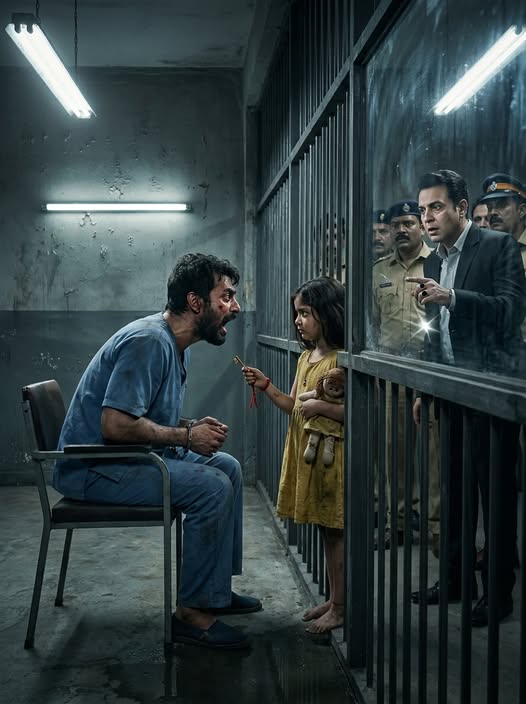
“What is this drama, Superintendent?” he asked. “A condemned murderer hears one childish story and now the prison stops?”
Anaya’s fingers tightened around the golden key.
Arjun looked as if he might throw himself across the room despite the handcuffs.
“You were there,” he whispered. “You were in my house.”
Suryavanshi did not look at him.
He looked at Rana.
“Execution is scheduled for four p.m. The warrant is active. You know the rules.”
Rana’s jaw tightened.
“I know the rules well enough to know I will not hang a man while new evidence is sitting in my visitors’ room.”
“There is no evidence,” Suryavanshi snapped. “There is a child with trauma.”
Anaya stepped forward.
“I am not trauma.”
The room went still again.
The social worker touched her shoulder. “Anaya…”
The girl did not look away from Suryavanshi.
“My mother told me your ring scratched her wrist.”
Arjun made a broken sound.
Suryavanshi’s smile vanished.
Only for a heartbeat.
But Rana saw it.
“Enough,” the prosecutor said. “This child has been coached.”
“By whom?” Rana asked. “Her father has been in prison for five years.”
“By relatives. By defense activists. By anyone trying to stop lawful punishment.”
Rana looked at Anaya.
“Who brought you today?”
“The madam from the children’s home.”
“Before that?”
Anaya’s eyes lowered.
“Nani kept me.”
Arjun’s face changed.
His mother-in-law.
The woman who had testified against him.
The woman who cried in court and said, “He killed my daughter because she refused to obey him.”
The woman who took custody of Anaya and cut every visit.
Rana asked softly, “Did your nani know about the key?”
Anaya shook her head.
“Ma sewed it in my doll before she sent me to play outside. She said, ‘If anything happens, Dolly will keep the door.’ I thought she meant hide-and-seek.”
Her voice faltered for the first time.
“I was four.”
Arjun fell to his knees.
The guards reached for him, but Rana raised one hand.
Let him fall.
Some grief must be allowed the floor.
Anaya looked at her father, and her face trembled. But she did not cry.
She had already spent too many years crying where no one cared.
Rana turned to Suryavanshi.
“Until the red room is checked, the execution is stayed internally.”
“You do not have that authority.”
“I have authority to report emergent evidence to the sessions court and prison headquarters.”
Suryavanshi’s voice lowered.
“Be careful. Careers end this way.”
Rana stepped closer.
“Better career than conscience.”
For the first time, Suryavanshi looked angry.
Good.
Rana preferred men angry. Their masks slipped.
Within fifteen minutes, calls began.
The jail control room became a storm.
The district judge was unreachable.
The court clerk said the judge was in chambers.
The police station said the old house had been locked for years.
The prosecution office insisted no stay could be processed without formal motion.
Suryavanshi stood in the corridor, speaking into his phone in a low voice.
Rana watched him through the glass.
A man with nothing to hide did not make secret calls before a house search.
Arjun sat in the visitors’ room with Anaya on his lap, both his cuffed hands resting uselessly at his sides because he was afraid to hold her too tightly and lose his last chance.
“Papa,” she whispered, touching his beard, “you look different.”
He gave a laugh that became a sob.
“You were so small.”
“I remember your song.”
His eyes widened.
“You do?”
She nodded.
“The one about moon eating laddoo.”
Arjun closed his eyes.
“I sang that when you wouldn’t sleep.”
“Nani said you were bad.”
He opened his eyes.
“I know.”
“I did not believe her always.”
“Only sometimes?” he asked, voice breaking.
She looked ashamed.
“I was little.”
He leaned forward, pressed his forehead to hers, and whispered, “You survived. That is enough.”
At 11:20 a.m., Rana received confirmation.
A magistrate had been informed.
A search team was being sent to Kavita’s mother’s old house.
Suryavanshi heard the news and turned sharply.
“You are making a mistake.”
Rana looked at his ring.
“Maybe. But today, mistakes will be written down.”
The search began at noon.
Rana could not leave the prison, but he demanded video call access from the local police team. The screen in his office showed a crumbling old house in a narrow lane, its faded green gate locked with rust. Neighbors gathered outside, whispering.
Arjun stood beside Rana’s desk, shackled, guarded by two men. Anaya stood between the social worker and the superintendent, clutching the doll now emptied of its secret.
The police broke the lock.
Inside, dust rose like ghosts.
The prayer room was at the back.
Small.
Dark.
A framed goddess blackened by years of incense.
Behind it, the wall was painted red.
“The red room,” Arjun whispered.
Anaya looked up.
“Ma said the key opens the god who does not bless liars.”
The search officer on video moved the framed goddess.
Behind it was a small brass plate.
A keyhole.
Rana looked at Anaya.
“The key.”
She held it close.
“Papa should give it.”
The room fell silent.
Arjun stared at her.
Then at his cuffed hands.
Rana nodded to the guard.
“Remove one cuff.”
“Sir…”
“Remove it.”
The guard unlocked Arjun’s right hand.
Anaya placed the key in his palm.
His fingers closed over it like a man holding his wife’s last breath.
The key was taken to the house by a constable waiting outside the jail with authorization. Every minute stretched.
At 12:47 p.m., the search officer inserted the golden key into the hidden lock.
It turned.
The brass plate clicked open.
Behind it was not a room.
It was a narrow compartment inside the wall.
A small metal box sat within.
Red cloth wrapped around it.
The search officer pulled it out and placed it on the floor.
On top was one name.
Arjun.
Written in Kavita’s handwriting.
Arjun covered his mouth.
Anaya whispered, “Ma wrote nicely.”
The box was opened under camera.
Inside were three items.
A USB drive.
A small diary.
And a strip of black cloth stained brown.
Blood.
Rana felt his skin tighten.
The diary was opened first.
The first page read:
If this is found, I am dead. My husband did not kill me.
Arjun made a sound so raw that the social worker began crying.
Rana’s eyes moved to Suryavanshi, who had entered the office silently.
The prosecutor’s face was blank.
Too blank.
The search officer read excerpts aloud.
Kavita’s words filled the prison office like the voice of a woman walking out of her own grave.
“Ma wants me to sign the land transfer to Mama.”
“Mahesh came again. He says Arjun will be blamed if I refuse.”
“He wears the black ring. It cut me when he grabbed my hand.”
“Anaya saw him. I told her never to forget the ring.”
“They think I don’t know about the insurance.”
“Arjun trusts too easily. That is his goodness and my fear.”
The room seemed to shrink around Suryavanshi.
Rana looked at him.
“You want to explain?”
Suryavanshi smiled slowly.
“A dead woman’s diary? Convenient.”
“Let us see the USB,” Rana said.
The file took several minutes to load.
The screen flickered.
Then a video appeared.
Kavita.
Alive.
Standing in what looked like the prayer room, face swollen, hair loose, eyes terrified but determined.
“If you are watching this,” she said, “then I failed to escape.”
Arjun whispered, “Kavita…”
She continued.
“My mother and my uncle want the ancestral property transferred. I refused because Arjun and I wanted it for Anaya’s education. Deputy Prosecutor Mahesh Suryavanshi has been helping them. He said if I do not sign, he will make sure Arjun is ruined.”
In the prison office, no one breathed.
Behind her, a sound came.
A door.
Kavita turned quickly.
The video shook as she hid the camera.
Voices entered.
A woman’s voice.
Her mother.
“Sign it and stop acting holy.”
Then a man’s voice.
Smooth.
Cold.
Suryavanshi’s.
“Your husband has a temper. One complaint, one knife, one neighbor, and the story writes itself.”
Arjun lunged toward Suryavanshi with such force that both guards barely caught him.
“You killed her!” he screamed. “You killed my Kavita!”
Suryavanshi stepped back.
Finally, fear.
Real fear.
Rana pointed to the officers.
“Detain him.”
Suryavanshi shouted, “You have no jurisdiction!”
The ACP on the video call spoke from the old house.
“We do. The search has yielded material evidence in a capital case. Mr. Suryavanshi, you are not leaving.”
The prosecutor tried to run.
He made it three steps.
The younger guard, the one who had looked away when Arjun first asked to see his daughter, tackled him near the office door.
The black ring struck the floor.
It cracked down the middle.
Inside the broken stone, something tiny fell out.
A micro-SD card.
Rana stared at it.
Suryavanshi froze beneath the guard.
That was not the reaction of a man surprised by a hidden object.
That was the reaction of a man seeing his own grave open.
By 2:00 p.m., the execution was officially stayed.
By 2:30, news had leaked.
“Death-row execution halted after child reveals hidden evidence.”
“Prosecutor detained in murder case shock.”
“Diary of victim may prove condemned husband innocent.”
Reporters gathered outside the prison gates.
Inside, Arjun sat in a small interview room with Anaya beside him, his head bowed over his hands.
He was not free.
Not yet.
The law moves slower when it has to admit it was wrong.
But the rope would not touch him that day.
Anaya leaned against him, exhausted.
“Papa,” she murmured, “will they still kill you?”
He pulled in a shaking breath.
“No, baby. Not today.”
“Tomorrow?”
He looked at Rana.
Rana’s throat tightened.
“No,” the superintendent said. “Not tomorrow.”
Anaya nodded.
As if she had merely confirmed a school timetable.
Then she closed her eyes and slept against her father’s arm.
Arjun did not move for nearly an hour.
He was afraid even breathing too deeply would wake her.
At 4 p.m., the hour marked for his hanging, the prison bell rang as usual.
Every man in the condemned block heard it.
But no execution took place.
Instead, Rana stood alone in the gallows room, looking at the empty rope.
In thirty-four years, he had learned to survive by believing procedure was morality.
That day, a nine-year-old girl had reminded him procedure could also become a noose for truth.
At dusk, Suryavanshi was taken away in a police vehicle.
His face was covered with a cloth, but the whole prison had already seen the ring.
Kavita’s mother was arrested at the old house.
Her uncle too.
The neighbour who testified against Arjun vanished before police reached him.
But the cracked ring’s memory card revealed why.
It held payments.
Voice recordings.
A video of the staged scene.
And one audio file labeled: Final Pressure.
In it, Suryavanshi’s voice said, “Once Arjun hangs, no one will reopen a widow’s old property dispute.”
He had been wrong.
Because he forgot the child.
He forgot the doll.
He forgot that dying mothers sometimes leave keys where monsters never look.
Three days later, Arjun appeared before court by video link.
The judge who had signed the final warrant watched the new evidence with a face that aged ten years in twenty minutes.
The execution was stayed indefinitely.
A reinvestigation was ordered.
The conviction review began.
The media screamed.
Politicians shouted.
Lawyers debated.
But Arjun cared about only one thing.
Anaya was allowed to visit again.
This time, not for goodbye.
For time.
She brought him a drawing.
Three people standing under a yellow sun.
A mother in the sky.
A father behind bars.
A girl holding a golden key.
Arjun touched the paper like it was scripture.
“You made me tall,” he said.
Anaya shrugged.
“You are tall.”
He laughed, and the sound startled both of them.
He had forgotten what laughter felt like in his chest.
Weeks passed.
Then months.
Slow legal months.
But with each hearing, the old case cracked wider.
The fingerprints on the knife had been lifted badly.
Blood on Arjun’s kurta came from him holding Kavita after finding her.
The neighbour had lied.
The mother-in-law had hidden property papers.
The prosecution had suppressed a child’s early statement in which Anaya had said, “A man with a black stone hurt Ma.”
The social worker wept when that file was found.
She had not seen it.
Someone had buried it.
Of course someone had.
One evening, as monsoon clouds gathered over the prison, Superintendent Rana came to Arjun’s cell.
“Thakur.”
Arjun stood.
“Yes, sir?”
Rana held a paper.
His hand was not steady.
“High Court has ordered immediate release pending final acquittal. You are going home.”
Arjun stared at him.
No joy came first.
Only disbelief.
A man who has been buried alive does not run when the lid opens.
He waits to see if the light is another trick.
“Home?” he whispered.
Rana nodded.
“Your daughter is outside.”
That did it.
Arjun stumbled once, caught the wall, and began to cry.
Not quietly.
Not like a condemned prisoner.
Like a father whose death had been postponed long enough to become life again.
When he walked out of the prison gate, reporters shouted.
Cameras flashed.
Questions flew.
“Did you forgive the system?”
“What will you say to the prosecutor?”
“What is your first feeling?”
Arjun saw none of them.
Anaya stood beyond the barricade in her yellow frock, holding the cloth doll.
This time, she ran.
She ran so fast one sandal flew off.
Arjun dropped to his knees.
She crashed into him.
For the first time in five years, no handcuffs stood between father and daughter.
He held her and sobbed into her hair.
“I came back,” he whispered.
She nodded against his chest.
“I kept the key.”
Behind them, Rana stood at the gate, watching.
The younger guard wiped his eyes.
The older one pretended not to.
That night, Arjun and Anaya returned to the old house where Kavita had died.
Police tape still hung across the prayer room.
The red wall had been broken open.
The hidden compartment was empty.
Arjun stood before it for a long time.
Anaya held his hand.
“Papa?”
“Yes?”
“Can we paint this room?”
He looked down.
“What color?”
She thought seriously.
“Yellow.”
He nodded.
“Yellow.”
“For Ma.”
“For Ma.”
They slept that night at a neighbour’s house because the old house still smelled of dust and evidence.
At 2:17 a.m., Arjun woke to the sound of Anaya whispering.
She was sitting up beside him, holding the cloth doll.
“What happened?” he asked.
She looked toward the window.
“Someone is outside.”
Arjun froze.
The lane beyond the curtain was dark.
Too dark.
Then his phone buzzed.
Unknown number.
One message.
No greeting.
No name.
Only a photograph.
Kavita.
Alive in an old video still, standing beside a man Arjun had never seen.
Under it were six words:
She hid more than one key.