By the time my father tried to take my ranch, the worst part had already happened.
It wasn’t the threats.
It wasn’t the paperwork.
It wasn’t even seeing him pull into my drive with a realtor in the passenger seat like my life was a deal he could close by lunchtime.
The worst part had happened on Christmas Eve, when I stood outside his house in the Colorado snow and watched him laugh at a table where there was no place set for me.
That was the moment something old in me finally broke.
My name is Olivia Carter, and for most of my life I had been what everyone politely called dependable.
In our family, dependable meant useful.
It meant I answered every call, fixed every crisis, and asked for almost nothing in return.
Dad had learned early that I was the child he never had to worry about.
I got good grades, worked part-time, paid my own way through community college for a year, then joined the Army because I wanted a life built on something steadier than his moods.
Even after I came home, that role stuck to me.
I was still the one who mailed money when Dad was short on property taxes.
The one who drove over on weekends to help patch roofing or clear fallen limbs.
The one who listened when he complained about bills, aches, weather, politics, and especially my younger brother Evan.
Evan was the opposite of steady.
He was charming, impulsive, and forever one bad decision away from a new disaster.
If he missed a payment, it was because the bank was predatory.
If his girlfriend left, it was because she couldn’t handle his ambition.
If his business failed, the timing had been unfair.
Dad loved that boy with a softness he never quite managed with me.
Even when Evan lied, even when he burned through money, even when he vanished for weeks and came back needing help, Dad’s answer was always the same.
“He just needs one more chance.”
I became part of the machinery that kept those chances coming.
I sent money when Dad asked.
I co-signed nothing, but I paid enough emergencies that it barely mattered.
Once, after Evan wrecked a truck he couldn’t afford, Dad called me at midnight to say the tow yard wouldn’t release it without cash.
I paid that too.
I told myself I was helping family.
What I was actually doing was teaching them that my limits did not matter.
Three days before Christmas, Dad sent a group text that landed before sunrise.
“Christmas dinner is family only this year.
Everyone already knows the plan.”
For a few seconds I thought there had to be some mistake.
Maybe he meant children only, spouses only, something weird and clumsy and badly phrased.
I called right away.
He sent me to voicemail.
I called again.
Nothing.
Around noon, my phone buzzed with a reply.
“Don’t make this difficult, Olivia.
We’ve already discussed it.”
We had discussed nothing.
That message hurt more than if he had simply written, We don’t want you there.
It made me feel erased, as if there had been a conversation from which I had somehow been absent about my own exclusion.
I should have stayed home.
I know that now.
hope is humiliating like that.
It keeps a door open in your mind long after everyone else has locked it.
On Christmas Eve, I drove two hours through snow to his place anyway.
The roads were ugly, visibility bad, and I kept telling myself I was going there for an explanation, not an invitation.
What I really wanted was proof that my father had not done something this cruel on purpose.
I parked down the road with my headlights off.
His house glowed warm against the dark, every window gold.
I walked close enough to see inside.
Dad sat at the head of the table.
Evan was on his right.
There were candles, dishes passed hand to hand, bourbon in thick glasses.
Dad was smiling in that open, proud way I had spent years trying to earn without success.
He slid a wrapped box across to Evan and raised a toast.
I couldn’t hear the words through the glass, but I didn’t need to.
I could read the room.
There was no empty chair.
No extra plate.
No coat laid aside in case I came late.
Nobody had forgotten me.
They had planned for my absence.
I stood in the snow until my fingers went numb, then turned around and walked back to my truck.
I did not knock.
I did not call.
I did not let them see me standing there like a child outside a window.
I drove until I found a highway diner still open.
It smelled like burnt coffee and syrup.
A tired waitress set down a slice of pecan pie I had not asked for and told me holiday dessert was included with every meal.
I sat in that cracked booth and realized I was done trying to win a place in a house where love was measured in usefulness.
That night, I made a decision.
If I was not welcome in his home, I would make one of my own.
The ranch in Montana found me faster than I expected.
An old service friend had settled outside Billings and had once mentioned a small property coming on the market.
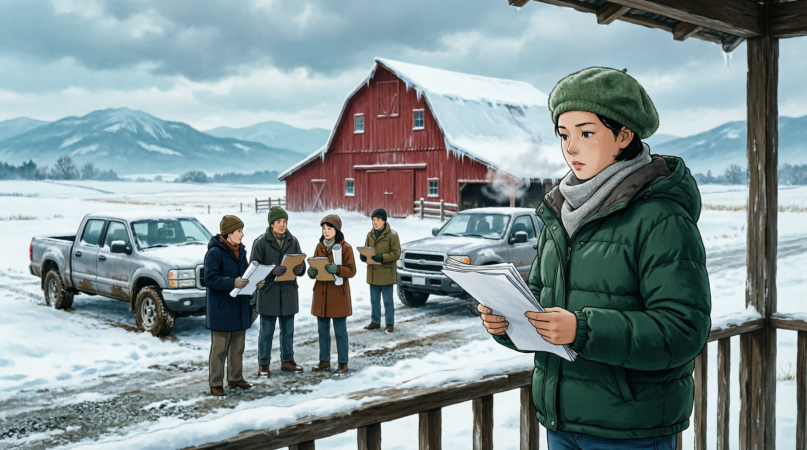
It was more work than dream at first glance: forty acres, a tired barn, a sagging side fence, a farmhouse with chipped paint and windows that rattled in the wind.
But the bones were solid.
The well tested clean.
The land had room to breathe.
Most important, the deed would carry only one name.
Mine.
I used savings I had guarded for years, the kind of money I never talked about because in my family any sign of stability became a request.
The closing took place in a plain office with bad coffee and fluorescent lights, and I still remember how my hand shook a little when I signed.
Not from fear.
From relief.
I changed every lock the first week.
I put in motion lights.
I mounted cameras at the gate, the porch, the barn, and the back drive.
Part of that was common sense in a rural place.
Part of it came from a deeper instinct I had finally learned to trust.
Peace is worth protecting.
Those first weeks on the ranch felt like exhaling after years of holding my breath.
I hauled feed, stacked wood, scrubbed cabinets, patched trim, and learned the
sounds of the property at night.
The wind had moods.
The old barn popped and settled after sundown.
Coyotes barked far off in the dark.
For the first time in a long while, nobody needed anything from me.
Then the mail came.
Mixed in with utility notices and county records was an envelope from a law office.
The name typed across the front was Evan Carter.
My address sat beneath it.
The envelope had split slightly at one corner, enough for a folded page to show.
I saw the parcel number first.
Mine.
Then the line underneath.
“Client: Evan Carter — missed financing deadline.”
My stomach dropped.
I called the law office immediately.
The receptionist asked for the parcel number and then went so cautious it practically confirmed my fears.
She would not discuss client matters, but when I said I was the titled owner and there should be no client connected to my property except me, the silence on the other end turned electric.
She took my number.
Nobody called back.
Dad did, two days later.
His tone was clipped, annoyed, as if I had inconvenienced him by noticing something illegal.
“You bought property,” he said.
It was not a question.
“Yes,” I said.
He exhaled hard.
“Evan needs that land.
His financing fell apart.
Sell it to him, or sign it over so he can close what he started.”
I stared at the wall of my kitchen while the words settled in.
No apology for Christmas.
No explanation.
Just a demand.
“You cut me out of Christmas,” I said, “and now you want my ranch?”
“Don’t be dramatic,” he snapped.
“This is about family.”
That word nearly made me laugh.
Family had become his favorite disguise for whatever he wanted from me.
I told him no.
He dropped his voice into that cold, flat register he used when he wanted obedience.
“You owe this family.
Evan has a real future if you stop being selfish.”
I told him no again.
Then he made the mistake that saved me.
“Fine,” he said.
“We’ll come up Saturday with the realtor and handle it face-to-face.
Bring your deed packet.”
He said it like an instruction, like my refusal had merely been a first draft.
The moment we hung up, I started calling people smarter than me.
The county clerk confirmed my title was clean.
The title company was more interesting.
A woman there, after verifying my identity, admitted that someone had contacted them multiple times claiming authority to discuss my closing documents.
When I asked who, she gave me a pause heavy with legal caution and said, “A family representative.”
I knew exactly what that meant.
An old Army friend in Billings sent me the number for Maya Reed, a property attorney who had served years as a JAG officer before going civilian.
I called her from my porch with the wind cutting across the pasture and told her everything, starting with Christmas and ending with my father’s promise to arrive on Saturday.
She listened without interrupting.
When I finished, she asked, “Did your father ever hold power of attorney for you?”
The question startled me.
Years earlier, during a deployment, Dad had held a very limited power of attorney for a vehicle sale if I could not sign in time.
It had expired almost immediately after I returned.
I had not thought about it in years.
When I told Maya, she made a quiet sound that was not surprise.
“Send me whatever you have,” she said.
“Texts, mail, deed, title paperwork, camera timestamps.
And do not meet them alone.”
By the end of that day she had sent formal notices to Dad, Evan, and the brokerage involved.
They were not authorized to enter, inspect, list, market, discuss, or convey my property on my behalf.
She also contacted the title company and county offices to flag the file.
Dad texted once.
“You really want to do this to your own family?”
I did not answer.
Instead, I added two more cameras and called the sheriff’s office.
Deputy dispatch transferred me to Sheriff Caleb Dorsey, who listened with the kind of stillness that told me he had heard every variety of rural entitlement there was to hear.
When I mentioned attempted unauthorized transfer and prior notice of trespass, his voice sharpened.
“Call when they hit the gate,” he said.
Saturday arrived gray and windy.
I barely slept the night before.
Not because I doubted what was right, but because some part of me still hated that this was what it had come to.
I had wanted distance, not war.
At 10:14 in the morning, my phone buzzed with a gate alert.
Dad’s truck.
Evan’s SUV.
A white sedan with a local real estate logo on the door.
I watched them roll up the drive on my screen before I stepped onto the porch.
Dad got out first, carrying a folder.
Evan climbed out slower, his eyes down, looking less confident than I expected.
The realtor was a woman in a camel coat, polished and tidy, holding a leather portfolio.
She glanced around with professional interest, taking in the barn, the field, the house.
To her, this probably looked like one more family transfer with a little tension attached.
She had no idea she was standing inside a trap my father had built for himself.
Dad did not greet me.
He lifted the folder and said, “Let’s not embarrass ourselves.
Sign the transfer, and your brother can still save his deal.”
“Leave my property,” I said.
The realtor blinked.
Evan looked up then, really looked at me, and I saw uncertainty flicker across his face.
Another engine sounded behind them.
Sheriff Dorsey’s SUV came through the gate, followed by Maya’s truck.
Dad turned and stiffened.
For the first time that morning, he looked less certain.
Maya joined me on the porch with a file tucked under her arm.
Sheriff Dorsey stopped near the steps, calm and broad-shouldered, his hat tipped back just enough to study all of us.
Dad tried first.
“This is a family matter,” he said.
“It became my matter when there was a trespass notice and an attempted unauthorized conveyance,” the sheriff replied.
The realtor’s expression changed instantly.
She looked at Dad, then at Maya, then at me.
Maya held out a hand.
“Mr.
Carter, let’s see the paperwork you brought.”
Dad hesitated.
That hesitation did more damage than any confession could have.
Evan frowned.
“What paperwork?”
“The paperwork that fixes your deadline,” Dad said, too quickly.
Evan’s eyes narrowed.
“You told me Olivia agreed.”
I answered before Dad could.
“I told him no.
Twice.”
The wind snapped hard across the pasture.
The realtor swallowed.
Maya opened her file and pulled out a copy of my old power of attorney.
Across the top, in thick red letters, was the word REVOKED.
“Before another lie gets told,” she said, “someone should explain why this expired document was referenced in calls to the title company.”
The realtor turned to Dad.
“You said you had authority.”
Dad’s jaw set.
“I said I was handling it for my daughter.”
“That is not what you told my office,” Maya said.
She removed printed emails and held them up.
“You represented that Ms.
Carter was purchasing this ranch as a temporary hold for her brother until his financing cleared.
You requested a quitclaim template in advance of her signature.
You also attempted to discuss closing records while identifying yourself as her authorized agent.”
The realtor went white.
“You never told me she didn’t know.”
Then came the part even I had not known until that moment.
Maya slid one more document from the file.
It was a draft transfer page bearing a signature that looked almost like mine until you actually knew my handwriting.
Almost.
Not enough.
The air left my lungs.
Dad had not merely planned to pressure me.
He had prepared to fake consent.
Sheriff Dorsey stepped forward.
“Mr.
Carter, put the folder on the hood of the truck.
Now.”
Dad’s face flushed dark.
“This is ridiculous.
She owes—”
“Now,” the sheriff repeated.
Dad slammed the folder down.
Inside were the draft quitclaim deed, printed parcel details, and a typed statement describing the transfer as a family accommodation for Evan Carter.
The fake signature page sat clipped behind it.
The realtor backed away from him as if the papers might stain.
Evan stared at the documents, then at Dad.
“What is this?”
Dad looked at him with furious disbelief, like he could not understand why the room had shifted.
“I was fixing it,” he snapped.
“For you.”
“By forging her name?” Evan’s voice cracked on the last word.
Dad did not answer.
That silence was the only confession anyone needed.
Sheriff Dorsey informed him he was being detained pending a fraud report and investigation into attempted unauthorized conveyance and criminal trespass.
Dad protested, then raged, then turned on me with the old, familiar accusation that I was tearing the family apart.
It did not land the way he thought it would.
Not anymore.
Because standing there on my own porch, with the deed secure and witnesses all around, I could finally see the truth.
The family had been broken for years.
I had just stopped pretending I could keep it together by sacrificing myself.
The realtor gave a statement on the spot.
She said she had been told this was a consensual intra-family transfer and that I understood the arrangement.
Her brokerage later dropped Dad as a client entirely and sent written confirmation that no listing, transfer, or representation connected to my property would proceed.
Evan sat on my porch steps after the sheriff left with Dad and looked like a man waking from anesthesia.
I had never seen him that still.
He admitted his financing deadline on a separate parcel had fallen apart weeks earlier.
Dad had told him not to worry, that
I had bought land in Montana and would “do the right thing.” Evan claimed he thought Dad had already spoken to me.
I believed only part of that.
He had benefited from our father’s favoritism his whole life.
He had accepted my help too many times to count and asked where it came from too rarely.
But I also saw, maybe for the first time, that Dad’s manipulation had trapped him in a different way.
Evan had been raised to think rescue was love.
That did not excuse him.
It did explain some things.
He asked me what would happen now.
I told him the truth.
“Now you fix your own life.”
Maya helped me file additional protections with the county, including an affidavit against unauthorized conveyance and a formal record of the revoked power of attorney.
The title company locked down the file.
The sheriff’s office took copies of everything, including camera footage showing Dad arriving after being warned not to come and carrying the prepared transfer documents.
In the months that followed, Dad’s world shrank fast.
The fraud charge did not become a dramatic prison story the way television writes these things, but it became something worse for a man like him: a public record, legal bills, and the collapse of the authority he had always used to bully people into silence.
He ended up accepting a plea arrangement tied to attempted fraudulent filing and trespass-related violations, along with restitution for the legal costs directly triggered by his actions.
He was ordered to have no contact with me except through counsel.
Evan sent one letter three months later.
Not a text.
A real letter.
He wrote that he had spent most of his life confusing loyalty with dependence.
He admitted he had taken my help without asking what it cost me.
He said he was working a steady job in Wyoming, renting a small place, and trying to stay afloat without Dad engineering the outcome.
He did not ask for money.
He did not ask for forgiveness.
He simply wrote, “I think I always knew Dad used you hardest because you were the strongest.
I am sorry I let that become normal.”
I read the letter twice and put it in a drawer.
I have not answered it yet.
As for the ranch, it slowly became mine in every way that matters.
I repaired the barn roof before spring runoff.
I planted a windbreak.
I painted the kitchen a deep warm cream that caught the morning sun.
Neighbors stopped by with advice I did not ask for and casseroles I did not need.
One of them helped me mend fence after a storm and refused payment because, as he put it, “That’s what decent people do when the weather gets stupid.”
The next Christmas, I did not go back to Colorado.
I stayed home.
A few veterans from town came by.
So did two neighbors and Sheriff Dorsey near the end of his shift, still in uniform, carrying a pie his wife had sent over.
We ate in my kitchen while the wind pressed softly against the windows and the lights I had strung on the porch reflected over the snow.
There was enough food for everyone.
Enough chairs.
Enough warmth.
No one had to earn their place
at the table.
Sometimes I still think about that Christmas Eve outside Dad’s house and wonder whether he understood, even for a second, what he threw away.
Not the ranch.
Not the lawsuit.
Me.
And sometimes I wonder something harder.
What was the bigger red flag: the holiday he excluded me from, or the fact that some part of him believed I might still hand him the deed after all of it?
I never found a clean answer.
But I know this much.
The ranch is still mine.
And for the first time in my life, so is the peace.