Chapter 2: The Hearth That Slept
The cabin did not belong to the forest.
I knew these woods. My father had dragged me along the lower timber lines since I was seven, pointing out the ridges where the hemlocks grew thickest and the marshes where the mules would sink to their hocks. There was no homestead here. There was no clearing either—not until my knees had hit the dirt. The space it occupied felt forced, as if the ancient pines had been pushed aside by an invisible shoulder to make room for the square, black timber of its walls.
The wood of the cabin was dark, the color of charred bone after a lightning strike, but it wasn’t burnt. It was smooth, lacking the rough bark of the cabins built by the settlers. No moss grew on its northern side. No dead leaves clung to the pitch of its roof, even though the wind was currently tearing them from the canopy by the hundreds.
“Violeta,” I whispered, my voice rattling against my teeth. “Look.”
She didn’t look. Her small face was tucked so deeply into the hollow of my neck that her nose felt like a marble pressed against my collarbone—cold, hard, and terrifyingly still. The only sign of life was the occasional shudder that ran through her tiny ribs, a rhythmic hitching that grew slower with every passing minute.
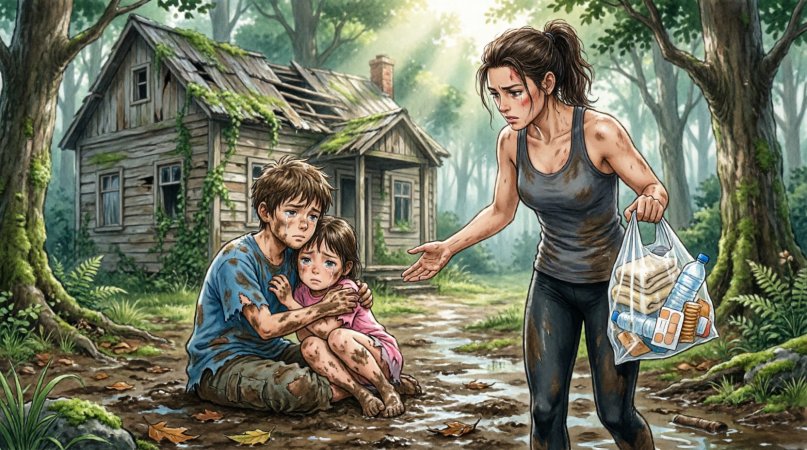
I stood up. My knees screamed, the damp cold having settled deep into the joints, making my legs feel like dry firewood about to snap. I didn’t walk toward the cabin; I staggered, my boots dragging through the needles, leaving two dark furrows behind me.
The air changed as I crossed the threshold of the clearing. The wind didn’t touch the dark wood. Ten feet from the porch, the howling of the gale simply died, replaced by a silence so heavy it made my ears ring.
The cabin had three windows on the front, each one made of thick, green-tinted glass that looked like the bottom of old rum bottles. There was no light behind them, yet they didn’t reflect the grey evening sky. They were opaque, absorbing the twilight.
I reached the porch. The steps were made of single, massive logs split perfectly down the middle. When my wet boot touched the first step, there was no creak. No groan. The wood felt remarkably solid—and warm.
Not hot, but the temperature of a horse’s flank after a long walk. The frost on the rim of my soles began to melt instantly, turning into tiny beads of steam that hissed softly against the dark timber.
I came to the door. It had no latch, no iron handle, no keyhole. There was only a heavy brass ring shaped like a snake biting its own tail, fixed to the center of a plank so thick it looked like it could withstand a battering ram.
“Hello?” I called out. My voice sounded flat, choked by the strange stillness of the porch. “Is anyone there? My sister… she’s freezing. Please.”
No one answered. The forest behind me was a wall of black spikes against a purple sky, but here, the air smelled of things that didn’t belong to October. It smelled of dried chamomile, melted beeswax, and old sheepskin rugs. It smelled like the interior of my mother’s cedar chest before Bernarda threw her clothes into the yard and filled it with her own heavy woolens.
I didn’t knock with the brass ring. I couldn’t risk the sound. Instead, I pressed my shoulder against the center of the door, intending to push just enough to see if it was barred.
The moment my weight touched the timber, the door slid inward. It didn’t swing on hinges; it glided back into the wall with a soft, greasy sigh, opening into a dark, cavernous room.
The warmth hit me first. It wasn’t the smoky, choking heat of Bernarda’s hearth, where the green wood always spit sparks and filled the rafters with gray soot. This was a deep, dry, ancient heat that seemed to rise from the floorboards themselves. It soaked through my wet trousers, through the thin soles of my boots, directly into the marrow of my frozen bones.
I took three steps inside, my eyes straining against the gloom.
The door glided shut behind me. The click of its seal was as final as the drop of a guillotine.
The Bread on the Trestle
I didn’t panic. When you are ten years old and have spent two years watching a woman calculate exactly how many ounces of cornmeal will keep you alive without making you strong, you lose the capacity for sudden fear. You only think of the next grain.
“Violeta,” I muttered, unwrapping the top layer of the stiff coat.
Her eyes fluttered. In the dim light of the cabin, her skin no longer looked gray; the heat was already bringing a faint, mottled pink back to her cheeks, though she remained deep in that heavy, unnatural sleep.
The room was vast, far larger than the exterior of the cabin suggested. A long trestle table of the same dark wood ran down the center. There were no chairs, only a single high-backed bench at the far end, carved with patterns that looked like eyes or knots in pine—it was hard to tell in the dark.
At the center of the table sat a white ceramic platter.
On it lay a loaf of bread.
It wasn’t the hard, grey hardtack Bernarda kept in the cellar for the dogs and me. It was a high, round loaf, its crust the color of polished chestnut, split across the top where the pale, soft interior peeked through. Beside it sat a small crock of yellow butter, a knife with a bone handle, and a wooden cup filled to the brim with goat’s milk.
The milk was steaming. A thin ribbon of white vapor curled upward toward the rafters, perfectly straight, undisturbed by any draft.
My mouth flooded with water so suddenly I choked on my own spit. My stomach twisted into a knot so tight it felt like a fist gripping my spine. I hadn’t eaten since the previous noon—a handful of parched corn I’d scraped from the bottom of the mule’s trough while Bernarda wasn’t looking.
I moved to the table, my hand trembling so hard I nearly dropped Violeta. I laid her down gently on the bench, wrapping her in the coat once more, then reached for the wooden cup.
The milk was sweet. It tasted of clover and wild honey, so rich it coated the inside of my throat like cream. I drank half of it in three massive swallows, then forced myself to stop. I held the cup to Violeta’s lips, wetting my finger first and smearing the warm milk across her dry, cracked mouth.
She stirred. Her tongue came out, tasting the sweetness. Her small fingers reached up, grabbing my wrist with surprising strength.
“More,” she whimpered, her voice a tiny, gravelly scrape.
“Slowly,” I whispered, tilted the cup against her chin. She drank, her small throat working as she swallowed, her eyes remaining shut but her breathing shifting from those terrifying, short gasps into a deep, regular rhythm.
Once she was finished, she turned onto her side and sank back into the bench, her thumb slipping into her mouth. The grayness was gone from her face. She was warm.
Only then did I look at the bread.
The knife was cold when I picked it up. The bone handle was yellowed with age, etched with tiny, precise lines that resembled a map or the veins of a leaf. I pressed the blade into the loaf. The crust crackled with a sound like dry twigs snapping underfoot, revealing an interior so white and soft it looked like sheep’s wool.
I cut a thick slice. I didn’t use the butter. I didn’t need to. The bread tasted of malt and salt, so substantial that each bite felt like a full meal. I ate the first piece in silence, standing over my sister, my eyes constantly darting toward the corners of the room.
There were no candles, yet the darkness was receding. It wasn’t that the sun was rising outside—I could see through the green glass of the windows that the forest was now completely black—but rather that the room itself was beginning to glow with a faint, phosphor-like luminescence.
The light was coming from the floorboards. Between the cracks of the dark timber, thin lines of pale green light were pulsing, slow as a sleeping pulse.
And that was when I noticed the walls.
The Names in the Grain
They weren’t log walls. Not really.
Now that the room was brighter, I could see that the interior was lined with hundreds of small, square drawers, stretching from the floor all the way up to the high, vaulted ceiling. Each drawer was made of a different wood—some pale ash, some red cherry, some dark, oily walnut.
Each drawer had a small brass plate screwed to the front.
I chewed my second piece of bread slowly, walking toward the nearest wall. The floorboards didn’t creak under my weight, but with every step I took, the green light beneath my feet flared slightly brighter, following my boots like ripples in a pond.
I reached the first row of drawers and squinted at the brass plates.
They weren’t numbers. They were names.
Tobias Vance — 1842 Maren Vance — 1844 Peter Claes — 1851
I ran my fingers over the cold metal of the plates. The letters were engraved deeply, the grooves filled with a dark, dried substance that looked like old ink or old blood.
I moved down the wall, my heart beginning to thump against my ribs with a different kind of intensity. These weren’t names of people from our valley. Our village was small—thirty cabins clustered around the mill, where everyone knew whose grandfather had built which chimney. I had never heard of a Vance or a Claes.
Then I reached the third row from the bottom, near the corner where the shadows were deepest.
The brass plate here was newer than the others. It didn’t have the green tarnish of age that covered Tobias Vance. It was bright, polished, as if someone had rubbed it with oil only that morning.
The name engraved on it made the bread turn to ash in my mouth.
Clara Ward — 1884
Clara.
That was my mother’s name.
She had died twelve years ago—no, that couldn’t be right. I was ten. She had died two years ago, when I was eight, during the winter the river froze all the way to the bottom. But the plate said 1884. That was ten years ago. The year I was born.
My hand shook so violently I dropped the remaining piece of bread. It fell to the floor without a sound.
I reached for the small copper medal in my pocket, the one she had given me before the fever took her tongue. I pulled it out and held it up to the pale light of the floorboards.
The medal was small, stamped with the image of a woman holding a bundle of dry wheat. On the reverse side, my mother had scratched three letters with a nail: C.W.
I looked back at the drawer.
Clara Ward — 1884.
With a dry throat, I hooked my finger into the small ring on the drawer and pulled.
It didn’t stick. It slid open with the same greasy silence as the front door.
Inside, there was no velvet lining, no jewelry, no money. There was only a single, small glass jar, no bigger than a salt cellar, filled with a dark, thick liquid that didn’t move when I tilted the drawer. Beside the jar lay a single, long strand of dark brown hair—the exact shade of my own.
And beneath the jar, there was a slip of paper.
I reached in, my fingers tingling as they crossed the threshold of the wooden box. The air inside the drawer was cold, like the air in a root cellar in mid-winter. I took the paper. It was thick, rough-edged, and smelled faintly of vinegar.
Written on it, in a neat, cramped hand that I recognized from the margins of the old Bible my father kept on the high shelf, were four lines.
The prayer.
Not the one from the church. Not the one the itinerant preacher shouted about when he passed through the valley in August. It was the specific, strange prayer my mother had whispered into my ear when the skin around her eyes turned yellow and her hands grew cold.
The earth will take what the earth has sown, The hearth will burn what the hearth has grown, The blood will return to the iron stone, When the third daughter comes to claim her own.
I stared at the ink. It wasn’t black. It was a dark, rusted red.
“She wasn’t your mother,” a voice said from behind me.
The Woman in the Shroud
I spun around so fast my heel caught on the edge of a floorboard. I didn’t fall, but I staggered back against the wall of drawers, my hands flat against the cold brass plates.
The high-backed bench at the end of the table was no longer empty.
A woman sat there. She hadn’t come through the front door; she hadn’t come from the corners of the room. She was simply there, as if she had always been part of the dark timber and had chosen this moment to separate herself from it.
She was old—older than anyone I had ever seen. Her face was a web of deep, gray wrinkles, so pale her skin looked like tissue paper stretched over bone. She wore a heavy dress of unbleached wool, the color of a dirty sheep, and around her shoulders was wrapped a grey shawl that seemed to shift and blur at the edges, like smoke rising from a wet fire.
Her hands were resting on the trestle table, curled around the wooden cup I had used to feed Violeta. Her fingernails were long, thick, and yellow, like the talons of an old owl.
But it was her eyes that made me freeze.
They had no whites. They were entirely black, from corner to corner, like two pools of stagnant swamp water reflecting a midnight sky.
“She wasn’t your mother, child,” the old woman repeated. Her voice didn’t sound like it came from a throat; it sounded like the scraping of two flat stones across dry sand. “Clara Ward was the vessel. Nothing more. She took the copper coin, she took the seed, and she ran. They always run.”
I didn’t answer. I looked at Violeta. My sister was still sleeping, her small chest rising and falling regularly, completely unaware of the thing sitting five feet from her feet.
“Who are you?” I managed to squeeze the words past my teeth.
The woman didn’t smile. Her mouth was a thin, dark line that didn’t seem to have lips. “I am the keeper of the ledger. I am the frost before the harvest. I am the one Bernarda paid fourteen pesos to find you.”
The fourteen pesos.
The sound of the coins hitting the table two nights ago echoed in my ears. I won’t waste another cent on another woman’s children.
“Bernarda didn’t throw you into the woods because she was cruel,” the old woman said, her black eyes fixating on my face. “She threw you into the woods because the contract was due. She knew exactly which path you would take. She knew exactly when your knees would give out.”
She leaned forward. The smoke-colored shawl drifted across the table, its edge brushing against the loaf of bread. Where the wool touched the crust, the chestnut brown immediately turned black and crumbled into a fine, soot-like ash.
“The bread was good, wasn’t it?” she asked softly.
I couldn’t speak. My throat had closed completely.
“The milk was sweet,” she continued. “It took the frost out of the little one’s blood. It gave her back her breath. But nothing in this cabin is free, little girl. Your mother knew that. Bernarda knows that.”
She stood up. She was tall—unnaturally so—her long body uncoiling like a black snake rising from a basket. The grey shawl trailed behind her, leaving a dark smudge on the floorboards wherever it dragged.
“The fourteen pesos Bernarda paid… they weren’t for your death,” the woman whispered, walking slowly around the table toward Violeta. “They were for the location. The woods belong to me. Everything that enters them after the sun goes down belongs to the ledger.”
She reached out a long, yellow-nailed hand toward my sister’s forehead.
“No!” I screamed.
I didn’t think. I forgot that I was ten. I forgot that I was small. I lunged forward, grabbing the bone-handled knife from the table, and thrust it toward the woman’s arm.
The blade didn’t hit flesh. It entered the grey shawl and felt as if I had plunged it into a drift of cold snow. A blast of icy air rushed up the handle, freezing my fingers instantly, making my grip slick.
The woman stopped. She didn’t look at me; she looked down at the knife stuck in the folds of her sleeve.
Slowly, she turned her head. Her neck made a series of sharp, dry pops, like dry twigs breaking in a fireplace.
“You have your mother’s iron,” she said, her black eyes widening until the skin around them stretched white. “But you do not have her time.”
She raised her other hand and snapped her fingers.
The sound was like a rifle shot in the enclosed room.
The Opening of the Larder
Behind me, the wall of drawers began to move.
Not one or two. All of them.
The hundreds of small wooden boxes began to slide out of their slots simultaneously, their brass plates clattering against one another with a sound like a thousand dry teeth chattering in the dark.
From inside the drawers, things began to rise.
They weren’t ghosts. They weren’t bodies. They were jars—hundreds of glass jars, all filled with that thick, dark liquid, each one containing a single strand of hair, a single slip of paper, or a small, preserved piece of clothing. A baby’s mitten. A silver button. A tooth.
And from the center of the room, beneath the trestle table, the floorboards began to part.
A heavy, square hatch—one I hadn’t seen before—swung upward, thrown back by some force from below. A smell hit the room then that wiped out the chamomile and the beeswax. It was the smell of old mud, wet fur, and something that had been dead for a very long time but was still warm.
From the dark opening of the hatch, a ladder made of thick, raw hemp rope dropped into the depths.
“The ledger must be balanced,” the old woman said, her voice rising in pitch until it vibrated in the soles of my feet. “One for the wood, one for the hearth. You fed the child the milk of the black goat. You gave her the bread of the deep root. Her debt is paid. Yours is not.”
She pointed a long finger at the hatch.
“Go down, daughter of Clara. Go down and find your mother’s real name.”
At that moment, Violeta woke up.
She didn’t cry. She didn’t scream. She sat up on the bench, her eyes wide, staring not at the old woman, nor at the clattering walls, but at the door behind me.
The heavy, latchless door was vibrating.
From the other side of the timber, through the green-tinted glass of the windows, I saw a light. It wasn’t the pale green light of the floor, or the purple of the twilight.
It was the bright, orange, dancing glare of torches.
And then, a voice shouted from the porch—a voice I knew better than my own name, a voice that had spent two years telling me how worthless I was.
“Open the door, you old witch!” Bernarda screamed from outside, her fists slamming against the heavy planks. “The mule died an hour after they left! The well has gone black! You took the money but you didn’t finish the work! Open up or I’ll burn the forest down around you!”
The old woman in the shawl didn’t look toward the door. She kept her black eyes fixed on me, her hand still pointing toward the open hatch in the floor.
“Choose,” the woman whispered, as the wood of the door began to smoke from Bernarda’s torches outside. “The fire above… or the roots below?”
I looked at the black square in the floor. I looked at my sister, whose small hand was now reaching for mine.
And then, from the depths of the hatch, someone called my name.
It wasn’t my mother’s voice.
It was my own.

