Camille crossed her arms. “I think you of all people don’t get to lecture me about being soft.”
Marco’s eyes flicked to Gabriel, then away.
The room was too quiet again.
Camille had struck something true, and she knew it.
She stepped closer, lowering her voice, but not enough to hide the venom in it. “Don’t stand there pretending you’re some saint because a maid got burned. I’ve seen the men who come in and out of this house. I’ve heard the phone calls you think I don’t understand. You’ve done worse than spill tea, Gabriel.”
Gabriel did not deny it.
That seemed to unsettle her more.
“No,” he said. “I’m not a saint.”
“Then stop acting like one.”
“I know exactly what I am.”
His voice was calm. Empty of pride. Empty of apology.
Camille’s expression faltered.
“And that,” Gabriel continued, “is why I know what you are.”
Her eyes flashed. “Careful.”
The warning almost made him laugh.
Three months ago, he might have admired the nerve.
Tonight, he felt nothing but exhaustion.
“You hurt someone who couldn’t fight back,” he said. “Not because you were threatened. Not because you were afraid. Because you could.”
“She’s nobody.”
The moment Camille said it, something in Gabriel settled.
Not snapped.
Settled.
A decision becoming bone.
He turned away from her.
“Marco.”
“Yes?”
“Miss Whitaker is leaving.”
Camille’s mouth opened.
Gabriel continued, “Have her things packed from the east suite. Anything purchased by her or her family goes with her. Anything purchased by me stays.”
Camille’s face went white.
“You wouldn’t dare.”
Gabriel looked back at her. “You should know better than to say that to me.”
The room changed after that.
Not visibly. Not dramatically.
But Camille felt it.
She was no longer the future Mrs. Moretti.
She was no longer the woman staff feared offending.
She was no longer protected by Gabriel’s silence.
She was a guest who had overstayed her welcome.
Two of Gabriel’s men moved toward the hallway. Camille looked from them to Gabriel, panic beginning to break through her polished mask.
“Gabriel, this is insane,” she said, trying for softness now. “Baby, come on. I lost my temper. That’s all.”
He said nothing.
She touched his arm.
He looked down at her hand until she removed it.
Her pride came back like a slapped match.
“You’re choosing a servant over me?”
“No.”
“Then what are you doing?”
“I’m choosing what I will not become.”
Camille laughed, but her eyes were wet now. “That’s poetic. Did you rehearse it?”
“No.”
“You think this makes you noble?”
“No.”
“You think she’ll thank you? You think all these people suddenly love you because you played hero for five minutes?”
Gabriel looked around the room.
At Ruth bent over Elena’s burned arm.
At the cook standing in the service doorway with a towel in both fists.
At Marco watching carefully, as if seeing a version of Gabriel he did not know whether to trust.
“No,” Gabriel said. “I don’t expect love from people I taught to fear me.”
That silenced her.
For just a second, the mask dropped completely, and Gabriel saw the ugly panic beneath.
Not heartbreak.
Loss of position.
Loss of access.
Loss of a throne she had almost claimed.
“You’ll regret this,” Camille whispered.
Gabriel picked up the ring from the table and held it out.
Camille stared at it.
“Take it,” he said. “Sell it. Keep it. Throw it in the harbor. I don’t care.”
She did not take it.
So Gabriel set it on the edge of the table between them.
“Then leave it.”
Behind him, Elena made a small sound of pain as Ruth poured cool water over the burn.
Gabriel turned immediately.
Camille noticed.
Her face twisted.
“Oh my God,” she said. “You really are doing all this because of her.”
Gabriel walked away from Camille as if she had not spoken.
He crossed the dining room and stopped beside Elena’s chair. The young woman tried to stand.
“Don’t,” he said.
She froze.
His voice softened, and that softness felt strange in his own mouth.
“Please.”
Elena sank back down.
Up close, she looked even younger than he had realized. Maybe twenty-four. Brown hair pulled into a low bun. A thin gold cross at her neck. Eyes red from pain and humiliation. She had been in his house for six weeks, hired through an agency Ruth trusted. He had signed her employment file without reading past her background check.
He knew men in three countries who would answer his call at midnight.
He did not know the name of the woman burned in his dining room until he had needed to command a doctor for her.
That shame moved through him quietly.
“What do you need?” he asked.
Elena looked confused.
“I… I don’t know, sir.”
“The doctor is coming. Is there anyone you want called?”
Her lips parted, then closed.
Ruth touched her shoulder. “Honey, your sister?”
Elena shook her head quickly. “No. She’ll worry.”
Gabriel glanced at Ruth.
Ruth said, “Her little sister lives with her. College kid.”
“Call her,” Gabriel said.
Elena panicked. “No, please, Mr. Moretti. She has finals. I’m fine.”
“You’re not fine.”
“I can work. I can still—”
“No.”
The word came out sharper than he intended. Elena flinched.
Gabriel breathed once, slowly.
“You’re not in trouble,” he said. “You’re going to be treated. You’re going to be paid. And no one in this house will punish you for being hurt.”
Elena stared at him like she had never heard such a rule before.
Across the room, Camille’s heels clicked on the marble as she moved toward the doorway, escorted but not touched. At the threshold, she turned back.
Her eyes were no longer wet.
They were cold.
“You think tonight is the end?” she said.
Gabriel did not look at her.
Camille smiled.
“It’s not.”
Then she walked out of the Moretti dining room with her head high, her future collapsing behind her.
Part 2
By midnight, the east suite was empty.
By one in the morning, Camille Whitaker’s driver had taken her through the iron gates with six designer suitcases, two garment bags, and a jewelry case Marco had personally inspected before allowing it into the car.
By two, the story had already begun to mutate.
Gabriel knew because his phone would not stop lighting up.
Camille’s mother called first.
Then her father.
Then a senator whose campaign had enjoyed Whitaker money and Moretti protection.
Then Gabriel’s uncle Sal, who left a voice mail so furious it bordered on theatrical.
“You ended a marriage alliance over a housemaid? Are you out of your mind? Call me before you turn this family into a joke.”
Gabriel listened once, deleted it, and poured the bourbon he had not touched at dinner down the sink.
The doctor had come and gone.
Second-degree burns, painful but not life-threatening. Elena needed medication, bandages, follow-up care, and rest. She had refused the hospital until Ruth quietly told Gabriel that Elena did not have insurance good enough to make an emergency room feel safe.
Gabriel had nearly laughed at the absurdity.
Not because it was funny.
Because he lived in a house where a broken antique mirror cost more than a nurse’s yearly salary, and a young woman was afraid medical care would ruin her life.
“Take her,” he had told Marco. “Private clinic. My name. My account.”
Elena had protested.
Gabriel had ignored her.
Not cruelly. Not dismissively.
Simply because some decisions should not depend on whether a frightened person knew how to accept help.
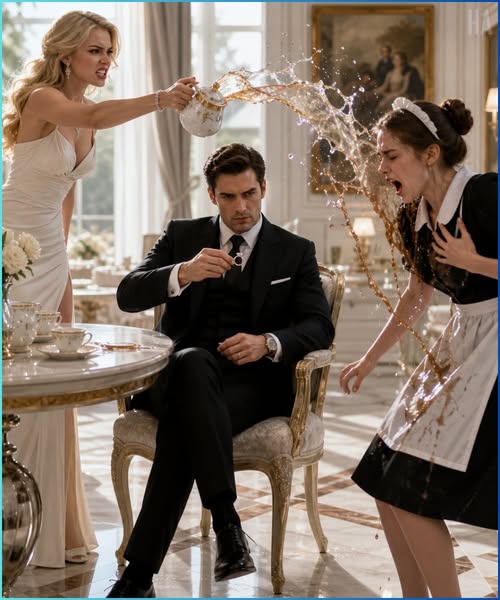
Now the dining room was dark except for one lamp near the sideboard. The staff had cleaned the tea from the marble, but Gabriel could still see where it had been. His mind kept replaying the arc of liquid through the air. Camille’s wrist. Elena’s scream. The ring against the table.
He stood alone at the window overlooking the north lawn, watching fog move over the grass.
Marco entered without knocking.
He was the only man alive besides family who could do that.
“Clinic called,” Marco said. “They treated her. Ruth took her and her sister home.”
Gabriel nodded.
“How bad?”
“She’ll heal. Scar maybe. Doctor said it could’ve been worse.”
Gabriel’s jaw tightened.
Marco waited.
He had a fighter’s patience, built in South Boston basements and prison visiting rooms. At forty-two, he carried himself like a man who expected betrayal but still left room to be surprised by decency. He had known Gabriel since they were boys stealing cannoli from Gabriel’s grandmother’s kitchen.
Finally Marco said, “You know this doesn’t stay quiet.”
“It already isn’t.”
“Camille’s telling people you humiliated her over a clumsy maid.”
“Elena.”
Marco blinked.
“Her name is Elena,” Gabriel said.
A brief silence passed between them.
Then Marco nodded. “Elena.”
Gabriel turned from the window. “Say it.”
Marco’s mouth twitched. “You won’t like it.”
“I rarely do.”
“You did the right thing.”
Gabriel looked at him.
Marco shrugged. “See? You hate it.”
Gabriel almost smiled.
Almost.
Marco continued, “But right doesn’t mean simple. Whitaker’s got friends. Your uncle’s going to push. Some of the old men will say you looked weak.”
“They can say what they want.”
“They won’t just say it. They’ll test it.”
Gabriel understood that better than anyone.
In his world, mercy was not received as goodness. It was read as an opening. Men who had bowed yesterday might lift their eyes tomorrow. Rivals might wonder whether Gabriel Moretti had gone soft because he dismissed a fiancée instead of silencing a scandal.
And perhaps worse than all of that, people inside his own organization might resent the sudden appearance of a line.
For years, Gabriel’s rule had been clear.
Do not betray me.
Do not steal from me.
Do not harm children.
Everything else could be negotiated if it served the empire.
But tonight, without warning, he had created a new law in front of his entire household.
Do not hurt the powerless because you can.
That law was dangerous because it raised a question Gabriel had spent his life avoiding.
How many powerless people had been hurt because he allowed it?
He sat at the end of the table, in the same chair he had occupied before the scream.
“Find out everything Camille did while she was here,” he said.
Marco’s expression changed. “You think there’s more?”
“I think tonight wasn’t the first time she enjoyed cruelty.”
Marco nodded once. “I’ll talk to Ruth.”
“No.” Gabriel’s voice sharpened. “Ask. Don’t pressure.”
Marco studied him.
Gabriel looked away.
“Ask,” he repeated.
“Understood.”
At six the next morning, Gabriel walked into the staff kitchen for the first time in years.
Conversation died instantly.
Ruth stood at the sink. The cook, Mrs. Alvarez, held a bowl of eggs in midair. Two cleaners froze beside the pantry. A young groundskeeper stopped chewing.
Gabriel could feel the fear.
It had always been there, of course. Fear was part of the architecture of the estate, as real as marble and iron. But he had rarely stood in the servants’ kitchen long enough to breathe it.
Now it embarrassed him.
“Good morning,” he said.
No one answered.
He deserved that.
“Ruth,” he continued, “how is Elena?”
Ruth wiped her hands on a towel. She was sixty, with silver hair, a straight back, and the careful courage of someone who had survived rich people for decades.
“She’s resting. Her sister called me at four to ask if she still had a job.”
Gabriel closed his eyes briefly.
“She does.”
“I told them that.”
“Tell them again. In writing. Full pay while she recovers.”
Ruth nodded.
Gabriel looked around the kitchen.
Every pair of eyes dropped.
He felt the old instinct rise in him, the desire to command, settle, move on. Instead he forced himself to remain still.
“I need to know whether Miss Whitaker harmed or threatened any of you before last night.”
The kitchen became so quiet the refrigerator hum sounded loud.
Mrs. Alvarez looked down at the eggs.
The younger cleaner’s eyes filled.
Ruth’s face hardened.
Gabriel’s stomach sank.
“Ruth,” he said quietly.
Ruth folded the towel once. Twice.
“She slapped Daisy in August,” she said.
The young cleaner’s shoulders trembled.
Gabriel turned to her. “Daisy?”
Daisy nodded without looking up.
“Why wasn’t I told?”
The question came out wrong. Too sharp.
Daisy flinched.
Ruth answered for her. “Because the last girl who complained about Miss Whitaker was dismissed by the agency the next morning.”
Gabriel went still.
“What girl?”
“Lena Park. She worked upstairs. Miss Whitaker accused her of stealing perfume.”
“Did she?”
Ruth’s silence was answer enough.
Gabriel’s hands curled at his sides.
“Who dismissed her?”
“Mr. Salvatore’s office handled it.”
Uncle Sal.
Of course.
A familiar anger began to build, old and hot. But underneath it was something colder.
Shame.
Because Sal had handled household complaints because Gabriel had not wanted to.
Because Gabriel had told himself linen schedules and staff disputes were beneath him.
Because his indifference had become Camille’s weapon.
“Anything else?” Gabriel asked.
No one spoke.
Then Mrs. Alvarez set down the bowl.
“She called my son a charity case when he came to pick me up.”
Gabriel looked at her.
“He has Down syndrome,” she said, her voice steady but her eyes bright. “He brought me flowers on my birthday. She said I shouldn’t let him wander around the main entrance because it made the house look like a shelter.”
Gabriel felt something in him go quiet.
Not empty.
Focused.
Daisy whispered, “She made me get on my knees to scrub champagne from the rug at her bridal shower. In front of her friends.”
Another cleaner said, “She said if we didn’t smile in front of guests, she’d tell Mr. Sal we were stealing.”
The groundskeeper added, “She threatened to have my brother picked up by immigration. He’s a citizen. She didn’t care.”
Every sentence landed like a stone.
Gabriel listened until there were no more.
Then he said, “I failed you.”
The staff stared at him.
The words seemed more shocking than his presence.
Gabriel felt the weight of them, but did not take them back.
“I let someone into this house and gave her authority she had not earned. I allowed my name to be used against you. That ends now.”
Ruth’s expression softened by a fraction.
Daisy finally looked up.
Gabriel continued, “No one will be fired, demoted, blacklisted, or threatened for telling the truth. If anyone from Miss Whitaker’s family, my uncle’s office, or any agency contacts you, you forward it to Marco.”
He looked at Marco, who had entered silently behind him.
Marco nodded.
“And Elena?” Ruth asked.
Gabriel said, “I’ll visit her today, if she’ll allow it.”
Ruth’s eyebrows rose.
“She might not want that.”
“I know.”
“She might be afraid to say no.”
Gabriel absorbed that.
“Then you ask her. And if she says no, I don’t go.”
For the first time that morning, Ruth looked at him as if she recognized a human being beneath the name.
At noon, Camille struck back.
The first article appeared on a Boston gossip site.
Mafia prince dumps philanthropist fiancée after dinner party meltdown.
By two, the headline had grown teeth.
Inside Gabriel Moretti’s toxic mansion: staff drama, screaming match, broken engagement.
By four, Camille had posted a photograph of herself on Instagram wearing dark sunglasses and no ring, with a caption about “surviving emotional intimidation behind closed doors.”
Gabriel’s PR attorney called.
“Say nothing,” the attorney advised. “If you respond, you feed it.”
Gabriel stood in his office, watching the post collect comments.
Poor Camille.
I always thought he looked dangerous.
Imagine what he did that made her leave.
Then he saw another comment.
People defending a maid over his actual fiancée is insane. Staff need to know their place.
He closed the laptop.
“Find out who filmed last night,” he told Marco.
Marco frowned. “You think someone did?”
“I know Camille.”
Within an hour, they found the camera.
A tiny device hidden in a flower arrangement near the dining room mantel. Not Gabriel’s. Not his security team’s.
Camille’s.
“She planned to record dinner?” Marco asked.
Gabriel stared at the small black lens in the evidence bag.
“No,” he said. “She planned to record me.”
The realization came together piece by piece.
Camille had expected some confrontation. Maybe she had intended to provoke the maid, maybe not. But she had wanted footage of Gabriel reacting like the monster everyone believed he was. A raised voice. A threat. A hand slamming the table. Something useful.
Instead, she had recorded herself.
Marco said, “There’s a memory card.”
Gabriel looked at him.
“Play it.”
The footage was clear.
Camille’s voice. The spill. The insult. The teapot. The scream.
Gabriel removing his ring.
His words.
You showed me exactly who you are.
Marco exhaled slowly.
“Well,” he said, “that changes things.”
Gabriel watched Elena stumble backward again on the screen.
“No,” he said. “It confirms them.”
That evening, Ruth called.
“Elena says you can come,” she said. “But her sister will be there.”
“Good.”
“She asked if she needs to dress formally.”
Gabriel closed his eyes.
“No.”
Elena lived in a third-floor walk-up in Revere, above a laundromat and a nail salon. Gabriel arrived with Marco but left him downstairs, despite Marco’s objections.
Elena’s sister opened the door.
She was nineteen, maybe twenty, with the fierce eyes of someone too young to be that protective. She wore Boston University sweatpants and held a pepper spray keychain in one hand.
“You alone?” she asked.
Gabriel nodded.
“I’m Ava,” she said. “If you’re here to scare her, I’ll scream so loud the whole building comes out.”
Gabriel believed her.
“I’m here to apologize.”
Ava looked skeptical. “Rich men love that word when lawyers get involved.”
Gabriel almost smiled. “Smart.”
“I wasn’t trying to be charming.”
“I know.”
She let him in.
The apartment was small but clean, with thrift-store furniture, a bookshelf made of cinder blocks and painted wood, and a kitchen table covered in textbooks. Elena sat on the couch with her arm bandaged, wearing an oversized sweatshirt. She looked pale and exhausted.
When Gabriel entered, she tried to stand.
Ava pushed her gently back down. “Absolutely not.”
Gabriel stopped near the door.
“I won’t stay long.”
Elena nodded.
For a moment, he did not know what to do with his hands. In his world, apologies usually came attached to settlements, threats, or performances. This one had to stand alone.
“I’m sorry,” he said. “For what Camille did. For what I allowed before last night. For not knowing enough to stop it sooner.”
Elena looked down at her bandage.
“You didn’t throw the tea.”
“No. But my house taught her she could.”
Ava’s expression changed slightly.
Elena swallowed. “Am I really not fired?”
“No.”
“Because the agency called. They said Miss Whitaker’s assistant complained about me.”
Gabriel’s eyes darkened. “The agency will call again tomorrow with a different message.”
Ava lifted her chin. “Meaning?”
“Meaning they’ll apologize, and if they don’t, they’ll lose every contract connected to my businesses.”
“That sounds like a threat.”
“It is.”
Ava stepped forward.
Gabriel looked at her, then at Elena.
“To them,” he clarified. “Not to you.”
Elena’s mouth trembled. “I don’t want anyone hurt because of me.”
Something about that nearly broke his composure.
“You were hurt because of them.”
She shook her head. “People like me don’t win fights like this.”
Gabriel crouched slightly, not too close.
“Then don’t fight it alone.”
Elena studied him, searching for the trap.
“What do you want from me?” she asked.
“The truth,” he said. “Only if you want to give it.”
Ava sat beside her sister. “Truth about what?”
Gabriel took a folded paper from his coat.
A list of names.
Daisy. Mrs. Alvarez. Lena Park. Three others. Staff Camille had bullied, humiliated, or had dismissed.
“Elena isn’t the only one,” he said.
Ava read the paper, her anger growing with each name.
Elena closed her eyes.
“She said she’d ruin my sister’s scholarship,” Elena whispered.
Ava turned sharply. “What?”
Elena’s face crumpled. “I didn’t tell you. I’m sorry.”
Gabriel’s voice went quiet. “When?”
“Two weeks ago. She said if I kept looking at her like I felt sorry for her, she’d make sure BU knew our rent money came from criminals.”
Ava laughed once in disbelief. “Our rent money comes from you working sixty hours a week.”
Elena looked at Gabriel. “I didn’t mean—”
“I know.”
But the word criminals hung in the room between them.
Not false.
Not entirely.
Gabriel stood slowly.
“I’ll make sure your scholarship is untouched.”
Ava crossed her arms. “And how exactly do you do that?”
“Legally,” Gabriel said. Then added, because it mattered, “This time.”
Elena looked up at him.
For reasons he could not explain, that look hurt more than fear.
The next morning, Gabriel went to war without firing a shot.
He sent the video to his attorney.
He sent staff statements to an employment lawyer.
He terminated the Whitaker family’s access to Moretti properties, accounts, events, and security.
He canceled the wedding venue, not privately, but with a written notice stating the engagement had ended due to documented abuse of household employees.
He reinstated Lena Park with back pay through a different agency and offered a formal apology.
He created a direct staff protection policy with an outside reporting firm, making Ruth the head of household operations instead of Uncle Sal’s office.
And then, at 3:12 p.m., he received a call from Camille.
He let it ring twice before answering.
“You released the venue statement,” she said.
“Yes.”
Her breathing was tight. “You humiliated my family.”
“You burned an employee.”
“You think I won’t release what I know?”
Gabriel leaned back in his chair.
“There it is.”
Camille’s voice dropped. “I know enough to destroy you.”
“I’m aware.”
“You really want to test me?”
“No,” Gabriel said. “I want you to decide who you are without my protection.”
A pause.
Then Camille laughed softly.
“You think you’re protecting the maid? That’s sweet. But you should’ve asked yourself who gave me her address.”
Gabriel went still.
Camille continued, “Revere, right? Above that ugly little laundromat?”
The line went dead.
Gabriel was already moving.
Part 3
Marco broke three traffic laws getting to Revere.
Gabriel broke none.
He sat in the back seat of the black SUV, one hand closed around his phone, the other resting motionless on his knee. Outwardly, he looked calm.
Inside, something old and violent paced behind his ribs.
Camille had crossed from cruelty into threat.
In another life, Gabriel would have answered that language in the only way men in his world respected. He would have sent men to her father’s office. He would have made donors vanish. He would have turned her perfect family name into a curse whispered through every boardroom from Boston to Manhattan.
He knew how to ruin people.
That was the easiest part of him.
The harder thing was not to.
“Boss,” Marco said from the front passenger seat, “I’ve got two guys already outside Elena’s building. No sign of Camille.”
“Police?”
Marco glanced back.
Gabriel’s jaw tightened. “Call them.”
Marco stared for half a second, then nodded. “Yeah. Okay.”
That half second told Gabriel everything.
Even Marco, who had watched him take off the ring, had not fully believed the line was real.
Maybe Gabriel had not fully believed it either.
The SUV stopped in front of the laundromat. Gabriel stepped out before the driver could open his door.
Ava appeared at the third-floor window, saw him, and vanished.
By the time he reached the apartment, the door opened on the chain.
Ava’s face was pale.
“What happened?” she demanded. “There are men downstairs.”
“They’re mine,” Gabriel said. “Camille threatened you.”
Elena appeared behind her sister, bandaged arm held close to her chest.
Ava’s eyes blazed. “She what?”
“She knows where you live.”
Elena’s knees almost gave out.
Gabriel felt the violent part of him surge again, demanding release, demanding that fear be answered with greater fear.
Instead, he took one step back from the door.
“I’m sorry,” he said. “My world touched your home. I’m going to fix that.”
Ava stared at him through the gap.
“How?”
“I have an apartment downtown. Secure building. Empty. You can stay there tonight. Or I can pay for a hotel under a name no one connects to mine. Or I can leave two guards here and arrange police presence. Your choice.”
Elena whispered, “We can’t afford—”
“I didn’t ask you to afford it.”
Ava opened the door fully.
“I hate this,” she said.
“So do I.”
“No, you don’t. You’re used to it.”
Gabriel met her eyes. “That’s why I hate it.”
Ava had no answer for that.
They chose the hotel.
Not his apartment. Not his property.
Gabriel respected it.
By nightfall, Elena and Ava were checked into a suite at a quiet waterfront hotel under Ruth’s name. Police had taken a report. Camille’s threat had been documented. The tiny camera footage had been secured in multiple places. And Gabriel had learned who gave Camille the address.
Uncle Sal.
Salvatore Moretti summoned Gabriel to the old cigar lounge in the North End as if Gabriel were still a boy late for Sunday dinner.
Gabriel went because some confrontations needed witnesses.
The lounge was closed to the public, dark wood and leather chairs, old men in expensive coats murmuring around glasses of red wine. Sal sat near the back beneath a framed photograph of Gabriel’s father. He was in his sixties, broad and silver-haired, with a smile that could bless or condemn depending on who owed him money.
He spread his hands when Gabriel entered.
“There he is. The groom with no bride.”
No one laughed loudly.
That was wise.
Gabriel stopped across from him. Marco stood behind his right shoulder.
Sal lifted his glass. “You’ve made a mess.”
“You gave Camille Elena’s address.”
Sal sighed. “We’re using first names for maids now?”
Gabriel’s face did not change.
Sal set down the glass. “Don’t look at me like that. The Whitaker girl called in hysterics. She said the maid was making accusations. I gave her a reminder that we know everything in our own house.”
“You gave her a target.”
“I gave her perspective.”
“You gave her a target,” Gabriel repeated.
The room quieted.
Sal leaned back, eyes hardening. “You forget who taught you this business.”
“No. I remember too well.”
A few of the old men shifted.
Sal smiled without warmth. “Your father would be ashamed.”
For years, that sentence would have done what it was designed to do. It would have called Gabriel back into line, back into the shape carved for him before he was old enough to choose.
Tonight, it felt like a door closing behind him.
“My father left my mother bleeding on a kitchen floor,” Gabriel said.
The silence became absolute.
Sal’s face darkened. “Watch your mouth.”
“I did. For twenty-six years.”
“Are we confessing sins now? Is that what this is? All because some girl got burned?”
Gabriel stepped closer.
Marco moved with him.
“No,” Gabriel said. “Because I finally understood something. Men like us always say the world is cruel, so we have to be crueler. But that’s a lie we tell because cruelty is convenient.”
Sal’s lip curled. “You sound weak.”
“I sound tired.”
“Same thing.”
Gabriel reached into his coat.
Every man in the room tensed.
He removed an envelope and placed it on the table.
Sal looked at it with disgust. “What’s that?”
“Your resignation from household operations, Moretti Imports, and the foundation board.”
Sal laughed. “You don’t remove me.”
“I already did.”
“You don’t have the votes.”
“I do.”
Sal’s smile faded.
Gabriel’s voice stayed level. “You spent twenty years using family accounts like personal pockets. You thought I didn’t know because I let you think it was easier than fighting you. That ended last night.”
Sal looked around at the others.
No one came to his rescue.
Power was shifting again.
Quietly.
Finally.
Sal stood slowly. “You want a war with your own blood?”
Gabriel looked at the photograph of his father.
“No,” he said. “I want the blood to stop deciding what kind of man I am.”
Sal grabbed the envelope and tore it in half.
Gabriel did not blink.
“That was a copy.”
Marco placed another envelope on the table.
Sal’s face flushed red.
Gabriel turned to the room. “Anyone who believes my house needs to remain what my father built can leave with him. Anyone who stays follows the rules as I write them now.”
One man near the fireplace scoffed. “And what are those rules?”
Gabriel looked at him.
“People under our roof are protected. Women are not bargaining chips. Workers are paid, insured, and heard. No threats against families. No punishment for telling the truth.”
The man laughed. “That’s a church bulletin, not a code.”
Gabriel’s eyes went cold.
“There’s one more. Break the first rules, and you answer to me.”
No one laughed after that.
For the next three days, the city watched the scandal bloom.
Camille tried to control the story. She gave hints to bloggers. She cried to society friends. She suggested Gabriel had been unstable, possessive, dangerous.
Then the video leaked.
Not from Gabriel.
From Camille’s own circle.
One of her bridesmaids, apparently tired of being threatened too, sent it to a journalist after Camille tried to blame the entire incident on Elena.
The footage spread in hours.
The internet did what the internet always does. It judged with speed, cruelty, and occasionally accuracy.
Camille Whitaker became the woman who burned a maid.
Her family’s foundation postponed its annual gala.
Two board members resigned.
The senator returned their donation.
And Camille, who had once enjoyed watching others squirm beneath her, learned what it felt like when a room looked at you and no one stepped forward to save you.
Gabriel did not celebrate.
He watched the video once after it went public, then never again.
The world called him a hero for taking off a ring.
He knew better.
A hero would have noticed sooner.
A hero would have built a house where Elena never had to whisper apologies while her skin burned.
A hero would not need one scream to understand that fear was not respect.
A week later, Elena returned to the estate.
Not to work.
To collect her final paycheck in person.
Gabriel met her in the garden because Ruth said the dining room still made her hands shake.
The late October air was crisp. Leaves moved across the stone path. The estate looked softer in daylight, less like a fortress, more like a house pretending it had never harmed anyone.
Elena wore a gray coat, her bandaged arm tucked carefully against her side. Ava came with her and stood a few feet away, pretending not to listen.
Gabriel handed Elena an envelope.
“Your pay through the end of the year,” he said. “Medical expenses are handled separately. There’s also a letter confirming your employment record, with no disciplinary notes.”
Elena held the envelope but did not open it.
“I’m not coming back,” she said.
“I know.”
“I don’t mean to sound ungrateful.”
“You don’t.”
She looked toward the house. “It’s beautiful here.”
Gabriel followed her gaze.
“Yes.”
“It’s also terrifying.”
He nodded. “Yes.”
Elena seemed surprised he agreed.
“I used to think houses like this meant people were safe,” she said. “Like if you had enough money and enough gates, nothing bad could reach you.”
Gabriel gave a faint, bitter smile. “Sometimes the gates just keep the bad inside.”
Elena looked at him then.
For the first time, not as a boss. Not as a monster. Not as a savior.
As a man.
“What are you going to do now?” she asked.
He glanced back at the house.
“I don’t know.”
It was the most honest answer he had given in years.
Ava stepped closer. “That’s not very mafia-boss of you.”
Gabriel looked at her.
She did not smile.
Then he did.
Just slightly.
“No,” he said. “It isn’t.”
Elena tucked the envelope into her bag. “Ruth said you’re setting up some kind of staff fund.”
“Yes. Healthcare, legal support, education grants. Independent board. No Moretti family control.”
Ava narrowed her eyes. “That sounds suspiciously decent.”
“I’m told I’m allowed to try.”
Elena’s eyes softened.
“Trying matters,” she said. “But don’t make me the reason you change. That’s too much to put on someone who just wanted to pour tea and go home.”
The words struck him cleanly.
He nodded.
“You’re right.”
“I don’t want my pain turned into your redemption story.”
Gabriel absorbed that, too.
Not defensively.
Carefully.
“Then it won’t be,” he said. “Your life is yours. What I do with mine is my responsibility.”
Elena seemed to accept that.
Ava took her sister’s good hand.
Before they left, Elena turned back once.
“For what it’s worth,” she said, “when you told me I was safe, I didn’t believe you.”
Gabriel nodded. “You had no reason to.”
“I’m starting to believe you meant it.”
Then she walked away with her sister, down the stone path, through the garden gate, and out of Gabriel Moretti’s world.
He did not stop her.
He did not call after her.
He let her leave untouched by his need to be forgiven.
Winter came early that year.
By December, the Moretti estate had changed in ways outsiders would not notice. The dining room table remained. The chandeliers still glowed. The walls still held portraits of men who had mistaken fear for legacy.
But the staff kitchen was louder now.
Ruth had an office.
Daisy was taking night classes with tuition support.
Mrs. Alvarez’s son came every Friday with flowers and was greeted at the front entrance by name.
Lena Park returned for one week, accepted her back pay, then quit to start her own cleaning company. Gabriel invested anonymously until Ruth told him anonymous money from powerful men still felt like control, so he changed it into a public small-business grant available to anyone on staff.
Uncle Sal moved to Florida and called it retirement.
No one believed him.
Camille disappeared from Boston society for a while. The last Gabriel heard, she was staying with an aunt in Palm Beach, still insisting she had been misunderstood. Perhaps she believed it. People who worship power rarely recognize cruelty when it wears their own face.
On Christmas Eve, Gabriel stood alone in the dining room.
Snow pressed against the windows. The long table was set, not for senators or donors or men with quiet guns under their jackets, but for the people who lived and worked within the estate walls. Ruth had insisted on a staff dinner where everyone could bring family.
Gabriel had argued that his presence would make people uncomfortable.
Ruth had looked at him over her glasses.
“Then be uncomfortable somewhere useful.”
So he stayed.
Before the guests arrived, he walked to the place where Camille had stood that night.
He could almost see it all again.
The silk dress.
The teapot.
The scream.
The ring.
For months, people had told him the ring removal was the powerful moment. The dramatic moment. The moment everything changed.
They were wrong.
The change had not been taking off the ring.
That was easy.
The real change came afterward, in every moment he chose not to reach for the old tools. Every moment he refused to answer humiliation with destruction. Every moment he listened when power told him to command. Every moment he admitted that fear had built his house, but it did not have to keep living there.
Marco entered carrying two bottles of wine.
“You brooding again?”
“Thinking.”
“Same face.”
Gabriel took one bottle from him.
Marco looked around the room. “You know, your father would hate this.”
Gabriel glanced at the portraits.
“Yes.”
Marco smiled. “Merry Christmas, then.”
The front door opened.
Voices filled the hall.
Ruth’s laugh. Daisy’s younger brothers arguing about dessert. Mrs. Alvarez scolding someone in Spanish. A child running too fast across expensive marble and not being told to slow down.
Gabriel listened.
No one sounded afraid.
Not completely.
Not anymore.
That did not erase what had been.
It did not absolve him.
It did not make him good.
But it made the house different.
And sometimes, Gabriel was learning, different was where better began.
As people entered the dining room, Ruth guided them toward seats. Marco poured wine. Mrs. Alvarez’s son handed Gabriel a slightly crushed poinsettia and said, “My mom said you own the house, so you need a flower.”
Gabriel accepted it with solemn dignity.
“Your mom is right.”
The young man beamed.
Across the room, Ruth watched Gabriel place the poinsettia in the center of the table where the engagement ring had once landed.
Their eyes met.
She nodded once.
Not forgiveness.
Not approval.
Something quieter.
Recognition.
Gabriel sat at the table he had once used to display power and listened as ordinary life rose around him. Plates passed. Chairs scraped. Someone spilled water and immediately began apologizing until Daisy laughed and said, “Relax, it’s just water.”
Just water.
Just a mistake.
Just a human being in a room where mistakes no longer required fear.
Gabriel looked at the glass, the small spill spreading harmlessly across the tablecloth, and felt the past loosen its grip by one more inch.
Outside, snow covered the iron gates.
Inside, nobody screamed.
And for the first time in his life, Gabriel Moretti understood that a man could command silence with fear, but he could only earn peace by putting fear down.
THE END

