After surviving years of cold, relentless cruelty from my in-laws, I finally asked for a divorce.
My father-in-law laughed right in my face and called me a pathetic excuse for a wife.
My mother-in-law did not even bother to look sorry.
“Good riddance,” she said, turning a page in her magazine.
“You little parasite.”
I remember standing there with both hands wrapped around the handle of my suitcase, feeling the wheels tremble against the marble floor because my hands were shaking so badly.
For three years, I had imagined that leaving would feel dramatic.
Loud.
Maybe even satisfying.
Instead, it felt strangely quiet.
Like the last thread holding me to that house had finally snapped.
The Whitmore estate sat behind black iron gates in an expensive neighborhood outside Boston, the kind of place people slowed down to admire.
Stone columns framed the front porch.
The hedges were trimmed so sharply they looked measured.
Every window gleamed.
From the street, it looked like security.
Inside, it felt like a sentence.
My husband, Andrew Whitmore, had grown up in that house under the careful control of his parents, Richard and Evelyn Whitmore.
Richard ran Whitmore Development, a company that owned office parks, luxury condos, and half the arrogant opinions in Massachusetts.
Evelyn had never held a job, but she had perfected the art of making charity luncheons sound like military campaigns.
They treated wealth as proof of character.
And from the moment Andrew brought me home as his fiancée, they decided I had none.
My name was Claire Bennett then.
My father was a public-school history teacher.
My mother had been a nurse who worked double shifts until the cancer made her hands too weak to tie her own shoes.
We were not poor, but we were ordinary in the way that offended people like the Whitmores most.
We paid bills late sometimes.
We clipped coupons.
We kept old cars running longer than they should have.
I had worked through college, taken internships nobody else wanted, and built a career in nonprofit administration because I believed money should move toward people who needed it most.
Richard once laughed when Andrew mentioned my job.
“So she organizes handouts?” he said.
Andrew had squeezed my knee beneath the dinner table, as if that counted as defending me.
Back then, I told myself he was uncomfortable.
I told myself he needed time.
He had grown up with them.
Their cruelty was probably so normal to him that he did not always recognize it.
That was the first lie I swallowed.
The second was that love would eventually make him brave.
Before the wedding, Andrew was different when we were alone.
He remembered tiny things.
He brought coffee to my office when I stayed late.
He listened when I talked about my mother, who had died when I was seventeen, and my father, who had become quieter every year afterward.
He told me I made him feel like he could be more than his last name.
I believed him.
Then we married, and somehow the house swallowed him whole.
We moved into the Whitmore estate “temporarily,” because Richard wanted Andrew nearby while preparing him for a senior role in the company.
Evelyn said she had been having dizzy spells and felt safer with her son at home.
Andrew promised it would only be a few months.
A few months became three years.
At first, the insults came wrapped in silk.
Evelyn would look me up and down before dinner and say, “That dress is brave.”
Richard would ask about my work and then smile as if I had admitted to something shameful.
“Nonprofit administration,” he said once, swirling wine in his glass.
“That sounds like what people do when they cannot survive in real business.”
Andrew always found something fascinating in his plate.
When I confronted him afterward, he sighed as if I were asking for the moon.
“They’re old-fashioned, Claire.”
“Your father called my career useless.”
“He says things badly.
You know how he is.”
“I know how he is.
I don’t know why you let him be that way to me.”
Andrew rubbed his forehead.
“Can we not make every dinner into a trial?”
That was how it began.
Not with one huge betrayal, but with hundreds of small permissions.
Richard learned he could mock me and lose nothing.
Evelyn learned she could humiliate me and still have her son kiss her cheek goodnight.
Andrew learned that if he stayed quiet long enough, I would eventually get tired of begging him to speak.
By our second anniversary, I had stopped decorating the bedroom because Evelyn kept rearranging anything I touched.
By the third, Andrew and I were sleeping in separate rooms, though nobody said it out loud.
He claimed he worked late and did not want to wake me.
I moved into the guest suite at the end of the hall because pretending became more exhausting than loneliness.
The guest suite had pale blue walls, a narrow writing desk, and a view of the back lawn.
It was beautiful in the empty way hotel rooms are beautiful.
Nothing in it belonged to me except the clothes in the closet and the little framed photo of my parents that I kept on the nightstand.
Every morning, I looked at my mother’s face and wondered what she would think of the woman I had become.
She had been gentle, but not weak.
I remembered her standing in our tiny kitchen after a twelve-hour shift, still in scrubs, telling me never to confuse endurance with virtue.
“Some things you survive,” she said.
“Some things you leave.”
For years, I heard that sentence and still stayed.
The breaking point came on a gray Thursday in October.
Andrew had left before sunrise for meetings in New York.
Evelyn had spent breakfast criticizing the way I held my coffee mug.
Richard had read the financial section and muttered that Andrew would have gone further if he had married a woman who knew how to host investors instead of “writing grant proposals for professional victims.”
I stood at the kitchen island, listening to him, and suddenly felt nothing.
No anger.
No shame.
No desperate need for Andrew to walk in and defend me.
Just a clean, terrifying clarity.
I went upstairs to the guest suite, closed the door, and pulled both suitcases from the closet.
My hands moved before my mind fully caught up.
Sweaters.
Jeans.
Documents.
My mother’s photograph.
The small gold necklace my father had given me when I graduated college.
Then I sat on the edge of the
bed and called a divorce attorney whose number I had saved six months earlier under the name “dentist.”
When the receptionist answered, my voice almost failed.
“I need to speak with someone about filing for divorce,” I said.
The words hung in the room.
And then I cried.
Not loudly.
Not beautifully.
Just a few silent tears that felt less like sadness than relief leaving my body.
The attorney could see me the following morning.
She told me what documents to gather, what accounts to photograph, what not to sign, and where to go if I did not feel safe returning home.
When I hung up, my phone showed one missed call from a number I did not recognize.
I ignored it.
Then a voicemail appeared.
I almost deleted it, assuming it was spam, but something made me press play.
A woman’s voice, formal and careful, filled the room.
“Ms.
Bennett, my name is Marissa Cole.
I represent Theodore Harlow.
He understands this message may be unexpected, but he has been trying to reach you regarding a private family matter.
He is in Boston today.
If you are willing to speak with him, please return this call.”
My whole body went still.
Theodore Harlow.
I had not heard that name spoken directly to me since I was a child.
He was my mother’s father.
To the rest of the world, he was a billionaire investor, a philanthropist, a man whose family name appeared on hospital wings and university buildings.
To me, he was a shadow in a dark suit at my mother’s funeral, standing in the back of the church with wet eyes and a face full of regret.
My mother had grown up in his world and walked away from it when she married my father.
The story I knew was simple: Theodore had disapproved, my mother had chosen love, and pride had done the rest.
By the time she got sick, the silence between them had become so old nobody knew how to break it.
I remembered him approaching me after the funeral.
I was seventeen, hollow with grief, gripping my father’s hand.
“You look like Catherine,” he had said softly.
My father had gone rigid beside me.
Theodore looked like he wanted to say more.
He did not.
He handed me a card.
I slipped it into a drawer and never called.
That was nearly twenty years ago.
Now his lawyer was leaving messages on my phone on the same day I finally decided to leave my husband.
I stared at the screen, my pulse thudding.
I did not call back right away.
I was too raw, too suspicious, too tired of powerful families and the damage they hid behind beautiful gates.
I put the phone in my pocket, took one last look around the guest suite, and zipped my suitcases closed.
When I came downstairs just after noon, Richard was in the study with a glass of scotch in his hand.
It was too early for scotch, but rules never applied to Richard.
Evelyn sat in the armchair near the window, flipping through a design magazine and wearing cream silk like armor.
My suitcase wheels clicked over the marble.
Both of them looked up.
Evelyn’s eyes narrowed first.
Richard’s gaze dropped to the luggage, then rose
slowly to my face.
“Going somewhere?” he asked.
“I’m leaving,” I said.
The words trembled, but they came out.
“I spoke to a lawyer this morning.
I’m filing for divorce.”
For one second, the room seemed to lose all sound.
Then Richard threw his head back and laughed.
It was not a surprised laugh.
It was full and open and vicious, the kind of laugh meant to make a person smaller.
“You?” he said.
“You are filing for divorce?”
I held the suitcase handle tighter.
“You were never anything but a pathetic excuse for a wife,” he said, pointing at me.
“Andrew will be relieved once the embarrassment is gone.”
Evelyn turned a page.
“Good riddance,” she said.
“You little parasite.”
My face went hot.
For a moment, the old reflex rose in me, the one that wanted to explain, defend, prove, beg someone to see I was human.
Then it passed.
I looked at them, really looked at them, and saw how small they were beneath all that money.
Their cruelty had always depended on my willingness to be wounded by it.
“Then you won’t mind if I never come back,” I said.
Richard’s smile thinned.
“Do not imagine you are taking anything from this house.”
“I’m taking myself.”
That was the first sentence I had said in years that felt completely true.
I walked to the front door.
No one followed at first.
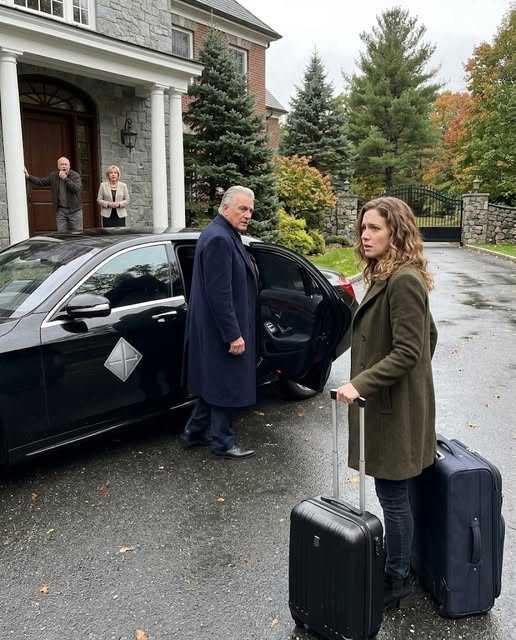
I opened it myself, stepped into the damp October air, and pulled my suitcases onto the front drive.
The sky was low and silver.
Wet leaves clung to the stone path.
My car was parked near the side garage, but my knees were shaking so badly I was not sure I could drive.
That was when my phone buzzed again.
The same unknown number.
This time, I answered.
“Ms.
Bennett?” the woman asked.
“This is Marissa Cole.
I apologize for calling again.
Mr.
Harlow is nearby.
He asked me to tell you he knows today is difficult, and he would like to make sure you have somewhere safe to go.”
I closed my eyes.
“How does he know that?” I whispered.
A pause.
“He received your letter.”
My eyes opened.
“I never sent him a letter.”
“Your mother did,” Marissa said gently.
“Years ago.
It was to be delivered when he was ready to stop being a coward.
Those were her words, not mine.”
The air left my lungs.
Behind me, I heard the front door open.
Richard stepped onto the threshold, impatient now, probably eager to make sure I did not linger long enough to stain his driveway with grief.
“Claire?” Marissa asked.
“May we come in?”
Before I could answer, the gates at the end of the drive began to open.
A sleek black sedan rolled through, silent and polished, its windows dark against the gray afternoon.
It looked nothing like the cars Richard’s clients drove when they came to flatter him.
It looked quieter.
Heavier.
Certain.
A uniformed driver stepped out first and moved to the rear passenger door.
Richard made an irritated sound behind me.
“What is this?” he demanded.
Then he saw the silver crest on the door.
The effect on him was immediate.
His face drained of color so quickly it frightened me.
His hand shot out to grip
the doorframe.
The arrogance vanished from his expression, leaving something naked and ugly underneath.
Fear.
“No,” he whispered.
“That’s impossible.”
Evelyn appeared behind him, annoyed by the interruption.
“Richard, what is it?”
He did not answer.
The rear door opened.
The man who stepped out was tall, thin, and older than the memory I had carried of him.
His silver hair was combed neatly back.
His black coat hung from his shoulders with the weight of another world.
But his eyes were the same as my mother’s.
Pale blue.
Steady.
Full of something that hurt to look at.
Theodore Harlow stood in the Whitmore driveway and looked at me as if I were not an inconvenience, not a burden, not a woman who had failed to earn her place.
As if I were family.
“Claire,” he said.
My throat closed.
Richard moved before I did.
“Mr.
Harlow,” he said, his voice suddenly polished and eager.
“This is unexpected.
Had I known you were coming personally, I would have arranged—”
Theodore did not look at him.
He walked past Richard’s words as though they were smoke.
He stopped in front of me, his gaze dropping to my suitcases, then lifting to my face.
“I am sorry,” he said quietly.
Two words.
Not grand.
Not theatrical.
But no one in that house had said them to me in years.
“For what?” I managed.
His jaw tightened.
“For being late.”
Something inside me cracked then.
I did not fall into his arms.
I did not forgive a lifetime in one breath.
But my eyes filled, and I could not stop them.
Behind him, Richard was trying to recover.
“Mr.
Harlow,” he said again, with a strained laugh.
“There seems to be some confusion.
Claire is my daughter-in-law.
We were just having a family disagreement.”
Theodore finally turned his head.
Richard froze under that look.
“I heard enough from the doorway,” Theodore said.
Evelyn’s mouth tightened.
“I’m afraid you’ve arrived at an emotional moment.
Claire has always been very sensitive.”
Theodore studied her for one cold second.
“My daughter was sensitive too,” he said.
“It did not make her weak.
It made her better than the people who mistook cruelty for strength.”
Evelyn looked as if she had been slapped, though no one had touched her.
Richard swallowed.
Theodore turned back to me.
“You do not have to go anywhere with me.
But there is a room prepared at my home.
There is also an attorney waiting, independent from my office, if you would like protection before your husband returns.”
My husband.
The word landed like a bruise.
As if summoned by it, Richard’s phone rang.
He glanced down, ignored it, then looked at Theodore with desperation creeping into his face.
“Mr.
Harlow,” he said.
“Perhaps we should speak privately.
There are business matters between our firms that could be affected by misunderstandings.”
I looked at Richard.
For three years, he had treated me like a charity case he resented feeding.
Now he looked like a man watching the floor vanish beneath him.
Theodore’s expression did not change.
“There are no business matters between us anymore.”
Richard’s lips parted.
“The bridge loan,” he said, too quickly.
“Your office indicated final approval was merely administrative.”
“It was under review.”
“We submitted everything you requested.”
“You
did.” Theodore’s voice was calm.
“Including payroll records, subsidiary transfers, and charitable disbursement schedules.”
Richard went still.
For the first time, I saw real panic in his eyes.
Evelyn noticed it too.
“Richard?”
Theodore did not raise his voice.
He did not have to.
“My auditors found several irregularities.
I was prepared to discuss them discreetly next week.
Then I learned the woman you have spent years humiliating in your home is my granddaughter.”
The word hit the driveway like thunder.
Granddaughter.
Evelyn’s face changed first.
Not guilt.
Calculation.
Her eyes snapped to me as if she were trying to fit a new price tag around my neck.
Richard stared at me.
“You never said,” he whispered.
I let out a small, bitter laugh.
“You never asked who I was.
You only asked what I had.”
His mouth tightened.
Theodore looked at the driver.
“Please put Claire’s bags in the car.”
The driver moved immediately.
Richard stepped forward.
“Now wait just a moment.
She is still married to my son.”
“No,” I said.
Everyone looked at me.
I was surprised by how steady my voice sounded.
“I am legally married to Andrew today.
That is paperwork.
I stopped being his wife a long time ago.”
Evelyn’s eyes flashed.
“You ungrateful little—”
“Careful,” Theodore said.
Just one word.
Evelyn closed her mouth.
My phone began ringing again.
This time it was Andrew.
I stared at his name on the screen and felt nothing like longing.
Only exhaustion.
Richard saw it.
“Answer him.”
I declined the call.
A second later, Richard’s phone rang again.
He answered sharply, turning away.
“Yes?”
I could hear Andrew’s voice through the speaker, frantic and breathless.
“Dad, Harlow Capital just pulled out.
What happened? They said the review is suspended and their legal team is involved.
What did you do?”
Richard’s shoulders hunched.
Theodore’s face remained unreadable.
Evelyn whispered, “Legal team?”
Richard ended the call without answering his son.
For years, I had imagined revenge as something loud.
I thought, if justice ever came, it would arrive with shouting, slammed doors, maybe someone finally begging me to stay.
But this was quieter and far more devastating.
Richard understood that the man he needed most had arrived not for him, but for me.
“I didn’t know,” Richard said, looking at Theodore now.
“Had I known Claire was your granddaughter—”
“That sentence tells me everything about you,” Theodore said.
Richard’s face twitched.
He turned to me then, desperation making him almost unrecognizable.
“Claire, listen.
Things were said.
Emotions were high.
You know how families can be.”
I looked past him into the house where I had spent three years shrinking myself to survive.
“I know exactly how families can be,” I said.
Then Andrew’s car screeched into the driveway.
He got out without closing the door, tie loosened, face pale.
He looked from the sedan to Theodore to me, and I watched realization move through him in stages.
Confusion.
Alarm.
Recognition.
Fear.
“Claire,” he said.
There was a time when hearing him say my name would have undone me.
Now it only reminded me how rarely he had said it when it mattered.
“What is going on?” he asked.
“I’m leaving,” I said.
His eyes dropped to the suitcases being loaded into Theodore’s car.
“With him?”
“With my grandfather.”
Andrew blinked.
Richard made a low sound, almost a groan.
Andrew looked at his father.
“Grandfather?”
Evelyn’s voice came out thin.
“Apparently Claire failed to mention she was a Harlow.”
I turned to her.
“My mother stopped using that name before I was born.
I did not hide it.
I just didn’t think love required a financial disclosure.”
Andrew flinched.
Good.
Let him feel one clean cut.
He stepped closer.
“Claire, we can talk about this.”
“We talked for three years.”
“No, we argued.
We were under pressure.
I know my parents can be difficult—”
“Difficult?” I said.
The word came out sharper than I expected.
Andrew stopped.
“Your mother called me a parasite ten minutes ago.
Your father called me a pathetic excuse for a wife.
And you know what the worst part is? I already knew what you would have done if you had been standing there.”
His eyes reddened.
“You would have looked at the floor,” I said.
Silence spread across the driveway.
Theodore did not interrupt.
Neither did Richard.
Even Evelyn seemed to understand that something final was happening, something no money could rearrange.
Andrew’s voice dropped.
“I was trying to keep peace.”
“No,” I said.
“You were keeping your place.”
His face crumpled, but not enough to change the past.
Marissa Cole stepped from the passenger side of the sedan then, a leather folder in her hands.
She introduced herself, calm and professional, and handed me a card.
“The attorney I mentioned is ready whenever you are,” she said.
“There is also documentation regarding your mother’s trust.
Mr.
Harlow can explain when you feel prepared.”
“My mother’s trust?” I asked.
Theodore’s eyes softened.
“She left instructions,” he said.
“I honored too few of her wishes while she was alive.
I do not intend to fail this one.”
I did not ask more.
Not there.
Not in front of the people who had spent years measuring my worth and had still somehow missed the whole person standing in front of them.
Richard, however, could not stop himself.
“What trust?” he demanded.
Theodore looked at him with faint disgust.
“The kind that is none of your concern.”
That finally broke something in Richard.
“You cannot destroy a company over a domestic misunderstanding.”
Theodore’s gaze hardened.
“Your company is not in danger because of my granddaughter.
It is in danger because you moved money where it did not belong and assumed no one powerful would care enough to read the files.”
Evelyn inhaled sharply.
Andrew looked at his father.
“Dad?”
Richard said nothing.
And that silence told everyone enough.
I should have felt triumphant.
Part of me wanted to.
But mostly, I felt tired.
The kind of tired that lives in your bones after years of swallowing words until they turn into poison.
I looked at Andrew one last time.
“My attorney will contact you.”
“Claire, please.”
He reached for my hand.
I stepped back.
Not dramatically.
Just enough.
His hand fell between us.
“I loved you,” he said.
“I know,” I answered.
“Just not enough to protect me.”
The driver opened the rear door.
Theodore waited beside it, giving me the choice without touching my arm, without pushing, without claiming a right to decide for me.
That small restraint nearly broke me more than anything else.
I
took one breath, then another.
Then I got into the car.
As we pulled away, I did not look back until we reached the gates.
Andrew stood in the driveway with his hands at his sides.
Evelyn had one hand pressed to her throat.
Richard was staring at the sedan like it had carried away the last piece of ground beneath him.
The gates opened.
For the first time in three years, I passed through them as someone leaving by choice.
The weeks that followed were not clean or magical.
Divorce was paperwork, appointments, ugly emails, and nights when grief arrived without warning.
Theodore and I did not become a perfect family overnight.
There was too much history, too many missing years, too much pain attached to my mother’s name.
But he showed up.
Quietly.
Consistently.
He told me my mother had written to him before she died, not asking for money, but asking him to stop punishing the child she might leave behind.
He had been ashamed, then afraid, then ashamed of being afraid.
By the time he found the courage to reach out, I had already built a life that seemed closed to him.
“I thought leaving you alone was respecting your peace,” he said one evening, sitting across from me in his library.
I looked at the fire between us.
“It was also easier,” I said.
He nodded.
“Yes.”
That honesty mattered more than an excuse.
Richard Whitmore’s company did not collapse because I left.
It collapsed because men like Richard always confuse delay with escape.
The audit widened.
Investors withdrew.
Employees began talking.
The same newspapers that once printed his charity gala photos began printing words like investigation and misappropriation.
Evelyn sent one handwritten note, not an apology, but something close enough to insult me all over again.
It said she hoped I would not let personal bitterness ruin a family.
I threw it away.
Andrew fought the divorce for two months, then stopped.
Maybe his lawyer explained reality.
Maybe he finally understood that silence had consequences.
On the day we signed the final agreement, he looked older than I remembered.
“I should have left that house with you,” he said.
I believed him.
That was the painful part.
I believed he knew it now.
I believed he regretted it.
I believed he had loved me in the limited, frightened way he understood love.
But regret was not a home.
“I hope someday you become the man you kept promising me you were,” I said.
Then I walked out without crying.
A year later, I moved into a small brick townhouse with crooked floors, warm windows, and no one criticizing how I folded towels.
I kept working in nonprofit administration, though Theodore’s foundation began partnering with my organization after a very strict conflict review that I insisted on personally.
The first time my name appeared on a donor agreement as Claire Bennett again, I stared at it for a long time.
Not Harlow.
Not Whitmore.
Bennett.
My father’s name.
My mother’s chosen name.
Mine.
People later said Richard got what he deserved.
Some said I should have exposed the Whitmores sooner.
A few even said Theodore’s arrival was too convenient, as if rescue erases the years before it.
But the truth was more complicated.
No car,
no fortune, no powerful grandfather gave me back my life.
I had already taken the hardest step before the gates opened.
I had packed the suitcases.
I had called the lawyer.
I had walked out while they were still laughing.
The car did not save me.
It only arrived in time for them to see that the woman they thought was worthless had never needed their permission to matter.