The silence that fell over the principal’s office was so heavy that even the children in the playground seemed to fade away on the other side of the door. I felt Lucy trembling behind me, her small fingers gripping the fabric of my blouse as if I were a shore and she had just stepped out of the sea.
“Repeat it,” I demanded.
Albright didn’t look down.
“Your daughter never died, Mrs. Helen. The little girl you buried… wasn’t her.”
The principal let out a muffled gasp. One of the police officers frowned, confused, as if he had just realized he hadn’t been called to control a hysterical mother, but to witness something that could destroy a lot of people’s careers.
I couldn’t speak. My throat closed up.
Two years.
Two years bringing flowers to the wrong grave.
Two years kissing a tombstone with a name that was still breathing.
“Where was she?” I asked, and my voice came out broken, ugly. “Where did you have my daughter?”
Albright reached into his suit jacket. I reacted like a wounded animal.
“Don’t move!”
The police officers also tensed up. He slowly raised his hands.
“I’m just going to take out some documents.”
“I don’t give a damn about your documents,” I spat at him. “You made me sign everything. You told me not to open the casket because ‘the accident had left her unrecognizable.’ You gave me sleeping pills the night of the funeral. You told me it was better to remember her sweet face alive.”
For the first time, something broke in his face.
“I wasn’t the one giving the orders.”
“But you obeyed.”
Lucy began to cry silently. I turned just enough to see her. She was scared. Not of me. Of him.
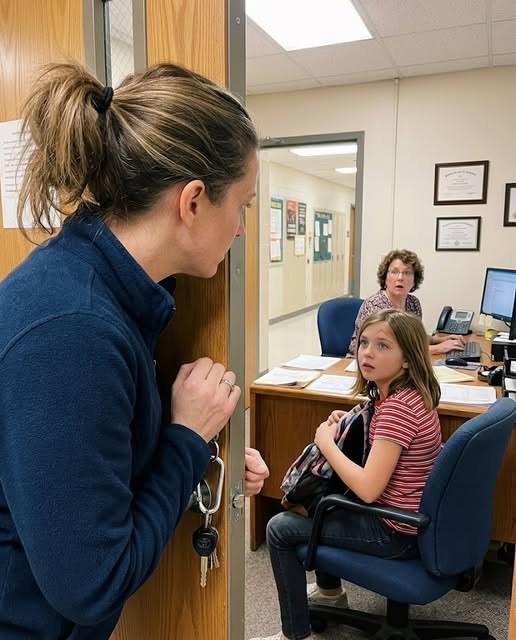
“My love,” I said, swallowing my tears. “Look at me.”
She looked up.
“Did that man hurt you?”
Lucy shook her head, but it wasn’t relief that I felt. It was something worse. Because then she whispered:
“Not him. The lady of the house did.”
My hands turned to ice.
“What lady?”
Albright closed his eyes for a second, like someone listening to a sentence being handed down.
“Helen, I need you to come with me. There are things that cannot be explained here.”
I laughed. This time with true rage.
“Do you think I’m stupid? Do you think I’m going to get into a car with the man who stole my daughter?”
“I didn’t steal her.”
“You buried her alive in paperwork!”
The principal picked up her phone.
“I’m going to call the District Attorney.”
Albright looked at her with a sickening calm.
“They are already on their way. But other people are coming too. And if you want the girl to stay alive, you have to listen to me first.”
One of the police officers took a step forward.
“Counselor, be careful what you say.”
“It’s not a threat. It’s a warning.”
Lucy clung closer to me.
“Mom, don’t let them take me again.”
That sentence completely broke me.
I knelt in front of her. I took her face in my hands. It was warm. Real. She had a tiny brown freckle on her neck that I had known since she was a baby. I kissed her there. Once. Twice. As if doing that could recover all the kisses they had stolen from me.
“No one is going to take you,” I told her. “Even if I have to set this whole place on fire.”
Then Lucy brought her lips to my ear.
“Mom… I have something.”
She reached under her uniform sweater. She pulled out a small plastic bag folded and taped to her skin. Inside was a tiny, black USB flash drive, and a crumpled piece of paper.
“The nurse told me that if I ever managed to escape, to give this to you. She said you would know what to do.”
“What nurse?”
“The one who took care of me when I got sick. Her name was Martha. But the lady called her ‘the useless one.’”
Albright turned pale.
“Martha is still alive?”
Lucy looked down.
“I don’t know. That night she screamed a lot.”
The air turned to ice.
The principal covered her mouth. One of the police officers called for backup on his radio. I just stared at the USB drive as if it were a bomb.
“Where was that house?” I asked.
Lucy squeezed her eyes shut, trying to remember.
“There were a lot of trees. An empty pool. A blue room. And a red door with a rooster painted on it.”
“Who was the lady?”
Lucy didn’t answer right away. She looked at Albright. Then at me.
“She told me I was her gift. That God had taken one daughter from her and sent her another.”
Something in Albright’s face sank completely.
“Claudia,” he murmured.
The name hit me, meaningless.
“Claudia who?”
He ran a hand over his face.
“Claudia Montgomery. Wife of Richard Montgomery.”
I felt the principal tense up.
“The businessman?”
“The very one,” Albright said. “Owner of Saint Regis Hospital.”
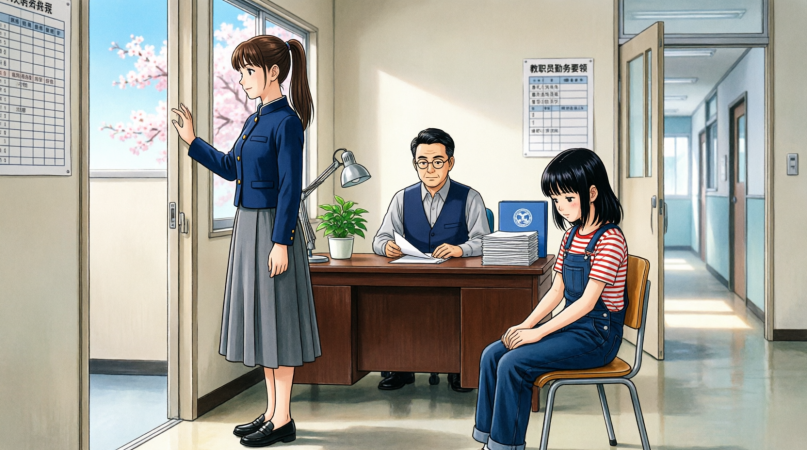
My mind started piecing together rotten fragments. The hospital where they took Lucy the night of the accident. The hospital where they told me there was nothing they could do. The hospital where Albright showed up without me calling him. The hospital that handed me a covered, sealed body, “for my own good.”
“Why?” I whispered. “Why my daughter?”
Albright looked at me and for the first time, I didn’t see arrogance. I saw shame.
“Because she had the same blood type as their daughter. Because she looked like her. Because Claudia Montgomery went insane when her little girl died on the operating table. And because Richard Montgomery had enough money to buy doctors, police officers, documents, and silence.”
“No,” I said, even though I already believed him. “No, no, no…”
Lucy hugged my waist. I wrapped my arms around her.
“The little girl you buried was Claudia’s daughter,” Albright continued. “They swapped them before you arrived. They told you Lucy had died. They gave Claudia your daughter alive, sedated, with another name. I drew up the papers. I… I helped erase Lucy.”
I slapped him so hard the sound echoed off the walls.
No one stopped me.
Albright took the blow without moving.
“I deserve that.”
“You deserve much worse.”
“I know.”
“And why are you coming forward to tell the truth now?”
He looked at Lucy.
“Because Martha sent me a video three days ago. She told me Claudia was losing control. That the girl was remembering too much. That Richard was planning to make her disappear for real.”
My knees trembled.
“Make her disappear?”
“Yes.”
Lucy buried her face in my side.
“Yesterday I heard they were going to take me ‘to the cabin upstate,’” she said. “Martha snuck me out through the kitchen before dawn. She put me on a bus. She put my uniform in a bag. She gave me the address of the school. She told me: ‘Run to your mom, even if they tell you she’s dead inside.’”
I couldn’t hold it in anymore. I hugged her so tightly she let out a small whimper.
“I’m sorry, my love. I’m sorry for not finding you. I’m sorry for believing them.”
“I searched for you in my dreams, too,” she said.
That destroyed me in a soft, unbearable way.
The principal approached with an old laptop.
“We can open the flash drive here.”
Albright quickly shook his head.
“No. It could have a tracker or something that alerts them when it’s plugged in.”
“Then we hand it over to the District Attorney,” a police officer said.
“Which District Attorney?” Albright replied. “Montgomery has people everywhere.”
“Then the press,” I said.
Everyone turned to look at me.
I was still crying, but something inside me had straightened up. I was no longer the broken mother from the funeral. I was no longer the woman who slept with her daughter’s clothes so she wouldn’t forget her scent. I was someone else. Someone who had just received her little girl back from the grave and had no intention of losing her out of fear.
“The press, live,” I repeated. “Let the whole country see her face before they can hide her.”
The principal took a deep breath.
“My sister works at a local news station. It’s not a national network, but she can broadcast a signal.”
“Call her.”
Albright took a step toward the window.
“It’s too late.”
Outside, by the school gates, two black SUVs parked.
Lucy went rigid.
“It’s them.”
I saw a woman step out of the first SUV. Tall, elegant, with dark sunglasses, wearing heels that did not belong in the dust of a public elementary school. She walked as if the world needed her permission.
Claudia Montgomery.
Behind her, two men with earpieces stepped out. And then Richard Montgomery, in a gray suit, with a notary’s smile and a predator’s gaze.
The principal slammed the blinds shut.
“My God.”
“Hide her,” Albright said.
“No,” I replied.
They all looked at me as if I had gone crazy.
I wiped Lucy’s tears away with my thumbs.
“My love, listen to me. You’ve run enough. They’ve hidden you enough. Now it’s time for the world to see you.”
“I’m scared, Mom.”
“I am too. But we are going to be scared together.”
I took her hand and we walked out of the principal’s office.
The hallway filled with teachers peeking out, quiet children, whispers. The principal walked behind us with her cell phone broadcasting a video call. I don’t know who she talked to, I don’t know how she did it, but when we reached the playground, her sister was already recording the screen and repeating: “Don’t cut the feed, don’t cut it, we’re going live.”
Claudia Montgomery walked through the gate as if she owned the school.
When she saw Lucy, her face twisted.
It wasn’t surprise.
It was fury.
“Isabella,” she said with fake sweetness. “Come to mommy.”
Lucy squeezed my hand.
“My name isn’t Isabella.”
Claudia slowly took off her sunglasses.
“My love, you’re confused. That woman has filled your head with nonsense.”
I took a step forward.
“Her name is Lucy Davis. She is my daughter. And you had her kidnapped for two years.”
Richard Montgomery smiled faintly.
“Ma’am, I understand your pain, but you are making a grave mistake. That girl is our adopted daughter. We have the paperwork.”
“Paperwork drawn up by him,” I said, pointing at Albright. “And by your hospital.”
The camera on the principal’s phone was pointed right at us. Richard noticed it. His smile vanished.
“Turn that off.”
“No,” said the principal, her voice trembling but firm.
Claudia walked toward Lucy.
“Isabella, come here. I bought you that yellow dress you wanted. Let’s go home. I’ll forgive you for running away.”
Lucy started to cry.
“You’re not my mom.”
Claudia’s face shattered like struck porcelain.
“I took care of you! I gave you everything! That woman let you die!”
The scream made several children start crying.
I felt the blood rush to my head.
“Don’t you ever say that again.”
“What do you know about being a mother?” she spat at me. “A mother feels it when her daughter is alive.”
That sentence was a perfect knife. For a second, it knocked the wind out of me.
Then Lucy let go of my hand, took a step forward, and spoke in a tiny, but clear voice:
“She did feel it. That’s why she came when they called her.”
Claudia raised her hand.
She never got to touch her.
I shoved her with my entire body. She fell to her knees on the concrete playground. Richard lunged at me, but the police intercepted him. The security detail moved in; the teachers got in the way. Suddenly the playground was a chaos of screams, radios, running children, and phones recording from everywhere.
Albright raised his hands.
“I’ll testify!” he shouted. “I have copies! I have the names of doctors, payoffs, forged death certificates! Everything is on that flash drive!”
Richard stopped struggling.
His gaze changed.
It was no longer fear of justice.
It was a decision to kill.
He pulled something from his waistband.
A gun.
The world went into slow motion.
I heard someone scream. I saw Claudia on the ground, smiling through her tears as if that confirmed we were all crazy except her. I saw Lucy turn toward me.
And then Albright stepped in the way.
The gunshot cracked through the air.
Albright fell backward, a red stain blooming on his shirt.
The police tackled Richard. The gun clattered to the ground. Claudia screamed her husband’s name, but no one listened to her. The entire playground was staring at the man bleeding out next to the colorful backpacks.
I crouched beside him, never letting go of Lucy.
Albright looked at me. There was blood on his lips.
“I’m sorry,” he barely choked out. “It’s not enough… but I’m sorry.”
I hated him.
And yet, in that instant, I couldn’t wish him any more pain.
“Where is Martha?” I asked him.
He gasped for air with difficulty.
“Safe house… the Poconos… red door… rooster…”
His eyes clouded over.
“Don’t let them… say… that you were crazy…”
And he went still.
The broadcast didn’t cut off.
That saved us.
By the time more patrol cars arrived, thousands of people were already watching the video. By the time they tried to take the principal’s phone, her sister had already sent the footage to three news channels, two newspapers, and a reporter who wasn’t afraid of anyone. By the time Richard Montgomery tried to claim it was a “family misunderstanding,” half the country had seen his wife call my daughter “Isabella” and him pull a gun in an elementary school.
We didn’t sleep that night.
They took us in to give our statements. They asked horrific questions. They asked me to describe the funeral. They asked me to identify signatures. They asked me to recount how many times I had seen the body. Every answer was a stone being pulled from my chest with tweezers.
Lucy never left my side.
When they gave her hot chocolate in a styrofoam cup, she held it with both hands and asked me:
“Do I still have my bed?”
My soul broke.
“Yes, my love. It has your star sheets.”
“And my bunny?”
“That too.”
“Is he still mad that I left?”
I hugged her right there, in front of prosecutors, psychologists, and cops.
“No one is mad at you. You didn’t leave. You were ripped away. And I am going to plant you back at home, very slowly, until you grow roots again.”
Three days later, they found Martha.
She was alive.
Beaten, hidden in a warehouse in the Poconos, tied to a chair, with a fever and two broken ribs, but alive. When they took her to the hospital, she asked to see me before the doctors.
I walked in holding Lucy’s hand.
Martha cried when she saw her.
“You did it, my sweet girl.”
Lucy ran to hug her.
I stood in the doorway, not knowing what to say to the woman who had cared for my daughter when I couldn’t.
“Thank you,” was all I could manage.
Martha shook her head.
“Don’t thank me. It took me far too long.”
Then she told us everything. That Claudia had lived convinced that Lucy was the reincarnation of her daughter. That at first they drugged her so she wouldn’t ask questions. That they invented memories, photo albums, birthdays, a fake life. That when Lucy started singing the song about the moon and the little bunny in her sleep, Claudia became so enraged that she ordered all the windows in the house locked “so the other mother couldn’t get in.”
The other mother.
That’s what they called me.
As if I were a ghost.
But ghosts don’t sign police reports. They don’t give interviews. They don’t identify scars in front of a judge. They don’t hold their daughter’s hand when the DNA test is finally done and the result confirms what the blood already knew from the very first hug.
Maternal probability: 99.9999%.
The day they exhumed the grave, I went alone.
I didn’t take Lucy. She had already seen too much death for such a little life. I stood in front of the tombstone bearing her name and placed the photo in the uniform on it, the one with chocolate on her mouth.
“I found you,” I whispered.
Then I watched as they lifted the casket I had cried over until I was dry. Inside, the forensic team confirmed what Albright had said: another girl, another DNA, another tragedy buried beneath my pain.
I cried for her, too.
Because that little girl, the real Isabella, wasn’t to blame either. She was also used. She was also erased by parents incapable of accepting that you can’t buy love by stealing another family’s life.
Months later, the house with the red door and the painted rooster was seized by the state. In the blue room, they found drawings hidden behind a baseboard: a dark-haired woman holding hands with a little girl; a giant moon; a bunny; a house with one word written over and over again.
Mom.
They gave me those drawings in a folder. That night I taped them to my bedroom wall, right next to the new ones Lucy had started drawing in therapy. At first, they were all dark. Houses without windows. Women without mouths. Girls behind doors.
Then, little by little, the color returned.
A crooked sun.
A dog we didn’t have but she wanted.
A bed with star sheets.
And finally, a drawing of the two of us.
I had enormous arms, way too big for my body. When I asked her why, Lucy smiled faintly.
“Because that’s how you hug when you’re scared.”
The trial lasted almost a year.
Richard Montgomery went down first. Then the doctors. Then two county clerks. Claudia screamed until the very last day that Lucy was hers, that I had stolen her, that a real mother didn’t need a piece of paper.
When the judge handed down the sentence, Lucy was sitting on my lap. She had grown. Her hair was styled better, though she still bit her lip when she got nervous.
Claudia turned toward us before they took her away.
“She’s going to miss me,” she said.
Lucy lifted her head.
“I am going to heal from you.”
It was the bravest sentence I have ever heard in my life.
That night, when we got home, Lucy asked me to sing to her.
I froze.
Since her return, she had never asked me to. I hadn’t dared to either. The song about the moon and the little bunny had stayed trapped in that impossible first night, in the principal’s office, when a girl walking out of death called me Mom.
I sat next to her bed. The light from the hallway spilled in softly. Her old bunny was tucked under her arm. The scar on her eyebrow barely caught the light.
“Do you remember it?” she asked me.
I felt the tears welling up.
“Every single word.”
I started softly.
The moon came out barefoot,
with a little gray bunny,
looking for a lost little girl
who dreamed of returning home…
Lucy closed her eyes.
“Mom…”
“Yes, my love?”
“When I was in the other house, sometimes I couldn’t remember your face anymore. But I did remember your voice. I think that’s why I didn’t become theirs.”
I leaned down and kissed her forehead.
“You were never theirs.”
“What if one day I get scared again?”
“You wake me up.”
“Even if it’s late?”
“Even if it’s late.”
“Even if you’re tired?”
“Even if I’m broken.”
She opened her eyes and looked at me with that ancient seriousness of children who have suffered too much.
“I don’t want you to be broken anymore.”
I smiled through my tears.
“Then we’ll fix each other together.”
Lucy snuggled under the covers. I kept singing until her breathing grew steady. Outside, the city made noise like always: cars, dogs, distant vendors—a life that didn’t stop for any miracle.
But inside that house, for the first time in two years, everything was right where it belonged.
The photo in the uniform was still on the table, but it was no longer an altar. It was a memory. The grave no longer bore her name. My chest was no longer an empty room.
And my daughter, my Lucy, the little girl I had buried without ever losing her, slept just inches from my hand.
That night I understood something no one had taught me about grief: sometimes life doesn’t return what it takes cleanly. Sometimes it returns it wounded, changed, with nightmares, with silences, with questions that ache. But it returns it breathing.
And as long as Lucy was breathing, I was too.
I turned off the light.
From the bed, half asleep, she murmured:
“Mom, will you take me to school tomorrow?”
My heart skipped a beat.
“Are you sure?”
“Yes. But this time you wait until I get inside.”
I leaned closer in the dark and squeezed her hand.
“This time,” I promised her, “I’m never letting you out of my sight.”

