My husband kept his hand on the small of my back as we walked through the automatic doors of St. Mercy Regional, and for the first time in twelve years of marriage, the touch made my stomach turn.
Not because he was rough. Not because he was cold. Trent had never been the kind of man who shouted in public or slammed doors where neighbors could hear. He smiled at nurses. He held doors for old women. He remembered birthdays, anniversaries, and the names of people’s dogs.
He had built a whole personality out of being the calm one, the steady one, the husband every woman’s mother said she should be grateful to have.
But lately, every time he touched me, I felt a strange crawling panic under my skin, as if some buried part of me knew something my mind had not been allowed to know yet.
“You’re shaking,” Trent said softly.
“I’m fine.”
“You’re not fine, Maren. That’s why we’re here.
He said it with that gentle patience that made me feel foolish, childish, difficult. I tightened my grip around the strap of my purse and stared at the polished hospital floor.
For nearly a year, my body had been betraying me.
It started with exhaustion so heavy I sometimes sat on the edge of the bed for twenty minutes before I could stand. Then came nausea, bruises I couldn’t explain, fainting spells, and a dull ache in my left side that woke me before dawn.
My hands trembled when I signed checks at the elementary school office where I worked. My blood pressure swung from normal to terrifying. I lost weight even though Trent insisted I was eating enough.
Every doctor Trent took me to said some version of the same thing.
Stress.
Hormones.
Anxiety.
Maybe grief.
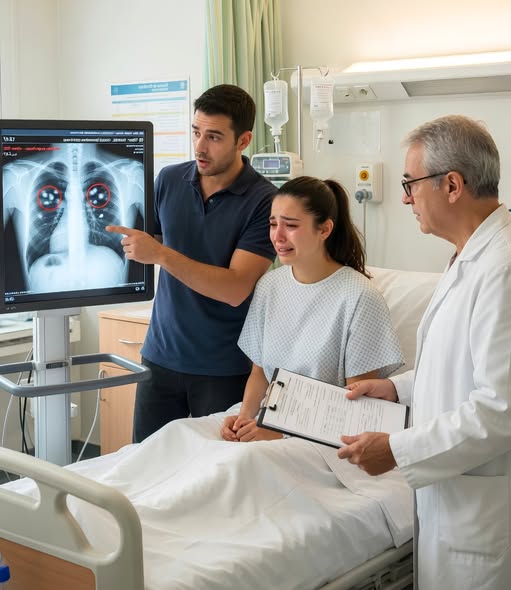
That last one became his favorite. Grief had been his explanation for everything since my mother died two years earlier, though he never seemed to remember that grief did not usually leave a person doubled over on the bathroom floor at three in the morning, sweating through her nightgown.
My brother, however, had never accepted the easy answers.
Dr. Caleb Whitaker was three years older than me and had been bossing me around since we were kids in Ohio, back when he used to check my bike tires before I rode and interrogate my middle school boyfriends like a tiny district attorney.
Now he was chief of surgery at St. Mercy Regional in Columbus, and when I finally called him after collapsing in the grocery store parking lot, he didn’t ask if I was anxious.
He asked, “Has anyone done a full abdominal CT?”
I told him no.
There was silence on the line.
Then Caleb said, “Come to my hospital tomorrow.”
Trent didn’t like that.
He pretended he did, of course. He kissed my forehead and said, “Anything that helps you feel safe.” But I saw the flicker in his eyes. I saw how his jaw worked when I told him Caleb wanted to run tests himself.
I saw him step into the garage to make a phone call he ended the moment I opened the kitchen door.
Now, standing in my brother’s hospital with Trent’s palm pressing lightly against my back, I wondered why I had ever mistaken control for care.
At the radiology desk, a young woman with copper-red braids smiled at us. “Maren Doyle?”
“That’s me.”
“Dr. Whitaker has everything ready. We’ll get you checked in.”
Trent leaned over the counter before I could answer. “I’ll stay with her.”
The woman glanced at her screen. “For the CT, she’ll go back alone.”
“She gets nervous,” Trent said.
“I’m okay,” I said quickly.
He looked down at me. “Honey.”
It was one word, soft as velvet and tight as a leash.
“I’m okay,” I repeated.
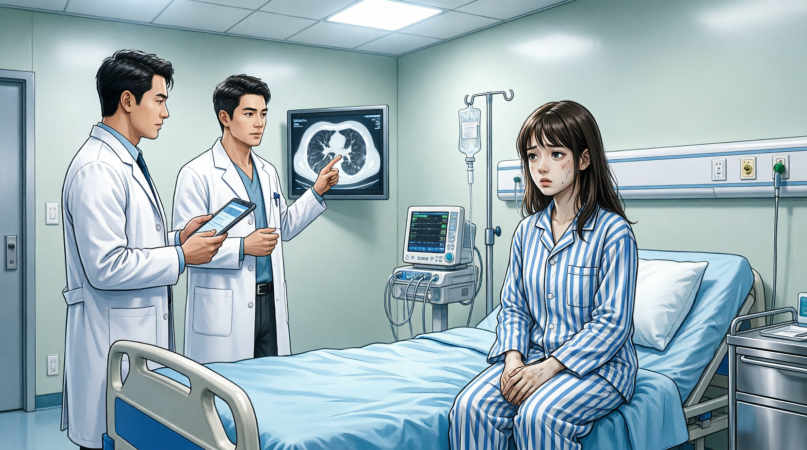
Something changed in the receptionist’s face. Not much. Just enough. Her smile became smaller, more professional. “Mrs. Doyle, you can follow me.”
As I walked away, I felt Trent’s hand slide off my back.
The CT room was cold enough to raise goose bumps on my arms. The technician, a broad-shouldered man named Luis, explained every step in a calm voice. I lay down on the narrow table, stared at the white curve of the machine, and tried to breathe normally.
“You’re doing great,” he said from behind the glass.
The table moved.
The machine hummed.
A voice told me when to hold my breath.
For those few minutes, I felt almost peaceful. There was something comforting about being scanned, measured, looked at by something that had no opinion of me. The machine would not ask why I was tired. It would not tell me to try yoga. It would not call my symptoms grief. It would simply show what was there.
Then the scan ended.
Luis came back into the room, unhooked the IV line, and helped me sit up. He was still polite, still professional, but the warmth had drained from his face.
“Is everything okay?” I asked.
He didn’t answer right away.
His eyes flicked toward the control room. Then back to me. “Dr. Whitaker is going to speak with you.”
“My brother?”
“Yes, ma’am.”
“Did you see something?”
Luis swallowed. “He’ll explain.”
The air felt suddenly too thin.
I changed back into my clothes with clumsy fingers. When I stepped into the hall, Trent was already standing from his chair.
“What took so long?” he asked.
Before I could answer, Caleb appeared at the end of the corridor in a white coat, his expression so strange that I almost didn’t recognize him.
My brother had always been steady. Even at our mother’s funeral, he had been the one who signed papers, thanked guests, carried casseroles to the refrigerator. But now his face was pale, his mouth set hard, his eyes burning with something that looked too much like fear.
“Maren,” he said. “Come with me.”
Trent stepped forward. “What’s going on?”
Caleb did not look at him. “I need to speak with my sister.”
“I’m her husband.”
“I know who you are.”
The hallway went quiet around us.
Trent gave a small laugh. “Caleb, don’t be dramatic.”
Caleb’s eyes finally moved to him. “Sit down.”
Two words. Flat. Surgical. Commanding.
Trent’s smile faded.
I had never seen anyone speak to my husband like that. I had certainly never seen him obey. But something in Caleb’s voice made even Trent pause.
“Maren,” Caleb said again, softer now. “Please.”
I followed him.
He led me past radiology, past a nurses’ station, and into an administrative hallway I had never seen before. At the end, he opened a door marked Director of Clinical Operations. Inside, a gray-haired woman in navy scrubs stood beside a desk, her face grim.
“This is Dr. Helen Park,” Caleb said. “Hospital director.”
My heartbeat thudded in my ears. “Why is she here?”
Caleb closed the door behind me.
Then he locked it.
“Caleb,” I whispered.
He turned toward a monitor mounted on the wall. His hands were trembling.
I had never seen my brother’s hands tremble.
He brought up an image in black, white, and ghostly gray. At first, it meant nothing to me. Shapes. Shadows. The secret architecture of my own body.
Then Caleb pointed.
“In your body,” he said, voice breaking. “Maren, look at this.”
I leaned closer.
There was empty space where something should have been.
My mind refused to understand it.
Caleb clicked to another image. Then another. He pointed again, not just at the absence, but at a row of tiny bright marks that looked like metal teeth.
“Surgical clips,” he said. “Old ones.”
“What does that mean?”
His throat moved. “Your left kidney is gone.”
The room tilted.
I grabbed the edge of the desk. “No.”
“Maren—”
“No. That’s not possible.”
Dr. Park stepped closer, but Caleb lifted a hand. He knew me. He knew touching me would make it worse.
“You weren’t born with one kidney,” he said. “I checked your childhood records. You had an abdominal ultrasound at fifteen after that soccer injury. Two kidneys. Normal anatomy.”
I stared at the monitor. “No.”
“There are removal clips. Scar tissue. Whoever did this knew what they were doing.”
My mouth opened, but no sound came out.
A memory flashed in my mind: waking up in a dim room with beige curtains, my throat raw, Trent sitting beside me and telling me I’d had an emergency procedure for a ruptured ovarian cyst while we were on our anniversary trip in Georgia.
I remembered pain.
I remembered bandages.
I remembered Trent saying, “Don’t scare yourself with details. The doctors handled it.”
I remembered asking for paperwork and him kissing my forehead.
“I have it all at home,” he had said. “Rest.”
I never saw the paperwork.
Caleb’s face twisted as he watched me remember.
“That trip,” I whispered.
“What trip?”
“Savannah. Last May. I got sick. Trent said I had surgery.”
Caleb closed his eyes for one second.
When he opened them, he looked older.
Dr. Park picked up the phone on her desk.
Caleb said, “I’m calling the police now.”
The words landed like ice water.
“No,” I said automatically, though I didn’t know why.
“Yes,” Caleb said. “Maren, this is assault. This is organ theft. This is a major felony, and he is sitting twenty feet away from you.”
The door suddenly rattled.
“Maren?” Trent called from the hallway. “Open the door.”
My blood turned cold.
Caleb moved in front of me.
The handle jerked again.
“Maren, what is going on?”
Dr. Park spoke into the phone in a low, controlled voice. “This is Dr. Helen Park at St. Mercy Regional. We need hospital security and Columbus Police to radiology administration immediately.”
Trent knocked harder. “Caleb, open the damn door.”
My brother did not move.
For the first time, I understood that the man outside the door was not simply my husband.
He was evidence.
And I was the crime scene.
Security arrived before the police.
Two guards in dark uniforms positioned themselves in the hallway while Dr. Park opened the office door only halfway. Trent’s face appeared through the gap, flushed and furious beneath the smile he was trying to force into place.
“There’s been a misunderstanding,” he said.
Dr. Park’s voice was calm. “Mr. Doyle, please wait with security.”
“I want to see my wife.”
Caleb stepped forward. “You lost that privilege.”
Trent’s eyes snapped to him. There it was, finally. The real thing under the manners. Hatred, sharp and naked.
“Maren,” he said, looking past Caleb. “Whatever they told you, don’t panic. Your brother has always hated me.”
I almost laughed.
It came out as a broken breath.
“My kidney,” I said.
The hallway went still.
Trent blinked once.
That was all. One blink. One fraction of a second. But I saw it. Caleb saw it. Dr. Park saw it.
A guilty man does not always confess. Sometimes he simply fails to be surprised.
“Maren,” Trent said carefully, “you’re confused.”
My legs went weak.
Caleb turned and caught my elbow before I fell.
“You had a complicated emergency surgery,” Trent continued. “You were septic. They had to make decisions quickly.”
“What hospital?” Caleb demanded.
Trent looked at him. “I don’t have to answer you.”
“You do if you want to explain why my sister’s kidney was removed without her knowledge.”
Trent’s jaw tightened. “She consented.”
The room seemed to shrink.
I whispered, “I didn’t.”
“You don’t remember,” he said quickly. “You were in pain. You were frightened. I signed because you asked me to handle it.”
“No,” I said.
His voice warmed, softened, became the voice he used when guests were over and I contradicted him about something small. “Sweetheart, this is exactly what I mean. Your memory has been unreliable for months.”
Caleb took one step toward him.
Security moved too.
Trent lifted both hands. “I’m just telling the truth.”
But the truth had finally developed edges, and they were cutting through everything.
The police arrived in pairs. Uniforms. Radios. Questions. I answered what I could from Dr. Park’s office while Trent sat down the hallway under security’s watch. Caleb stayed beside me, not speaking unless I looked at him.
The first officer, a woman named Daniels, had kind eyes and a notebook already half full.
“Mrs. Doyle, do you feel safe going home with your husband tonight?”
“No.”