A homeless girl begged a millionaire, “Please, I’ll pay you back when I grow up, just one box of milk for my baby brother.” What he said next left everyone silent. Winter in Boston had turned the whole downtown into a field of glass and gray slush. The sidewalks glittered with frozen puddles. Steam lifted from manholes in restless white clouds, and every person on Tremont Street seemed to be walking faster than usual, shoulders hunched, faces hidden, trying to outrun the cold. Andrew Keller stepped out of the café beside his office tower just after three in the afternoon. He wore a charcoal wool coat, polished shoes, and the distracted expression of a man whose mind was still trapped in a conference room thirty stories above the street. He had spent the morning discussing a merger that would put his company on every financial page in the country. Keller Technologies had started in his apartment fifteen years earlier and grown into something powerful enough to make mayors return his calls and bankers laugh too loudly at his jokes. His life was precise. His meetings had agendas. His car arrived before he did. His world rarely left room for surprises. Then a voice came from behind him. “Sir… please.” It was so small that the wind nearly swallowed it. Andrew kept walking for half a step, then stopped. Something in the sound had reached him before he could bury it under habit. It was not the practiced shout of someone begging from a corner. It was careful. Almost embarrassed. He turned. A girl stood near the curb where dirty snow had piled against a fire hydrant. She could not have been more than ten years old. Her coat was several sizes too large, with one sleeve folded twice and the other hanging loose around her wrist. Her shoes were split near the toes, soaked dark from slush. A torn knit hat covered most of her tangled brown hair. In her arms was a baby boy wrapped in a threadbare towel and the remains of a blue blanket. His cheeks were pale. His lips trembled. One tiny fist pressed against the girl’s coat as if even he understood she was the only safe thing left in the world. “My brother’s hungry,” the girl said. Andrew looked around. People were passing on both sides of them. Some glanced over and quickly looked away. Others moved around the girl the way they would step around a puddle, careful not to let anything touch them. The girl lifted her chin, but her voice shook. “Could you buy one box of milk? I promise I’ll pay you back when I grow up.” That sentence did something to the street. A woman coming out of the café slowed down and stared. A man in a navy suit checked his phone, frowned, and walked faster. The doorman from the building next door looked over, then pretended to adjust the brass handle. Andrew’s first instinct was the one the city had taught him. Keep moving. Give later. Donate to a foundation. Let systems handle suffering at a safe distance. But the girl was not holding out a cup. She was not asking for cash. She was bargaining with the only currency she had left: a future she was not even sure she would survive long enough to reach.
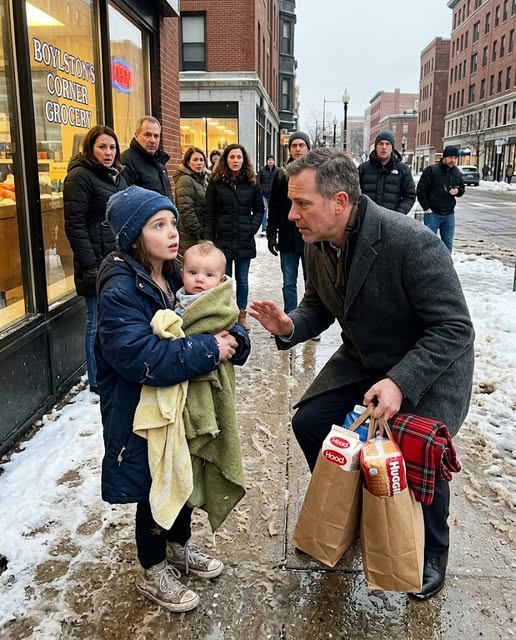
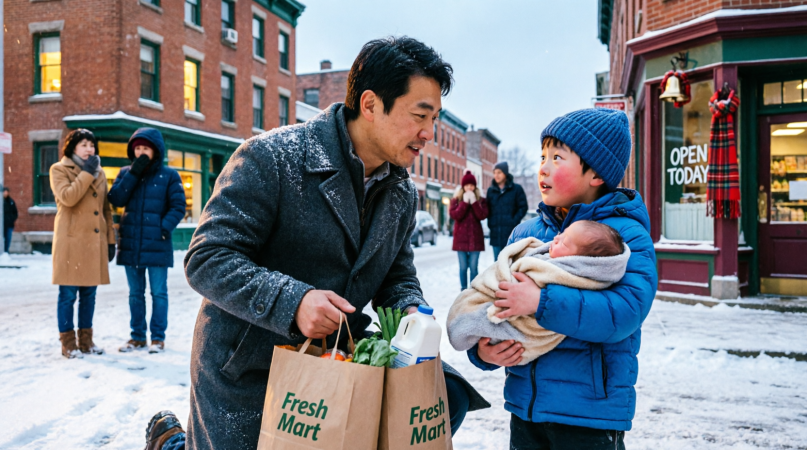
“What’s your name?” Andrew asked. The girl blinked, as if nobody had asked her that in a long time. “Ruth,” she whispered. “And him?” She looked down at the baby, and her face changed. It softened with a fierce, exhausted love too old for her small body. “Samuel.” Andrew nodded. Across the street, a corner market glowed warm behind fogged windows. He gestured toward it. “Come with me, Ruth.” For a second she did not move. Her eyes flicked to his coat, his shoes, the watch on his wrist. She had learned to measure adults quickly. Kind voices could turn impatient. Helping hands could come with conditions. “I only need milk,” she said. “I heard you.” He waited until the traffic light changed, then walked slowly enough for her to follow. Inside the store, heat rushed over them. Ruth flinched at it. Samuel stirred and made a dry, weak sound that made the cashier look up from a magazine. Andrew took a basket. He put in two cartons of milk. Then bread. Then jars of baby food. Diapers. Wipes. Applesauce. A pair of small gloves from a wire rack near the register. A knit hat for Samuel. A thick fleece blanket, dark green and soft, from a shelf near the back. Ruth followed him down each narrow aisle with her mouth slightly open. “Sir,” she whispered, “that’s too much.” “It’s not.” “I can’t pay for all that.” Andrew stopped beside a display of canned soup. He turned and looked at her properly this time, not as an interruption, not as a problem, but as a child standing in a grocery store holding another child like a responsibility. “You don’t have to.” At the register, the cashier’s eyes traveled from Andrew’s tailored coat to Ruth’s broken shoes. The line behind them went quiet. Andrew placed his black card on the counter. The cashier scanned the items slowly, as if the ordinary sound of beeps had become part of something delicate. Ruth shifted Samuel higher on her hip. Her arms were shaking from the weight, but she refused to set him down. When the bags were packed, Andrew took the blanket out first. He unfolded it and wrapped it around Samuel, tucking it carefully without touching the baby more than he had to. Ruth stared at him. “I’ll remember,” she said, the words barely above a breath. “I really will pay you back.” Andrew crouched so they were eye to eye. Behind him, the cashier had stopped moving. The people in line had stopped pretending not to listen. “You owe me nothing,” Andrew said. “Just keep your brother safe. That will be enough.” Ruth’s eyes filled, but she did not cry. She pressed her lips together and nodded once, the way adults do when they are trying not to fall apart in public. “Thank you, Mr…?” “Keller,” he said. “Andrew Keller.” Her expression flickered at the name. It was small, almost nothing, but Andrew saw it. Recognition, maybe. Or fear. Then it was gone. She gathered the bags awkwardly, clutching Samuel tight against her chest. “Come on,” Andrew said. “Where are you staying? I can call someone. A shelter. A family service.” Ruth took one step back. “No.” The word came out sharper than anything she had said before.
Andrew paused. “It’s too cold for him outside.” “I know.” Her voice cracked. “But we can’t go there.” “Go where?” Ruth looked toward the store window. Snow was falling harder now, blurring the passing cars into streaks of light. Her hand tightened around the bag handles until her knuckles whitened. “Thank you,” she said again. Then she turned and hurried out before Andrew could ask another question. He followed to the door, but by the time he reached the sidewalk, Ruth had already crossed half the block, bent over the baby against the wind. She moved with purpose, not wandering, not lost. She knew exactly where she was going, and that made Andrew uneasy. His driver pulled up in a black sedan. “Home, Mr. Keller?” Andrew did not answer right away. He watched Ruth and Samuel become two small shadows swallowed by the weather. Something about the way she had reacted to his name stayed in his chest like a stone. “Not yet,” he said. He got into the car, but instead of closing the door, he leaned toward his driver. “Follow them. Slowly. Don’t scare her.” The driver glanced at him in the mirror, surprised, then nodded. For three blocks, they trailed far behind as Ruth wound through downtown streets. She stopped once beneath an awning and adjusted the blanket around Samuel. Then she kept going past shops, office lobbies, and restaurants where warm yellow light spilled onto people who had never had to beg for milk. Finally, she slipped into an alley behind a boarded-up church building near the edge of Chinatown. Andrew stepped out before the driver could protest. The alley smelled of wet cardboard and old smoke. Snow collected on rusted fire escapes. At the far end, beneath a shallow overhang, Ruth crouched beside a pile of blankets arranged behind stacked crates. She pulled out a small plastic bottle, poured milk with careful hands, and fed Samuel while rocking him against her chest. Andrew stopped before she saw him. There was no shelter worker. No parent. No adult. Just a child keeping another child alive. Ruth looked up suddenly, and terror flashed across her face. “You followed us.” “I was worried.” “We didn’t steal anything.” “I know that.” She stood too fast, nearly dropping the bottle. Samuel began to cry, a thin sound that echoed between brick walls. Andrew raised both hands. “I’m not here to take anything from you.” “That’s what they said last time.” The words stopped him. “What happened last time?” Ruth’s eyes filled again, but now the tears looked angry. “They took us to a place. They said it was temporary. Then they wanted to separate us.” Andrew felt the cold differently then. Not on his skin, but somewhere deeper. “Where are your parents?” Ruth looked down at Samuel. “Our mom got sick.” The alley went quiet except for the wind pushing snow along the pavement. “She cleaned offices at night,” Ruth continued. “She kept coughing, but she said missing work meant missing rent. Then one morning she didn’t wake up right. I called the number she had written on the fridge, but by the time they came…” She stopped. Her face tightened. She was ten years old and already knew how to cut a memory short so it would not destroy her.
Andrew swallowed.
“And your father?”
“Gone before Samuel was born.”
“Do you have anyone?”
Ruth shook her head.
The answer was too small for how much it meant.
Andrew took one step closer.
“Ruth, you can’t stay in this alley tonight.
The temperature is dropping.”
“I kept him warm yesterday.”
“Yesterday wasn’t tonight.”
She held Samuel tighter.
“You’ll call them.”
“I will call someone who can help.”
“They’ll split us up.”
“I won’t let that happen.”
Ruth laughed once, not because it was funny, but because she had heard adults make promises before.
“You don’t know that.”
Andrew wanted to say he did.
He wanted to say money could solve anything because for most of his life, it had.
But standing in that alley, looking at a little girl who trusted no door because every door had failed her, he knew the wrong promise would only make him another liar in a long line of them.
So he told the truth.
“I don’t know everything,” he said.
“But I know I can get you both warm tonight.
And I know I can stay until we find out what happens next.”
Ruth studied him.
Snow gathered on Andrew’s shoulders.
His phone buzzed again and again in his pocket.
Board members, lawyers, assistants, people with urgent things that suddenly felt weightless.
Finally Ruth whispered, “You’ll stay?”
“Yes.”
“With Samuel too?”
“With both of you.”
It took another ten minutes before she agreed to step into the car.
Even then, she sat pressed against the far door, watching Andrew as if kindness might change its mind at any second.
Andrew took them first to a pediatric urgent care clinic his company supported through a charitable program he had barely remembered approving.
Samuel was dehydrated, underfed, and fighting a respiratory infection, but the doctor said he had arrived before it became dangerous.
Ruth stood beside the exam table the entire time.
When a nurse tried to take Samuel to weigh him, Ruth nearly panicked.
“No,” she said, grabbing his blanket.
The nurse froze.
Andrew stepped in quietly.
“Can she walk with him?”
The nurse nodded.
“Of course.”
Ruth looked at Andrew then, and for the first time, there was something like surprise in her face.
He had not told her to calm down.
He had not made her fear smaller to make the room more comfortable.
He had simply made space for it.
By evening, Andrew had called his legal team, a private child advocate, and the director of a family emergency housing program.
For once, he did not delegate and disappear.
He sat in the clinic waiting room with Ruth while Samuel slept in her lap under the green blanket.
The television played soundless news above them.
The vending machine hummed.
Ruth ate half a turkey sandwich in tiny bites, saving the other half in the paper wrapper until Andrew gently told her there would be more food later.
At eight o’clock, his assistant called for the sixth time.
“Andrew, the Singapore call has been waiting twenty minutes,” she said.
“Cancel it.”
There was a stunned silence.
“The entire call?”
“Yes.”
“And tomorrow’s board breakfast?”
“Move it.”
“Are you sick?”
Andrew looked at Ruth, asleep upright now, one hand still resting protectively on Samuel’s blanket.
“No,” he said.
“I think I’m finally paying attention.”
The emergency housing program found a family room in a secured building in Cambridge, but paperwork delayed everything.
There were questions about custody, records, identification, the hospital report from her mother’s death, and the previous placement Ruth had fled.
At one point, a caseworker arrived with a tired face and a thick folder.
Ruth woke instantly when she heard the word “placement.”
“No,” she said, backing into the corner with Samuel.
“No.
Please.”
The caseworker softened.
“Ruth, I’m not here to take him from you tonight.”
“That’s what Ms.
Danner said.”
Andrew saw the caseworker’s face change.
“Who?” he asked.
The woman hesitated.
Andrew’s voice lowered.
“Who is Ms.
Danner?”
The caseworker opened the folder and found a page.
“The foster intake supervisor assigned when their mother passed.
Ruth and Samuel were placed separately for assessment.
Ruth left the facility the next morning before final placement.”
Ruth’s face went white.
“They put him in another room,” she said.
“He cried and cried.
I could hear him.
I asked to sleep beside him and she said big girls don’t need babies.
She said if I kept acting difficult, no family would want me.”
Andrew felt something hard and controlled rise in him.
The caseworker closed the folder slowly.
“That should not have happened.”
“But it did,” Ruth said.
No one answered, because the truth had already filled the room.
Andrew hired a child welfare attorney that night.
Not to bully the system, not to buy his way through it, but to make sure Ruth’s voice did not get buried under forms.
He learned quickly that money opened doors, but presence kept them from closing again.
Over the next week, Andrew became a familiar figure in places he had once only mentioned at charity dinners.
Family court waiting rooms.
Social services offices.
Clinic hallways.
A temporary housing center where Ruth slept with Samuel’s crib pulled so close to her bed that the staff stopped trying to move it.
Every morning, Andrew expected Ruth to trust him a little more.
She did not.
Trust came slower than that.
It came in almost invisible pieces.
The first time she accepted a second sandwich without hiding it.
The first time she let a nurse carry Samuel while she tied her shoe.
The first time she asked Andrew what time he was coming back instead of asking whether he was coming back at all.
One afternoon, two weeks after the café, Andrew brought Ruth a new winter coat.
It was dark purple, practical and warm, with deep pockets.
She touched the sleeve but did not put it on.
“What’s wrong?” he asked.
“How much was it?”
“It doesn’t matter.”
“It matters if I have to pay you back.”
Andrew crouched in the doorway of the family room.
Samuel was on the floor with a soft block in his hand, babbling to himself.
“Ruth,” Andrew said, “do you remember what I told you in the store?”
She looked away.
“That I didn’t owe you.”
“That you owed me nothing.”
Her jaw tightened.
“My mom said you always owe somebody something.”
“Your mom was probably trying to survive.”
Ruth looked at him then, startled by the gentleness in his voice.
Andrew sat on the floor, not caring about his
suit.
“Can I tell you something?”
She nodded.
“When I was nineteen, my father died owing money to almost everyone in our town.
I spent years thinking the only way to be safe was to become the kind of man nobody could ever pity.”
Ruth listened carefully.
“I built a company.
I bought buildings.
I sat in rooms where people laughed because I was rich, not because I was funny.
And somehow I started walking past people because stopping felt inconvenient.”
Ruth looked down at the coat.
“Then you asked me for milk,” he said.
“Not for yourself.
For him.
And you promised to pay me back with a future you had every reason to stop believing in.”
Her eyes filled.
“I meant it,” she whispered.
“I know you did.”
That was the day she put on the coat.
Months passed.
Samuel gained weight.
His cheeks filled out.
He started smiling at anyone who made a ridiculous noise and crying whenever Ruth left the room for longer than ten seconds.
Ruth started school again through a temporary placement program.
The first week, she kept extra crackers from lunch in her backpack.
By the third week, she stopped hoarding food.
By the sixth, she brought home a drawing of Samuel in a green blanket and Andrew standing beside them under falling snow.
Andrew taped it to the wall in his office.
His executives noticed the change in him before he did.
He no longer tolerated speeches about community impact that had no living person attached to them.
He redirected a marketing budget into emergency family housing grants.
He ordered an audit of every charitable partnership Keller Technologies claimed credit for and personally visited the ones serving children.
One board member called it emotional overcorrection.
Andrew looked at him across the polished table and said, “Maybe we have been undercorrecting for years.”
The room went silent.
Six months after the day in the snow, Ruth’s case reached a decisive hearing.
The court had identified a distant aunt in Ohio, but the woman had declined custody.
The children needed a long-term guardian who could keep them together.
Andrew sat behind Ruth in the courtroom, hands folded, heart beating harder than it had before any investor pitch.
His attorney had already explained the process.
Becoming a guardian was not sentimental.
It was invasive, difficult, slow.
Background checks.
home studies.
parenting classes.
court monitoring.
Andrew had completed all of it.
Still, he knew the judge would ask the only question that mattered.
Why?
Ruth sat at the table beside her child advocate, wearing the purple coat even though the courtroom was warm.
Samuel slept in a carrier near her chair.
The judge reviewed the file, then looked at Andrew.
“Mr.
Keller, you are an unmarried man with no prior children, a demanding career, and significant public visibility.
You understand this is not a charitable sponsorship.”
“Yes, Your Honor.”
“This is not a donation.”
“I understand.”
“This is daily responsibility.
Illness.
school meetings.
fear.
grief.
ordinary inconvenience.
The children need stability, not a rescue story.”
Andrew nodded slowly.
“I agree.”
“Then tell me why you are petitioning for guardianship.”
Andrew looked at Ruth.
She was staring down at her hands, trying to look brave.
He remembered her in the slush, shoes soaked through, asking for one
box of milk with more dignity than many powerful men brought into boardrooms.
He turned back to the judge.
“Because the first time I met Ruth, she was already doing the job every adult around her had failed to do,” he said.
“She was protecting her brother.
She did not ask me to save her.
She asked me to help her keep him alive.”
The courtroom was very still.
“I used to believe responsibility was something you accepted when it fit into your life,” Andrew continued.
“Ruth taught me it is something that finds you and tells the truth about who you are.”
Ruth’s shoulders began to tremble.
“I cannot undo what happened to them,” Andrew said.
“But I can make sure no one separates them because caring for each other is inconvenient on paper.
I can give them a home.
I can show up.
And I can keep showing up after everyone stops calling this story remarkable.”
The judge looked at Ruth.
“Ruth, do you wish to say anything?”
For a moment, she could not speak.
Then she stood.
Her voice was small, but it carried.
“When my mom died, everybody talked over me,” she said.
“They said they knew what was best.
Mr.
Keller was the first grown-up who asked my brother’s name.”
Andrew lowered his head.
Ruth wiped her cheek with her sleeve.
“He bought milk,” she said.
“But then he stayed.”
That was what broke the room.
The judge removed her glasses and took a breath.
Even the clerk looked away.
The guardianship was granted that afternoon, provisional at first, then permanent after the required review period.
Ruth and Samuel moved into Andrew’s Beacon Hill home, a place so quiet and polished that Ruth whispered for the first three days.
Andrew hired help, but he did not outsource fatherhood.
He learned bottle schedules, school forms, bedtime fears, and the exact way Samuel liked his blanket folded.
The first night Ruth slept there, Andrew found her curled on the rug beside Samuel’s crib instead of in her bed.
He did not scold her.
He brought in a pillow and slept in the chair by the door until morning.
Years later, people would tell the story as if one generous moment had changed everything.
They would say a millionaire bought groceries for a homeless girl and gave her a new life.
But Ruth knew the truth was sharper and harder than that.
The milk mattered.
The blanket mattered.
The warm room mattered.
But the thing that saved her was not Andrew’s money.
It was the fact that when she expected him to walk away, he chose to remain.
On Ruth’s eighteenth birthday, she stood in the kitchen before sunrise, already dressed for her scholarship interview at Boston College.
Samuel, now a loud, healthy boy with missing front teeth, sat at the counter eating pancakes Andrew had burned around the edges.
Ruth placed a small envelope beside Andrew’s coffee.
“What’s this?” he asked.
“Payment.”
His face changed.
“Ruth.”
“Open it.”
Inside was a folded piece of paper and a ten-dollar bill, worn soft from being handled many times.
The paper said, “For the first box of milk.
I know you said I owed you nothing.
You were right.
But I wanted you to know I never forgot.”
Andrew stood
there for a long time without speaking.
Then he pulled Ruth into his arms, and the girl who had once refused to cry in a grocery store cried freely into the coat of the man who had become her family.
“You paid me back years ago,” he whispered.
“How?”
He looked toward the refrigerator, where her childhood drawing still hung in a frame.
“You made me human again.”
Ruth went on to study social work and child advocacy.
Not because pain had made her noble, and not because suffering needed to become a lesson, but because she knew exactly how a child sounded when she said “please” and everyone pretended not to hear.
Andrew never allowed the company to turn Ruth into a campaign.
No glossy video.
No headline about kindness.
No staged photograph in the snow.
The people closest to them understood why.
Some gifts are not stories to be owned by the giver.
They are debts the world owes to children it failed to protect.
And even years later, whenever someone praised Andrew for saving Ruth, he corrected them.
“She saved Samuel first,” he would say.
“I only finally stopped walking.”
For some people, Andrew was a hero.
For others, the real question was why a child had to beg in the cold before anyone powerful noticed her at all.

