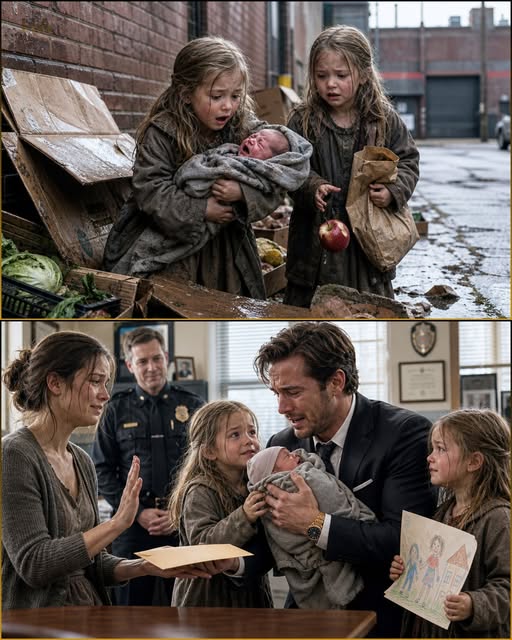
“Mom,” June whispered, “is he going to die?” That question decided what Lena did next—not forever, but for that hour. “No,” she said, taking the baby gently into her arms. “Not if I can help it.” For the next two weeks, the abandoned baby became the center of the Walker family’s world. Lena knew she was living on borrowed time. Every morning she told herself she would go to the police station. Every morning the baby woke hungry, the twins hovered over him like tiny nurses, and Lena found one more reason to wait. He was too weak. He needed another day of feeding. She needed to understand whether someone was truly searching for him. She needed to make sure whoever got him next would not be the same person who had left him behind the market. They named him Noah because June said “he came out of the flood,” and because Lily said it sounded like a boy who would survive. Noah slept in a cardboard produce box lined with the softest things they owned. Lena made diapers from old T-shirts and washed them by hand in a plastic basin. She bought formula with money she had saved for rent, then stretched her own meals thinner to make up the difference. Lily learned how to warm a bottle by setting it in a cup of hot water. June learned that if she sang softly enough, Noah would stop fussing and stare at her as though her voice had tied him gently to the earth. At night, the shack changed. Before Noah, hunger had filled the room with silence. After Noah, even poverty seemed to step aside for the sounds of care: the soft clink of a bottle, June humming, Lily whispering, “It’s okay, little man,” Lena murmuring prayers over a baby who had arrived with no explanation and no permission. The twins loved him with a fierceness that frightened Lena. They loved him as if love alone could make him legally theirs. They loved him as if the world might apologize if it saw how carefully they folded his blanket. On the ninth night, while rain clicked against the roof, June asked the question Lena had been avoiding. “Mom, if nobody comes for Noah, can he stay?” Lena looked at the baby sleeping against her chest. “I don’t know, baby.” “But he needs us.” “I know.” “And we need him,” June said.
Lily, who was pretending to sleep, opened her eyes. “We do.” Lena’s throat tightened. “Needing somebody doesn’t always mean you get to keep them.” “That’s not fair,” June whispered. “No,” Lena said. “It isn’t.” But fairness had never been a reliable visitor in their home. On the fourteenth day, everything changed in front of an electronics store window on Euclid Avenue. Lena had found a one-day cleaning job at a dentist’s office. It paid forty dollars cash, enough to buy formula, bread, eggs, apples, and a pack of cookies for the girls. Because Noah had been restless that morning and because Lily begged not to leave him, Lena wrapped him against her chest and took all three children with her. After shopping, they stopped in front of a store where televisions played silently behind glass. The twins loved watching the colors flash across the screens. They could not hear the sound, but they made up stories about the people on the news. June pointed to a cartoon on one screen. Lily looked at a cooking show on another. Lena’s attention drifted to the center television because the same photograph kept appearing. A man in a dark suit stood behind microphones. His face was drawn with exhaustion, his eyes red in a way no expensive tailoring could hide. Beside him, a photo of a newborn appeared. Lena stopped breathing. The baby in the photograph had dark eyes, a small crease above his left eyebrow, and a birthmark near his collarbone shaped like a tiny comma. Noah had that birthmark. White letters moved across the bottom of the screen. BILLIONAIRE GRANT WHITAKER PLEADS FOR RETURN OF MISSING INFANT SON. Lena gripped the grocery bag so tightly the plastic stretched. Lily noticed first. “Mom?” The screen changed to another image: the same man holding a baby wrapped in a white hospital blanket. Then a photo of a woman—beautiful, smiling, with warm brown hair—appeared beside the words LATE WIFE, CLAIRE WHITAKER. Lena stepped closer to the glass, desperate to read the captions. The words came in fragments. INFANT NOAH WHITAKER MISSING SINCE APRIL 3. REWARD INCREASED TO $2 MILLION. FATHER SAYS: “PLEASE BRING MY SON HOME.” Lena’s knees nearly gave out. Noah. His real name was Noah. “Mom, you’re hurting my hand,” June whispered. Lena loosened her grip. She looked down at the baby sleeping against her chest. His mouth moved in a tiny dream. He had no idea that the life waiting for him had gates, cameras, lawyers, and a father whose grief was being broadcast across the city. Lily’s face had gone pale. She could read enough to understand one word. “Missing,” she said.
Lena turned away from the window. “We have to go.” “But we just got here,” June protested. “Now.” They walked home in a silence that frightened the twins more than shouting would have. By the time they reached the shack, Lily’s eyes were already wet. “The baby on TV was him, wasn’t it?” she asked. Lena set the groceries down. For a moment she wanted to lie. Not because she was cruel, but because the truth would break something tender in both her daughters. But Lily had carried that baby through cold streets. June had sung him back to sleep when he cried. They deserved truth. “Yes,” Lena said. “It was Noah.” June looked at the baby. “But we named him Noah.” “That must have already been his name.” “His daddy is looking for him?” Lily asked. “Yes.” June’s lower lip trembled. “Then he’s not ours.” Lena sat on the mattress and pulled both girls close with Noah between them. “He was never ours to keep.” “But we saved him,” June cried. “We fed him. We loved him. He smiles when Lily holds him. He sleeps when I sing.” “I know.” “So why does that man get him?” “Because he’s his father.” Lily wiped her face with the heel of her hand. “What if his father is bad?” Lena had asked herself the same question. Wealth did not make a person good. Desperation did not make a person bad. She knew that better than anyone. “I don’t know what kind of man he is,” Lena said. “But I saw his face on that television. He looked like someone whose heart had been torn out.” June hugged Noah’s blanket. “Maybe he’s pretending.” “Maybe,” Lena admitted. “That’s why we’re going to the police station. Not straight to his house. The police can make sure everything is right.” Lily understood before June did. Her small shoulders folded inward, as if she were trying to protect her heart from the blow. “When?” Lena looked at Noah. He was waking now, blinking up at her as if she were morning itself. “Tomorrow.” June sobbed so hard Noah began to cry too. Lily reached for him, but Lena held him close and let all three children cry against her. That night, nobody slept much. Lena washed Noah’s clothes twice in the basin and hung them near the stove. Lily folded the gray blanket he had been found in, even though it was ugly and stained, because “it came with him.” June drew a picture on a scrap of cardboard: two girls, one mother, one baby, and a house with a crooked roof. Above the baby she wrote N-O-A-H in uneven letters. “Can he take this?” she asked. Lena nodded, though she did not know if anyone in Grant Whitaker’s world would keep a cardboard drawing made by a poor child. At dawn, Lena dressed the girls in their cleanest clothes. Lily wore a faded blue dress donated by a church basement. June wore a yellow sweater with sleeves too short for her wrists. Lena put on the black pants she used for cleaning jobs and brushed her hair until it looked smooth. Then she dressed Noah. He looked healthier than the day they found him. His cheeks had filled out. His skin had warmed into a soft brown-pink glow. His eyes followed their voices. He was, in every visible way, a baby who had been loved. Before they left, June kissed his forehead. “Don’t forget me,” she whispered. Lily touched his tiny hand. “If you get scared, remember the song.” Noah stared up at them, solemn and trusting. The walk to the police station took forty minutes. Every step felt wrong and right at the same time. Lena carried Noah. Lily held June’s hand. June cried quietly, wiping her cheeks whenever a car passed because she did not want strangers to see. Inside the station, the front desk officer looked tired until Lena said, “I think I have the missing Whitaker baby.” Then everything moved quickly. An older detective named Marcus Bell brought them into a private room. He had kind eyes and a voice trained not to frighten children. “You found him?” he asked. “My daughters did,” Lena said. Detective Bell looked at Lily and June. “Can you tell me where?” Lily sat straighter. “Behind McKinley’s Market. In the alley. He was behind cardboard boxes.” “He was cold,” June added. “But he stopped crying when Lily held him.” Detective Bell wrote everything down. He asked dates, times, details. Lena told him about the hospital bracelet. Lily produced it carefully from her pocket. The detective’s expression changed when he saw the partial name. N. WHIT— “This is important,” he said.
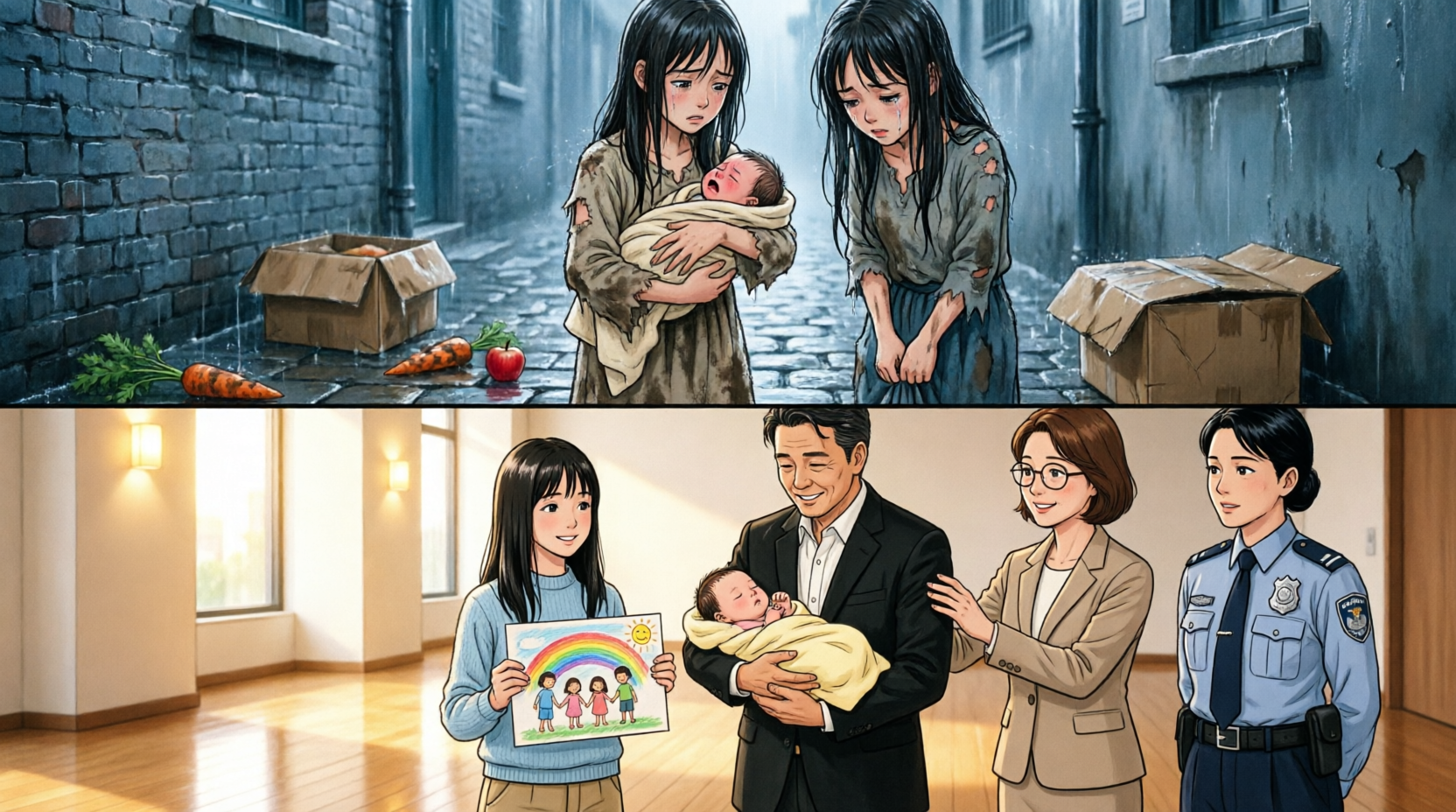
Lena also handed him the gray blanket. As she did, a small piece of cream-colored fabric slipped from one fold and fell to the floor. Lily picked it up. “That was stuck in there.” Detective Bell took it with gloved fingers. It looked like torn silk, embroidered with two initials in pale gold thread. M.V. The detective’s face tightened almost imperceptibly. “Did you notice this before?” Lena shook her head. “No. We were focused on keeping him alive.” Detective Bell nodded. “You did well.” After a doctor examined Noah and declared him stable, the detective made the call. Lena sat with the twins in the private room, holding the baby one last time. June sang under her breath. Lily kept staring at the door. When it opened, Grant Whitaker stepped inside. He was taller than Lena expected, with dark hair threaded by a little gray and a face that looked as if sleep had become foreign to him. His suit was expensive, but wrinkled. His tie was crooked. He entered like a man prepared to meet monsters. Then he saw Lena, two little girls, and his baby asleep in a poor woman’s arms. The hardness went out of his face so suddenly Lena almost looked away. “Noah,” he whispered. Noah stirred at the sound, then opened his eyes. Grant crossed the room but stopped a few feet away, as if afraid to move too fast and wake himself from a dream. “May I?” he asked. Lena stood. Her arms did not want to release the child. She made them. “This is your father,” she whispered to Noah, though the baby could not understand. Grant took him with trembling hands. For a moment, he simply stared. His mouth twisted with grief and relief so raw that June hid behind Lily. “My son,” Grant said, voice breaking. “My boy.” Noah blinked, uncertain, then began to fuss. Grant tried to rock him, awkwardly. June stepped forward before fear could stop her. “He likes when you support his head more.” Grant looked at her. June demonstrated with her hands. “Like this. And if he cries, you can sing.” Grant adjusted his hold. Noah quieted a little. “You cared for him?” Grant asked. Lily nodded. “We all did.” “How long?” “Two weeks,” Lena said. Grant closed his eyes. “Two weeks.” “He was weak,” Lily added. “But he got stronger.” June lifted the cardboard drawing with both hands. “This is for him. If you let him keep it.” Grant stared at the drawing. Something shifted in his expression, a crack opening in the wall around him. “I’ll keep it,” he said. “I promise.” Then, as if remembering the language of his world, he turned to Lena. “The reward,” he said. “You’ll receive it, of course.” Lena stiffened. “No.” Grant blinked. “No?” “We didn’t bring him here for money.” “It’s two million dollars.” “I know what the news said.” “You need it,” he said, looking at their clothes before he could stop himself. Lena’s face went still. “We need many things, Mr. Whitaker. But we didn’t save your son to sell him back to you.” The room went silent. Detective Bell looked down, hiding the smallest smile. Grant flushed. “That’s not what I meant.” “But it’s what you said.” “I’m sorry.” He looked at Lily and June. “I’m sorry. I don’t know how to speak about something this big.” Lily’s voice was small but clear. “Just say thank you.” Grant looked at her for a long moment. Then he lowered his head. “Thank you.” June wiped her eyes. “Is he going to be okay?” Grant looked at Noah, then at the twins. “Because of you, yes.” Noah began crying harder then, reaching with one tiny fist toward Lily’s voice. Grant did not understand until Lily stepped closer. “Can I say goodbye?” Grant handed him back without thinking. Noah settled against Lily’s chest immediately. That undid something in Grant Whitaker. He watched his missing son calm in the arms of a hungry child and realized money had not saved Noah. Security teams had not saved Noah. Private investigators had not saved Noah. Two five-year-old girls picking through garbage had saved him because they recognized his life as precious when someone else had treated it as disposable. When Lena and the girls left the police station, June cried the whole way home. Lily did not cry until they reached the shack and saw the empty cardboard box in the corner.
Then she folded herself beside it and whispered, “He’s gone.”
Lena sat on the floor and gathered both girls into her lap.
“Yes,” she said. “But he’s alive.”
That was the only comfort she had to offer, and for a while, it was not enough.
Grant took Noah home to a mansion overlooking Lake Erie, where every room had been designed by someone famous and none of them felt warm. The nursery had imported furniture, a hand-painted ceiling, a camera system, and shelves of toys Noah was too young to notice. Grant had built the room while his wife, Claire, was pregnant, believing luxury could prepare a man for fatherhood.
Claire had died three days after Noah’s birth from complications no one had expected.
Then Noah vanished from the hospital’s private recovery wing on the morning he was supposed to come home.
For two weeks, Grant had lived inside a nightmare. Police questioned nurses, orderlies, guards, and family. His fiancée, Marissa Vale, organized press conferences, charity vigils, and candlelight events. She stood beside him in designer black and wept beautifully for cameras.
But now, with Noah back in his arms, Grant could not stop thinking about the torn silk with M.V. embroidered on it.
Marissa Vale.
When he arrived home, Marissa rushed down the staircase.
“Grant!” she cried. “Oh, thank God. Is he really okay?”
She reached for Noah, but the baby turned his face into Grant’s chest and whimpered.
Grant noticed.
Before, he might have explained it away. Babies fussed. Babies sensed stress. Babies were mysterious. Now he saw everything differently.
“He’s tired,” Grant said.
Marissa’s hands hovered, then dropped. “Of course. Poor little angel.”
Grant looked at her cream silk scarf.
The same shade as the torn piece found in Noah’s blanket.
“Where were you the morning Noah disappeared?” he asked.
Marissa’s expression flickered.
“What?”
“You heard me.”
“At the hospital. With you. Then downstairs speaking to reporters. Grant, why are you asking me that?”
He shifted Noah higher on his shoulder. “Because something with your initials was found in the blanket he was wrapped in.”
The color drained from her face, then returned too quickly.
“My initials? That’s absurd. Many people have those initials.”
“Detective Bell has it.”
Marissa stepped back. “You’re exhausted. You’re letting those people confuse you.”
Those people.
Grant heard the words as if from far away.
Two weeks earlier, he would not have noticed the contempt in them. Now it landed like a slap.
“Those people kept my son alive.”
Marissa’s mouth tightened. “And now they’ll want money. People like that always do.”
“No,” Grant said. “They refused it.”
That surprised her before she could hide it.
Grant saw the truth begin not as proof, but as pattern. Marissa had pushed him to declare Noah legally dead after only ten days. She had urged him to sign emergency changes to the Whitaker family trust. She had reminded him that Claire’s shares in the company would become complicated if Noah remained missing. She had cried in public and complained in private.
He handed Noah to the nanny, then called Detective Bell.
By midnight, the investigation that had stalled for two weeks opened like a locked door.
Hospital security footage, once believed corrupted by a technical malfunction, was recovered from an off-site backup. It showed Marissa entering a restricted corridor at 5:42 a.m. with Grant’s head of private security, Colin Beck. It showed Colin carrying a laundry cart out through a service elevator eighteen minutes later. It showed Marissa wearing a cream silk scarf.
Colin broke first.
He confessed that Marissa had paid him to remove the baby from the hospital. She had not told him to kill Noah, he insisted. Only to leave him somewhere “he would be found.” She wanted Grant shattered, dependent, and legally pressured to restructure the trust before Noah was recovered. If Noah died, she would act devastated. If Noah lived, she would claim it was a miracle.
But Colin panicked when police checkpoints appeared downtown. He abandoned the baby behind McKinley’s Market before sunrise and ran.
When Detective Bell told Grant, something colder than rage entered him.
Marissa was arrested the next morning.
She screamed his name as officers led her down the front steps of his mansion.
“Grant, listen to me! I did it for us!”
Grant stood in the doorway holding Noah.
“There is no us,” he said.
Her final expression before the police car door closed was not guilt. It was disbelief that the world had stopped obeying her.
The story exploded across the news.
But Grant did not watch the coverage. He sat in Noah’s nursery, holding the cardboard drawing June had made. Two girls. One mother. One baby. A crooked house. Four smiling faces under a yellow sun.
Noah cried that night for almost three hours.
Grant tried bottles, blankets, rocking, pacing, expensive white-noise machines, and a nurse recommended by the best pediatrician in the city. Nothing worked.
Finally, desperate, Grant whispered, “Do you miss them?”
Noah’s cries softened only when Grant said Lily’s name.
The next morning, Grant drove himself to the east side.
He did not take a security team. He did not call ahead. He wore jeans, an old sweater, and guilt so heavy it changed the way he walked.
Finding Lena’s shack was not difficult. The detective had given him the address after Grant insisted he needed to thank her properly. Still, seeing it was different from reading it on paper.
The shack was smaller than his walk-in closet. Rainwater had carved lines in the dirt outside. A plastic bucket sat beneath a roof leak. Children’s clothes hung from a rope. Through a gap in the curtain, he saw Lily teaching June how to write Noah’s name in the dust with a stick.
Lena emerged from behind the shack carrying a basin of wet clothes. She stopped when she saw him.
“Mr. Whitaker.”
“I’m sorry to come without warning.”
Her posture tightened. “Is Noah all right?”
“Yes. He’s safe.” Grant hesitated. “He misses you.”
Lily and June appeared at the curtain.
June’s whole face changed. “Noah?”
“He’s at home with his nurse,” Grant said. “I didn’t want to bring him without asking.”
Lily tried to look composed, but hope betrayed her. “Can we see him someday?”
Grant looked at the three of them standing in front of a house the world had ignored.
“Yes,” he said. “But that’s not the only reason I came.”
Lena set the basin down. “We told you we don’t want the reward.”
“I know.”
“Then why are you here?”
Grant looked past her into the shack. He saw the cardboard box where Noah had slept. He saw the stove balanced on bricks. He saw the corner where a baby had been given warmth by people who barely had enough heat for themselves.
“I found out who took him,” he said.
Lena’s hand went to her mouth. “Who?”
“My fiancée. And my security chief.”
The twins did not understand all the words, but they understood enough to move closer to their mother.
Lena’s eyes hardened. “Someone from your own house did that?”
“Yes.”
“And you thought we might be the kind of people who wanted money.”
Grant lowered his gaze. “Yes.”
“At least you’re honest.”
“I was wrong.”
“Yes,” Lena said. “You were.”
The words should have offended him. Instead, they relieved him. For once, someone was speaking to him without polishing the truth first.
“I came to make it right,” he said.
Lena’s expression closed. “Mr. Whitaker, be careful with that. Rich people like saying they’ll make things right. Most of the time, they just make themselves feel better.”
Grant absorbed the blow because he deserved it.
“You’re right,” he said. “So I won’t call it charity. I won’t call it generosity. I’ll call it a debt.”
“We don’t want you owing us.”
“I owe Noah the chance to grow up connected to the first people who loved him when I couldn’t protect him. And I owe your daughters a future, because without them, my son would be dead.”
Lena looked away, blinking hard.
Grant took an envelope from his pocket but did not hand it to her yet.
“There’s a house,” he said. “Three bedrooms. Safe neighborhood. Good public school nearby. It’s already in your name, not mine. There’s also a trust for Lily and June’s education. Health insurance. And a job offer for you if you want it—not cleaning my house,” he added quickly. “A paid position with a family foundation I’m creating in Claire’s name. Helping other families in emergencies. You would advise us. You know what people actually need.”
Lena stared at him as if he had begun speaking another language.
“No.”
Grant expected that. “Lena—”
“No,” she repeated, but her voice shook. “You don’t get to walk in here and change everything because you feel guilty.”
“You’re right.”
“I have kept my girls alive with nothing.”
“I know.”
“You don’t know,” she snapped. “You have read about it. You have looked at it. You do not know what it feels like to tell your children you already ate when you didn’t. You do not know what it feels like to send five-year-olds to collect bottles because the alternative is watching them cry from hunger.”
Grant said nothing.
Lena’s anger broke into tears, which seemed to humiliate her. She wiped them away sharply.
“I am not a project.”
“No,” Grant said. “You’re not.”
“My daughters are not a story for your conscience.”
“No.”
“And Noah is not a bridge you can build to make yourself feel forgiven.”
That one struck deepest.
Grant looked at Lily and June. Lily stood protectively in front of her sister. June was crying silently.
“You’re right about all of it,” he said. “I can’t undo what I thought. I can’t undo the life you lived before this. I can’t buy forgiveness, and I’m not asking for it.”
“Then what are you asking?”
“That you let me honor what your daughters did without forcing them to keep paying the price for my blindness.”
The alley went quiet except for the flap of laundry in the wind.
Grant placed the envelope on the wooden crate beside the door.
“You don’t have to answer today. You can have a lawyer look at everything. Detective Bell can recommend one. The deed is yours whether you ever speak to me again. The education fund is theirs whether you forgive me or not. Noah will know their names no matter what you decide.”
June whispered, “Will he really?”
Grant looked at her. “Every day.”
Lily’s eyes filled. “Can he visit?”
“If your mother allows it.”
Both girls turned to Lena.
Lena looked at the shack. The sagging roof. The dirt floor. The basin of clothes. The daughters who had been brave because childhood had not protected them. Then she looked at the envelope.
“For them,” she whispered.
Grant nodded. “Only for them.”
Lena picked up the envelope with trembling fingers.
Three weeks later, Lily and June slept in separate beds for the first time in their lives.
June was delighted for ten minutes, then climbed into Lily’s bed because the room felt “too big for sleeping alone.” Lily complained, but she lifted the blanket anyway. Lena stood in the doorway of their new bedroom and watched them whisper under clean sheets.
The house was modest by Grant’s standards and miraculous by theirs. It had blue shutters, a working furnace, a kitchen with running water, a bathroom with a lock, and a backyard where June immediately planted marigolds. Lily arranged donated books on a shelf by height and subject. Lena spent the first night turning faucets on and off because part of her could not believe water would keep coming simply because she asked it to.
The next afternoon, Grant brought Noah.
The twins ran to the door before he could knock.
“Noah!” June shouted.
Noah, now stronger and round-cheeked, kicked his legs when he saw them. Grant laughed, surprised by the force of his son’s joy.
“He knows,” Lily said, crying and smiling at once. “He knows us.”
Grant handed Noah to her.
The baby pressed his face into Lily’s shoulder and sighed.
It was not dramatic. There were no cameras, no reporters, no speeches. Just a baby returning to familiar arms and two little girls learning that goodbye had not meant forever.
From then on, Noah had two homes.
He lived with Grant, but he spent three afternoons a week at Lena’s house. At first, Grant told himself the visits were for Noah. Then he admitted they were for him too. In Lena’s kitchen, he learned how to hold a baby without fear. From Lily, he learned that children listened more to what adults did than what they promised. From June, he learned songs that had no price and somehow worked better than any machine in his nursery.
Months passed. Then a year.
Grant’s foundation opened its first emergency family center in Cleveland, with Lena as one of its founding advisors. She insisted the center offer practical things first: diapers, formula, safe transportation, temporary housing, legal help, and no humiliating questions at the door. Grant listened. For once, he did not assume money made him the expert.
Lily and June started kindergarten late, then caught up with startling speed. Lily loved numbers and science. June loved stories and drawing. They still protected each other, but slowly, they learned they did not have to be on guard every minute.
On Noah’s second birthday, they held the party in Lena’s backyard.
Grant’s mansion staff expected him to host something grand. He refused. Noah did not need ice sculptures, celebrity guests, or a cake taller than he was. He needed the people whose voices had taught him safety.
So there were paper decorations June made herself, a chocolate cake Lena baked, and balloons Lily tied to the fence in careful patterns.
Noah toddled across the grass wearing a crooked party hat. When he saw the twins, he shouted one of his first clear words.
“Sissies!”
June burst into tears. Lily pretended not to, then failed.
Grant stood beside Lena near the porch, watching his son run into the arms of two girls who had once carried him home from the trash.
“I used to think family was blood, documents, names on buildings,” he said quietly.
Lena smiled. “Those things matter sometimes.”
“But not most.”
“No,” she said. “Not most.”
He looked at the yard. Detective Bell was there with his wife. Some neighbors from Lena’s old street had come too. Grant had invited nurses who helped with Noah’s recovery. There were wealthy people and poor people, polished shoes and worn sneakers, all eating the same cake from paper plates.
“What matters most?” Grant asked.
Lena watched Noah smear frosting on June’s cheek while Lily tried to clean him with a napkin.
“Showing up,” she said. “And staying kind after the easy part is over.”
Years later, people would still ask Grant Whitaker about the scandal.
Reporters wanted to talk about Marissa’s trial, the trust, the betrayal, the headlines. Business magazines wanted to frame his transformation as a leadership lesson. Charity boards wanted polished speeches about purpose.
Grant always answered carefully.
But when Noah was old enough to ask the real question, Grant told him the truth.
He told him about a cold alley behind McKinley’s Market. He told him about two hungry little girls who heard a cry and chose compassion before fear. He told him about Lena Walker, who had almost nothing and still made room for one more child. He told him that being rescued was not the same as being found.
“You were found by chance,” Grant said. “But you were rescued by love.”
Noah, ten years old by then, sat between Lily and June at Lena’s Sunday table. Lily was already talking about becoming a pediatric surgeon. June wanted to teach art to children who had never owned crayons. Lena had finished her degree in social work. Grant had become softer around the eyes, more patient in silence, less impressed by rooms full of powerful people.
Noah looked at the twins.
“So you were my first sisters?”
June grinned. “Still are.”
Lily nudged him. “Don’t forget it.”
Noah leaned into them both, embarrassed but happy.
“I won’t.”
Every Sunday after that, they gathered at Lena’s house.
Sometimes the meal was roast chicken. Sometimes it was soup. Sometimes it was spaghetti because Noah insisted nobody made it like Lena. Grant brought groceries but no longer made a performance of giving. Lena accepted help without feeling owned by it. The twins grew into young women with bright futures and stubborn hearts. Noah grew up knowing that love could cross class, blood, grief, and every cruel border the world tried to draw.
And in the hallway of Grant’s mansion, framed not in gold but in simple oak, hung June’s cardboard drawing from the day they gave Noah back.
Two girls.
One mother.
One baby.
A crooked little house.
A yellow sun above them all.
Visitors sometimes asked why a billionaire kept a child’s torn cardboard drawing in the most visible place in his home.
Grant would look at it and answer the same way every time.
“Because that was the day my son came home,” he said. “And the day I learned what a home actually is.”
THE END