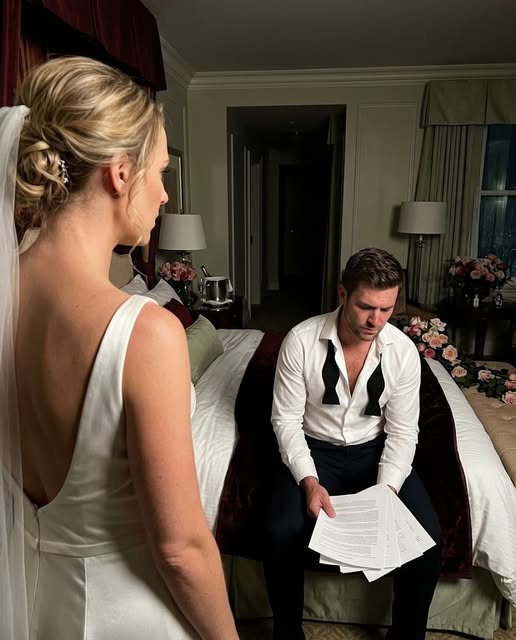
On our wedding night, when Michael Whitmore stepped out of the bathroom and the truth about his body became impossible to ignore, my first feeling was not disgust.
It was terror.
Terror, because in one instant I understood that nothing about our marriage had been normal, and that the Lake Tahoe villa his family had given me was not generosity.
It was payment.\n\nHe must have seen the answer on my face, because he did not come closer.
He sat on the edge of the flower-covered bed, put both hands flat on his knees, and said in a voice so low I barely heard it — I told them not to do this.\n\nThen he opened the drawer of the nightstand and handed me a thin folder.
The first paper was the deed to the lake house, already prepared for transfer.
The second was a copy of an old family trust.
Buried halfway down the page was the sentence that explained my entire wedding day: Michael Whitmore must be legally married by his thirty-fifth birthday to assume control of the Whitmore Foundation and the voting block attached to it.\n\nI kept reading with shaking hands.
Stapled to the back was a note in Eleanor Whitmore’s elegant handwriting, as cold as the marble floors downstairs.
If no heir is expected within one year, settlement options should be discussed discreetly.
The wife can be replaced.
I read that sentence twice before the meaning truly landed.
I was not a bride.
I was a temporary solution.\n\nMaybe I should tell you that I had always been hard to shock.
Poverty teaches you to swallow things most people would call unbearable.
I grew up in West Texas in a house that let dust through the window frames and heat through the roof.
My father died before I was old enough to understand what being protected felt like, and after that, my mother spent more days in bed than on her feet.
By sixteen, I was working full-time and pretending I was not still a child.\n\nSan Francisco had looked like a postcard when I first arrived, all hills and blue water and homes that seemed too polished for human grief.
The Whitmore estate in Pacific Heights was the largest house I had ever stepped inside.
I became one more quiet pair of hands in a place that ran on silence, silver trays, and old money.
I learned which crystal was used for guests, how Eleanor liked her tea, how Michael’s father snapped at staff without raising his voice, and how Michael himself moved through the house like a man apologizing for taking up space.\n\nHe was the only one who ever thanked me by name.
Not dramatically.
Not in a way that blurred class lines.
He simply looked at me when he spoke, which in that house felt almost radical.
Still, he carried a sadness I could never place.
He skipped charity luncheons, avoided the women his mother kept introducing to him, and spent long evenings in the library with the lights low, as if hiding from the life planned for him.\n\nWhen Eleanor summoned me to the formal sitting room three months before the wedding, I thought I had made some terrible mistake.
Instead, she placed a marriage license application on the coffee table and folded her hands like awoman proposing an ordinary business arrangement.
Marry Michael, she said, and the Lake Tahoe property will be yours.
Your mother will also receive the best care available.
It will solve problems for everyone.\n\nThere are moments when humiliation comes dressed as mercy.
That was one of them.
I should have stood up and walked out.
But at the exact same time, my mother was coughing blood into kitchen towels back in Texas, and I had been calculating which medicine to delay that month so the electricity would stay on.
Eleanor knew all of that.
Wealth like hers did not investigate by accident.\n\nSo I said yes, and hated myself for how quickly the word left my mouth.\n\nThe wedding at the Fairmont San Francisco was the kind people write about in society columns.
White orchids dripped from gold stands.
The ballroom glowed under chandeliers the size of small cars.
I wore silk so soft it frightened me to touch it, and strangers smiled at me as if I had won some impossible lottery.
Only Michael seemed unable to perform the fantasy.
He was calm, handsome, perfectly mannered, and utterly absent behind the eyes.\n\nAll through the reception, I felt him measuring his own silence.
When guests toasted us, his smile appeared half a second too late.
When Eleanor squeezed my wrist for the cameras, her nails pressed hard enough to remind me who had arranged every detail of my new life.
By the time the doors finally closed on our suite that night, I felt less like a wife than like someone who had been carefully wrapped and delivered.\n\nNow, with the trust papers in my hand, I turned to Michael and asked the only thing that mattered.
Why me.\n\nBecause you were kind, he said.
Then he closed his eyes, ashamed of how weak that sounded.
A second later he corrected himself.
Because my mother believed kindness would make you easier to persuade, and poverty would make you harder to lose.
I am sorry for both truths.\n\nI wanted to hate him in that moment.
A part of me did.
But hatred requires distance, and he looked too broken for that.
He told me about the condition he had been born with, the surgeries that never gave him what the world considered normal, the doctors who spoke about his future as if his manhood were a failed investment.
His father stopped hugging him after the third procedure.
At boarding school, boys learned enough to mock what they did not understand.
By thirty, Michael had mastered every elegant skill expected of a Whitmore except the one his family cared about most: the ability to produce an heir and make the newspapers believe nothing was wrong.\n\nI asked why he had not warned me before the wedding.
He did not defend himself.
He just said — Cowardice has a way of sounding like obedience in my family.
I told myself I was protecting you from gossip until the deal was done.
The truth is that I let my mother lead me to the altar because I had been raised to mistake surrender for duty.\n\nHe slept on the chaise lounge that night, still wearing his white shirt.
I sat by the window until dawn and watched fog swallow the city.
Every time I looked at the folder in my lap,that sentence burned again: The wife can be replaced.

I had agreed to sell my future for my mother’s treatment, but I had not realized how cheaply they thought it could be rented.\n\nBy morning, I had decided to leave as soon as I knew my mother was safe.
Then Michael made that decision harder.
Without announcement, without using it as leverage, he had already arranged for my mother to be transferred to a specialist in California.
The hospital called me before breakfast.
The deposit had been paid in full.\n\nEleanor wore pearls to breakfast and spoke as if nothing in the world was unusual.
She asked whether the suite had been comfortable, whether I preferred the Tahoe villa furnished in creams or grays, whether I understood which events required formal attendance.
Michael said almost nothing.
His father read the financial pages.
I stared at the silver toast rack and realized I had married into a family so practiced at control that they could discuss a fraudulent marriage over marmalade.\n\nFor the next two weeks, Michael and I lived like polite strangers connected by documents and other people’s expectations.
The tabloids called me mysterious.
Society women called me lucky to my face and opportunistic behind my back.
Eleanor placed jewel-toned dresses in my closet and sent stylists to teach me how to stand, how to smile, how to answer without revealing where I came from.
It was not education.
It was erasure.\n\nMichael never asked anything of me.
He did something worse and better at once: he treated me with care.
He checked on my mother after her tests.
He made sure the staff showed me the truth of every account with my name on it.
He left doors open when we were alone, as if determined never to make me fear him.
I began to see that the coldness I had mistaken for arrogance was really discipline, the kind built by years of being watched for weakness.\n\nThe first time I saw him lose control was in the hospital parking lot.
My mother had just come through a risky procedure, and the surgeon had said the mass was operable after all.
I burst into tears so hard I could not breathe.
Michael stepped toward me, then stopped, uncertain, as if he no longer trusted his right to comfort anyone.
When I grabbed his hand first, his entire face changed.
Not with romance.
With relief.\n\nThat was the moment I understood the cruelest part of what his family had done.
They had used my poverty to trap me, yes, but they had also used his shame to convince him he did not deserve honesty.
We were both standing in cages built by Whitmore money.
Mine was obvious.
His was upholstered.\n\nA few days later, Eleanor sent me to Lake Tahoe to oversee minor renovations before a magazine shoot she wanted to stage there.
The villa sat above the water like something cut from a dream, all glass, cedar, and impossible blue views.
I walked through rooms bigger than my mother’s entire house and felt nothing that resembled gratitude.
Beautiful things become ugly fast when they are used as bait.\n\nMichael arrived the next evening, later than planned, after driving up alone.
We ate takeout in the designer kitchen because neither of us had the appetite for the chef Eleanor offered.
Rain slid down the windows.
The lake disappeared into darkness.
For the first time since the wedding, we spoke without the house listening.\n\nHe told me about the only woman he had nearly married before me, a philanthropist’s daughter who loved the Whitmore name more than she ever loved him.
When he told her the truth about his body, she cried for an hour, then asked whether there were discreet ways to produce a baby without anyone knowing.
Eleanor adored her for that question.
Michael ended the relationship the same week and spent the next two years refusing every woman his mother suggested.\n\nWhy did you agree this time, then, I asked.\n\nBecause I saw you reading to my grandmother when you thought nobody noticed, he said.
Because you stayed with her on the nights she forgot her own name.
Because I told myself you deserved security and that I could give it without hurting you.
Then his mouth twisted bitterly.
I was lying to myself.
I knew this would hurt you.
I just hoped it might hurt you less coming from me than from someone crueler.\n\nThat honesty landed harder than any polished apology could have.
I told him about my father dying in a work accident and how every adult after that seemed to speak about bills before grief.
I told him how shame settles into the body until you start thanking people for crumbs.
By the time the storm ended, we were sitting on opposite sides of the same sofa, exhausted from telling truths that should have been spoken long before a wedding.\n\nThe next morning, while looking for stationery in Michael’s study, I found an overnight envelope tucked into a drawer beneath a folder of trust documents.
Inside was a draft agreement from the Whitmore family attorneys.
It was newer than the papers Michael had shown me.
The Tahoe deed transfer could be reversed if the marriage ended before six months.
I would also be bound by a nondisclosure clause broad enough to make speaking the truth financially ruinous.
At the bottom, in Eleanor’s sharp handwriting, was a second note: If Lily resists, offer monthly support.
Remind her where she came from.\n\nI stared at those words until the lake outside blurred.
It was one thing to be used.
It was another to see the contempt written down so casually, as if my dignity were a negotiation point.
When Michael came in and saw my face, I handed him the papers without a word.\n\nHe read them once.
Then again, slower.
I had never seen rage move through a person so quietly.
He did not shout.
He did not throw anything.
He just set the papers on the desk and said — She lied to both of us.\n\nThat night he called Eleanor on speaker.
I stood by the window and listened as his voice turned colder than I had ever heard.
He asked whether she had really planned to reclaim the villa and silence me after using my name.
There was a long pause on the line, then Eleanor answered in the tone of a woman explaining taxes to a child.
She said she was protecting the family, protecting him, protecting the Foundation from scandal.
She said women in my position often became emotional and greedy once they tasted money.
Shesaid arrangements only work when everyone remembers their place.\n\nMichael hung up before she finished.\n\nHe wanted to end the marriage the next morning.
I wanted that too for about ten minutes.
Then his attorney, an older man named Daniel Reese who had known Michael’s grandfather, arrived at the villa with a complication that felt almost biblical in its cruelty.
The trustees were set to vote in ten days on control of the Whitmore Foundation, which funded clinics and research hospitals across the state.
If Michael publicly broke the marriage before the vote, the marriage clause failed, and control would pass to his uncle Victor, a man who had spent years trying to cut free care programs and turn the Foundation into a prestige brand for donors.
My mother’s hospital wing existed partly because of that Foundation.\n\nI hated how quickly morality became expensive.\n\nMichael told Daniel he would rather lose every dollar than keep one through fraud.
Daniel said quietly that this was no longer only about dollars.
Thousands of employees, grants, and patient programs sat underneath the family war.
Michael walked out onto the terrace and stood there in the cold for almost an hour, staring at the water like he was measuring what kind of man he could live with being.\n\nWhen he came back inside, he said the words I remember more clearly than our vows.
— I won’t ask you to stay for them.
But I will ask one last unfair thing.
Let me tell the truth in a room where it can still protect something.\n\nI should have said no.
I had already given too much.
But I kept thinking about my mother’s surgeon, about the nurses, about the people who would never know their care depended on the conscience of wealthy strangers.
I also kept thinking about the boy Michael had been, turned into a project by his own family.
So I agreed to stand beside him at the Foundation gala ten days later.
Not as a purchased bride.
As a witness.\n\nThose ten days changed us.\n\nWe returned to San Francisco with an alliance nobody in the Whitmore house understood.
Eleanor mistook silence for obedience.
Victor mistook me for decoration.
The staff watched us more carefully, sensing a shift they could not name.
At night, Michael and I sat in the library and planned what truth looked like when spoken in public.
We would not humiliate him by detailing his body.
We would not let Eleanor rewrite me as a liar.
We would speak about coercion, contracts, and consent.
We would make it impossible for the family to call this marriage romantic or respectable.\n\nSomewhere in those late hours, affection entered the room without asking permission.
It lived in small places.
The tea he left by my elbow when I forgot to eat.
The blanket I draped over him when he fell asleep over legal notes.
The way he laughed the first time I told him Pacific Heights smelled like expensive soap and old secrets.
Love did not arrive like thunder.
It arrived like breath returning after being held too long.\n\nThe gala was held in a glass hall overlooking the bay, all mirrors and candlelight and donors wearing fortunes around their throats.
By then the papers had already whispered about tension in the Whitmore family.
Eleanor responded by making me wear a sapphire necklace heavy enough to feel like a collar.

She kissed my cheek for the photographers and said — Smile, Lily.
Tonight decides everything.\n\nShe was right, though not in the way she meant.\n\nAn hour into the reception, after speeches about innovation and legacy, Eleanor led me into a side salon where Daniel Reese and two other attorneys were waiting.
On the table lay a revised deed, a confidentiality agreement, and a separate document creating a monthly settlement in exchange for my silence once the trustees confirmed Michael’s position.
Eleanor did not bother pretending anymore.
She simply said — Sign tonight and spare us all ugliness.\n\nI looked at her and saw, more clearly than ever, a woman so terrified of imperfection that she had learned to confuse control with love.
She believed she had done something practical, maybe even generous.
In her world, a poor girl given money should have called that mercy.\n\nI asked one question.
— Did you ever once think to ask what I wanted.\n\nShe adjusted one pearl earring.
— Want has nothing to do with survival.\n\nMichael heard the last sentence from the doorway.\n\nI will remember that silence until I die.
Eleanor straightened.
Daniel looked sick.
Victor, who had followed Michael in with curiosity written all over his face, realized too late that the family conversation was no longer private.
Michael walked to the table, looked at the papers, and then at his mother.
— You were willing to rent a life to protect a name, he said.
— And you called that survival.\n\nEleanor answered with the first true crack in her composure.
— I did what your father never had the courage to do.
I made sure no one could use your weakness against you.\n\nMichael’s face changed then, not into anger, but into something colder and final.
— My weakness was never my body, he said.
— It was believing you loved me when you were really managing me.\n\nHe took the settlement papers, the deed reversal, every page on that table, and walked straight back into the ballroom.\n\nThe next minutes happened with the bright unreality of a nightmare.
Michael stepped onto the stage while a trustee was introducing the next award.
People turned.
Forks stilled.
He asked for the microphone, and because powerful families are trained to trust appearances until the last possible second, someone handed it to him.\n\nI did not know exactly what he would say.
That was the terrifying part.
But when he looked toward me from the stage, he did not look ashamed.
He looked free for the first time since I had known him.\n\nHe told the room his marriage had begun as an arrangement designed to satisfy a trust clause.
He said the woman seated three rows from the front — me — had been offered a house and security in exchange for lending her name to a lie.
He did not describe his condition.
He did not need to.
He simply said that his private medical history had been weaponized inside his own family, and that the real scandal was not his body.
It was coercion dressed up as tradition.\n\nThe room went silent in that particular wealthy way, where everyone understands the social earthquake before they react to it.
Then Eleanor rose and demanded he stop.
Victor called it a misunderstanding.
One
trustee asked whether there was written evidence.
Michael held up the documents from the side salon.\n\nI walked to the stage on legs that barely felt attached to me.
My pulse hammered in my throat.
When I took the microphone from Michael, my hands steadied instead of shaking.
Maybe because poor women are taught from childhood to speak clearly when nobody wants the truth.\n\nI told them my name.
I told them I had worked in the Whitmore home.
I told them I had agreed to the marriage because my mother was ill and I thought desperation was the same as choice.
Then I held up the settlement agreement Eleanor had asked me to sign and read the clause that would have silenced me in exchange for monthly support.
I did not cry.
I did not plead.
I only said that being poor had made me vulnerable, not purchasable.\n\nThat was the moment the room changed sides.\n\nDonors began whispering.
Two trustees asked Daniel Reese whether the documents were authentic.
He answered yes.
Victor tried to turn the chaos toward Michael’s eligibility, arguing that the trust clause had failed and control should pass immediately.
But public disgust moves faster than private succession plans.
By midnight, what everyone was discussing was no longer Michael’s body or my background.
It was Eleanor’s scheme, Victor’s eagerness, and the legal exposure of a foundation built on public virtue.\n\nMichael stepped back to the microphone one final time and said he would not accept control purchased through deception, nor would he allow his mother’s actions to be hidden behind family privacy.
He announced his resignation from any claim that required the marriage clause and asked the trustees to conduct an independent review before transferring anything to Victor.
Then he put the microphone down and walked off the stage.\n\nHe came straight to me.\n\nOutside, the bay wind cut through silk and black tie fabric alike.
Flashbulbs were already going off beyond the gates.
I thought he might apologize again.
Instead he said — I don’t want the house, the title, or the lie.
I want one honest thing left when this is over.
Tell me whether you want to leave alone, and I will help you.
Tell me you want me beside you, and I will spend the rest of my life being worthy of that answer.\n\nNobody had ever spoken to me like that.
Not because it was romantic, though it was.
Because it left the choice in my hands.\n\nI did not answer right away.
We stood there under the cold San Francisco sky while guests began pouring out behind us, hungry for scandal.
Then I took off Eleanor’s sapphire necklace, placed it in Michael’s palm, and said — Start by walking away with me.\n\nSo we did.\n\nThe months that followed were messy, public, and more honest than anything that came before.
The trustees froze Victor’s attempt to seize the Foundation while investigators reviewed financial decisions he had buried for years.
Eleanor resigned from the board after donors threatened to pull major gifts if the coercion scandal was buried.
My mother finished her treatment in privacy because, for once, powerful people were too busy saving themselves to interfere with my life.\n\nMichael rented a furnished apartment near the hospital rather than return to Pacific Heights.
It was the first home he had ever chosen
for himself.
The kitchen was too small, the floors creaked, and the view was a brick wall instead of the bay, but we laughed there more than I ever had in the Whitmore mansion.
Some nights we talked until two in the morning.
Some nights we said nothing and let quiet be gentle for the first time.\n\nHe never asked me to stay married.
Not once.
That mattered.\n\nWeeks later, after the legal dust started settling, Daniel Reese came to see us with one final surprise.
Michael’s grandfather had left him a separate personal trust years earlier, outside Eleanor’s control, intended for the day he chose a life not run by the family machine.
The amount was nowhere near Whitmore-empire money, but it was enough to live independently and enough to make one symbolic decision.\n\nMichael sold a portion of his private holdings and bought the Lake Tahoe villa outright from the shell company that had been holding it.
When he handed me the new deed, there were no reversals, no settlement clauses, no nondisclosure pages.
Just my name and a clean transfer.\n\nI asked him why he would spend that much on a place that had nearly ruined us.\n\nHe said — Because they used a home as a cage.
I wanted to see whether it could become a home again.\n\nI cried then, harder than I had on the wedding night, because grief and healing often arrive wearing the same face.
A month later, after my mother’s scans came back better than anyone had dared hope, Michael and I drove to Tahoe alone.
We opened every window in that house.
We stripped away the staged furniture Eleanor had chosen.
We ordered cheap pizza and sat on the floor like people who had just learned the difference between ownership and belonging.\n\nThat was the weekend I told him I did not want an annulment.\n\nHe looked at me for a long time before answering.
— Out of pity, don’t.\n\n— This isn’t pity, I said.
— Pity is what your family wrapped in silk and called protection.
This is me knowing exactly who you are and choosing anyway.\n\nOur marriage did not become a fairy tale after that.
Real things rarely do.
We had to learn how to trust without contracts, how to touch without old shame rising between us, how to build a future that did not worship appearances or bloodlines.
But we learned.
And because life enjoys irony, the first truly intimate thing between us was not physical at all.
It was honesty without bargaining.\n\nA year later, Michael accepted a limited role helping rebuild the clinic arm of the Foundation under new governance, after the trustees permanently blocked Victor from control.
Eleanor wrote once.
The letter was not an apology so much as a defense written in elegant language.
Michael read it, folded it, and placed it in a drawer he never opened again.\n\nAs for me, people still ask whether I married for money.
Some ask it with cruelty.
Some ask it with fascination.
The answer is both simpler and harder than they expect.
I married because I was desperate.
I stayed because somewhere inside the wreckage of that arrangement, Michael chose truth when it cost him everything, and I chose not to mistake the sins of his family for the limits of his heart.\n\nEven now, the
story divides people.
Some believe I should have taken every Whitmore dollar I could find and never looked back.
Some say I was foolish to forgive a man who let the lie reach the altar.
Some say Eleanor was monstrous.
Others insist she was just a mother doing whatever she could to shield her son from a cruel world.
Maybe that is what makes the story linger.
The ugliest thing was never Michael’s secret.
It was the moment another human being decided my poverty made my consent cheaper.

