My Grandma Found Me in a Shelter—Then Revealed the House My Parents Hid
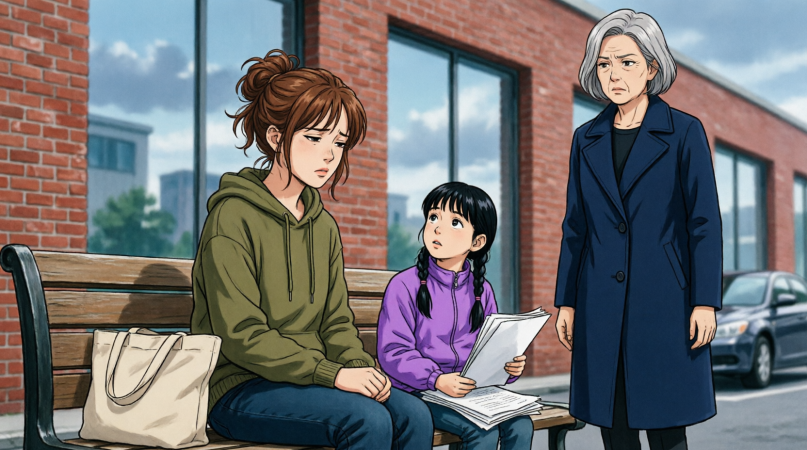
My daughter Lia and I had been in the shelter for eleven days when the black sedan pulled into the parking lot.
Even before I looked up, I knew the car didn’t belong there.
You get used to the sounds of a shelter fast.
Minivans with bad brakes.
Denting mufflers.
Volunteers in hatchbacks.
This engine was too smooth, too controlled, too expensive sounding for a place where women carried their whole lives in laundry bags and grocery totes.
Lia was sitting beside me on a splintered bench, drawing flowers in a notebook I had found on the donation table.
She had her tongue pressed to the corner of her mouth the way she always did when she concentrated.
I was staring at a job application on my phone, trying to make my work history sound less fragile than it was.
The sky was gray, the wind was sharp, and the shelter smelled the way it always smelled when the kitchen had just finished serving lunch: bleach, industrial cleaner, and hot food that had been sitting too long under metal lids.
Inside, fourteen cots lined the room where we slept.
Outside, I was trying very hard to pretend this was just one stop on the way to somewhere better.
Then the sedan stopped near the curb, and the back door opened.
My grandmother stepped out wearing a dark wool coat and leather gloves, her silver hair pinned back so neatly that not even the wind dared touch it.
Evelyn Hart did not look like the kind of woman who should ever have to stand in a shelter parking lot.
She looked like she belonged in old houses with polished banisters, quiet charities, and legal stationery.
We hadn’t spoken in almost two years.
That hadn’t happened because of one dramatic explosion.
It had happened the way a lot of family estrangements happen—through accumulated hurts, misunderstood loyalties, and the kind of pride that keeps everyone waiting for the other person to reach first.
My parents said Evelyn judged everything.
Evelyn said my parents controlled everything.
I got tired of being the rope in the middle and eventually let the silence settle.
But when my grandmother saw me sitting outside that shelter with my daughter, that silence ended instantly.
“Sarah,” she said, coming straight toward me.
“What on earth are you doing here?”
Lia looked up first.
“Grandma Evelyn,” she said, bright and certain, because children don’t perform adult amnesia.
They remember faces, tones, warmth, and absence with unsettling accuracy.
My grandmother’s expression softened for exactly one breath at the sight of her, then sharpened again as she turned to me.
“Answer me,” she said.
“Why are you here?”
“We’re staying here temporarily,” I said.
“I’m figuring things out.”
It was the kind of sentence people say when the truth is too humiliating to lay out in public.
My grandmother scanned the bench, Lia’s cheap spiral notebook, the shelter door, and the window behind us where the edge of a metal cot was visible if you looked at the right angle.
Her jaw tightened.
“Get in the car,” she said.
I started to protest.
She did not let me finish.
“Both of you,” she said.
“Now.”
There are tones from childhood that never really leave your bones.
I recognized that one immediately.
Lia climbed
in first, hugging her notebook to her chest.
I followed with our canvas bag and the quiet, sick feeling that comes from being seen at your lowest by someone who knew you when you still believed life moved in straight lines.
For several minutes, the only sound in the backseat was the low hum of the road.
Lia sat between us, looking from me to Evelyn as if she knew something important was unfolding but hadn’t yet been given the vocabulary for it.
Finally my grandmother spoke.
“When did this start?”
I told her.
Five weeks earlier I had lost my job when the office where I worked cut staff without much warning.
I had some savings, not enough.
Rent swallowed most of it.
Groceries swallowed the rest.
I picked up temp work where I could, sold a bracelet I loved, skipped meals more often than I admitted, and still ended up staring at an eviction notice with Lia asleep in the next room.
I told her how fast everything had gone after that.
The apartment was gone before I found another job.
The cheaper listings vanished before I could even schedule viewings.
Every place wanted deposits I didn’t have, credit I couldn’t prove, stability I was trying to rebuild in real time.
My grandmother listened without interrupting until I said, “The shelter was the only place that would take us right away.”
She turned to me then, fully, her face unreadable in a way that made me nervous.
“What about the Hawthorne Street property?” she asked.
I stared at her.
“The what?”
“The house on Hawthorne Street,” she said.
“Why aren’t you living there?”
I thought I had misheard her.
“I don’t know what you’re talking about.”
The look she gave me after that was one I will never forget.
It was not confusion.
It was calculation.
Pieces were rearranging themselves behind her eyes, and every rearrangement made her angrier.
“Three years ago,” she said carefully, “I placed a house on Hawthorne Street into a trust for you and any children you had.
Your parents were named trustees.
They were instructed to make sure you would always have access to it if you ever needed a place to live.
Are you telling me nobody told you that house existed?”
My hands went cold.
“I’m telling you I’ve never heard a word about any house.”
The backseat went silent.
My grandmother did something then that frightened me more than shouting would have: she became very still.
She pulled out her phone and made two calls in quick succession, her voice low, precise, and sharper with each answer she got.
Then she lowered the phone and said, “You’re coming with me.
We are not taking you back to that shelter.”
She took us to a hotel downtown.
It was not the kind of place I would ever have booked for myself.
The lobby smelled like cedar and citrus.
The sheets were white in that aggressive, expensive way that makes you afraid to wrinkle them.
Evelyn checked us into a suite without hesitation, ordered grilled cheese and tomato soup for Lia, asked room service to add corn when she heard my daughter liked it, and had someone bring up toothbrushes, pajamas, and children’s socks from the gift shop downstairs.
Lia climbed onto
the bed like she was afraid to bounce on it and looked at me with wide eyes.
“Are we staying here?” she whispered.
“For tonight,” I said.
My grandmother corrected me without looking up from her phone.
“For as long as needed,” she said.
While Lia ate and watched cartoons under a blanket, I sat at the small desk by the window and told Evelyn everything.
The layoff.
The savings.
The landlord.
The applications.
The places I almost secured and lost to someone with better credit or faster cash.
The shelter intake worker who was kind enough not to look pitying.
The way I lied to Lia every day by calling it temporary like that word itself could build walls around us.
When I was done, my grandmother asked, “Did your parents know?”
I swallowed.
“Yes.”
“All of it?”
“I told my mother the night we checked in.”
For the first time since finding us, Evelyn’s face actually broke.
Not dramatically.
Just a flicker.
Enough to show grief underneath the steel.
Before she could respond, her attorney called.
His name was Mason Reed, and within the first minute of the conversation, I knew the house was real.
Hawthorne Street existed.
It belonged to a trust.
My parents were listed as trustees exactly as my grandmother had said.
Then came the part that made me feel like the room had tipped.
The house had not been sitting empty.
It had been rented out for more than two years.
The tenants were on a month-to-month lease.
The lease had been signed by my parents in their role as trustees.
But the rental income was not sitting inside the trust account where it was supposed to go for taxes, maintenance, or beneficiary use.
It had been routed through an LLC connected to my parents.
I actually made Mason repeat that part because the sentence would not settle in my brain.
My grandmother ended the call, set the phone down with terrifying care, and finally explained why the house had been created in the first place.
After my grandfather died, she said, she had started thinking less sentimentally and more structurally.
She had seen how fragile life could become when one income vanished, one marriage failed, or one medical bill arrived at the wrong time.
She knew my own marriage had been unstable long before the divorce became official.
So she bought a small house on Hawthorne Street outright and placed it into a housing trust meant for me and any children I had.
“It was supposed to be your floor,” she said quietly.
“Not your ceiling.
Not charity.
Not control.
Just a floor.
Something solid under you if life ever gave way.”
I couldn’t speak.
She went on.
There was a written instruction letter attached to the trust.
If I ever needed housing, I was to be offered possession first.
If the house was rented while I didn’t need it, the money was to stay in the trust for taxes, maintenance, and future repairs.
The point had never been income.
The point had been protection.
“And I trusted your parents to administer it,” she said.
“That was my mistake.”
A second call from Mason brought even worse details.
Annual reports had been sent only to my parents.
My contact information had been replaced
in the file with theirs.
The trust had not been paying me distributions because, on paper, there were no distributions—just rental activity, maintenance, and holding costs.
But the bank trail showed most of the rent didn’t stay anywhere near the trust for long.
That was when another memory rose up so sharply it made my stomach hurt.
The night we got the shelter bed, I had called my mother from the intake office bathroom because it was the only place I could cry privately.
I told her we had nowhere to go.
I told her Lia was trying not to be scared.
My mother had gone quiet for a moment, then said, “I’m sorry, but we don’t have room for this right now.” After that she lowered her voice and added, “And don’t call your grandmother to play rescuer.
You need to handle your own life.”
At the time, it had just felt cold.
Now it felt monstrous.
Later that night, as Lia slept in the hotel bed with one hand curled under her cheek, my grandmother sat in the armchair by the window and stared out at the city lights.
“I should have checked sooner,” she said.
I looked at her.
“I should have called you,” I said.
She shook her head once.
“Both things can be true.”
The next morning, Mason asked my parents to come to his office under the pretense of reviewing trust paperwork.
Evelyn wanted them in a room with witnesses, documents, and no chance to rewrite the moment afterward.
Lia came with us because there was nowhere else for her to go, and because, by then, my grandmother had decided there would be no more hiding reality from the people who had caused it.
My parents arrived ten minutes late.
My mother walked in first, carrying a leather purse and wearing the exact expression she always used when she expected to be mildly inconvenienced but ultimately in control.
My father followed with his car keys in one hand and a polite smile already prepared.
Then they saw me.
Then they saw Lia.
Then they saw the folder on the conference table labeled Hawthorne Street.
My mother’s purse slipped from her hand and hit the carpet with a soft, ugly thud.
No one sat immediately.
Mason did not bother with small talk.
He handed everyone copies of the trust documents and read the relevant clause aloud in a voice so calm it made the words sound even harsher: the property was held for the benefit of Sarah Hart and her descendants; trustees were required to prioritize beneficiary housing needs; all rental income was trust property; self-dealing and unauthorized diversion of funds constituted breach of fiduciary duty.
My father recovered first.
He said they had only rented the house to keep it occupied and maintained.
He said I had never needed it before.
He said they had intended to tell me “when the time was right.”
My mother nodded too fast.
“You were married when it was set up,” she said.
“Then after the divorce, everything was chaotic.
We thought it was better to preserve the house until you were stable.”
I looked at her and asked the only question that mattered.
“Stable enough for what? To stop sleeping in a shelter?”
Neither of them answered.
So I asked another.
“When I called you and said Lia and I had nowhere to go, did you know there was a house in my name?”
My mother’s mouth opened, then closed.
My father leaned in instead.
“It wasn’t in your name,” he said.
“It was in a trust.
There’s a legal difference.”
There are moments when a person tells the truth in a way that reveals far more than they meant to.
That was one of them.
“You knew,” I said.
My father’s jaw hardened.
“We knew the property existed,” he said.
“Yes.
But you were not in a position to take over a house.
You had just gone through a divorce.
You’ve struggled with money.
You bounce between jobs.
We couldn’t risk you moving in some man and losing the place.”
I actually felt my skin go cold.
Not because it was new.
Because it was old.
That voice.
That logic.
The one that always called control concern and disrespect protection.
Before I could answer, my grandmother spoke.
“You watched your daughter and granddaughter sleep in a shelter,” she said, every word clipped clean, “while cashing checks from the roof over their heads.”
My father started to object, but Mason slid another packet across the table.
Bank records.
The monthly rent from Hawthorne Street had been deposited into the LLC account, then transferred in chunks into my parents’ joint checking.
From there it paid for a kitchen renovation, a cruise deposit, a car payment, and dozens of ordinary household expenses that had nothing to do with trust administration.
There were some maintenance charges, yes.
A plumber once.
Roof patching another time.
But the pattern was obvious.
They had not protected the asset.
They had harvested it.
My mother started crying.
Not the kind of crying that begins in grief.
The kind that begins when the structure of your defense collapses all at once.
She said the money had gotten mixed.
She said they meant to put it back.
She said they were trying to manage everything.
She said they had been thinking long-term.
“Long-term?” my grandmother said.
“A six-year-old child was sleeping in a shelter bed.”
My father tried one last angle.
He said family shouldn’t do this to family.
He said lawyers and accusations would destroy what was left.
He said maybe mistakes had been made, but public humiliation and legal threats were excessive.
My grandmother did not blink.
“You destroyed what was left when you chose secrecy over shelter,” she said.
Then she signed the removal paperwork.
The trust gave her authority, as grantor, to remove trustees for cause.
Mason had prepared the documents that morning.
My parents were stripped of their roles on the spot.
A corporate fiduciary affiliated with Mason’s firm was appointed interim trustee.
An immediate accounting was ordered.
Restitution was demanded.
If they refused, civil action would follow, along with whatever additional remedies the court found appropriate.
My father looked stunned.
My mother looked old.
Lia, who had been coloring quietly at the far end of the room, came over and slipped her hand into mine.
“Mom,” she whispered, “can we go now?”
That was the moment I stood up.
Not during the documents.
Not during the admissions.
Not even during the apology attempts that started spilling out of my mother’s
mouth once she realized the money trail was impossible to explain away.
I stood up when my daughter asked to leave.
We left together.
The tenants living in the Hawthorne house turned out to be decent people who had no idea any of this was wrong.
My grandmother refused to punish them for my parents’ decisions.
The new trustee gave them thirty days, relocation assistance, and a reference.
Until the house was available, Lia and I stayed in my grandmother’s guest cottage behind her home.
Those weeks were strange in a gentler way.
Lia discovered my grandmother kept butter cookies in a blue tin and crossword puzzles on the kitchen table.
My grandmother discovered Lia liked corn with almost any meal and could not be trusted around fresh peonies because she picked them too early.
I discovered that some of the distance between Evelyn and me had not been pure pride after all.
It had been managed.
Looking back over old emails and messages with Mason, we realized my parents had been translating us to each other for years.
They told Evelyn I didn’t want help, that I thought her money came with strings, that I wanted distance.
They told me Evelyn found me irresponsible, unstable, dramatic.
None of it had to be entirely fabricated to work.
It only had to be bent just enough to keep both sides offended.
That may have hurt almost as much as the house.
Because money is one kind of betrayal.
But being carefully separated from someone who loved you is another.
Five weeks later, the Hawthorne house was ready.
It was smaller than I had imagined and warmer too.
A brick bungalow with blue shutters, a narrow front porch, and a maple tree that dropped tiny helicopter seeds across the walkway.
The paint needed touch-ups.
The kitchen was dated.
One bedroom had curtains that looked like they had survived three decades and a war.
It was beautiful.
Lia ran from room to room like she was afraid someone might change their mind if she didn’t claim them quickly enough.
She chose the smaller bedroom because it had the best afternoon light for drawing.
My grandmother stood in the doorway watching her with a look I still can’t describe without feeling something catch in my chest.
In the kitchen, she handed me a ring of keys and said, “I bought this place because I wanted there to be one door in the world nobody could close on you.”
That was when I cried.
Not quietly into a shelter pillow.
Not turned toward a wall.
I cried standing in my own kitchen with my child laughing down the hall, my grandmother beside me, and a front door that locked from the inside with my keys in my hand.
The first thing Lia asked for that night was grilled cheese and corn.
So that’s what we made.
We ate on the floor because the furniture hadn’t arrived yet, and the room echoed when she laughed.
It was the best meal I’d had in months.
The legal fight ended faster than I expected.
My parents settled before it reached court.
Their attorney must have explained what fiduciary breach looks like when documented in bank transfers and signed leases.
They agreed to repay a significant portion of the
diverted rent, refinance assets to cover the rest, and sign a full accounting.
The recovered money went back into the trust for repairs, taxes, and an emergency reserve so the house would stay mine in more than sentiment.
A few months after moving in, I found steady work again at a medical office.
Not glamorous.
Not enough to pretend hardship never happened.
But enough to let me breathe without counting every egg in the refrigerator before payday.
My parents sent letters.
My mother wrote that she had been afraid.
Afraid I would let the wrong person move in.
Afraid I would mishandle the house.
Afraid that giving me security too early would somehow keep me from becoming responsible.
My father wrote in shorter, colder sentences.
He said they had only been trying to preserve the asset until I was “ready.”
Some relatives took their side in the softest way possible.
They admitted my parents had been wrong but insisted they meant well.
They said family decisions get messy.
They said older generations show love badly.
They said I should think about forgiveness because carrying anger is heavy.
They aren’t wrong about that last part.
Anger is heavy.
But so is the memory of your child sleeping in a shelter while a house meant for her sits across town generating income for people who call that protection.
I don’t know what everyone else would call what my parents did.
I know what I call it.
I call it control dressed up as concern.
And I still think that is the part people argue about most—whether intention matters when the outcome was a six-year-old learning to be grateful for corn in a shelter cafeteria.