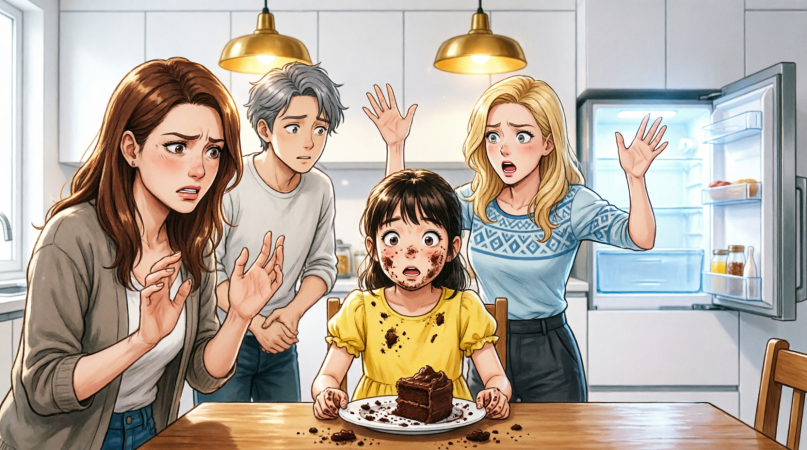
My Sister Attacked My Daughter Over Cake—Then They Lost Everything
The drive to my parents’ house took almost five hours, and Ruby spent every one of them in the kind of joy only a six-year-old can sustain.
She asked if clouds ever got tired.
She sang the same three lines from a school concert until I could have screamed.
She colored two lopsided cats on the back of an old receipt and told me one was me and the other was Grandma because we both looked stern when we concentrated.
Every thirty minutes she asked if Grandpa would let her hold the flashlight in the garage again while he showed her the old tools hanging on the wall.
She had been counting down to that weekend since Monday.
I had been dreading it since Wednesday.
That is the hardest part to admit now.
Not that I ignored danger once it was in front of me.
I did not.
I fought the second my mind understood what was happening.
The hardest part is that I knew my family had never been safe in the deeper sense of the word.
I knew my younger sister Vanessa had spent her entire life being protected from consequences.
I knew my parents treated her tantrums as if they were weather systems that everyone else had to survive.
I knew my mother had always believed keeping Vanessa calm mattered more than anyone else’s dignity.
And still, I went.
I went because I was tired.
I went because single motherhood can turn even bad help into something that looks, from a distance, like relief.
I went because Ruby adored my parents, and because children should not have to carry the map of every fracture inside a family.
I went because part of me still hoped that becoming a grandmother had softened my mother in the places motherhood had hardened her.
By the time I pulled into the familiar driveway, my back hurt, my coffee had gone cold hours earlier, and Ruby was bouncing in her seat like a spring.
My parents’ house looked exactly as it always had.
White shutters.
Narrow front porch.
Rose bushes trimmed so neatly they looked artificial.
The same porch light that flickered once before settling.
The same garage with my father’s rows of vintage tools displayed like museum pieces.
From the outside it always looked like steadiness.
Tradition.
The sort of home people picture when they say the word family.
My mother opened the front door before we reached the steps.
She lifted Ruby into her arms with theatrical delight and exclaimed over how tall she had gotten.
My father took our overnight bags and said dinner would be ready soon.
For the first half-minute, everything almost felt normal.
That ordinary opening is what still haunts me.
There was no warning siren.
No dramatic pause.
Just the quiet ease of people slipping into practiced roles.
Ruby dropped her backpack in the hallway and ran toward the kitchen because she heard the words almost ready and believed they were an insult to her hunger.
I followed more slowly.
Mom laughed and said she had bought all of Ruby’s favorite snacks.
Dad disappeared toward the den.
I remember loosening my shoulders a little.
I remember thinking maybe I had been unfair.
Maybe this weekend really would be simple.
Then Ruby opened the refrigerator.
There
was a plate on the middle shelf with a single slice of chocolate cake.
Thick frosting.
Raspberry filling.
Not the sort of casual leftover you forget about.
The sort of dessert made for being admired before being eaten.
Ruby turned around with the plate held proudly in both hands.
Can I have this?
My mother was standing in the doorway.
She flicked her hand and said of course, sweetheart, go ahead.
I should have asked whose it was.
That thought comes to me in different forms every week, but grief loves false doors.
I was tired from the road.
My mother had given permission without hesitation.
Ruby climbed into a chair and began eating with the full, absorbed joy only children and the very old seem able to have.
Twenty minutes passed.
Then a car door slammed outside so hard the windows shook.
Vanessa’s voice came through the entryway before her body did.
She was complaining about traffic, about some coworker, about the line at a coffee shop.
Her heels struck the hardwood in that fast, slicing rhythm I knew from childhood.
Vanessa never entered a room.
She arrived like she meant to conquer it.
She did not greet me.
She did not greet Ruby.
She went straight to the refrigerator, opened it, and stared.
Then she turned.
Who ate my slice?
Ruby froze with her fork lifted halfway to her mouth.
She looked confused, not guilty.
Her mouth had a little streak of frosting at one corner.
Crumbs dotted the plate.
Vanessa’s eyes fixed on those details, and something in her face changed.
You little brat, she screamed.
I was pushing back my chair before the last word left her mouth.
But Vanessa moved faster.
Three strides, maybe four.
Her hand shot into Ruby’s hair and jerked her head backward.
Ruby’s eyes went wide in pure shock.
Then Vanessa slammed her forward onto the table.
I still hear the sound.
The crack of impact.
The shatter of porcelain.
My own scream arriving too late.
Ruby folded sideways in the chair.
Blood spread almost instantly across the table and the front of her yellow dress.
One of her shoes fell off and landed near the broken plate.
For one impossibly long heartbeat, my body could not interpret what I was seeing.
Then instinct took over and I lunged.
My mother grabbed me from behind.
It was not a startled reflex.
It was a deliberate restraint.
Her arms locked around my torso and pulled me back with shocking force.
Her mouth was close to my ear when she hissed, let your sister calm down.
Calm down.
My daughter was bleeding and unconscious, and my mother’s priority was still Vanessa’s emotional comfort.
I fought her.
I twisted, screamed Ruby’s name, drove my heel backward into the floor for leverage.
My father came in from the den and grabbed my forearms, pinning me as if I were the dangerous one in that kitchen.
You’re overreacting, he said.
Vanessa barely touched her.
Kids are dramatic.
Ruby was not moving.
I got one hand free, reached into my bag, and dialed emergency services with fingers so clumsy I almost dropped the phone twice.
My father tried to take it from me.
My mother kept saying everybody needed to settle down.
Vanessa started crying and shouting
that Ruby had stolen from her.
The paramedics arrived fast, though it felt like a lifetime.
The moment they stepped into the kitchen, every lie in that room lost oxygen.
One medic knelt beside Ruby and spoke into her radio in a tone that snapped the whole scene into its true shape.
The other looked at my parents still holding me and ordered them to let me go immediately.
That authoritative voice accomplished what morality had not.
I dropped to the floor beside Ruby and touched her hand.
It was cold with shock.
Her breathing was shallow.
Blood matted her hair above one eye.
There was cake frosting on the table beside the smear of red, which felt obscene in its ordinariness.
The medic asked me who had injured her.
I pointed at Vanessa.
Police arrived while the paramedics were stabilizing Ruby.
Vanessa began sobbing.
My mother shifted seamlessly into her public voice, the one she used at church fundraisers and neighborhood disputes.
She said Ruby had slipped.
My father said everyone was too emotional to understand what they had seen.
Vanessa said the child had startled her and she had only reached out.
No one who looked at that kitchen believed them.
Ruby was taken by ambulance to the hospital, and I rode in front because there was no room beside the pediatric equipment.
I stared at the road through the windshield and kept turning around every few seconds just to see the rise and fall of her little chest.
At the emergency department they rushed her to imaging, then to surgery.
A social worker sat with me while I shook so hard I could not hold the paper cup of water she handed me.
A detective asked preliminary questions and then stopped when he saw my condition.
Blood dried stiff on the sleeve of my shirt.
There was still frosting on one cuff.
My mother called three times before the first scan was finished.
I did not answer.
Then the voicemails began.
We are all upset.
Do not make this bigger than it is.
Vanessa is fragile.
Families handle things privately.
The last one came from my father.
He said I needed to remember how a criminal record could ruin Vanessa’s life.
He never once asked whether Ruby was alive.
Hours later, a facial trauma surgeon and a pediatric ophthalmologist came into the waiting room together, and I knew before they opened their mouths that the worst had not passed.
Ruby had fractures around her eye socket and cheekbone.
The impact and the shattered ceramic had caused catastrophic damage to her left eye.
They had operated to repair what they could, but the surgeon’s voice softened in that terrible professional way before he said the one sentence that split the rest of my life in half.
She will never regain vision in that eye.
For a moment the room emptied of sound.
I heard the words.
I understood the words.
But they did not become real until I looked through the recovery-room glass later and saw my six-year-old with one side of her face bandaged, a stuffed rabbit tucked under her arm because a nurse had found one in the gift shop.
Ruby had eaten a piece of cake and lost half her sight forever.
I did not
cry then.
Not because I was strong.
Because something colder arrived first.
The detective returned the next morning, and by then I could speak in complete sentences again.
I told him exactly what happened.
I told him what my mother whispered.
I told him my father restrained me while my child lay unconscious.
He listened without interrupting.
Then he asked if there had been cameras in the kitchen.
That question lit up something in my memory.
Three months earlier, my father had bragged at Thanksgiving about installing a security camera over the pantry after a package theft from the back door.
He had shown everyone the app on his phone and talked about motion alerts like he had joined the secret service.
I told the detective.
My parents refused consent when police returned to the house for the footage.
That would have frightened me once.
It didn’t now.
They were too late anyway.
The system backed up automatically to a cloud account, and a warrant solved the rest.
The video did not show the entire kitchen table, but it showed enough.
It showed Ruby sitting in her chair.
It showed Vanessa crossing the room in a rage.
It showed Vanessa’s arm jerk backward in Ruby’s hair.
It showed my mother grabbing me from behind instead of my sister.
It showed my father pinning my arms while the child remained slumped in the chair.
There was no accident left to argue.
Within forty-eight hours Vanessa was arrested for aggravated assault on a child and felony child abuse.
My mother and father were not arrested that same day, but the investigation widened.
The detective obtained my father’s voicemail.
He obtained my mother’s messages.
He obtained the 911 call in which I was audibly restrained while begging for help.
He obtained the paramedics’ body-camera footage from the moment they entered the kitchen and ordered my parents to let me go.
Then my mother made the mistake that finished her.
She sent me a text that read: If Ruby had not touched Vanessa’s food, none of this would have happened.
That single sentence traveled from my phone to the detective to the prosecutor’s file in under an hour.
Ruby spent six days in the hospital and another three months in and out of specialist appointments.
She had nightmares.
She panicked when anyone raised a voice.
For weeks she would ask permission before touching any food that was visible in any kitchen, even in my own apartment.
She also had to learn, at six years old, what it meant to live without depth perception on one side.
Children adapt in ways that break your heart.
She learned to turn her head more when crossing a room.
She learned why stairs felt strange.
She learned to catch a ball with one eye closed at therapy because the occupational therapist turned practice into a game.
She learned to accept the custom glasses that protected her remaining eye.
She did not complain once when the adults in white coats explained things that should never have become part of a first grader’s life.
I complained enough for both of us.
I hired a lawyer before Ruby left the hospital.
Then I hired another who specialized in civil litigation.
I obtained a protective order the same week.
My parents sent
cousins, neighbors, even our old pastor to tell me grace mattered more than revenge.
Not one of them called it by its true name: accountability.
Vanessa’s defense attorney tried to float the idea of diminished judgment and stress.
The prosecutor answered with the video.
My parents tried to frame their actions as panicked confusion.
The state answered with body-camera footage, their text messages, and the fact that they restrained the one person trying to reach the injured child.
When the criminal case finally reached court, I barely recognized my sister.
Not because she looked remorseful.
Because she looked furious that consequences had dared to arrive.
She sat in a tailored navy suit with her hair smoothed flat and avoided my gaze.
My mother cried every time anyone entered the room.
My father looked like a man insulted by the inconvenience of reality.
The jury watched the kitchen footage in silence.
They watched Vanessa charge toward a six-year-old over cake.
They watched my mother grab me.
They watched my father hold me down.
They watched the aftermath.
No one needed theatrics after that.
Vanessa was convicted.
At sentencing, the judge called the attack savage, disproportionate, and morally incomprehensible.
He also called my parents’ conduct one of the most disturbing examples of enabling he had seen in a child-assault case because they protected the attacker while the victim lay injured in front of them.
Vanessa received a long prison sentence.
My mother later accepted a plea on obstruction-related charges after it came out that she had tried to coach Ruby through an intermediary cousin before the child-advocacy interview.
My father avoided jail but ended up with probation, fines, and a permanent record tied to his role in physically restraining me during an emergency.
The criminal verdict was only the first collapse.
The civil case came next.
My attorney sued Vanessa, my parents, and the homeowners insurance carrier.
The insurer fought hard at first because Vanessa’s act was intentional, but my parents’ negligence, their failure to protect a child guest, and their interference with emergency response opened doors they could not close.
Discovery was brutal.
Their messages surfaced.
Family emails surfaced.
Old incidents surfaced too—years of Vanessa’s violence minimized as moods, meltdowns, rough patches, a difficult season.
The case settled only after the numbers became too ugly to ignore.
My parents had to sell the house.
The white-shuttered house with the rose bushes and the flickering porch light, the house my mother worshipped as proof of family respectability, went on the market under a cloud of court filings and whispers.
My father’s beloved tool collection was auctioned.
Their retirement accounts were gutted.
Vanessa lost the condo my parents had helped her buy because legal fees and restitution devoured everything around her.
I never once celebrated that part.
I had promised myself they would lose everything, but when it finally happened, what struck me most was not triumph.
It was clarity.
The house had always been a stage set.
The values inside it were rotten long before any For Sale sign appeared on the lawn.
A year passed.
Ruby kept going.
That is the sentence I return to most often.
Ruby kept going.
She went back to school with protective glasses in purple frames because she said clear ones made her feel like a
doctor.
She learned which side to turn in crowded hallways.
She kept drawing cats with impossible whiskers and suns that took up half the page.
She started therapy with a counselor who taught her that bad adults do not get to steal good things from the rest of life.
One afternoon she asked me if the reason Aunt Vanessa was in prison was because of the cake.
I told her no.
I told her it was because Aunt Vanessa chose cruelty and too many people had helped her avoid consequences for too long.
Ruby thought about that carefully in the back seat while I drove home from therapy.
Then she said, so it was because she was mean on purpose.
Yes, I said.
That was the child’s version of a truth it had taken the adults decades to say aloud.
We moved to a smaller town the following spring.
New school.
New routines.
New bakery two blocks away that sold cupcakes with ridiculous swirls of frosting.
Sometimes Ruby still startled when someone opened a fridge too fast.
Sometimes she woke crying from dreams she could not fully explain.
Healing did not arrive in a straight line.
But it arrived.
On her seventh birthday, she asked for chocolate cake.
I stood in our own kitchen, heart pounding harder than it should have, while she watched me frost it.
Then she said the words that nearly undid me.
Is this slice mine?
Every slice in this house is yours if I say it is, I told her.
She smiled, slow and certain.
That evening she took the first piece herself.
No fear.
No hesitation.
Purple glasses catching the candlelight.
Her friends sang off-key around our little dining table while paper streamers drooped from the ceiling fan.
Before she blew out the candles, she closed one eye—the good one was enough, she said, because she wanted to make her wish extra strong.
Then she leaned forward and whispered to the cake.
When she opened both eyes again, she looked at me and grinned.
I did not ask what she wished for.
I did not need to.
For the first time since that night, our kitchen felt bigger than memory.
The past had not disappeared.
Ruby’s left eye would never work again.
The scars along her brow would fade but never vanish completely.
My family of origin was gone in every way that mattered.
There would be no reunion, no apology worth hearing, no repaired version of what had been broken long before the cake, the table, and the blood.
But there was this.
A child laughing with frosting on her lip.
A safe home.
A locked door that existed to protect, not imprison.
A table where no one had to ask twice if they were allowed to eat.
Ruby reached for another piece and looked up at me with complete trust.
That was the real ending.
Not the courtroom.
Not the sale of the house.
Not the prison sentence.
The real ending was my daughter learning that the world could still hold sweetness—and that this time, no one was going to hurt her for taking it.