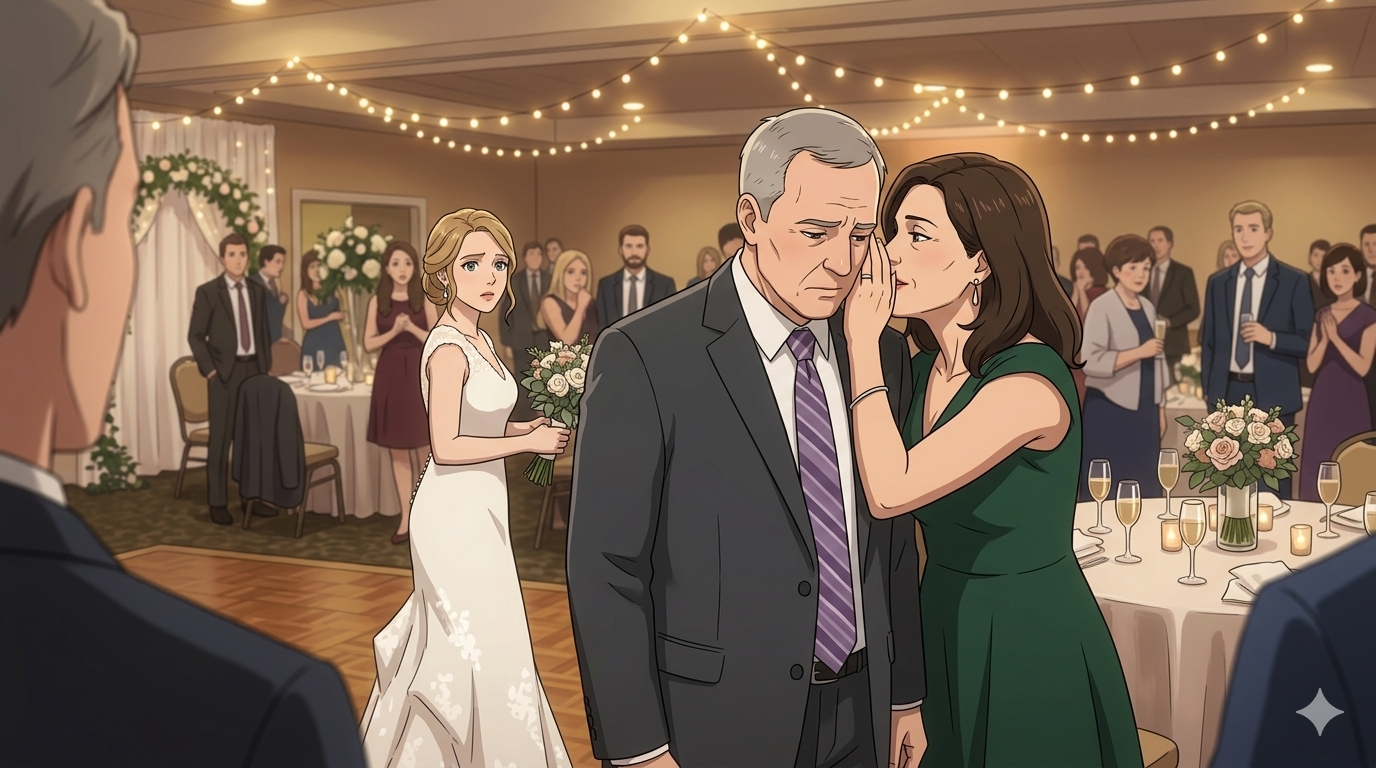
The woman appeared halfway through the reception, just as the band was easing from a slow love song into something brighter and the room was settling into that warm, relieved happiness weddings get after the vows are over.\n\nI had stepped away from the dance floor for a moment to catch my breath and watch my daughter laugh with her new husband.
Lily had a champagne glass in one hand, her head tipped back, the lights catching in her earrings.
For one impossible moment, life felt gentle.\n\nThen I noticed the woman by the entrance.\n\nShe stood too still for a guest.
Mid-forties, maybe, in a dark green dress that looked nice enough for the event but somehow still wrong on her, like she had dressed for courage instead of celebration.
Her eyes moved across the room with the panicked focus of someone who had come for one reason and was losing the nerve to do it.\n\nI assumed she was from the groom’s side, maybe an aunt who had arrived late.
I was about to go over and help her find her table when she saw me.\n\nHer expression changed instantly.
Recognition.
Fear.
Decision.\n\nShe came straight toward me.\n\nWhen she stopped in front of me, she glanced past my shoulder at Lily and said, in a voice so tight it barely sounded human, “You have no idea what she was hiding from you.”\n\nThose words hit with the old force of disaster.
I felt it in my chest first, then in my hands.\n\n”What are you talking about?” I asked.\n\nThe woman swallowed.
“My name is Nora,” she said.
“I’m Lily’s mother.”\n\nThe room did not go silent.
The band kept playing.
Glasses clinked.
Someone laughed near the bar.
But inside me, everything stopped.\n\nThirty-three years earlier, a police officer had stood in my doorway and told me my wife, Rachel, and our four-year-old daughter, Chloe, were gone.
A drunk driver had crossed the line on a wet road and folded my life in half.\n\nI was twenty-two years old and newly convinced that God either didn’t exist or had a vicious sense of humor.\n\nPeople say grief comes in waves.
Mine didn’t.
Mine came like weather that never moved on.
I went to work, paid bills, answered questions, and came home to an apartment so quiet it felt staged.
I kept Chloe’s red rain boots by the door for almost two years because throwing them away felt like losing her a second time.\n\nFriends stopped checking in after a while.
Not because they were cruel, but because no one really knows what to do with a man who has become a ruin in plain sight.\n\nI stayed that way longer than I like to admit.\n\nThe decision to adopt didn’t come in some noble, cinematic moment.
It came on an ordinary Tuesday when I passed a playground and realized I had spent ten years loving nobody because I was terrified of losing them.
I sat in my car with both hands on the steering wheel and understood that grief had turned me into a man who knew how to protect emptiness better than he knew how to offer his heart.\n\nI did not want to die having done that well.\n\nSo I started making calls.
Filling out paperwork.
Sitting through interviews in beige offices with social workers who asked careful questions in soft voices.\n\nThe day I
walked into St.
Mary’s Children’s Home, I had no picture in my mind of who I might meet.
I only knew I wanted a child who needed somebody to stay.\n\nLily was by the window in a wheelchair, her chin tipped toward the rain.
She couldn’t have been more than five.
The other children were building something noisy on the floor behind her, but she sat apart from them with the stillness of a person who had already learned disappointment.\n\nWhen I greeted her, she looked at me with wide gray eyes that reminded me so suddenly of Chloe that I had to steady myself against the back of a chair.\n\nThe caregiver told me Lily’s father had died in a car accident.
Her mother had signed the surrender papers a few months later.
Lily had nerve damage in one leg and a long recovery ahead of her, maybe several surgeries.
Families had come and gone.
Nobody chose her.\n\nI did.\n\nOr maybe, if I’m honest, she chose me.
She looked at the cheap toy car in my hand, then at my tie, and said, “You look sad.”\n\nI laughed so hard I nearly cried.\n\nThe adoption took months.
The first year after she came home was harder than any brochure or caseworker would have admitted.
Lily woke from nightmares screaming for a father she couldn’t remember clearly.
She flinched when I raised my voice, even over something harmless like spilled milk.
On good days she was curious and stubborn and funny.
On bad days she tested every promise I made, as if she had to prove I would leave.\n\nI understood that better than she knew.\n\nSo I stayed.
Through the tantrums, the surgeries, the physical therapy, the school meetings, the fevers, the questions she began asking once she was old enough to understand that families can begin more than one way.\n\nShe wanted to know if she had been difficult.\n\n”No,” I told her.
“You were heartbroken.”\n\nShe wanted to know whether I adopted her because I felt sorry for her.\n\n”No,” I said.
“I adopted you because when I saw you, I knew my life was still meant for love.”\n\nAt eight, she made me a Father’s Day card with uneven purple letters that read THANK YOU FOR PICKING ME.
I kept it in my desk drawer at work until the edges softened.\n\nAt twelve, after her third surgery, she stood without help for nearly fourteen seconds and yelled, “Did you see that?” so loudly that two nurses came running into the room.
I had seen it.
I had also seen every hour before it, every exhausted tear and frustrated silence and furious refusal to quit.\n\nBy high school, she moved with only a slight limp.
By college, she carried herself with a confidence that seemed to come from somewhere deeper than posture.
She was warm without being naive, bright without cruelty, and strong in a way that made other people feel safer around her.\n\nWhen she introduced me to Evan, I knew within ten minutes that he loved her properly.
He listened when she spoke.
He never tried to speak over her.
And when she mentioned an old knee flare-up from the weather, he shifted his chair without making a show of it so she’d have room to stretch her leg.\n\nI asked him one afternoon what he admired most about her.\n\nHe said, “Nothing
breaks her for long.”\n\nI liked him after that.\n\nThe only thing I couldn’t quite read in the months before the wedding was Lily herself.
She was happy, genuinely happy, but underneath it there was a new restlessness.
She stepped out to take phone calls and came back pale.
She asked if I still had any paperwork from the adoption.
She wanted the name of the orphanage director, the county where the accident happened, the exact year.\n\nI assumed it had something to do with medical records or future children.
When I asked, she kissed my cheek and said, “Just tying up loose ends.”\n\nI believed her because parents do that when they want peace more than clarity.\n\nNow Nora stood in front of me at my daughter’s wedding, telling me peace had been borrowed.\n\n”You need to leave,” I said quietly.\n\nHer face tightened.
“I didn’t come to ruin her day.”\n\n”Then you’ve chosen a terrible way to prove it.”\n\nShe reached into her purse with shaking hands.
For one wild second I thought she was about to hand me some forged document, some scam dressed up as tragedy.
Instead she pulled out a photograph worn white at the corners.\n\nA teenage girl sat on a hospital bed, bruised and exhausted, holding a toddler on her lap.
The child’s curls were damp.
One sock was missing.
There was a tiny crescent-shaped birthmark near her left ear.\n\nLily’s.\n\nMy throat closed.\n\n”She found me eight months ago,” Nora said.
“She contacted me after she requested her original records.
She wanted medical history at first.
Then she wanted the truth.”\n\n”What truth?”\n\nNora looked down for a moment, then back at me.
“That I did not stop loving her.”\n\nAnger rose so fast it almost helped.
“You signed her away.”\n\n”I signed papers in a hospital after the accident,” she shot back.
“I was nineteen.
My pelvis was broken.
I was on pain medication.
My father kept saying I had no money, no job, no way to care for a child who might never walk right again.
Tommy’s parents blamed me for the crash because he’d come to pick me up.
Everyone was shouting.
Everyone wanted the problem solved.”\n\nHer voice shook on the last word.\n\n”I asked where they were taking her,” she said.
“My mother told me it would be temporary.
She said I could get stable and then bring her home.
By the time I understood I’d signed a permanent surrender, the file was sealed and the placement was moving.
I was young and broke and ashamed.
I spent years trying to find her.”\n\nI wanted not to believe her.
I wanted something simple and ugly I could reject.
But pain has a sound, and hers had it.\n\nBefore I could answer, I looked toward the dance floor and saw Lily staring at us.\n\nShe had gone completely still.
Evan followed her gaze, then looked back at me and the woman beside me.
Whatever he saw on Lily’s face made him set down his drink immediately.\n\nLily started toward us.\n\nEven after years of therapy, stress still tightened her gait.
Seeing her cross the room like that, in her wedding dress, one hand gathering silk above her ankles, I felt a sharp paternal urge to meet her halfway and spare her whatever came next.\n\nBut there are moments a parent cannot intercept.
Only witness.\n\nWhen she reached us, her face was pale enough to
make the makeup artist’s careful work irrelevant.\n\n”Dad,” she said softly.
Then to Nora: “I told you not today.”\n\nThere was no denial in her voice.
No confusion.\n\nOnly dread.\n\nI heard myself ask, “You know her?”\n\nLily closed her eyes for a second.
“Yes.”\n\nThe word landed harder than Nora’s first sentence.\n\nEvan looked between us.
“Should we go somewhere private?”\n\nLily nodded, and we moved into a small side lounge off the hall where the florist had stored extra centerpieces.
The muffled music from the reception thudded faintly through the wall like a second heartbeat.\n\nLily stood near the closed door, gripping the back of a chair.
Nora remained by the entrance, arms wrapped around herself.
Evan stayed beside Lily without touching her, as if he understood she needed steadiness, not rescue.\n\nI was the one who could not seem to find a place to put my hands.\n\n”How long?” I asked.\n\nLily looked at the floor.
“Since September.”\n\nEight months.
Nearly the exact span Nora had named.\n\n”You’ve been meeting her?”\n\n”Yes.”\n\n”And you didn’t tell me.”\n\nHer eyes lifted to mine.
“I know.”\n\nNo apology in the world can soften a sentence like that.\n\nSomething in my face must have changed, because Lily’s voice broke on the next words.
“Dad, please listen to all of it before you decide what this means.”\n\n”What it means,” I said, more sharply than I intended, “is that my daughter was living a second life while I paid for the flowers.”\n\nThe moment it left my mouth, regret followed.
Not because it wasn’t true in some wounded way, but because it was smaller than the real pain underneath.\n\nLily flinched anyway.\n\n”I started looking because of medical records,” she said.
“Evan and I were talking about children someday.
The doctor asked about family history, and I realized all I had was a thin file with half the pages blacked out.
I requested the original documents.
There were names in them I’d never seen before.”\n\nShe glanced at Nora.
“I didn’t expect to find her.
I thought maybe I’d get a diagnosis, a blood type, some missing information.
That was all.”\n\n”But you did find her.”\n\n”Yes.”\n\n”And then what?”\n\nLily swallowed.
“Then I needed to know whether the story I’d grown up with was true.”\n\nThere it was.
The story.
The one the orphanage had given us.
Father dead.
Mother gave her up.
End of sentence.\n\nNora spoke carefully, like someone crossing broken glass.
“I told her everything I remembered.
The accident.
The hospital.
My parents.
The papers.
The lawyers I couldn’t afford.
The months I spent calling places that wouldn’t tell me anything because I wasn’t listed as her legal mother anymore.”\n\nLily reached into the small beaded purse at her wrist and pulled out a folded stack of papers.
“She brought these the third time we met,” she said.
“Copies of letters.”\n\nShe handed them to me.\n\nEvery letter was addressed to Lily.
Some were written in tight, slanted handwriting on cheap lined paper.
Some were formal requests to agencies.
Some had return-to-sender stamps.
One was dated on Lily’s seventh birthday.
Another on her tenth.
Another when she turned sixteen.\n\nI stared until the ink blurred.\n\n”She kept writing,” Lily said.
“Nobody ever gave them to me.”\n\nI looked at Nora.
“Why come here today?”\n\nHer answer came fast, too fast.
“Because Lily wouldn’t decide.”\n\n”Decide what?”\n\nNora’s eyes filled.
“Whether I was going to keep existing as a secret.”\n\nLily’s jaw tightened.
“That is not fair.”\n\n”You said
after the engagement,” Nora shot back.
“Then after Christmas.
Then after dress shopping.
Then after invitations.
Then after the bridal shower.
There was always another reason to wait.”\n\n”Because every time I tried, I saw his face in my head,” Lily said, turning to me.
“I kept imagining the look on you right now.”\n\nThat should have softened me immediately.
It didn’t.
Hurt has its own timetable.\n\n”So you lied instead.”\n\n”I hid something,” she whispered.
“I was trying not to break you.”\n\nI laughed once, but there was no humor in it.
“Lily, you think this is kinder?”\n\nTears gathered in her eyes, and still she did not look away.
“No.
I think I was scared.”\n\nThe room held still around that admission.\n\nI knew fear in her voice.
I had heard versions of it when she was six and thought I might not come back from a business trip, when she was thirteen and the surgeon used the word complication, when she was seventeen and a boy she liked stopped answering her texts.
But this fear was adult.
Heavier.
More ashamed of itself.\n\n”I wasn’t afraid you’d stop loving me,” she said.
“I was afraid I would make you feel replaced.”\n\nThat stripped the fight out of me more effectively than any apology could have.\n\nBecause beneath my hurt was something so ugly I had not wanted to name it: the flash, just for a moment, of being set aside.
Of discovering that blood had entered the room and quietly outranked history.\n\nI hated myself for feeling it.
She must have hated herself for sensing it before I did.\n\n”You could never replace what you are to me,” I said, but the sentence came rough.\n\nLily’s mouth trembled.
“I know what you say.
I didn’t know what it would do to you in your body.
In your memories.
I know what losing family cost you.
I know what it took for you to trust loving me.
And once I opened this door, I didn’t know how to close it without hurting somebody.”\n\nEvan finally spoke.
His voice was gentle and steady.
“She came home after the first meeting and cried for an hour in the car before she came inside.
She wasn’t hiding a happy secret.”\n\nI turned to him.
“And you knew too.”\n\nHe nodded.
“Only after the second meeting.
She didn’t want to carry it alone anymore.”\n\nSome irrational part of me wanted to be angry at everyone in the room.
The sensible part knew that secrecy often grows exactly where love is strongest and people become desperate to protect it.\n\nStill, love does not make a lie hurt less.\n\nNora stepped forward.
“I know I have no right to ask for anything today.
But I needed you to know she did not deceive you because she loves me more.
She hid me because she loves you most.”\n\nLily wiped at her face with the heel of her hand, annoyed at her own tears.
“Please don’t speak for me.”\n\nNora recoiled as if struck.\n\nAnd in that instant I saw the whole miserable shape of it.
A young mother who had lost everything and spent decades rehearsing a reunion she could not control.
A daughter who had gone looking for facts and found an ache with a face.
And me, a father who had built his life on chosen love and was now discovering that chosen love does not
make the past vanish.
It only gives it somewhere new to echo.\n\n”What do you want?” I asked Nora.\n\nShe answered with startling honesty.
“A place.”\n\nThe word hung there.\n\n”In her life?” I asked.\n\n”In the truth,” she said.
“I know I’m too late for most things.
I know who raised her.
I know who sat beside hospital beds and school plays and every birthday cake.
I’m not delusional.” Her voice cracked.
“But I wanted one day where she didn’t have to pretend I never existed.”\n\nLily straightened.
She had inherited nothing from me biologically, but I would swear she got her steel from years of watching me survive.\n\n”You do exist,” she said.
“That was never the problem.”\n\nNora’s eyes searched her face.
“Then what was?”\n\n”You don’t get to choose this day,” Lily said.\n\nThe words were quiet.
That made them stronger.\n\n”You didn’t come because you were invited into my life,” she went on.
“You came because I wasn’t moving fast enough for your pain.
I understand that you’ve waited a long time.
I understand that what happened to you was cruel.
I do.
But showing up here anyway, after I said no, means you still aren’t listening to what I need.”\n\nNora’s shoulders folded inward.
“Lily—”\n\n”No,” Lily said, firmer now.
“Please hear me.”\n\nShe set her hand on the chair and took a slow breath.\n\n”I went looking for a medical history,” she said.
“What I found was more complicated than I expected.
I found letters.
I found a woman who had been young and trapped and alone.
I found reasons to have compassion.
But I also found out that every time I met with you, I went home feeling like I had betrayed the man who actually raised me.”\n\nHer voice broke on the last word.
Raised.\n\nI pressed my lips together hard enough to taste salt.\n\nLily turned to me then, fully.
“He is my father.”\n\nNothing else in that room could have matched the power of that sentence.\n\n”He is the one who stayed,” she said to Nora, but her eyes remained on mine.
“He is the one who taught me how to trust a home, how to stand again, how to believe I was wanted.
I was afraid to tell him because I didn’t want him to think any of that had become smaller.
It hasn’t.
It never will.”\n\nNora closed her eyes.
A tear escaped anyway.\n\n”I am sorry for what happened to you,” Lily said.
“I am.
But you do not get a seat at my wedding by forcing your way into it.
Not today.
Not like this.”\n\nFor a long moment, nobody spoke.\n\nThen Nora reached into her purse again, not with the frantic energy from before but with the slow resignation of someone finally accepting the shape of a loss.
She pulled out a small bundle wrapped with a rubber band.\n\n”The originals,” she said.
“The letters.
Pictures too.
I brought them in case…” She could not finish.\n\nLily looked at the packet but did not take it right away.\n\n”Will you ever see me again?” Nora asked.\n\nIt was the most dangerous question in the room, because it asked for a future on a day already overloaded with history.\n\nLily answered with the only honesty available.
“I don’t know.”\n\nNora nodded once.
The answer hurt her, but she seemed almost relieved by its clarity.\n\nShe held the bundle out.
Lily took it.\n\nThen Nora looked at me.
“I’m sorry,” she said.
“For today.
And for every year you had to explain to her why someone left.”\n\nI surprised both of us by answering gently.
“I never told her someone left.
I told her someone failed her.”\n\nNora flinched, because both things were true.\n\nShe gave the smallest nod and walked out of the room.\n\nI waited until the reception hall door swallowed her before I sat down.
My knees had turned unreliable without asking permission.
The band had started another song.
People out there were still celebrating, unaware that four lives had just collided in a storage lounge full of spare flowers.\n\nLily came toward me slowly.\n\n”Dad,” she said.\n\nThere are moments when love and hurt arrive at the exact same time.
You do not choose one over the other.
You hold both and pray you don’t drop either.\n\nShe knelt carefully in front of me, wedding dress pooling around her, and placed the packet of letters on my lap as if she were offering evidence and apology together.\n\n”I should have told you,” she said.
“Sooner.
Before today.
Before any of this.”\n\n”Yes,” I said.\n\nShe nodded, accepting it.\n\n”But I need you to know,” she whispered, “I wasn’t building a different family behind your back.
I was trying to understand the first wound of my life without opening the one you already carry.”\n\nThe sentence undid me.\n\nI put my hand against the side of her face the way I had when she was little and feverish.
“You don’t owe me less truth because I’ve been hurt before.”\n\nA tear slid down her cheek.
“I know that now.”\n\nEvan stepped closer, uncertain.
I looked up at him and said, “You should marry her again, just for surviving this morning.”\n\nHe let out a breath that was half laugh, half relief.\n\nLily gave the small, watery smile that had saved me a thousand times.\n\nI stood, pulled her into my arms, and held on longer than wedding etiquette required.
She was warm and real and mine in every way that had ever mattered.
Not by blood.
By choice.
By years.
By every ordinary day love had accumulated until it became unarguable.\n\nWhen I let her go, I wiped at my eyes and said, “Are you still the bride?”\n\nShe sniffed and nodded.\n\n”Good,” I said.
“Then let’s not make those people wait for cake.”\n\nShe laughed then, an unsteady, beautiful laugh, and the room loosened around us.\n\nWe returned to the reception together.
A few guests looked over, sensing some disturbance they couldn’t place, but weddings are noisy enough to hide a lot.
Lily slipped her hand into mine before we reached the door.\n\n”Will you still dance with me?” she asked.\n\nI looked at her, offended on principle.
“I already rented the shoes.”\n\nThat got a real laugh out of her.\n\nLater, during the father-daughter dance, she rested her forehead briefly against my shoulder.
The room blurred into soft lights and slow music and the faint scent of roses.
I could feel the packet of letters in the inside pocket of my jacket, close to my heart, like a second rhythm I hadn’t asked for.\n\n”I’m sorry,” she murmured again.\n\n”I know.”\n\n”I love you.”\n\nI swallowed.
“I know that too.”\n\nAfter the wedding, after the honeymoon, after the dress had been preserved and the leftover cake had dried out in my refrigerator because neither of us had the appetite to finish it, Lily came to my
house with the packet.\n\nWe sat at the kitchen table where she had once done spelling homework and later college applications.
Between us lay twenty-three years of a woman’s attempts to reach a child she had lost.\n\nSome letters were rambling, some painfully formal.
Some were returned unopened.
Some had never been mailed at all.
In one, Nora described seeing a little girl in a grocery store and crying in the cereal aisle because the child’s curls looked like Lily’s.
In another, she wrote that every year on Lily’s birthday she bought a cupcake and lit a candle anyway.
In a photo from years earlier, Nora stood outside St.
Mary’s holding a manila folder and looking heartbreakingly young.\n\nLily read in silence for a long time.\n\nFinally she said, “I can feel sorry for her and still be angry.”\n\n”Yes,” I said.
“That’s usually how the hardest truths work.”\n\nA month later, Lily chose to meet Nora again.
This time it was on her terms.
Daytime.
Public place.
No surprises.
She asked me to come, not to speak for her, just to be there if she needed somewhere steady to look.\n\nI went.\n\nNora apologized without defending herself.
That mattered.
Lily told her plainly that trust was not built by biology or remorse, and certainly not by hijacking a wedding.
That mattered too.\n\nThey did not become a perfect reunited family.
Life is not generous in that cliché way.
What they built instead was smaller, slower, and maybe more honest: cautious conversations, boundaries repeated and respected, the occasional shared memory pieced together from what had survived.
Nora never asked Lily to call her Mom.
She learned, eventually, that love offered too forcefully can feel like another form of taking.\n\nAs for me, Lily never stopped calling when she needed advice about mortgages or fevers or whether a strange noise in the car sounded expensive.
She still came over and stole food from my refrigerator without asking.
She still kissed my cheek on her way out the door.\n\nNothing of substance changed.\n\nAnd yet something did.\n\nI had spent years believing fatherhood meant winning against absence.
That if I loved her well enough, the people who failed her first would lose all power over the story.
I know better now.
Love does not erase what came before.
It stands beside it and says, I am here too.
Sometimes that has to be enough.\n\nOn the day Lily told Nora, “He is my father,” I felt more pride than victory.
Victory suggests someone had to lose.
Pride was different.
Pride was hearing the truth spoken aloud after fear had spent months distorting it.\n\nEven now, when I think about that wedding, I don’t only remember the shock.
I remember Lily in white silk, hands shaking, choosing honesty at last.
I remember a woman who had failed her in one way and been failed by the world in ten others.
I remember understanding that forgiveness and access are not the same thing, and that regret, no matter how sincere, does not grant a right to cross a boundary.\n\nSome people who hear our story think Lily should have told me the moment she found Nora.
Some think Nora deserved more grace because she was barely more than a child when her life collapsed.
Maybe they’re both right.
Maybe neither is.\n\nWhat I know is simpler and harder: the person who
raises you holds one kind of claim, and the person who lost you holds another.
When those claims collide, somebody usually bleeds, even if nobody meant to wound.

